Social Sciences

Gender Performance
Gender performance refers to the way individuals express and embody their gender identity through behavior, appearance, and mannerisms. It encompasses the social and cultural expectations associated with gender and how individuals conform to or challenge these norms. Gender performance is a key concept in understanding the complex and multifaceted nature of gender identity and expression.
Written by Perlego with AI-assistance
Related key terms
1 of 5

8 Key excerpts on "Gender Performance"
 eBook - PDF
Masculinity and Film Performance
Male Angst in Contemporary American Cinema
- D. Peberdy(Author)
- 2011(Publication Date)
- Palgrave Macmillan(Publisher)
Before evaluating the ways performance has been understood in film studies, the following section examines in more detail the notion of gender as performance. Performance and Masculinity 27 Performance and gender In conceiving of gender as an act rather than a fixed or innate char- acteristic directly related to an individual’s sex, Judith Butler’s study of the performative nature of gender provides a basis from which to understand film performances of masculinity. Elaborating on J. L. Austin’s definition of performativity as ‘performative utterances’, Butler examines gender as an intentional ‘corporeal style … manufactured and sustained through corporeal signs and other discursive means’. 21 According to Butler, because gender is performed – that is, made up of a series of acts and rituals that are consistently repeated – it not only questions the naturalness of gender, but also calls into question the existence of a ‘true’ gender to begin with: Because there is neither an ‘essence’ that gender expresses or externalizes nor an objective ideal to which gender aspires, and because gender is not a fact, the various acts of gender create the idea of gender, and without those acts, there would be no gender at all. Gender is, thus, a construction that regularly conceals its genesis. 22 The body becomes an ideological site of ‘naturalized knowledge’ whereby what is taken to be the norm or ideal is utilised in order to naturalise and hence disavow its very existence. 23 For Butler, discourses of gender ‘perform, produce, and sustain discrete and polar genders’, which then enter into the public con- sciousness to become the cultural or ‘regulatory fiction’. 24 Gender as performance in the theatrical sense is, therefore, distinguished from gender as performative; while the former refers to something eas- ily put on and taken off, the latter is ‘a forced reiteration of norms’ that are culturally imposed and maintained. eBook - ePub
- Helmi Järviluoma, Pirkko Moisala, Anni Vilkko(Authors)
- 2003(Publication Date)
- SAGE Publications Ltd(Publisher)
Performance and performativity in Butler’s use should not be mistaken as simply some kind of masquerade or an intentional play with gender roles (for instance, choosing to play the role of, to perform, a manly woman). Performativity refers to the performative constitution of gendered conventions. According to Butler (1993: 234), performance as an event (such as a staged performance) has to be separated from performativity, which consists of norms which precede and guide the performance and the performers. Power is always important in Gender Performance. Gender Performance is bounded by the gender system surrounding it, even though it may seem to contest, mask, or oppose conventional gender roles. Therefore, Gender Performance should be understood not only as a negotiation between an individual and his or her cultural surroundings and its conventions, but as repeated performances of the gender system, with their capacity for change and alteration. ‘A performative act is one which brings into being or enacts that which it names, and so marks the constitutive or productive power of discourse’ (ibid.: 134).Gender, like other cultural categories such as ethnicity and sexuality, is performed differently in different situations and locations. Gender Performance, like any performance of other cultural categories, takes place as a negotiation between context-bound and situational subjects. The gender system of the culture (including power relations) and personal experiences are involved in the gender negotiation. The performance of gender is not simply the performance of bodies, human beings in action; the concept of performativity is applicable also to language use and other cultural texts, such as the arts. The usefulness of performativity in gender analysis of many kinds of qualitative materials, such as music and film, conversation, literary and interviewed texts and in fieldwork, will be demonstrated later in this volume.The usefulness of the concept of performativity in gender analysis is manifold. It encourages us to see beyond individual gendered expressions, to see the conventions behind them and at the same time beyond those conventions. It liberates us from the idea of the ‘truth’ of gender by requiring us to examine gender as a process, in which it creates itself. Butler used the example of drag to illustrate the point: ‘Is drag the imitation of gender or does it dramatize the signifying gestures through which gender itself is established?’ (1990: xiii–ix). When the naturalness of ‘sex’ and heterosexuality are questioned, we can no longer claim that gender, as female or male, has any natural meaning. Drag is a way of demonstrating this political point, which, at the same time, also provides a valuable analytical tool. eBook - PDF
Gender, Youth and Culture
Young Masculinities and Femininities
- Anoop Nayak, Mary Jane Kehily(Authors)
- 2013(Publication Date)
- Bloomsbury Academic(Publisher)
In this reading gender identity is an embodied action that does not exist outside of its ‘doings’, rather its performance is also a reiteration of previous ‘doings’ that become intelligible as gender norms. Throughout our ethnographic research on the meanings of gender and sexuality in young people’s cultural worlds we discovered that ideas about gender were habitually embodied. We would further suggest that for youth the performance of gender and its imaginary attachments to ‘masculinity’ and ‘femininity’ are different to those of adults or the aged. As our examples of Kaguru people in Tanzania indicate, gender ideals differ across time and space, registering uniquely in particular places, and are embodied anew according to their cultural happenstance. The sign-wearing body appears the final repository of truth for who the subject ‘is’, a performance belied through bodily deportment. Connell (2002) has remarked how ‘Much of young people’s learning about gender is learning gender competence ’ (p. 81), an issue that was strikingly evident in the corporeal enactments and discursive ascriptions that featured in our investigations: Susan: Like if a boy crosses his legs or makes a comment and everybody – like rumours just spread. Anoop: Why would it be certain people that would be called gay and not others, even if they don’t know like, in class? Libby: I don’t know, they’ve just got this picture of a gay person in their heads ... Susan: They pick on Gavin because he hasn’t got a masculine voice and he’s not very well built like everyone else in our year. Amy: And if they walk funny, they’re gay. 188 Performing Gender and Youth The styling of the body through gestures, actions and utterances is a primary technique through which gender is performed. A failure to comply with the severe bodily regime of valorized masculinity could soon lead to homophobic comments and the creation of a disparaged or failed masculinity. eBook - ePub
Performing Ethnicity, Performing Gender
Transcultural Perspectives
- Bettina Hofmann, Monika Mueller(Authors)
- 2016(Publication Date)
- Routledge(Publisher)
Introduction
Performing Ethnicity, Performing Gender: Transcultural Perspectives Monika Mueller and Bettina HofmannDOI: 10.4324/9781315544977-1The concepts of ethnicity and gender are categories by which human beings define themselves. Ethnicity and gender are performed in myriad ways in daily life, on the streets, and in the media. As cultural constructs, ethnicity and gender are subject to continuous change brought about in their enactment or performance. Since they are normative, both categories are often viewed as oppressive. According to Judith Butler’s theories on performance and performativity, which are based on the findings of J. L. Austin and S. J. Tambiah, all normative behavior, including the behavior prescribed by the norms of race/ethnicity and gender, can actually be resignified and changed by performing a repetition with a difference, a more or less “parodic repetition” (Gender Trouble 138). Theorists, including Butler herself, who opts for a resignification that is contingent rather than deliberate, have debated how exactly gender and race are constructed and to what extent a transformation of oppressive norms can actually be the intended outcome of performance. Thus, Heath R. Davis, for example, formulates the following questions:How is gender [and, by extension, race] read in or on the body? When coming into a world that pre-exists us how does surface, a series of movements or gestures, “energy,” create a language with which we speak, communicate and transmit/produce knowledge? If our gender [race/ethnicity] is unintelligible, misread or misunderstood, how does it threaten the legitimacy of hegemonic gender [racial] structures? (online)The contributors to this volume address the important controversy over contingency versus intent in practices of poststructuralist resignification by exploring or even postulating a space in-between poststructuralism and political activism. In this context, Davis’s notion of an “aesthetics of activism” elucidates that a new political activism—informed by the poststructuralist turn—needs to be considered in order to theorize ethnicity and gender in the twenty-first century. This “aesthetics of activism” proves to be an important concept because it calls for performance-based expression that “scrambles” normative representations and thus makes “their common sense unintelligible” (H. Davis, online) in order to create space for resignification. eBook - ePub
Feminist Theory and the Body
A Reader
- Janet Price, Margrit Shildrick(Authors)
- 2017(Publication Date)
- Routledge(Publisher)
If gender attributes, however, are not expressive but performative, then these attributes effectively constitute the identity they are said to express or reveal. The distinction between expression and performativeness is crucial. If gender attributes and acts, the various ways in which a body shows or produces its cultural signification, are performative, then there is no preexisting identity by which an act or attribute might be measured; there would be no true or false, real or distorted acts of gender, and the postulation of a true gender identity would be revealed as a regulatory fiction. That gender reality is created through sustained social performances means that the very notions of an essential sex and a true or abiding masculinity or femininity are also constituted as part of the strategy that conceals gender's performative character and the performative possibilities for proliferating gender configurations outside the restricting frames of masculinist domination and compulsory heterosexuality.Genders can be neither true nor false, neither real nor apparent, neither original nor derived. As credible bearers of those attributes, however, genders can also be rendered thoroughly and radically incredible .From: J. Butler, Gender Trouble , New York: Routledge, 1990.Notes
1. See the chapter 'Role Models' in Esther Newton, Mother Camp : Female Impersonators in America (Chicago: University of Chicago Press, 1972).2. Ibid., p. 103.3. Fredric Jameson, 'Postmodernism and Consumer Society', in The Anti-Aesthetic : Essays on Postmodern Culture , ed. Hal Foster (Port Townsend, WA: Bay Press, 1983), p. 114.4. See Victor Turner, Dramas , Fields and Metaphors (Ithaca: Cornell University Press, 1974). See also Clifford Geertz, 'Blurred Genres: The Refiguration of Thought', in Local Knowledge , Further Essays in Interpretive Anthropology (New York: Basic Books, 1983). Passage contains an image
7.2 The Guilty Pleasures of Female Theatrical Cross-DressingKristina StraubA curious shift in theatrical cross-dressing took place in late seventeenth-century England. For a variety of complex reasons still being explored by some of our most interesting critics of sexuality and gender in the theater1
Passage contains an image
7.2 The Guilty Pleasures of Female Theatrical Cross-DressingKristina StraubA curious shift in theatrical cross-dressing took place in late seventeenth-century England. For a variety of complex reasons still being explored by some of our most interesting critics of sexuality and gender in the theater1 eBook - PDF
Hysteria, Trauma and Melancholia
Performative Maladies in Contemporary Anglophone Drama
- C. Wald(Author)
- 2007(Publication Date)
- Palgrave Macmillan(Publisher)
Just as the characters of a particular performance come alive through the embodiment by the actors alone, the (gendered) subject is constituted through the citational acts s/he performs. In the process of "doing gender" (1993a: 41), the doer is the product of the deed (1990: 33). Hence, Butler's early concept of Gender Performances as theatrical perform- ances does not imply that they are voluntary, deliberate, and controlled Butler's Performativity Theory 15 acts exerted by actors with full agency.19 Butler emphasises the compulsory character of most Gender Performances, as "there are strict punishments for contesting the script by performing out of turn or through unwarranted improvisations" (1988: 282). In Butlerian terms, the actor is perfonned by the particular production just as much as s/he performs it; the actor creates, or at least revives, the performance, but s/he is also determined by it (1993a: 282). Describing the complex relationships between agency and subjugation and between ostensible spontaneity and predetermination that are at work in the 'production' of gender, Butler resorts to the image of the theatrical stage and argues that the act that one does, the act that one performs, is, in a sense, an act that has been going on before one arrived on the scene. Hence, gender is an act which has been rehearsed [ ... ]. [T]he gendered body acts its part in a culturally restricted corporeal space and enacts interpretations within the confines of already existing directives. (1988: 277) Butler also uses the theatre metaphor to criticise cultural assumptions about psychic interiority. She strips her gender concept of the notion of an inner, or even innate, core of gender identity. eBook - PDF
- K. Backett-Milburn, L. McKie, K. Backett-Milburn, L. McKie(Authors)
- 2001(Publication Date)
- Palgrave Macmillan(Publisher)
(Delphy 1984: 194) No bodily function can ever be outside the social. The embodied experience of 12 Sex, Gender and Performing Bodies menstruation is not reducible to bleeding, stomach cramps or any other associated phenomena, but occurs in specific contexts, is already imbued with a range of meanings. The strategies used to keep it out of routine social interaction, the conventions circumscribing when, how, by whom and to whom it can be revealed, in themselves mark it as social. Although it is women’s bodies which are more often seen as prob- lematic, disruptive and unruly, both men and women are equally embodied. Men may have historically been privileged as rational actors, capable of mastering and transcending their embodied ‘animal’ natures (Jackson and Scott 1997), but this should not prevent us from recog- nizing that even this process of denial requires strategies for managing the body through, for example, dress and demeanour (see Reynaud 1983). Moreover, some versions of masculine transcendence, of exerting mind over bodily matter entail work on the body, as for example, in the tradition of masculine heroism evinced through feats of physical endurance. Understanding gendered embodiment, then, entails paying attention to both femininity and masculinity and how each is sustained in relation to the other. Gendered bodies/sexual bodies Early formulations of gender defined it in relation to biological sex, taking physical bodily differences between women and men as given (see Oakley 1972). While gender was taken to be cultural and social, the assumption of pre-social sex differences persisted. This distinction between sex and gender has proved difficult to sustain and, within feminist theory, has come under attack from two opposing directions. On the one hand there are those who see it as maintaining a dualism between nature and culture and, in the process, denying women’s embodied specificity (Gatens 1983; Brodribb 1992; Braidotti 1994).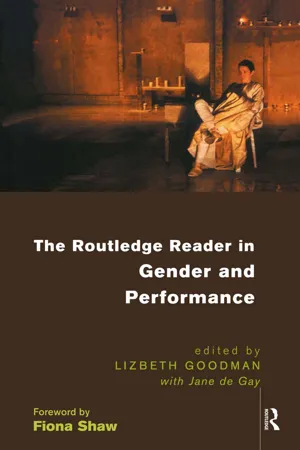 eBook - ePub
- Lizbeth Goodman, Jane de Gay, Lizbeth Goodman, Jane de Gay(Authors)
- 2002(Publication Date)
- Routledge(Publisher)
Or perhaps I should say, fields of specialization, for ‘gender’ and ‘performance’ are distinct fields which overlap but which also diverge and lead off in any number of unexpected directions. Academic work has, similarly, overlapped with practical work in the theatre and in the media as ideas about both gender and performance have developed. The terms ‘gender’ and ‘performance’ are defined in the articles included. Definitions vary and criss-cross, sometimes contradict each other but more often lead on from and clarify points from one author’s work to another’s. This rich field benefits from multiple perspectives, from analysis from different positions and comparative thought across disciplines, jobs, reasons for reading and studying about women and the theatre. This Reader does not attempt to cover any subject or period in the wide fields of ‘gender and performance’ in depth, but instead offers brief introductions to most of the main ideas, areas of work and schools of thought in common currency. The many contributions intersect as authors refer to and occasionally argue with each other. While most of the selections are quite recent or were specially commissioned for this book, a few were written years ago and may now seem a bit dated by the standards of the coming millennium and its demand for topicality. It would not suffice, though, to provide only the most challenging and exciting new pieces by leading critics, as these would not make sense without the necessary foundations. Instead, this book includes short extracts from the essays and books which have been shown to be most often read, studied, cited and discussed in classrooms and seminar groups. These ‘classic’ texts are discussed by the authors who introduce each chapter, and are compared and contrasted with more recent theoretical pieces by critics and scholars whose work engages with both theory and practice in a more ‘topical’ way
Index pages curate the most relevant extracts from our library of academic textbooks. They’ve been created using an in-house natural language model (NLM), each adding context and meaning to key research topics.

