Politics & International Relations

Incumbency
Incumbency refers to the holding of a particular political office by an individual or group. In electoral politics, incumbency advantage refers to the advantage that an incumbent candidate has over their challengers due to their existing position and resources. Incumbency can also refer to the existing state of affairs or conditions in a particular field or industry.
Written by Perlego with AI-assistance
Related key terms
1 of 5


3 Key excerpts on "Incumbency"
 eBook - ePub
Blaming the Government: Citizens and the Economy in Five European Democracies
Citizens and the Economy in Five European Democracies
- Christopher A. Anzalone(Author)
- 2016(Publication Date)
- Routledge(Publisher)
4Politics, Institutions, and the Definition of IncumbencyEconomics rhymes with politics, and not just in English .—Helmut NorpothPolitics and political institutions matter for the study of government popularity, both independently and as conduits for economic effects. Not only are political events, political parties, and political leaders different across countries, but the fundamental rules of the political game vary as well from one country to the next. As a result, political context and political institutions may mediate the assignment of credit and blame. Citizens in systems as different as France and Denmark face dissimilar constraints when they make choices between political alternatives; hence, they also face distinct opportunities to reward some political actors and punish others. One basic premise of this study is that the political context structures both the way people think about politics and the way in which support for governments in Western Europe changes as a function of varying economic performance. Put another way, public support, politics, and institutional structure interact.The five countries examined in this study—Great Britain, Germany, France, the Netherlands, and Denmark—are particularly well suited for a comparative analysis of government support that emphasizes the importance of political and institutional factors because they provide a wealth of variation along the political dimension. The main differences across these countries relevant in this context include the polity’s design, the party system, and the nature of Incumbency. Moreover, given different histories, a comparison across five countries necessitates the inclusion of political event variables that are unique to each system.Who, then, has the power to affect economic performance in western democracies? In one way or another, this power typically lies in the hands of the executive and the legislature. While democratic systems typically share such general institutional features, the five countries included in this study nonetheless differ with regard to their specific institutional design. All five countries are democracies, and four of the five belong to the category of parliamentary democracies. The only exception is the French Fifth Republic, which has a mixed presidential-parliamentary system with a double executive and a parliament.1 eBook - ePub
- Stephen K. Medvic(Author)
- 2011(Publication Date)
- Routledge(Publisher)
For the past 40 years, students of congressional elections have documented a fairly stable pattern in the context of House and Senate elections: the relative ease with which incumbents seem to get re-elected. Beginning with the work of scholars who first recognized the underlying advantages of Incumbency (see, e.g., Erikson 1971; Mayhew 1974b; Cover 1977; Ferejohn 1977; Fiorina 1977) and continuing with more recent and innovative attempts to estimate the extent of that advantage in congressional elections (see, e.g., Gelman and King 1990; Cox and Katz 1996, 1999, 2002; Erikson and Palfrey 1998; Ansola-behere, Snyder, and Stewart 2000; Brady, Cogan and Fiorina 2000), social scientists have widely examined both the causes and consequences of this recurring phenomenon. Although there is little doubt that incumbents have a substantial advantage over non-incumbents in congressional elections, there is considerably less agreement over the sources of the Incumbency advantage and the causes of its growth over time. This is unfortunate, since elections go to the very heart of accountability and representation, and an insufficient understanding of how they are conducted as well as their direct and indirect effects limits our ability to generalize from them.Why is the Incumbency advantage so conceptually important to our understanding of electoral politics? The simple answer is that public-spiritedness and good intensions aside, once a person wins public office, her goal rapidly becomes staying in office. As classically stated by Mayhew (1974a), legislators value re-election above all other goals. Individuals may enter public office with altruistic intensions, but their proximate goal quickly becomes re-election. To accomplish their other goals they must be re-elected, and Incumbency is their key advantage (Alford and Brady 1989). To some, the Incumbency advantage is indicative of an electorate that is, by and large, content with the performance of its elected representatives. To many others, however, it raises potential concerns about the issue of democratic accountability, often resulting in increased demands for campaign finance reform or enactment of term limits for incumbents—issues that have received a widespread amount of attention since the early 1990s.On the whole, concern about democratic accountability has sparked an interest among students of congressional elections to investigate the extent to which legislative behavior has discernible electoral consequences. While some scholars have focused on the electoral rewards associated with distributive benefits (see, e.g., Bickers and Stein 1994, 1996; Alvarez and Saving 1997; Sellers 1997), others have examined the potential advantages linked to casework (Alford and Hibbing 1981; Serra and Moon 1994) and incumbents’ roll call voting records (Erikson 1971; Wright 1978; Jacobson 1993). Although far from conclusive, these studies have offered evidence that incumbents typically receive marginal benefits from these and other legislative activities. This, of course, has been a source of concern among journalists, pundits, and scholars alike who question whether potential advantages that accrue to incumbents make it impractical for quality challengers to mount an effective campaign. After all, how can we expect legislators to be responsive to their constituents if incumbents have little reason to believe that they will be defeated in the upcoming election?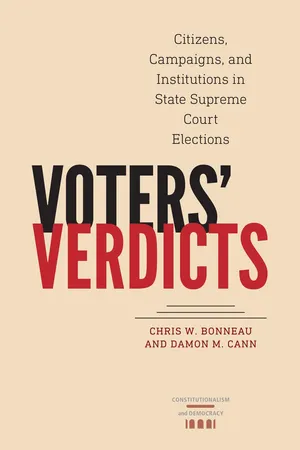 eBook - ePub
Voters’ Verdicts
Citizens, Campaigns, and Institutions in State Supreme Court Elections
- Chris W. Bonneau, Damon M. Cann(Authors)
- 2015(Publication Date)
- University of Virginia Press(Publisher)
In this chapter, we evaluate whether formal ballot information regarding Incumbency affords incumbents an additional advantage in contestable judicial elections. Incumbency in judicial elections is not as straightforward as it is in other institutional settings. In addition to the fact that some judges are elected in partisan elections while others are elected in nonpartisan elections, not all judges come by their Incumbency the same way. Some judges have previously won election to their seat (traditional incumbents), while about one-third of state supreme court judges were initially appointed to their position to fill a vacancy and so are running in an election for the first time (Bonneau and Hall 2009). While these judges are incumbents, they may not accrue all of the advantages of traditional incumbents (name recognition, established funding network, etc.). Using experimental research techniques, we take advantage of the ability to manipulate the presence or absence of a formal Incumbency indicator on a vote choice question that mimics a ballot setting. If voters indeed have a preference for incumbents, all else being equal, we expect to see subjects who received a ballot cue regarding Incumbency to be proportionally more supportive of the incumbent candidate over non-incumbents than subjects who received no such cue. Additionally, we examine whether the Incumbency advantage varies based on (1) type of election and (2) type of incumbent.The Incumbency AdvantageThe existence of an Incumbency advantage in congressional elections is taken as a given. Since 1980, the percentage of U.S. House incumbents seeking reelection who win has dropped below 90% in only three elections (1992, 2010, and 2012); never in that time period did the percentage drop below 85% (Ornstein et al. 2013). To be sure, highly vulnerable candidates, including those plagued by scandal or saddled with unpopular voting records, will often opt to retire rather than face a bruising election with an uncertain outcome. However, given the relatively modest number of retirements per election cycle, one can conclude with reasonable certainty that incumbents enjoy a considerable advantage over their challengers.
Index pages curate the most relevant extracts from our library of academic textbooks. They’ve been created using an in-house natural language model (NLM), each adding context and meaning to key research topics.
