Politics & International Relations

Minority Government
A minority government is formed when a political party does not hold an absolute majority of seats in a legislative body. This means that the governing party must rely on the support of other parties to pass legislation and remain in power. Minority governments often require negotiation and compromise to achieve their policy goals.
Written by Perlego with AI-assistance
Related key terms
1 of 5

11 Key excerpts on "Minority Government"
 eBook - PDF
Public Governance in Denmark
Meeting the Global Mega-Challenges of the 21st Century?
- Andreas Hagedorn Krogh, Annika Agger, Peter Triantafillou, Andreas Hagedorn Krogh, Annika Agger, Peter Triantafillou(Authors)
- 2022(Publication Date)
- Emerald Publishing Limited(Publisher)
Single-party Minority Governments also occur frequently in countries such as Spain, Ireland and Canada, where they have often been close to a majority. In Spain, in particular, multi-level govern-ments are also used to achieve important results ( Field, 2014 , 2015 ). There are currently 10 parties in the Folketing, which renders it dif fi cult to form majority governments, and there has only been one since 1971. Instead, Minority Governments consisting of one or more parties must fi nd majority sup-port in parliament. According to the international literature, minority govern-ments – minority coalition governments in particular – are typically less durable ( Cheibub & Rasch, forthcoming ; Lijphart, 1999 ). Yet Danish minority govern-ments, particularly since the 1990s, have proven quite durable, all remaining in of fi ce for at least two-thirds of the electoral term. They have also managed to pass a number of major, long-term public policy reforms on pensions and taxation across policy blocks ( Green-Pedersen, 2001 ). This corresponds with the Potrafke ’ s ( 2021 ) fi nding that Minority Governments perform as well fi scally as majority governments when they enjoy sustained support. To understand why Danish Minority Governments perform comparatively well, we must study ‘ the infra-structure ’ of coalition building and the internal functioning of government. Minority Governance: Support Party and Legislative Agreements In what has become a classic account of Minority Governments, Strøm (1990) distinguished between those with and without external support party agreements; that is, agreements with parties not in government that nevertheless provide support for the survival of the government, perhaps in return for procedural arrangements or substantive policy concessions. Recent studies have revealed the importance of such arrangements for Minority Government policy effectiveness ( Krauss & Th¨ urk, forthcoming ). eBook - ePub
- Timothy Peacock, Timothy Noël Peacock(Authors)
- 2018(Publication Date)
- Manchester University Press(Publisher)
inter alia, forming governments, handling parliamentary defeats, electoral timing, negotiating with other parties and making post-electoral plans for a minority or coalition government. At one level, by bringing to light hidden narratives, it aims to demythologise the widespread academic and popular understanding of this era, showing that both main parties were far more strategically proactive than has previously been assumed. At another level, it demonstrates the British exceptionalism in Minority Government against an international backcloth, and provides a methodological foundation for examining contemporary challenges of new forms of government in democracies around the world.The focus in this study is on events during the 1970s which have not been fully explored, but which were of great importance to contemporary actors in their day-to-day work in Parliament. While some of these events might seem comparatively trivial, they were of critical importance to the modus operandi of the Government and Opposition. This means that the study will not give as much attention to some of the issues which have been more widely debated, such as the postwar consensus (a more obvious manifestation of which was the aim of maintaining full employment through state intervention in the economy) and the International Monetary Fund (IMF) crisis in 1976.Definitional issues: what is a Minority Government?Minority Government is a concept which has become more commonly articulated in response to the changing landscape of British politics in the twenty-first century. Indecisive opinion-polling led to significant talk of a ‘hung parliament’ and prospective Minority Government prior to the 2010 and 2015 general elections, and, following devolved elections in 2016, the administrations in both the Scottish Parliament and Welsh Assembly were Minority Governments. The June 2017 Westminster election led to a Conservative Minority Government and has provoked much popular and scholarly commentary on the subject. However, the meaning of this term is often not clearly defined and has changed over time. eBook - ePub
Minority Governments in India
The Puzzle of Elusive Majorities
- Csaba Nikolenyi(Author)
- 2009(Publication Date)
- Routledge(Publisher)
One would have expected the Congress to take advantage of its centrist location in the parliamentary realm in exactly the same way as Riker had observed it in the electoral arena of party competition. To be more precise, given that the center party is always a Condorcet winner in a hung parliament, as long as there is one dimension, one would expect the Congress to be able to form a stable Minority Government thanks to its ideologically pivotal position. As long as the party controlled the median legislator, there could be no ideologically connected majority coalition of which it would not be a member. In turn, this advantage should have given the Congress the leverage to form and maintain a government of its own. However, clearly this was the case only once.A different explanation of Minority Governments is offered by Grofman, Straffin and Noviello (1996) who model cabinet formation as a sequential process of proto-coalition formation. According to this model, a Minority Government will have a knife-edge quality to it in that it will be formed only when two proto-coalitions have reached equal size and no further expansion is impossible. In a sense, this model provides a theoretical foundation for earlier observations by Taylor and Laver (1973) and Herman and Pope (1973) according to which most Minority Governments, in Western Europe, are formed by near-majority size parties. However, clearly some other dynamics must be at work in India. As shown, the Minority Governments in this period have varied considerably in terms of the size of their parliamentary basis.A third approach to understanding the formation of Minority Governments stresses the institutional incentives that encourage office- and policy-seeking political parties not to enter executive office and allow the formation of a minority cabinet instead of a majority coalition (Bergman 1993; Laver and Budge 1992; Strøm 1990; Strøm, Budge and Laver 1994). A number of different explanations have beenproposed in this new-institutionalistvein. For example, Bergman (1993) links the formation of Minority Governments to negative parliamentary rules of cabinet formation, while Strøm et al eBook - PDF
Parliamentary Democracy
Democratization, Destabilization, Reconsolidation, 1789-1999
- K. Beyme(Author)
- 2000(Publication Date)
- Palgrave Macmillan(Publisher)
In Norway, with the decline of the social democrats after Gerhardsen, coalitions of three parties commanded only a small major- ity in parliament (50.4 per cent). Bourgeois coalitions under Lyng (four parties), Borten (four parties), Korvald (three parties), Willoch (three parties) and Syse (three parties) were short-lived. The weakness of both camps led to a pendulum swing of alternating governments without a solid majority basis. Of the new democracies Greece was the only excep- tion: Portugal had many Minority Governments (five out of 13 from 1976–96) and Spain (six out of eight governments), both in the era of The Government and Parliamentary Majority 175 176 Parliamentary Democracy the UCD as well as under González and his PSOE when its majority withered after 1989. A recent study looked at 356 governments in the OECD countries and found that more than one third (35.1 per cent) were Minority Governments. In some countries they were a temporary phenomenon. In others (Canada, Italy, Ireland and France) they amounted to 40 per cent of the cabinets (Table 6.3). As long as Minority Governments are coalitions they can be included in coalition studies. But the toleration of one-party minority govern- ments by other parties is more difficult to assess because their motives do not follow the office-seeking model and only partly fit into the policy-orientation model because the ideological policy preferences of such parties can hardly be maximised under conditions of Minority Government. There are other rational criteria for a policy of toleration, such as to avoid a crisis and to avoid damaging the prestige of parlia- ment by long delays in coalition building. Some minority coalitions are facilitated by the ‘gravitation principle’ in government building (see Chapter 5). One study of 18 minority coalitions found that 13 included a central party. This is most frequently the case in Denmark and Finland. eBook - PDF
- Richard S Katz, William J Crotty, Richard S Katz, William J Crotty(Authors)
- 2006(Publication Date)
- SAGE Publications Ltd(Publisher)
Laver and Schofield (1990: 88) argued that Minority Governments may occur because of policy divisions amongst opposition parties, so that they cannot combine and agree on a viable policy alternative. Minority Governments exploit these divisions by forming majorities on an issue-by-issue basis. Strøm (1990) devised the following testable proposition: 9 The ‘division of the opposition’ proposi-tion: the more ideologically divided an opposition controlling a majority of parlia-mentary seats, the higher the chances that a minority cabinet will form. For an ideologi-cally extreme party, sustaining a minority solution can represent a good solution, as participating in a coalition could cause elec-toral damage due to the policy compro-mises it would trigger, while bringing down a Minority Government could result in the subsequent formation of a majority coalition ideologically more distant from the extreme party than is the current minor-ity government. 4 Generally, adding policy to the propositions has improved the predictive value of the early pure office-seeking theories. 5 Still, the empirical results remain modest. 6 While obviously richer in theoretical terms, policy-driven coalition theories require parties to be placed in an ideo-logical space (which can be one- or multidimen-sional) before they can be tested empirically. PARTIES INTO GOVERNMENT: STILL MANY PUZZLES 177 Whatever the placement method chosen (manifesto content analysis, survey analysis of electorates’ or elites’ policy positions, expert surveys), measuring party positions remains a difficult exercise. It is all the more so for multi-dimensional models of coalition formation, to which we now turn. Most early policy-driven theories were uni-dimensional, although the policy space in some of the countries on which the theories were tested were recognized to be multicleavage polities (Lipset and Rokkan, 1967; Lijphart, 1984: 130). eBook - PDF
Government Formation in Central and Eastern Europe
The Case of Minority Governments
- Dorothea Keudel-Kaiser(Author)
- 2014(Publication Date)
- Budrich UniPress(Publisher)
Herman and Pope (1973) showed that Minority Governments occur most often in situations “in which the party forming the government is only a small number of seats short of a legislative majority” (Herman and Pope 1973, p. 197 et. seq., see also Taylor and Laver 1973). This basic presumption seems to be very plausible, even intuitive. There is no reason why it should not apply to the Central and Eastern European context. It seems, however, appropriate to extend the condition a little further: a party, even if it comes very close to a majority, will not form a Minority Government if it does not have the (formal or informal) commitment from at least two of the opposition parties, namely that they will support the government (to come into office as well as during the parliamentary term). The commitment of only one party would be too uncertain; the withdrawal of its support would destabilise or even bring down the Minority Government. 69 In its extended form (near to a majority and support of at least two opposition parties), this factor is integrated in the analysis. Two party dominance In the Central and Eastern European countries, there are often two big parties that dominate party competition. If these two parties lack mutual coalition potential, the formation of a majority government becomes very difficult. Surprisingly, this factor does not appear in coalition research on Western Europe. It is, however, present in research on party systems. Here, the domi-nance of two parties is defined as follows: two parties control more than a quarter of the seats each and together more than two-thirds of the seats. The third largest party controls not more than half of the seats than the smaller of the two leading parties (Niedermayer 2010, p. 3). With regard to government formation, the crucial additional point is whether the two dominant parties are able to form a coalition with each other. In this modified form, the factor will be included in the analysis. eBook - PDF
Underdog Politics
The Minority Party in the U.S. House of Representatives
- Matthew N. Green(Author)
- 2015(Publication Date)
- Yale University Press(Publisher)
1 0ne THE POLITICS OF THE MINORITY PARTY The minority is a perpetual frustration. —Democratic congressman, 2003 But let me tell you that the delight of political life is altogether in opposition. Why, it is freedom against slavery, fire against clay, movement against stagnation! —Mr. Joshua Monk, Phineas Finn Frustration and freedom. Both are familiar to lawmakers unfor-tunate enough to be in the minority party. Though the two senti-ments differ, they come from the same source: disempowerment. The minority party’s lack of formal political power—an enduring feature of many legislative bodies, including the U.S. House of Representatives—understandably frustrates lawmakers from the mi-nority who want to have an effect on national policy. But powerless-ness also permits them to act with little worry for the consequences. Asked about serving in the minority, one House aide put it this way: “You can just sit back and say, whom do I want to mess with today?” 1 In the contemporary House, minority party members do not re-spond to this disempowerment by meekly accepting their plight or, as the congressional aide implied, acting pell-mell. To the contrary, they take advantage of being in government without having to govern and look instead for ways to influence political outcomes on their own terms. Even though the party is outnumbered and the House’s rules are stacked against it, the minority still tries to tilt the electoral playing field in its favor, make laws, protect its procedural rights, and steer presidential politics. And if the party is driven, creative, sizable, unified, and lucky enough, it can sometimes succeed. Anecdotal evidence, at least, suggests that the minority party in the House of Representatives is not without influence, even if the T H E P O L I T I C S O F T H E M I N O R I T Y PA R T Y 2 chamber’s rules grant it less legislative authority than the majority. eBook - PDF
European Politics
An Introduction
- Jan-Erik Lane, Svante Ersson(Authors)
- 1996(Publication Date)
- SAGE Publications Ltd(Publisher)
The majoritarian format of minimum winning coalitions works welJ only in homogeneous societies. Although a grand coalition could conceivably be a minimum winning coalition, it holds true that when it constitutes an oversized government, then it falls outside of both the office-seeking and the policy-pursuit perspectives, strictly speaking. Second, there is the model of a Minority Government which is durable (Strom, 1990) . Such a government may consist of more than one party but whether it is a one-party government or a coalition of several parties, the government receives less than 50 per cent support in Parliament. The Minority Government model falls outside of the office-seeking approach, because a Minority Government is not a minimum winning coalition. Yet, one could argue that Minority Governments, if durable, tend to secure enough Parliamentary support by informal coalition-building at the floor or in the committees of Parliament. Minority Governments may consist of parties that are close to each programatically in accordance with the policy-pursuit approach, but strictly speaking the minority coalition model falJs outside of this approach , because Minority Governments are not large enough to carry through their policies. Durable Minority Governments occur in societies where class cleavages separate socialist from non-socialist parties at the same time as neither camp being strong enough to secure a majoritarian position. Gordon Smith has pointed out one chief difficulty in the models of government formation discussed above. He argues that one needs to distinguish between social cohesion and governmental cohesion in relation to European realities. Cohesion in government as witnessed in government durability may be low whatever the institutions and the historical legacies may be (Smith, 1989b). eBook - PDF
Ideological Representation: Achieved and Astray
Elections, Institutions, and the Breakdown of Ideological Congruence in Parliamentary Democracies
- G. Bingham Powell, Jr(Authors)
- 2019(Publication Date)
- Cambridge University Press(Publisher)
Even objectives that can be accomplished with executive orders take time to enforce upon the bureaucracy. Thus, we would expect more durable governments in general to be more successful in changing the status quo in the direction of their desires and commitments (for some empirical evidence, see Thomson et al. 2010, 2014, 2017). Minority Governments can always be replaced with a vote of no con- fidence. In fact Minority Governments are less durable than majority governments (as many studies have shown and as is also true in our data). But when they do endure we might infer that they are successfully finding outside support. Thus, we might want to distinguish short-lived from durable Minority Governments, treating the latter as more similar to 160 A Special Analysis Problem at Stage III majority governments. Indeed, Thomson et al. (2010, 2014, 2017) find that parties in Minority Governments are as likely to realize their campaign promises as majority governments – at least controlling for government duration. It is not clear, however, what to do with very short-lived governments (minority or majority) with regard to congruence. Presumably the status quo tends to prevail. But does this imply that all parties have equal influence? That the median legislative party has more influence? That congruence “fails?” That it continues at the level of the previous govern- ment? There are many unexplored questions here. Hypothesis 7.4. Opposition parties that provide enough formal support to a Minority Government to give it a “majority in disguise,” will have general influence on policy making and be more able than other oppo- sition parties to fulfill election promises. Hypothesis 7.4 a. Seat-advantaged parties in Minority Governments (the largest party in the government and the formateur) will arrange diverse formal support or formal support closely fitting their prefer- ences. eBook - PDF
Why Minority Governments Work
Multilevel Territorial Politics in Spain
- Bonnie N. Field(Author)
- 2016(Publication Date)
- Palgrave Macmillan(Publisher)
The patterns remain when we divide the number of decrees by the government’s time in office. Minority Governments on average issue 16.6 decrees per year compared to 9.3 for majority governments. Thresholds Parliamentary voting procedures can also favor a Minority Government by lowering the threshold for approval (Tsebelis 2002, 99) or the “effec- tive decision point” (Herman and Pope 1973, 199). Particularly impor- tant are the distinct majorities required to pass legislation, including simple majorities (of the MPs voting, more yes than no votes), absolute majorities (50% + 1 of the members of the chamber), and super or quali- fied majorities (Rasch 1995). The lower the hurdle the easier it is for a Minority Government to reach it. In Spain, thresholds for decision-mak- ing are critical for understanding governing capacity, both in terms of the threshold for decision-making in parliament and the delegation of full legislative competence to committees. Most decisions can be made with a simple majority, which means that abstention votes, which are permitted, and absences lower the threshold. However, there are impor- tant exceptions, including the approval of organic laws (absolute major- ity threshold) and constitutional reforms (super majority threshold). 136 ● Why Minority Governments Work Legislation can be (and almost always is) voted upon in pieces (articles, partial articles, amendments, etc.), and a final vote on the entire piece of legislation is only necessary in the case of organic laws (Field 2005). We can first assess the importance of the simple majority threshold for decision-making in parliament, which is the most common thresh- old, by comparing patterns of abstention during majority and Minority Governments. When there is a simple-majority rule, abstentions favor the government by lowering the number of votes necessary for approval. Votes on legislation in Spain can be taken in a number of ways.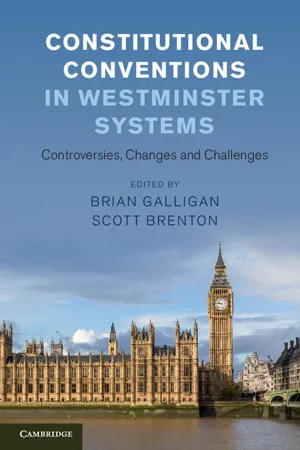 eBook - PDF
Constitutional Conventions in Westminster Systems
Controversies, Changes and Challenges
- Brian Galligan, Scott Brenton(Authors)
- 2015(Publication Date)
- Cambridge University Press(Publisher)
Where the incumbent government retains their majority, they continue to govern; if they lose their majority and the opposition gains a majority, the incumbent leader resigns and advises that the opposition leader be invited to form a government. Where both the government and the opposition fail to win a majority, conventions can be tested. The two major choices are either a coalition that binds partners to a joint policy platform negotiated during the government formation phase or a pure single-party Minority Government that requires ongoing nego- tiation, but international experience shows several variations of these arrangements (Paun and Hazell 2010: 215–16; Paun 2011: 448–9). Collective cabinet responsibility is seen to favour policy-compact coali- tions (Strøm, Budge and Laver 1994). There are risks for minor parties and independents in entering coalition-type partnerships explaining a preference for Minority Government formation (Curtin and Miller 2011: 8). Collective cabinet responsibility has been challenged by multiparty governance arrangements, but actually has remained largely intact with the emergence of what is commonly known internationally as the ‘New Zealand’ model. In this model collective responsibility is loosened and support parties can gain ministerial roles while maintaining the right to dissent on certain issues (Paun 2011: 450). Yet like so many presumed New Zealand innovations, the experimentation with conventions began in Australia (although New Zealand went much further). The first stage of the ‘Australian’ model began in the early 1990s and continued into the 2000s. Unlike Minority Governments in Canada, the major parties negotiated with minor parties and independents and attempted to reach agreements – ideally in writing – where guarantees 128 scott brenton of confidence and supply were exchanged for commitments on political and/or policy reforms.
Index pages curate the most relevant extracts from our library of academic textbooks. They’ve been created using an in-house natural language model (NLM), each adding context and meaning to key research topics.

