Politics & International Relations

Prime Minister
The Prime Minister is the head of government in a parliamentary system, responsible for leading the executive branch and implementing policies. They are typically the leader of the majority party in the legislature and are appointed by the head of state. The Prime Minister holds significant decision-making power and is a key figure in shaping a country's domestic and foreign policies.
Written by Perlego with AI-assistance
Related key terms
1 of 5
9 Key excerpts on "Prime Minister"
 eBook - ePub
- Simon James(Author)
- 2020(Publication Date)
- Routledge(Publisher)
Ever since the office of Prime Minister came into existence three centuries ago, foreign affairs have constituted a large part of the workload. Since 1945 this has grown considerably, and has similarly affected heads of government around the world. A revolution in communications allows politicians to travel faster and more frequently, and to speak to each other instantly, leading to more regular bilateral conversations between world leaders and the growth of international summitry. Second, the character of international relations has broadened to include a great range of military, economic, security and environmental issues, whose cross-governmental nature tends to draw in the head of government. Third, membership of the EU made many areas of domestic policy the subject of international action and so brought them to the European Council, the EU’s meeting of heads of government, fuelling the general practice of summitry; Brexit notwithstanding, discussion of these issues at head of government level is now a matter of habit for European leaders. International relations are examined at greater length in Chapter 5 ; the point of immediate importance is that they constitute a large part of the Prime Minister’s functions and take up a lot of time. Primus inter pares, presidentialism and conflict with ministers Given those functions, and particularly the right to intervene in policy areas, what leverage does the Prime Minister exercise within the system? Here we have to clear out of the way three misconceptions that bedevil the study of British central government. The first is the confusion caused to students by the familiar phrase primus inter pares (first among equals) – used, especially by politicians, to encapsulate their constitutional ideal of the Prime Minister as only the most senior of a collective of colleagues. It is neither an accurate nor an adequate summary of the premier’s position eBook - PDF
Australian Politics in the Twenty-First Century
Old Institutions, New Challenges
- Stewart Jackson, Joff Lelliott, Shannon Brincat, Josephine Bourne, Nick Economou(Authors)
- 2022(Publication Date)
- Cambridge University Press(Publisher)
Voters may or may not recognise members of the Cabinet, but they are almost certainly familiar with the Prime Minister of the day. This is no surprise. The Prime Minister, after all, wields the largest microphone in the land, with ready access to a media enthralled by the leader’s every utterance. Prime Ministers can call snap elections at times that maximise their chances of victory, and then campaign from a position of Prime Ministerial authority, with all the advantages that this confers. They claim to speak on behalf of the nation, a claim that is at least tacitly accepted by millions. In times of national crisis, it is the Prime Minister who is the public face of the government’s response. They salve national wounds and channel the emotions of their public, becoming the repository of both hopes and grievances. The Prime Minister is, in every sense of the word, the chief executive of the political executive. Arguably the power of the Prime Minister has grown in recent decades as they have become an increasing focus of the media and the public, have grown the bureaucratic and personal staff, and asserted their authority over party institutions. (For further discussion of these issues see Chapter 10). Prime Ministers as political agents The manner in which different politicians have occupied the position of Prime Minister, however, has been very different (Grattan 2000; Weller 1992). These differences are shaped partly by personality, partly by the circumstances under which Prime Ministers have secured and kept power, and partly by the institutional constraints that they confront at any point in time. Prime Ministers are political agents of change and/or continuity, and their choices and leadership matter, even if they are constrained by institutions and structures. eBook - PDF
In the National Interest
Canadian Foreign Policy and the Department of Foreign Affairs and International Trade, 1909-2009
- Greg Donaghy, Michael K. Carroll(Authors)
- 2011(Publication Date)
- University of Calgary Press(Publisher)
In Canada, the Prime Minister is traditionally very involved in the shap-ing of the country’s foreign policy. Promoting and defending the national interest, the Prime Minister plays a vital role as one of its managers, at times in tandem with the minister of foreign affairs, at times as the key actor. This is due, in large part, to the parliamentary system in which Canadian policies are set. The principle of responsible government, which is at the heart of the Canadian system, solidly anchors the leadership and the au-thority that the Prime Minister exercises, especially in the realm of foreign relations. 1 In addition, some observers may argue that foreign policy offers Prime Ministers glamour and exposure, but they overlook the fact that, un-like the United States where a foreign affairs role has an important impact on domestic perception of the leader, politics in Canada is essentially “lo-cal.” What is of importance is that these relations are conducted with the Prime Ministers’ counterparts around the world, which helps to explain why foreign affairs fall more easily under the leaders’ purview, a phenom-enon accentuated by summit diplomacy. 2 This prominent role is reinforced Setting the Canadian Foreign Policy Agenda, 1984–2009: Prime Ministers as Prime Actors? Nelson Michaud 10 Nelson Michaud 182 by a bureaucratic and political framework that feeds the Prime Minister with international issues to which attention should be paid. 3 There is also a historic factor that comes into play. From 1909, when the Department of External Affairs was first formed, until after the Second World War, foreign affairs fell, for the most part, under the purview of the Prime Minister. It was not until 1946, when Louis St. Laurent took the reigns of the department from an ageing Prime Minister W.L. Mackenzie King, that the position of secretary of state for external affairs was solid-ified as a separate entity. eBook - PDF
- Anne Stevens(Author)
- 2017(Publication Date)
- Red Globe Press(Publisher)
The presi-dent does not account to Parliament for his actions: he cannot be invited to attend debates, he does not speak in them, he cannot be questioned by members of Parliament. The Prime Minister has a crucial political role, whatever his or her relationship with the presidency, though clearly its balance and intensity alters during periods of cohabitation . The political role of the Prime Minister has three aspects: in relation to the government, for whose political cohesion he or she is largely responsible; in relation to Parliament, where the government must carry its programme and to some degree account for its actions, and in relation to the party or parties that support the government. In seeking to ensure the political cohesion of the government the Prime Minister may operate under a number of handicaps: ● He or she may not be solely responsible for the composition and nature of his team. General de Gaulle was in the habit of naming those whom he wished to see in the key posts – defence, foreign affairs, the interior – and ensured the continuation in office from 1959 to the end of his presidency of André Malraux as Minister of Culture. In 2002 it was reported that President Chirac had chosen all the ministers, (although Raffarin specifically asked for Luc Ferry, the philosopher, as minister of education) and they had in some cases already been informed of their appointment by the president some hours before the Prime Minister officially told them that he was, as the constitution requires, proposing them ( Le Point , 17 May 2002, p. 32, and 24 June 2002, p. 35). Compromises may occur. In the governmental reshuffles of 1990, for example, two ministerial departures (including that of Edith Cresson who was appointed Prime Minister the following year) were attributed to the wishes of the Prime Minister, two new appointments to the wishes of the president, and one more was alleged to have served the (different) interests of both. eBook - PDF
Administering the Summit
Administration of the Core Executive in Developed Countries
- NA NA(Author)
- 2016(Publication Date)
- Palgrave Macmillan(Publisher)
Having secured a parliamentary majority, he submits a list of all ministers of higher and lower rank to the president of the republic. The president swears in the new government, which then seeks a vote of confidence by parliament. In the view of most Greek constitutional experts, since 1986 the Greek political system has centred around the Prime Minister who enjoys institutional autonomy. 6 According to the current Con- stitution, the Prime Minister secures the unity of the government and directs the activities of the government and of the public ad- ministration, aiming at the implementation of government policies. 7 The most recent description of the role of the Prime Minister was provided in 1985 by Law 1558/1985. The extensive powers of the Prime Minister include: (a) securing the unity of the government and directing the govern- ment and the public administration; (b) specifying government policy; (c) co-ordinating the execution of government policy; (d) resolving disputes among ministers; (e) representing the government and presiding over the Cabinet; (f) overseeing the implementation of laws by the public adminis- tration and the function of the latter to the benefit of the state and the citizens; (g) giving permission for publication of voted texts of law in the Government's Gazette; and (h) exercising any other powers provided by law. 8 Other powers stem from the constitutional competence of the Prime Minister to co-ordinate the work of the government, which includes his power to alter the size and the composition of the Cabinet. This means that the Prime Minister has the power to appoint and dismiss ministers at will, to change their number by creating new ministerial posts or abolishing existing ones, and to create, merge or disband ministries. eBook - ePub
Churchill to Major: The British Prime Ministership since 1945
The British Prime Ministership since 1945
- R.L. Borthwick, Martin Burch, Philip Giddings(Authors)
- 2016(Publication Date)
- Routledge(Publisher)
The major determinants of power have remained essentially unaltered, but nobody would deny that the context in which Prime Ministers must operate has greatly changed since Churchill’s day. Although he would feel comfortably at home in many aspects of the position, as these essays have shown, he would also notice some developments which alter the way in which a Prime Minister’s various roles can be performed. This contextual revolution is, of course, not the same as institutional change and there is considerable evidence from the chapters in this book that the fundamental features of the Prime Minister’s office have endured remarkably unaltered in spite of the major changes in the broader political environment.Nearly all the chapters suggest that three distinctive and decisive contextual changes have taken place. The first is technological. The developments in communications, both the tangible aspects (such as transport improvements) and the intangible (such as the electronic media), have dramatically expanded the public visibility of Prime Ministers and their opportunities for short-term travel outside the United Kingdom. In foreign affairs, as J.M. Lee in particular emphasises, there is now no excuse for a Prime Minister not to attend a major international gathering, and indeed funerals of important political figures have become occasions for personal diplomacy. Ministers with responsibility for foreign affairs sometimes find that they are not merely advisers to Prime Ministers (that was always the case) but are sometimes personal assistants as well. There are variations, and tensions, in these relationships and no consistent pattern; but the opportunity for Prime Ministerial dominance has been increased. While the Major-Hurd relationship has plenty of earlier precedents, the Thatcher-Major relationship illustrated in extreme form the consequences of the new balance of concerns. Foreign policy issues have necessarily become more central to a Prime Minister’s agenda, especially in attention time, at the expense of the domestic scene.Even more obviously, the media (television in particular) have come to dominate much of a Prime Minister’s working day. This is the central theme of Colin Seymour-Ure’s chapter, but the point recurs regularly in all the others. It is ever more difficult for a Prime Minister to remain silent on an issue which the media have decided is one of national interest, and it is impossible for Prime Ministers now to avoid their performances being appraised, evaluated and criticised daily in the news media. Whatever the reality of their responsibility for specific government policies (and speeches), the presumption is that they are masters of their governments and that ministerial action reflects their priorities and choices. They must be ready with a good phrase, a plausible defence or a potent riposte whenever they are approached by journalists. As a corollary of this, Prime Ministers have tried to ensure that they dominate the agenda rather than react to questions posed by the media; the Lobby system and calculated off-the-record briefings are intended to ensure that the issues which the media address are those which the Prime Minister favours. This is not always possible, but it reflects a major change in the context of a Prime Minister’s political life.
- Takeo Hoshi, Phillip Y. Lipscy(Authors)
- 2021(Publication Date)
- Cambridge University Press(Publisher)
The principal can monitor the behavior of the agent to see whether the agent respects the principal’s interests. Or, the principal can create procedures through which the actions of the agent can be rejected or corrected. When we analyze the Prime Minister’s power, it is important to exam- ine it vis-à-vis other actors. Theoretically, a cabinet is collegial, and the Prime Minister cannot make decisions unilaterally. Yet, today, the Prime Minister is at the center of policy formulation. He receives public atten- tion and is often treated in the media as if he formulates policies. 10 If the cabinet is successful in formulating some policies, normally he receives the credit. If the cabinet fails, he usually receives the most blame. Voters MPs PM Minister Civil Service Figure 2.1 The chain of delegation in the parliamentary system Source: Strøm, “Parliamentary Democracy and Delegation,” p.65 46 Harukata Takenaka Given such a political environment, it is sensible to assume that the Prime Minister wants as much control and discretion as possible in the process of policy formulation – in other words, that he wants to retain independence from his principals (the MPs), while maximizing control over his agents (the ministers). This chapter pays particular attention to the Prime Minister’s rela- tionships with the MPs as well as the ministers. It starts with his relationship with the politicians in the parliament. It is possible to assume that the MPs rely on both ex ante and ex post mechanisms to control their agent, the Prime Minister. Projecting ex ante control, they can choose as Prime Minister the person who is likely to respect their interests. As means of ex post control, they can reject legislation proposed by the Prime Minister or even take a vote of no confidence to remove him/her. Yet what makes the Prime Minister distinct from other actors is that he has prerogatives to enhance his independence from his principals. eBook - ePub
The World in Canada
Diaspora, Demography, and Domestic Politics
- David Carment, David Bercuson(Authors)
- 2009(Publication Date)
- McGill-Queen's University Press(Publisher)
Ten years later, when Thomas Hockin assembled a group of analysts and policymakers to discuss the unique responsibilities of the Prime Minister in Canadian society, his participants concluded that the leader had a marked ability to shape public thinking on international issues and to manipulate the policy agenda (Hockin; Fletcher). A decade later Kim Richard Nossal provided the most thorough evidence of the importance of the Prime Minister. For all intents and purposes, he explained, Canadian heads of government were constitutionally responsible for treaty-making, diplomacy, and leading the country to war. They were the primary conduits between their state and other international political leaders. They made the key domestic appointments that affected, if not determined, how foreign policy was planned and pursued. An even more contemporary assessment by political scientist Paul Gecelovsky has concurred. 2 In the early 2000s, Prime Minister Martin’s experience supported these observations. Journalists who praised his foreign policy decisions noted that he was “emerging as his own foreign affairs minister” and described members of his Cabinet as implementers of his ideas instead of innovators of their own (Travers). Critics similarly pointed to Martin himself as the cause of his government’s “dismal record” in world affairs. It was Martin, wrote Mary Janigan (2005:18) in Maclean’s, who single-handedly derailed the release of the Canadian international policy statement with the simple proclamation, “I don’t like it.” When a much-revised version was finally published, those who had been directly involved largely agreed that the Prime Minister had made a significant difference. Martin’s L-20 was given prominent treatment, for example, regardless of whatever skepticism might have been felt within Foreign Affairs Canada. There was also money available to pursue a “Big Canada” approach to world affairs, an idea that had come directly from the Prime Minister’s office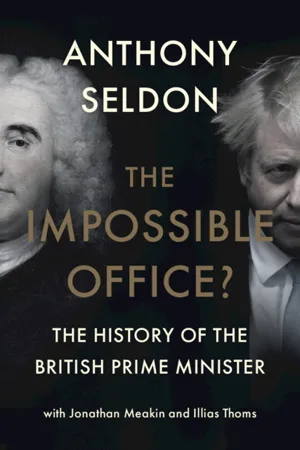 eBook - PDF
The Impossible Office?
The History of the British Prime Minister
- Anthony Seldon, Jonathan Meakin, Illias Thoms(Authors)
- 2021(Publication Date)
- Cambridge University Press(Publisher)
The National Security Advisor briefs the PM on intelligence, defence, foreign, and terrorism matters. Number 10 today is overseen by a Chief and Deputy Chiefs of Staff, and by a Permanent Secretary. The Cabinet Of fi ce, based at 70 Whitehall in the building the Treasury occupied until 1940, steers the PM through Cabinet business, allowing them to get a grip on government. There is little discernible correlation between the size of the Downing Street empire and the effectiveness of a Prime Ministership. Britain ’ s two strongest since 1945, Attlee and Thatcher, both operated with small Number 10s, working closely with the Civil Service. POLITICAL CAPITAL. A Prime Minister might be supremely talented, and have a very clear agenda, but unless they possess political capital, they will not be effective. A Prime Minister can be compared to an elegant THE POWERS AND RESOURCES OF THE Prime Minister, 1721–2021 166 Ferrari – they might be able to make a dazzling impression at speed, but without the fuel of political capital, they will go nowhere. As Richard Wilson, who saw several Prime Ministers close up, put it: What matters to a Prime Minister is whether they are in a strong or a weak position with their colleagues, their party, Parliament, the press, and public. If they are strong, they will be powerful. If they are in a weak position, they will not be powerful. So what matters for the power of Prime Ministers is the political context in which they operate. All power is fl uid. End of proposition. 77 Before the extensions to the franchise after 1832, political capital came to the PM through the af fi rmation of the monarch, credibility with Cabinet, and their pro fi ciency in Parliament. Since mass democracy, the elector-ate has become king, or queen. ‘ Power is fundamentally given by the electorate. If a Prime Minister has a strong mandate, then they are going to be powerful.
Index pages curate the most relevant extracts from our library of academic textbooks. They’ve been created using an in-house natural language model (NLM), each adding context and meaning to key research topics.

