Politics & International Relations

The UK Cabinet
The UK Cabinet is a group of senior government ministers chosen by the Prime Minister to lead various government departments and make key decisions. It is the main decision-making body of the government and plays a crucial role in shaping and implementing government policies. The Cabinet meets regularly to discuss and decide on important issues affecting the country.
Written by Perlego with AI-assistance
Related key terms
1 of 5
8 Key excerpts on "The UK Cabinet"
 eBook - ePub
Policy Making in Britain
An Introduction
- Peter Dorey(Author)
- 2014(Publication Date)
- SAGE Publications Ltd(Publisher)
The Cabinet is undoubtedly a vitally important forum through which senior ministers are kept informed of the government’s programme, including forthcoming legislation and parliamentary business for the next week. Cabinet meetings also include reports on international affairs by the Foreign Secretary, particularly those that have diplomatic, military or security implications for Britain. Of course, the provision of information also facilitates coordination, by keeping all Cabinet Ministers aware of the context in which they are collectively operating in, and what their individual colleagues and other departments are doing or planning to do.Occasionally, the Cabinet might engage in a more general or informal discussion over governmental objectives, policies or strategy, or about how the government ought to respond either to an ongoing and unresolved problem or to an issue that has just risen to the top of the institutional policy agenda. According to a former Chancellor of the Exchequer, Nigel Lawson:The Cabinet’s customary role was to rubber stamp decisions that had already been taken, to keep all colleagues reasonably informed about what was going on, and to provide a forum for general political discussion if time permitted.(Lawson, 1992: 125, emphasis added)However, only occasionally does time and the Prime Minster permit the Cabinet ‘to provide a forum for general political discussion’, particularly in view of the reduced frequency and length of Cabinet meetings, as noted above.CABINET COMMITTEESIt has long been the case that much of the detailed decision taking and policy making in the core executive is delegated to Cabinet committees, particularly when an issue affects or involves more than one department. The vital role of Cabinet committees not only reflects the increased responsibilities of British governments in industrial, economic and social affairs, especially since 1945, but also the growing political and administrative complexities of governing contemporary Britain. As a consequence, many policies are both administratively complex or specialized, and often require the contribution and cooperation of more than one department. eBook - ePub
- Bill Jones, Dennis Kavanagh, Dennis Kavanagh(Authors)
- 2013(Publication Date)
- Manchester University Press(Publisher)
By the nineteenth century this body comprised all the major portfolios and took all the major decisions. By the end of the century the Prime Minister was more than ‘first among equals’, as he was initially seen, and from then on the office acquired more prestige and power. But the Cabinet, too, was enhanced by more authority and prestige, which made it the key body to belong to and the pool of talent from which Prime Ministers were drawn.Size and composition
Cabinet usually comprises twenty to twenty-four ministers but during the two World Wars ‘War Cabinets’ were a quarter of that size. In normal times of peace, they include all the major ministers – Chancellor, Home Secretary, Foreign Secretary, Health, Work and Pensions Ministers, and so forth – but also included are those with the more specialist jobs of Leader of the House, Chief Whip, Leader in the Lords, Attorney General and Lord Chancellor, plus the occasional ‘all purpose’ and archaic portfolios of Lord Privy Seal or Lord President of the Council, who often chair Cabinet committees or perform specific tasks for the Prime Minister. Non-Cabinet ministers also attend by invitation.Collective responsibility
This long-established principle of British government is that once Cabinet has taken a decision, all ministers, including non-Cabinet ones, are obliged to support it even if they personally have reservations about it. As the rule is codified in Questions of Procedure for Ministers (now known as the Ministerial Code ), Cabinet decisions are ‘binding on all members of the government’. Anyone wishing publicly to oppose such a decision or policy is obliged to resign or will be sacked by the Prime Minister. In 1975, Cabinet ministers opposed to Britain’s continued membership of the European Community were allowed, owing to the special circumstances, to dissent from government policy on this course of action. However, more typical was Robin Cook’s resignation over Tony Blair’s policy of invading Iraq in 2003, together with the usual explanatory speech to the Commons, in his case an especially powerful one.Functions of the Cabinet
The Cabinet has the following functions:• Determining policy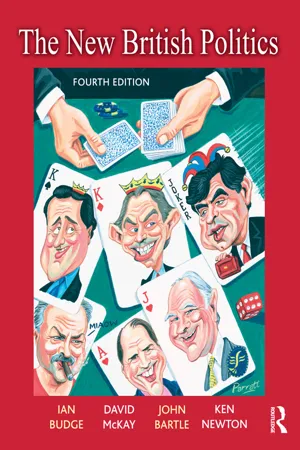 eBook - ePub
- Ian Budge, David Mckay, Kenneth Newton, John Bartle(Authors)
- 2013(Publication Date)
- Routledge(Publisher)
Talking Politics, 6 (3), 1994, p. 141Cabinet does not make all the decisions but it does make all the major ones, and it sets the broad framework within which more detailed policies are initiated and developed.M. Burch, ‘Prime minister and cabinet: an executive in transition’, in R. Pyper and L. Robins (eds), Governing the UK in the 1990s, London: Macmillan, 1995, p. 103The prime minister is the leading figure in the Cabinet whose voice carries most weight. But he is not the all-powerful individual which many have recently claimed him to be. His office has great potentialities, but the use made of them depends on many variables – the personality, the temperament, and the ability of the prime minister, what he wants to achieve and the methods he uses. It depends also on his colleagues, their personalities, temperaments and abilities, what they want to do and their methods.G. W. Jones, ‘The prime minister’s power’, in A. King (ed.), The British Prime Minister, London: Macmillan, 2nd edn, 1985, p. 216Centralisation of power in the hands of one person has gone too far and amounts to a system of personal rule in the very heart of our parliamentary democracy.Tony Benn, ‘The case for a constitutional premiership’, in A. King (ed.), The British Prime Minister, London: Macmillan, 2nd edn, 1985, p. 22The prime minister leads, guides and supports his team, but relies upon their energies and expertise, just as they in turn rely upon his leadership… The relationship is subtle and variable, but essentially it is one of mutual reliance. A strong prime minister needs strong ministers.S. James, British Cabinet Government eBook - ePub
- Ian Budge, David Mckay, Ian Budge, David McKay(Authors)
- 2014(Publication Date)
- Routledge(Publisher)
Thus, out of political necessity, was born the ‘principle of collegiality’, one of the principles that informs British constitutional practice to this day. The principle had, and has, three linked components. The first was that the ‘best’, the most authoritative, decisions in British government must be collective decisions – decisions of the whole Cabinet, not just of one member of it or of any group of members. The second was that, if the best decisions were to be collective decisions, then the collective’s members had the right to be consulted about the most important of them and to participate in the taking of them. The third was that, collective decisions having been taken, all the members of the Cabinet and the government had the duty to defend them publicly. Political strength lies in unity. The best way of achieving unity, and of increasing the chances that it could be publicly maintained, was collective deliberation. British government was not to be a one-man band; it was to be like an orchestra.This collegial mode of operation, the product of eighteenth- and nineteenth-century political circumstances, is still the dominant norm in the British constitution today. The Prime Minister still has few decisions that (s)he can take alone. The best decisions are still Cabinet decisions; indeed a decision that does not have the Cabinet’s sanction behind it is, in a strict sense, not a decision of the government at all.Moreover, institutions have grown up to reinforce the Cabinet’s collegiality and special constitutional status. The country’s principal civil servant is the Cabinet Secretary. The government’s principal co-ordinating mechanism is the Cabinet Office (not the Prime Minister’s office). The most authoritative record of the government’s decisions is the Cabinet Minutes. Not all government business, even in the upper echelons of Downing Street and Whitehall, is Cabinet business, of course. For reasons of convenience, speed, secrecy and political expediency, much high-level business is transacted by small groups of ministers (some formally constituted as Cabinet committees, some not); by groups of civil servants and ministers meeting together; and by means of ministerial correspondence. But the principal focus of governmental decision-making is still, in the 1990s as it was in the 1790s, the Cabinet.The principle of collegiality also finds expression in the language of Downing Street and Whitehall. Members of a collegial body are, in a literal sense, ‘colleagues’, and that is the word that British Cabinet ministers use in referring to one another. The use of the word ‘colleagues’ implies that Cabinet ministers are associated together in a common political enterprise. It also implies a degree of equality: colleagues are people who work together; they are not people who work for one another. Ministers correspondingly refer to the Cabinet and to the government as a whole as ‘we’. The doctrine that imposes a vow of silence on dissenting Cabinet minsters (unless they care to resign) is the doctrine of ‘collective eBook - PDF
- Roger Masterman, Colin Murray(Authors)
- 2022(Publication Date)
- Cambridge University Press(Publisher)
66. 88 See HM Government, The Cabinet Manual: A Guide to Laws, Conventions and Rules on the Operation of Government (Cabinet Office, 2011) p. 4. 89 See P. Cowley and D. Kavanagh, The British General Election of 2015 (Palgrave Macmillan, 2016) pp. 48–50. 90 HC Deb., vol. 933, col. 552 (16 June 1977). See V. Bogdanor, Beyond Brexit: Towards a British Constitution (Tauris, 2019) p. 126. 339 The Composition and Role of the Modern Executive ministers. 91 A government’s credibility can be threatened if ministers undertake ‘solo runs’. In the summer of 2017 Priti Patel, then International Development Secretary, held multiple meetings with Israeli politicians and officials outside standard government channels. After the story broke, Patel publicly apologised; being part of a cabinet team requires that ministers’ private interests aren’t seen to conflict with government policy and that officials are present in overseas meetings to ensure that no dealings conflict with government policy. 92 When revelations of more undisclosed meetings emerged, she was obliged to resign. Policy disagreements are often laid bare in the revelations of departing ministers in their resignation speeches to Parliament. Prior to the invasion of Iraq in 2003, Parliament was convulsed over the Government’s proposal to involve UK military forces. Robin Cook resigned from his ministerial post on the basis that he was unable to support the govern- ment’s foreign policy: It has been a favourite theme of commentators that this House no longer occupies a central role in British politics. Nothing could better demonstrate that they are wrong than for this House to stop the commitment of troops in a war that has neither international agreement nor domestic support. I intend to join those tomorrow night who will vote against military action now. It is for that reason, and for that reason alone, and with a heavy heart, that I resign from the government. eBook - PDF
The Constitutional Systems of the Commonwealth Caribbean
A Contextual Analysis
- Derek O'Brien(Author)
- 2014(Publication Date)
- Hart Publishing(Publisher)
4 The Executive Introduction – The Prime Minister and the Cabinet – The Public Service – Conclusion PART I: INTRODUCTION T HE CABINET SYSTEM of government, which provides for the government to be drawn from and accountable to the legislature, was introduced into the Commonwealth Caribbean somewhat belatedly by the Colonial Office in the years following the Second World War, as the apparatus of ‘Crown Colony rule’ was gradually dismantled and the region prepared for independence. Unsurprisingly, having fought so long to attain it, this was the system favoured by the region’s political leaders for their newly independent countries and was, accordingly, enshrined in all the Independence Constitutions. Each thus incorporated, either expressly or by implica-tion, the unwritten conventions that underpinned the operation of the Cabinet system of government as it had been evolving in Britain since the mid-nineteenth century. Under the Cabinet system executive authority is vested in the head of state, while executive power is vested in the Cabinet, comprising the Prime Minister and such other ministers from among the members of the legislature as the Prime Minister selects. The Cabinet is the principal instrument of policy and it is the Cabinet that is, collectively , charged with the general direction and control of government: deciding issues of policy, both domestic and foreign, and how public money should and should not be spent. Since independence, only one country in the region has departed from this template and that is Guyana, which in 1980 abandoned the tra-ditional Cabinet system in favour of an executive presidency, though it has more recently reverted to a semi-presidential system of government. 102 The Executive In this chapter I will begin by outlining the constitutional framework within which Cabinet government functions for all countries in the region, with the exception of Guyana, which I will deal with separately. eBook - ePub
- Mark Garnett, Simon Mabon, Robert Smith(Authors)
- 2017(Publication Date)
- Routledge(Publisher)
Other political scientists reach less apocalyptic conclusions on the basis of alternative explanatory models of British government. ‘Multi-level governance’, for example, takes note of transnational institutions, such as the EU, and (in the British case) the introduction of devolved institutions in Scotland, Wales and Northern Ireland since 1997. These developments have an obvious effect on the relevance of the traditional Westminster model. However, to date they have had a relatively limited effect on the making of foreign policy. Thus foreign and defence policy were among the ‘reserved powers’ which the British government explicitly retained when it embarked on the process of devolution after 1997. As for the EU, its policy-making competence was limited in scope when the UK joined what was then the European Economic Community (EEC) in 1973. While European legislation was a crucial concern for the Ministry of Agriculture, for example, most other ministers could concentrate on the domestic aspects of their work. Indeed, in the early years UK membership promised to bolster, rather than weaken, the institutional clout of the FCO within Whitehall. It played a very influential role, not least by providing Britain’s Permanent Representatives to the EEC. The foreign ministers of member states have also exercised an important coordinating role in what is now the Council of the European Union (formerly the Council of Ministers) through the General Affairs and External Relations Council, which since the 2009 Lisbon Treaty has been divided into the General Affairs and Foreign Affairs Councils.However, subsequent developments within what is now the EU have added plausibility to another explanatory framework for decision-making in British government: the ‘differentiated polity model’. From this perspective, government in Britain (and elsewhere) can no longer be a matter of ‘command and control’ from specific institutional locations; rather, decisions can only be made and implemented through a process of negotiation. The old understanding of a nation state is no longer viable: decision-makers have no alternative but to work with a variety of non-state institutions and to collaborate with other actors within their own formal government structures, since decision-making has become subject to overlapping areas of policy responsibility.Even if the EU has limited authority in foreign and defence policy, it provides numerous venues which encourage a range of government departments ostensibly concerned with ‘domestic’ policy to develop perspectives formerly associated with diplomatic activity. The Council of the European Union now covers a wide range of subjects, including the Environment; Justice and Home Affairs; Employment, Social Policy, Health and Consumer Affairs; Transport, Telecommunications and Energy; and Education, Youth, Culture and Sport. Through frequent attendance at such meetings the relevant British ministers and officials have inevitably become familiar with the workings of the EU; so although the FCO’s expertise in this respect might still surpass that of other UK departments, it can no longer be said to be ‘unrivalled’. Ministers and officials from various departments enjoy opportunities to acquire knowledge and personal connections which would once have been monopolised by the FCO. If Britain had joined the European single currency, the ubiquitous Treasury would almost certainly have become the leading departmental player in the EU; as it is, while the Chancellor of the Exchequer attends meetings of the Economic and Financial Affairs Council (Ecofin), he or she is excluded from the core eurozone group of ministers. No longer available |Learn more
- (Author)
- 2014(Publication Date)
- Learning Press(Publisher)
________________________ WORLD TECHNOLOGIES ________________________ Chapter- 3 Prime Minister and the Cabinet of the United Kingdom Prime Minister of the U.K. Prime Minister of the United Kingdom of Great Britain and Northern Ireland Arms of Her Majesty's Government ________________________ WORLD TECHNOLOGIES ________________________ Incumbent David Cameron since 11 May 2010 Style The Right Honourable Residence 10 Downing Street London, England, United Kingdom App ointer Her Majesty Queen Elizabeth II of the United Kingdom of Great Britain and Northern Ireland Term length At Her Majesty's pleasure Inaugural holder Sir Robert Walpole (Regarded as the First Prime Minister) Formation 4 April 1721 ________________________ WORLD TECHNOLOGIES ________________________ The Prime Minister of the United Kingdom of Great Britain and Northern Ireland is the political leader of the United Kingdom and the Head of Her Majesty's Government. The Prime Minister and Cabinet (consisting of all the most senior ministers, who are government department heads) are collectively accountable for their policies and actions to the Sovereign, to Parliament, to their political party, and ultimately to the electorate. The current Prime Minister, David Cameron, was appointed on 11 May 2010. Authority As the Head of Her Majesty's Government, the modern Prime Minister is the highest political authority in the United Kingdom: he leads a major political party, generally commands a majority in the House of Commons (the lower house of the Legislature), and is the leader of the Cabinet (the Executive). As such, the incumbent wields both legi-slative and executive powers. In the House of Commons, the Prime Minister guides the law-making process with the goal of enacting the legislative agenda of the political party he leads.
Index pages curate the most relevant extracts from our library of academic textbooks. They’ve been created using an in-house natural language model (NLM), each adding context and meaning to key research topics.

