Politics & International Relations

New World Order
The term "New World Order" refers to a geopolitical concept that emerged after the end of the Cold War, suggesting a new era of global cooperation and governance. It encompasses ideas of international relations, diplomacy, and the balance of power among nations, often associated with efforts to address global challenges and promote peace and stability.
Written by Perlego with AI-assistance
Related key terms
1 of 5

8 Key excerpts on "New World Order"
 eBook - ePub
- Mike Featherstone, Scott Lash, Roland Robertson, Mike Featherstone, Scott Lash, Roland Robertson(Authors)
- 1995(Publication Date)
- SAGE Publications Ltd(Publisher)
5
New World Order OR NEO-WORLD ORDERS: POWER, POLITICS AND IDEOLOGY IN INFORMATIONALIZING GLOCALITIES
Timothy W. LukeOn glocality
The celebrated New World Order of sovereign nation-states, jointly collaborating within the framework of the United Nations to pursue truth, justice and the American way, did not last much longer than the victory parades after the Gulf War. Something else has begun to fill the void left after the end of the Cold War, and it does not look like the international harmonization of interests promised by President Bush after the UN coalition’s victory over Iraq. This chapter deals with tendencies, suggesting that at least one kind of post-national and transnational order is gradually evolving out of the informational modes of production emerging above and below the realms of the modern nation-state. Characterizing these changes is difficult, but this study provides a start towards interpretation. Arguably, the workings of power, politics and ideology in these new transnational flows of capital, people, commodities, information and culture are generating a cybersphere/telesphere that is coextensive with, but different from, first nature in the natural biosphere and second nature in the industrial technosphere. This new ‘third nature’ of cyberspatial/televisual/informational glocality fuses the local and the global in new everyday life-worlds. And, it is the hyperreal estate of these glocal territories which now anchors many social struggles, political organizations, economic competitions and cultural creolizations in most regions of the existing capitalist world system. eBook - PDF
- Yunling Zhang(Author)
- 2010(Publication Date)
- World Scientific(Publisher)
Chapter 12 We Need a New World Order 1 Introduction We are living in a new and changing world. A “new” world means one that is different from the existing one before 1989, the collapse of the communist system in Eastern Europe and the disintegration of the Soviet Union. A “changing world”, means that the structure of the world order is still undergoing restructuring. Following the pro-pounding concept of a New World Order (NWO) by President George H. W. Bush in September, 1990, many ideas, theories and sugges-tions relating to NWO have been put forward. However, both the concept and the reality of the NWO are not at all clear. I think we have at least three questions relating to the NWO that need to be analyzed and answered: (1) What does NWO really mean? (2) What is our real world? and (3) How can we establish a new order in a disordered world? 1. Different Concepts of the NWO President George H. W. Bush first set out the concept of the NWO when he addressed the joint session of the US Congress on 1 This article was written for a conference organized by the United Nations Uni-versity in 1999. 191 192 Zhang Yunling September 11, 1990, by claiming “a New World Order may emerge: an era free from the threat of terror, stronger in the pursuit of justice, and more secure in the quest for peace”. 2 He gave this speech against the background of the Gulf War which the US won against Saddam Hussein. According to Charles Krauthammer, the Gulf War marked the beginning of a Pax Americana in which the world would acqui-esce to a benign American hegemony. 3 The US achieved hegemony through its victory in World War II. But its uni-polar hegemony was soon challenged by the Soviet Union, and the world was divided into two blocs in confrontation with the other. Even within the West, fol-lowing the recovery of Western Europe and the emergence of Japan as an economic power, both the position and the influence of the US were largely eroded. eBook - PDF
- Georg Sørensen(Author)
- 2016(Publication Date)
- Red Globe Press(Publisher)
In the present study it is recognized that the economic basis of world order and the tensions connected with it make up important elements for the analysis, but they must be seen in their interplay with other important material elements, such as politico-military power, and non-material elements, such as ideas and values. Robert Cox ( 1996 ; 2002 ; Schouten 2009 ) represents this broader approach, inspired by Giambattista Vico and Antonio Gramsci. The key message from Cox as regards the ‘world order’ dimension of analysis is that the balance of world power is shifting (Schouten 16 Rethinking the New World Order 2009 ); the global dominance by the United States will be replaced by something else. What will emerge instead is not yet fully clear; it might be a cooperative post-hegemonic order where states agree on peaceful cooperation for mutual benefit; or it might be a world marked by the open rivalry of conflicting power centres. As indicated, my analysis agrees with Cox in that a study of world order must include the economic dimension and its relationship to politico-military, institutional and value dimensions. Cox also points to the need to study international relations as well as domestic devel-opments in major groups of states, a view I have supported here. Yet it will also become clear that the present study gives more emphasis to issues of violent conflict, of war and peace, in the consideration of international and domestic dimensions. As regards world order in the narrow sense, Cox’s analysis, as many others, foresees a decline of the United States and the emer-gence of some form of post-hegemonic order. The Making of Global Capitalism by Leo Panitch and Sam Gindin (2013), another signifi-cant Marxist contribution, disputes that point. They argue that the making of global capitalism cannot be taken on by market forces on their own. eBook - PDF
Whose World Order?
Russia's Perception of American Ideas after the Cold War
- Andrei P. Tsygankov(Author)
- 2023(Publication Date)
- University of Notre Dame Press(Publisher)
c h a p t e r 2 World Order Ideas, Perception, and Responsibility 1. Ideas of World Order 1.1. Ideational Perspective of World Order In the 1970s, the prominent scholar Hedley Bull defined world order to mean “those patterns or dispositions of human activity that sustain the elementary or primary goals of social life among mankind as a whole.” 1 Since then scholars have emphasized the critical roles played by the military capabilities of the most powerful states, economic transnationalization, cultural identity, and social technology in the emergence of various world orders. 2 While these economic, political, and cultural factors certainly con- tribute greatly to shaping “patterns or dispositions” of global human activity, the role of ideas in establishing regularity in worldwide social life should not be underestimated. Ideas, understood as normative beliefs and worldviews held by individuals, groups, and societies, are crucial in the functioning and maintenance of world orders. For ex- ample, imperialism as a politically and socially institutionalized idea has been defining the shape of the world since at least the seventeenth cen- tury, whereas socialist and liberal ideas were behind many institutional 19 developments in the nineteenth and twentieth centuries. Recent con- structivist scholarship has established the proposition that social life is, in fact, “ideas all the way down” until “you get to biology and natural resources” 3 and that world order can be understood as practices of an ideological or discursive nature. 4 In the early 1980s, John Gerard Ruggie pioneered the claim that ideas provide purpose and imbue meaning to world orders, without which world orders cannot exist and successfully function. Responding to Kenneth Waltz’s familiar formulation, 5 Ruggie revealed that the neorealist view of world polity had no transformational logic, only a reproductive one, precisely because that view had no concept of a so- cial context or a social purpose.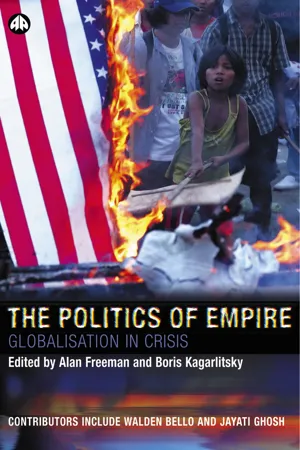 eBook - PDF
The Politics of Empire
Globalisation in Crisis
- Alan Freeman, Boris Kagarlitsky(Authors)
- 2004(Publication Date)
- Pluto Press(Publisher)
The recourse, after September 11, to Article 5 of the North Atlantic Treaty, the article that stipulates that any attack on one of the allies will be considered as an 134 The Politics of Empire attack on all, has confirmed the fact that NATO has been transformed so as to be functional in the construction of the NWO. One final point should be carefully noted. With the exception of the World Trade Organisation, itself the inheritor to the loose structure around GATT, all these international organisations are the products of the balance of forces towards and after the end of the Second World War. In that sense, there is a certain continuity between the NWO and the period of the Cold War that preceded it. These organisations are certainly much more in the forefront of world politics today than before and, more importantly, are being gradually transformed so as to satisfy new needs and requirements. But this does not obliterate the fact that they are products of an earlier period, and in that sense the question is posed whether any reform will conclusively render them adequate to the needs of the NWO. There are other, newer aspects of NWO, foremost among which are the denigration of national sovereignty, the revival of colonialism and the widening network of US bases around the world. These will be taken up in subsequent sections. However, before going into these, we first have to look at another dynamic behind the NWO. Repartition of the world The NWO is thus the political superstructure of the new system globalism is trying to establish. However, this political superstructure is being constructed within a definite historical context. And that context is determined to its very core by a world-historical development: the demise of the bureaucratic workers’ states. Hence, the NWO is also an attempt to realign international relations of power so as to fill in the vacuum created by the dissolution of the Soviet Union. eBook - PDF
- G. John Ikenberry(Author)
- 2014(Publication Date)
- Cambridge University Press(Publisher)
Introduction: power, order, and change in world politics G. John Ikenberry Introduction The global system is in the midst of a great transformation. The distribution of power is shifting. Great powers are rising and declining. For almost a century, the United States dominated world politics. But today, China and other rising non-Western states, such as India and Brazil, are growing in wealth, power, influence, and ambition. The old order – led by the United States and its allies – is still a commanding presence in the global system. But the power once concentrated in the hands of the United States is diffusing outward and, as a result, new struggles are emerging over global rules and institutions. In the midst of these changes, scholars have been asking basic questions about the logic and character of contemporary international order. How profound is the change that is underway in global order? If the United States is losing its position of preeminence, will the order that it created weaken and break apart, giving way to a new type of global order? Or will non-Western rising states ultimately become stakeholders in the existing order? Do rising states want great authority and privileges in the existing inter- national order or do they want to use their growing power to reorganize the basic principles and norms of the system? The struggles underway today over international order are, of course, not new. The rise and decline of great powers and convulsive shifts in international order have played out many times over the centuries. In past eras, states have risen up, fought wars, and built international order. Spain, France, Great Britain, Germany – each of these states grew in power in a past century and made a bid to dominate Europe and the wider world. In turn, each declined or was defeated in war, triggering a renewal of geopolitical struggle over leadership and the organizing rules and arrangements of global order. eBook - PDF
Revisiting Regionalism and the Contemporary World Order
Perspectives from the BRICS and beyond
- Élise Féron, Jyrki Käkönen, Gabriel Rached, Élise Féron, Jyrki Käkönen, Gabriel Rached(Authors)
- 2019(Publication Date)
- Verlag Barbara Budrich(Publisher)
Like the order, the theory of international relations, particularly after World War II, became almost identi-cal with studying the foreign policy of the United States (Wæver 1999). By defining the “science” of international politics, the Western academic commu-nity could “determine what can be said, how it can be said and whether or not what is said constitutes a pertinent or important contribution to knowledge” (Behera 2010). During the Cold War, the liberal international order existed mainly within the United States and Western Europe as many other parts of the world, in-cluding India and most of the Third World, remained effectively outside of it. The order was also challenged, in both theory and in practice, by communism in its many different variations. The communist states, despite their differ-ences, held a vision of a world communist order in which the states would eventually wither away and in which all humanity would work together in peace. After the collapse of communism in the late 1980s, it seemed that the lib-eral order with its definition of politics had defeated its last ideological and institutional challengers. The order, also known as the Washington Consensus, could now spread freely almost everywhere, and some liberal thinkers such as John Ikenberry even proposed that the United States might have finally found the correct recipe for a universally valid, sustainable, and stable order (see Ikenberry 2001). The triumph of the West was declared too early, however. Today, the West is increasingly unable to project its power beyond its core areas and is similarly 257 facing challenges in disseminating the Western understanding of international politics and its central values. The rising powers are, on the contrary, de-West-ernizing their conceptions of politics by rediscovering their deep cultural and intellectual roots, from which they are drawing inspiration (Käkönen 2017: 24– 25). eBook - PDF
Wars and Peace
The Future Americans Envisioned, 1861-1991
- D. Mayers(Author)
- 1998(Publication Date)
- Palgrave Macmillan(Publisher)
A de facto system of governance by transna- tional capital—institutionalized in the IMF, World Bank, G-7, GATT— constitutes a multilateralism not envisaged by the UN General Assembly or admitted by the tricksters and cognoscenti in Washington. The task of de- cent people in the north and south, then, is to combine their efforts to un- mask illegitimate authority and to fight, by whatever means necessary, for true freedom and justice. Until then, any order celebrated by Washington and lauding morality and economic fairness must be seen for what it is: a grand illusion to fool people into thinking that injustice is justice, cruelty is mercy, the jungle is civilization. Chomsky must necessarily agree with this judgment of Libya’s Muammer El-Qadhafi: The only visible difference be- tween the old and the new order is that the latter has even less inhibition in pursuing lustful self-aggrandizement and evil. 27 * * * * * What has the New World Order added up to? As an idea, it is meager. It lacks insight comparable to Lincoln’s on the needs of posthostilities healing. The moral intensity of Wilson’s internationalist reforms is also absent. Equally wanting is FDR’s finesse at marrying higher principle to the realities of force. Clarity of purpose, as in Kissinger’s balancing powers against powers to shore up stability, is also missing. Bland and devoid of conviction, the new-world- order idea blossomed briefly. It enjoys ever-less currency in official and pop- ular usage. Bush might reasonably be saddled with the blame. He was miscast in the role of imaginative leader, let alone designer of any international order. In- tellectual boldness was not his forte. Solidity, reliability, and predictability (the Somalia intervention aside) were his strengths and those of his cabinet officers. Clinton’s relative indifference to foreign policy has also helped to frustrate lively discussion in the years since Bush.
Index pages curate the most relevant extracts from our library of academic textbooks. They’ve been created using an in-house natural language model (NLM), each adding context and meaning to key research topics.

