Politics & International Relations

The World Bank
The World Bank is an international financial institution that provides loans and grants to the governments of poorer countries for the purpose of pursuing capital projects. It aims to reduce poverty by providing financial and technical assistance for development projects. The World Bank also conducts research and analysis to help governments formulate policies for sustainable development.
Written by Perlego with AI-assistance
Related key terms
1 of 5


11 Key excerpts on "The World Bank"
 eBook - ePub
The World Bank
From Reconstruction to Development to Equity
- Katherine Marshall(Author)
- 2008(Publication Date)
- Routledge(Publisher)
As the meaning of ‘‘development’’ deepened from a somewhat shadowy and poorly elaborated notion of progress to a complex and heavily debated set of approaches today, The World Bank itself took on a far more central role. The Bank also began to focus more intensely on the poorest countries, and the poorest communities within those countries—with fighting poverty increasingly seen as its overarching mission.Today The World Bank is widely regarded as a leading voice supporting the economic and social development of poor nations. The Bank’s antipoverty work has spurred it to grapple with the complex notion of equity, which includes human welfare, prosperity, and quality of life as well as income distribution and human rights (though this is rarely mentioned frontally, the issues that underlie human rights concerns are much in discussion within The World Bank). The contemporary World Bank is thus deeply engaged in all three challenges: reconstruction, development, and equity.The World Bank’s evolution reflects tumultuous historical developments. These include not only the deeply divided ideologies and strategic alliances of the Cold War and the end of colonialism as a major force, but also diverging regional development patterns, tensions around US domination after the Cold War, and the fast-paced and profound social, economic and technology changes of the globalization era. The profound changes in the array of global institutions such as the United Nations (UN) system and private-sector and civil society groups have also vigorously shaped the Bank’s role. Theories about economic and social change, too, have shifted radically during The World Bank’s lifetime and shaped its course—even as the Bank itself has shaped those ideas. And the Bank’s own lived experience in managing and funding thousands of projects in well over 130 countries has given the institution its form today.The intent and creation
1The overall design for the new World Bank played out during debates near the end of World War II and before the creation of the UN, largely within a small circle of financial officials and commentators. The Bretton Woods institutions—as The World Bank and the International Monetary Fund (IMF) are often called because of their joint birth at the July 1944 conference of representatives of 44 countries at the mountain resort in Bretton Woods, New Hampshire—were largely the brainchild of financial leaders in the US government, with the United Kingdom (especially economist John Maynard Keynes) taking an active part in the final discussions. eBook - ePub
The World Bank
New Agendas in a Changing World
- Michelle Miller-Adams(Author)
- 1999(Publication Date)
- Routledge(Publisher)
World Development Report, in particular, has suffered from what one observer called “an enforced reticence on political matters. Generally, anything that might offend politicians of particular countries has been avoided…In effect, each member country has veto power over material referring to it” (Stern 1997:571). As most developing countries have become more open politically this has been less of a problem.The apolitical norm had its origins in the multinational character of The World Bank and the need to obtain support from, and lend to, as broad a range of governments as possible. The onset of the Cold War in the 1950s made this orientation even more pressing. Although Eastern bloc countries (except for Yugoslavia) were not members of The World Bank during the Cold War and thus received no World Bank loans, the Bank’s officially apolitical nature enabled it to lend to Third World countries allied with the Soviet Union, as well as to non-aligned countries.The end of the Cold War brought the entry of formerly communist countries into The World Bank and resolved the decades-long schism between socialist and democratic systems of government in favor of the latter. With the geopolitical reins loosened, the Bank at the end of the 1980s was able for the first time to acknowledge explicitly the importance of political factors in economic development, including the benefits of representative government. Yet, despite some tentative experimentation in the direction of improving borrower countries’ governance, the Bank continues to maintain that politics lies outside its mandate and that its apolitical orientation remains central to its effectiveness. It appears that the apolitical philosophy, which emerged at a time when it filled an important need, has become sufficiently institutionalized to persist even though that time has passed.The technical norm
The World Bank’s second key institutional norm is that development can be achieved through technical means. Throughout its history, the Bank has relied on well-honed techniques that, whenever possible, involve quantitative measurement and can be applied in a wide range of countries. In its early days as a lender for infrastructure projects, Bank staff consisted largely of specialists with expertise in a given technical area, such as agronomy, engineering, or hydrology. The influence of economists grew in the 1960s and 1970s, and when project lending was supplemented by policy adjustment lending in the 1980s financial experts joined the ranks. Even now, as the Bank seeks staff with a different “skills mix” to carry out some of its newer activities, these skills are defined exclusively in technical terms. Despite the evolution of the Bank in new directions, the “mastery of technical knowledge based on objective and rational analysis” (Kardam 1990:117) remains the order of the day. eBook - PDF
Global Pension Policies.
Programs, frames and paradigms of the World Bank and the International Labour Organization.
- Remi Maier-Rigaud(Author)
- 2009(Publication Date)
- Duncker & Humblot(Publisher)
Another related cri-tique of The World Bank concerns its democracy deficit and secretiveness which have been repeatedly raised by different authors (Udall 1994) and most prominently by the NGO “Association pour une Taxation des Transac-tions financiers pour l’Aide aux Citoyens et citoyennes, ATTAC” (Grefe/ Greffrath/Schumann 2002: 62–66). In sum, the activities of The World Bank instigate controversial debate and, moreover, provoked already in the 1980s an international social counter-movement long before ATTAC was founded in 1998 (Trägerkreis des Internationalen Gegenkongresses der IWF/Welt-bank-Kampagne/Die Grünen im Bundestag 1989). The entrenched divergence in the interpretations and the quibble about the role of The World Bank and its activities are rendered even more com-plicated, if the historic changes of World Bank policy making are taken into account. Throughout the years, The World Bank but also the IMF have “undergone drastic changes in response to changes in the economic realities and the dominant economic thinking” (You 2002: 209, see also Krueger 1998). This is briefly outlined in the following. a) From a financial institution to a knowledge agency aa) Reconstruction and infrastructure projects (1944–1968) The World Bank was created in Bretton Woods (New Hampshire, USA) in 1944 at a conference of 44 countries. The Bretton Woods order was de-signed as a system of fixed exchange rates 117 with the US Dollar as lead currency deemed to stabilize the international economic system. At the same conference the IMF was founded as the second pillar of the new world eco-nomic order. The third pillar of the post-war international economic order and its underlying compromise of an “embedded liberalism” (Ruggie 1998: 72) is the General Agreement on Tariffs and Trade (GATT) which became part of the World Trade Organization (WTO) founded in 1995.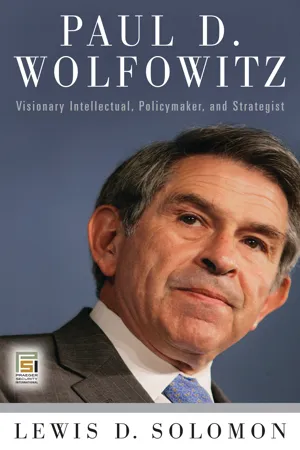 eBook - PDF
Paul D. Wolfowitz
Visionary Intellectual, Policymaker, and Strategist
- Lewis D. Solomon(Author)
- 2007(Publication Date)
- Praeger(Publisher)
23 However, despite Wolfowitz’s attempts to ingratiate himself, the staff’s reception of him continued to be some- what chilly. 24 The World Bank IN A TIME OF TRANSITION During James D. Wolfensohn’s tenure as president in the 1990s, The World Bank began to intervene in recipient nations’ governance matters. Although not encouraging overt regime changes, it started to promote good governance, a civil society, and empowerment as part of the conditions attached to its grants and loans. Gradually, the bank became committed to changing the political institu- tions in the countries where it operates. Although the bank is in the business of lending and giving grants for economic and social development, it has come to try to build nations and reform regimes. The Articles of Agreement of both the IBRD and the IDA require bank offi- cials to remain apolitical. Both charters mandate that the bank officials “shall not interfere in the political affairs of any member; nor shall they be influenced in their decisions by the political character of the member or members concerned. Only economic considerations shall be relevant to their decisions, and these considerations shall be weighed impartially in order to achieve the [unit’s] pur- poses.” 25 Until 1996, the bank did not overtly take political considerations into account in making grants or loans, nor did it make a concerted effort to address corruption in developing nations. Wolfowitz at The World Bank 135 However, such a policy became increasingly counterproductive as the bank’s focus turned to Africa, Asia, and Latin America. In regions subject to frequent regime changes and with its economic goals amounting to “construction” rather than “reconstruction” as was the case in post-World War II Europe, an assess- ment of political culture relies more on a government’s ability to benefit from a loan or grant than on making value judgments about the ideology behind that government.
- Adam McBeth(Author)
- 2009(Publication Date)
- Routledge(Publisher)
There are currently 78 countries that are sufficiently poor to be eligible to borrow from the IDA. 4 Loans provided by the IBRD and the IDA have a grace period before any repayments become due and a longer repayment period than most commercial loans. 5 World Bank Group, Working for a World Free of Poverty ( July 2003) available at , accessed 19 March 2009, p 21. International financial institutions 167 reduction’. 6 To the extent that World Bank programmes succeed in promoting development, provided that such development is targeted towards improving the lives of poor or disadvantaged people, the Bank’s positive contribution to human rights is clear. However, economic development will not necessarily be beneficial for everyone in an affected country or community. Where development entails physical alter- ation of an area, for example to build infrastructure such as a dam, the rights of some local people may be adversely affected despite the same process improving the enjoyment of the human rights of others – perhaps even the majority of the community in question. Similarly, where economic development is achieved through cuts to government spending or an increase in the cost of accessing essential services, the rights of people reliant on those services will potentially be violated, even if the economic reforms lead to greater prosperity for the country as a whole. These dilemmas and the approach required by international human rights law are examined below in the context of specific programmes of The World Bank as well as the IMF. 3. The role of the International Monetary Fund Whereas The World Bank was formed to rebuild the post-war world, particularly Western Europe, through providing medium- and long-term loans, the IMF was intended as an overseer of the international monetary system, ensuring macroeconomic stability. eBook - PDF
- W. Ryrie(Author)
- 1999(Publication Date)
- Palgrave Macmillan(Publisher)
The World Bank is in fact dealing with a social phenomenon which does not stem from concern with Third World problems but is internal to the western demo- cracies ± the hostility of the natural dissenters within the rich societies, motivated by antagonism to established authority and what they see as concentrations of power. For people with an inclination to believe in international conspiracy, the size and financial power of The World Bank is a natural object of hostility. And of course, the Bank has sometimes played into their hands by errors of judgment (such as the Narmada Dam in India, which provoked a major dispute with environ- mental organisations, leading to the Bank's withdrawal from the project in 1993). Besides all this, the Bank has not been good at public relations. It was slow to appreciate the image problem which was developing during the 1980s. For many years the Bank behaved as if it was unnecessary to respond to criticism, assuming that because it was engaged in good work, for the benefit of poor countries, there must be basic public support, 191 The World Bank and IMF which was not to be taken for granted at all. Under Jim Wolfensohn as President, since 1995, the Bank has been handling its public relations considerably better. The ineptitude of the Bank's response to attacks on it was perhaps a pointer to institutional problems. One such char- acteristic is that The World Bank is a surprisingly academic institution. In an organisation dedicated to a practical pur- pose, it is remarkable how intellectual performance seems to be valued almost above all else. A young professional member of staff gains reputation by producing a good report or paper or speaking brilliantly at a meeting, rather as if he was at a University. All this would be fine, if it did not have the effect that lower importance is attached to practical achievements on the ground ± the real work of development. eBook - ePub
Dinosaurs or Dynamos
The United Nations and the World Bank at the Turn of the Century
- Helge Ole Bergesen, Leiv Lunde(Authors)
- 2013(Publication Date)
- Routledge(Publisher)
Chapter 3 The World Bank from Past to PresentINTRODUCTIONEven if in a far stronger position than the UN, The World Bank is also facing a decisive crossroads. Critics from different quarters question its very existence. Environmental and anti-poverty advocacy groups have claimed that 50 years are enough, and want the Bank closed down. Jesse Helms, chairman of the US Senate’s Foreign Relations Committee, although for different reasons, is not far from joining the bandwagon. After numbers of assessments citing decreasing loan performance, the heat is on its current president, James Wolfensohn, to streamline and restructure the organization. Private capital threatens to crowd out The World Bank and the IFC, its private sector affiliate, from their main markets in Asia and Latin America. To many, the increasing flow of private finance to these regions serves to question what remains for the Bank to do, as it may soon find itself competing with rather than facilitating private investment. Better then to focus on environmental protection and poverty reduction, where markets fail to get things right. But is The World Bank, which still is, basically, a bank, the right place to start when the task in question is poverty reduction on a global scale?In order to understand the potential and limitations of The World Bank we first have to look at how it has coped with the challenges of the past. In particular, we will try to come to grips with how its governing structure and organizational design have influenced its problem-solving capacity. Given our main research question, a logical point of analysis is how the Bank has coped with the dilemma between the demand to produce tangible results on one hand, and the demand for participation, openness and equality on the other. An important dimension of success in these regards is adaptation to rapidly changing external demands, which have challenged the Bank to continuously move into new problem areas. As we will see below, many of these bear little resemblance to the functions for which the Bank was created.
- Jonathan E. Sanford(Author)
- 2019(Publication Date)
- Routledge(Publisher)
This chapter makes two basic points. First, its demonstrates that, in spite of their supposedly neutral economic characteristics, the multilateral development banks are political institutions whose activities are directly relevant to U.S. foreign policy. Second, it shows that U.S. policy toward the banks has been a mix of humanitarian and developmental goals, economic objectives, and national security or diplomatic concerns. The United States has generally been willing to concede short-run problems in order to protect its humanitarian, economic, or security priorities in the MDB program. On occasion, however, as the chapter documents, it has also been willing to use the U.S. position in the banks to achieve more immediate policy goals in particular situations. The particular weight which U.S. actors give to different policy goals in this area may depend as much on their specific roles or responsibilities in the process as on the intrinsic importance of the various objectives. Throughout the administrations of several U.S. Presidents in recent decades, the basic thrust of U.S. policy has remained relatively consistent, as U.S. officials have sought to balance multiple U.S. goals through participation in the banks.The Banks as Political Institutions
Early proponents of multilateral aid thought the banks would help reduce the political overtones associated with foreign aid and insulate development assistance from the cut and thrust of international diplomacy. To some extent, their expectations have been realized. The multilateral development agencies do moderate some of the overt clashes between governments and they reduce some of the overt competition among donor countries. The banks were designed to serve as technical organizations assessing their member’s needs and lending for projects that promote sound, productive development, and their charters prohibit them from considering the political character of their borrower countries.It would be wrong, however, for one to describe the banks as institutions detached “from the sphere of international or domestic politics” or to say that political and ideological factors have no role in their operations.1 /Various authors, in fact, have claimed the opposite. Baldwin shows how bank loans affect the distribution of influence among countries and affect domestic priorities in borrower states.2 /Hayter shows how the banks enforce Western economic principles when they use their lending power as leverage to impose performance and policy standards on their borrower lands.3 /Kakonen shows how bank lending programs can benefit countries and sponsor development strategies that are compatible with the economic interests of their large donor countries.4 /Oppenheim describes how shifting patterns of international economics can alter the relative influence of oil-exporting and industrial countries within the banks themselves.5 /Hurni shows how changing emphases in development thought can influence MDB lending policy and shape development priorities in borrower nations.6 /Krause and Nye show that international agencies can be arenas for policy, instruments of policy, or actors with their own policies on international economic issues. 7 eBook - PDF
Inside the World Bank
Exploding the Myth of the Monolithic Bank
- Y. Xu(Author)
- 2009(Publication Date)
- Palgrave Macmillan(Publisher)
The World Bank’s World 13 On the other hand, as in all organizations, domestic or international, there are expectations driven by organizational imperatives. The Bank has its corporate agenda, needs returns and is required to operate with some economic considerations in mind. It also expects that it will con- tribute to—and be well regarded by—the epistemic communities out- side. The question for staff is how important those economic factors should be, and whether they should trump good but less economic development prospects. The expertise that lies at the basis of the Bank’s operations is important in the way that the Bank understands and defines problems. As the range of professions expands, as environmentalists and lawyers, accountants and sociologists join the staff, so they bring more contested interpretations of how world development should be defined. Our Approach This is a project about the Bank. “Who is The World Bank?” a former senior staff member asked rhetorically, “its staff is and needs to be in many respects its strongest asset” (Marshall 2008:80). The highly qual- ified, multiple skilled, and extensively experienced staff give the Bank its standing in the international community. We seek to ask how the Bank staff exercise their influence. We ask how the structures of power provide opportunity, how organizational arrangements create expecta- tions and incentives, how modes of thinking and expertise shape their behavior. How they are organized, how they see their responsibilities, how they work with their superiors and client countries, all make the Bank different. We need to go beyond the insights PA and bureaucratic analyses have offered. To regard the Bank as a single entity takes all the politics out of the organization and sees it as a black box, an approach long since discred- ited in the study of domestic politics. eBook - PDF
- Karen A. Mingst(Author)
- 2014(Publication Date)
- The University Press of Kentucky(Publisher)
Under the leadership of Robert McNamara, The World Bank achieved this autonomy, extricating itself from the direct control of the United States government (Ascher, 1990). Compared to the other banks, The World Bank has acted the most autonomously. With a professional staff of over 3,000 individuals, The World Bank has developed procedures and ex-pertise that separate it from member states. Decisions of World Bank staff and management on both project specifics and policy advice have been increasingly taken with little input from the executive directors (Ascher, 1983:421). Despite the directors' official oversight responsibility, the board chooses to veto proj-ects under only the most extraordinary circumstances. They discuss the more general (and admittedly most important is-sues), while a professional, quasi-autonomous staff implements the decisions. None of the other banks has achieved such organizational autonomy. The executive directors representing state members play a much more critical role. As these organizations become more experienced and are able to attract the highly profession-ally qualified staff, there is apt to be more interorganizational competition. The Asian Development Bank has felt keenly competition from The World Bank in terms of personnel (high turnover [17% at end of 1970s] attributed in part to personnel joining The World Bank) and projects (where World Bank fi- 174 POLITICS & THE AFRICAN DEVELOPMENT BANK nanced the big projects; small business and South Pacific being the preserve of the Asian Bank) (Wilson, 1987:78, 108-9, 275). Interorganizational politics is relevant for the relationship between The World Bank and each of the regional development institutions. Each of these pair of banks is involved in cof inanc-ing of projects that bring them into direct contact with each other. With increased cofinancing, two politically sensitive is-sues have been placed on the agenda of each: cross-condition-ality and debt rescheduling. eBook - PDF
- Jost Delbrück, Rainer Hofmann, Andreas Zimmermann, Jost Delbrück, Rainer Hofmann, Andreas Zimmermann(Authors)
- 2013(Publication Date)
- Duncker & Humblot(Publisher)
The World Bank's role as an executing agency of the U N D P in the preinvestment phase of a project has in many cases led to the identification and preparation of bankable World Bank projects. This cooperation has, therefore, proven beneficial to all participants. Finally, the Bank provides technical assistance through an additional channel, its Economic Development Institute. That assistance primarily takes the form of training courses in economic development for high officials of the Bank's developing member countries. 124 121 Mason / Asher (note 61), 299. An important aspect of this country-related technical assistance are the sector-studies. 122 Op. cit., 295 seq. 123 See, Francis Lethem / Vincent Riley, The World Bank's Technical Assistance, in: Fi-nance and Development (Dec. 1982), 16—21 (16). 124 See, IBRD / IDA AR 1983, 44. 36 H. G. Petersmann 4. T h e W o r l d B a n k ' s R o l e as a n A i d -C ο ο r d i η a t i η g A g e n c y a) The Emergence of Development Diplomacy Since the early 1960s, the proliferation of bilateral and multilateral donor agencies for financial or technical assistance increasingly called for the estab-lishment of some coordination procedures. That need was expressly voiced by the Pearson Commission in 1969. On regional levels, various coordinating mechanisms had already existed for some time. The OECD Development Assistance Committee (DAC) regularly reviews the OECD donor states' bilateral development assistance policies, and the so-called Paris Club (another Western donors' forum) coordinates and facilitates the rescheduling of outstanding official loans to developing countries. In the Western Hemisphere, the Organization of American States (OAS) has created a regional system for reviewing a country's economic performance and requirements for external assistance through its Inter-American Committee on the Alliance for Progress (CIAP).
Index pages curate the most relevant extracts from our library of academic textbooks. They’ve been created using an in-house natural language model (NLM), each adding context and meaning to key research topics.
