Politics & International Relations

US Presidential Election
The US Presidential Election is a quadrennial event where American citizens vote for their next president. Candidates from major political parties campaign across the country, addressing key issues and debating their policies. The election culminates in a nationwide vote, with the winner becoming the next President of the United States.
Written by Perlego with AI-assistance
Related key terms
1 of 5

4 Key excerpts on "US Presidential Election"
 eBook - ePub
- Alan Grant(Author)
- 2019(Publication Date)
- Routledge(Publisher)
7 Elections and VotingNo nation in the world has as many elections as the United States. In a Presidential election year, American voters across the country select a total of over half a million officials in addition to the President, the members of the House of Representatives and a third of the Senate. Altogether there are over a million elected positions, the vast majority of which are at the local level for school boards, county boards of supervisors, sheriffs, and so on. As well as electing politicians to national, state and local offices Americans in many states are asked to vote on a wide range of issues in state and local referenda when propositions are submitted to the electorate for approval in accord with state constitutions. Before these general elections there are also primary elections which in many states determine who will represent the parties in the November contests.Elections are not only a method of deciding who shall govern and hold office but are also important in the process of political communication. Candidates and parties have to attempt to identify the interests of the people in their campaigns; not only do they speak about what they intend to do if elected, they are also obliged to listen to the views of the voters. Politicians who seek election or re-election need to be responsive to public opinion and American legislators are well aware of the ‘folks back home’. Elections allow ordinary citizens to participate in politics in a number of ways besides voting. If they are sufficiently interested they can work on behalf of a candidate or contribute money to his campaign funds, and the right to take part in these ways reinforces the feelings of Americans that they live in a liberal democracy. eBook - PDF
Beyond the Electoral Connection
A Reassessment of the Role of Voting in Contemporary American Politics
- Kim Ezra Shienbaum(Author)
- 2016(Publication Date)
With the decline of polit-ical parties, it is becoming embarrassingly obvious that the electoral process is effectively divorced from the political process, leaving the act of voting with only vestigial instrumental significance. 110 Ill The Role of Elections in American Democracy However, while many academics are still prepared to claim that elections in the United States do conform to their prescribed role, and although the public still pays lip service to their supposed instrumental importance, other informed observers (both consensus and revisionist) have begun to realize that the United States no longer conforms to the simple precepts of a repre-sentative democracy. Such grave doubts about the state of the electoral proc-ess have led to increasing concern about the viability of American democ-racy. In the course of this study so far, we have expressed similar concerns about elections yet have retained the belief that America remains democratic. We intend now to resolve this apparent conceptual dilemma by seeking an alternative definition of the term democracy. Given that popular participation occurs continuously and outside elec-toral channels, we intend to suggest that American democracy can more appropriately be characterized as citizen-participant rather than represen-tative in nature. Our departure from conventional usage, however, demands explanation, so we will begin by briefly investigating the origins and the intellectual liabilities of conventional conceptualizations of democracy as necessarily electoral, given the alternative modes by means of which citizen influence and control can be exercised. We shall also consider whether the primacy of the elected branches can be reasserted given the cultural, institu-tional, and organizational realities of contemporary American politics. Fi-nally, the role elections do play in a nonelectoral democracy will be assessed.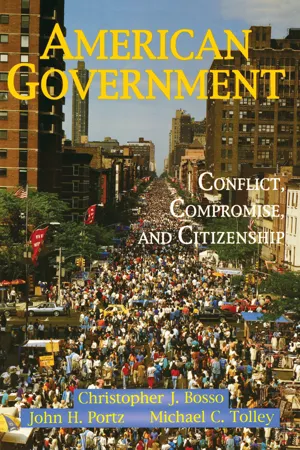 eBook - ePub
American Government
Conflict, Compromise, And Citizenship
- Christopher J Bosso, John Portz, Michael Tolley(Authors)
- 2018(Publication Date)
- Routledge(Publisher)
work. They are means by which a free people keep their government responsive, responsible, and accountable. In the absence of competitive elections in which voters participate in great numbers, the health of a democracy would be in question.We will address this fundamental concern throughout this chapter. In order to do so, we must begin by looking at the electoral system in the United States and how elections work.THE ELECTION SYSTEMElections seem noisy and chaotic, but they are not free-for-alls. They are structured means of participation. The ways in which candidates campaign and citizens vote are dictated by specific rules and procedures. These “rules of the game” have important impacts on elections. They affect who runs for office, what kinds of resources candidates use during campaigns, and what level of voter support is necessary for a candidate to declare victory. Rules affect who can vote, when, and how, and they may also be the key to why so many Americans don’t vote.All rules or laws encourage some kinds of behavior and discourage others.4 Electoral rules are no different. The biases in some of them are easy to see. For example, young children cannot vote, so issues of concern to them (such as education) may be overlooked during a campaign unless adults work on behalf of these issues. By contrast, the elderly can and do vote in very high numbers, so candidates pay attention to issues that are of concern to them, such as Social Security.The effects of other rules are more subtle. In the United States, elections for president and members of Congress are held on the first Tuesday in November. This constitutional provision dates back to the 1700s, when almost everyone farmed and spent Sundays in church. By November the crops were harvested, so people had time to get involved in politics. They could worship on Sunday and then take a day or two to travel to town to hear the candidates, attend campaign rallies, and vote. For them, elections were as much social occasions as political ones. The traditional date endures, even though farmers now account for less than 2 percent of the population. No longer available |Learn more
- Stephen Wayne(Author)
- 2019(Publication Date)
- Cengage Learning EMEA(Publisher)
The new secretaries and the White House did not trust the political loyalties and policy recommendations of the civil servants who had experience but worked in the previous administration. Trump began his presidency by hitting the ground falling. Summary Americans are fascinated by presidential elections. They want to know who will win, why the successful candidate has won, and what the election portends for the next four years. Their fascination stems from four interrelated factors: elections are dramatic, decisive, participatory, and affect leadership in government and public policy for the country. Using past elections as a guide, political scientists have tried to construct mod-els to anticipate how the electorate will react to economic, political, and social conditions prior to the election. Their models provide formulas for calculating the percentage of the popular vote the winning candidate is likely to receive on the basis of a combination of quantifiable economic and political variables. Although these forecasters have been reasonably accurate in predicting the popular vote, they did overestimate size Gore’s vote in 2000 and Bush’s in 2004, underestimated Obama’s win in 2012, and did not anticipate Trump’s Electoral College victory in 2016. To discern how campaigns affect the electorate, researchers constantly moni-tor public opinion. They do so by analyzing data from national and state opinion polls. The key is to identify likely voters. The electorate is not the public. It is a little more than half the eligible citizenry in a presidential election, less than half in most midterm elections and as little as 15 percent in a major party’s primary and much less in a party caucus. In 2016, most of the polls were reasonably accurate in predicting the popular vote within their margin of error but not in predicting the Electoral College outcome. Usually polls are also an important instrument for campaigning.
Index pages curate the most relevant extracts from our library of academic textbooks. They’ve been created using an in-house natural language model (NLM), each adding context and meaning to key research topics.

