History

2008 Presidential Election
The 2008 Presidential Election was a historic presidential election in the United States. Barack Obama, a Democrat, became the first African American to be elected president, defeating Republican nominee John McCain. The election was marked by high voter turnout and a focus on issues such as the economy, healthcare, and foreign policy.
Written by Perlego with AI-assistance
Related key terms
1 of 5
7 Key excerpts on "2008 Presidential Election"
 eBook - ePub
Conflict
African American Women and the New Dilemma of Race and Gender Politics
- Cindy Hooper(Author)
- 2012(Publication Date)
- Praeger(Publisher)
Chapter 13
The 2008 Presidential Election: The Choice
As an African American woman, I didn't feel that having two prominent women in this Presidential election this year brought such an impact on Black women. It appears to me that we were more divided on the issues than understanding the concept of a woman running for office.—AnonymousMany African American women felt that the 2008 Presidential Election was a powerful testament toward progress for both African Americans and the female gender. People felt that they were part of a broader movement for change. The increase in African American voter participation in 2008 was driven mostly by increased voter activity among African American women and younger voters. The Pew Research Center reports that overall, among all ethnic and gender groups, African American women had the highest voter turnout rate in the presidential election for the first time ever.1Barack Obama engaged and infused young people into his campaign as never seen before in a presidential race. Many younger voters felt that their concerns were being heard and that their call for change was taken seriously. Numerous feminist leaders and organizations supported Barack Obama for president, over his female competitor for the Democratic nomination. Leading feminist groups such as National Association for the Repeal of Abortion Laws enthusiastically endorsed Obama instead of Hillary Clinton.The election of 2008 remade the American political landscape. There was a major realignment in American politics. There was also an unprecedented choice for all Americans, including Black women in that historic presidential election cycle, as it related to both their race and their gender. Never before had there been an African American male and a female who had both mounted serious campaigns for the presidential nomination within a major political party simultaneously. eBook - ePub
A Decade of Disruption
America in the New Millennium
- Garrett Peck(Author)
- 2020(Publication Date)
- Pegasus Books(Publisher)
The 2008 ElectionT he Great Recession formed the backdrop for the 2008 Presidential Election. It felt like an earthquake as the economy melted down. The public desperately wanted change after eight years of the Bush administration and its many wars, and they looked to new leadership to rescue the economy. Change was what the country demanded. Dan Balz and Haynes Johnson, who published a detailed history of the 2008 election, called it “nothing less than a battle for America.”1Democrats had an advantage in that President Bush was deeply unpopular and that there was no incumbent. Dick Cheney was not running for office. A large number of Democratic senators threw their hat in the ring, including Joe Biden, Hillary Clinton, Chris Dodd, John Edwards (John Kerry’s 2004 running mate), and Barack Obama, along with New Mexico Governor Bill Richardson. Hillary Clinton was the presumed frontrunner because of her presidential husband Bill and her decades of experience in public service, but it quickly became a Clinton-Obama showdown.The 2008 presidential campaign proved both exceptional and historic. This was the first time that both a woman (Clinton) and a black candidate (Obama) ran for the highest office of the land. Clinton ran on a platform of experience, while Obama stressed change, but otherwise there was little ideological difference between the two. The Clintons were very popular within the black community, which initially sided with her, rather than Obama. Young voters in particular lined up behind Obama: they wanted change from the eight years of George Bush.But was America ready for a woman or a black man to be president? Pollster John Zogby affirmed that the country was. In June 2007, he measured that 72 percent of 18–27-year-olds agreed that the country was ready for an African American president; 64 percent of 28–41-year-olds, 61 percent of 42–61-year-olds, and 55 percent of 62–80-year-olds agreed. He also showed that nearly identical numbers believed the country was ready for a woman president: 76 percent of 18–27-year-olds; 64 percent of 28–41-year-olds, 62 percent of 42–61-year-olds, and 60 percent of 62–80-year-olds.2 No longer available |Learn more
Electoral Cultures
American Democracy and Choice
- Georgiana Banita, Sascha Pöhlmann(Authors)
- 2015(Publication Date)
- Universitätsverlag Winter(Publisher)
The most directly noticeable novelty of the 2008 election was, however, the specific candidate demographic, that is, the personal and political identity of the aspirants, which was also, more or less directly and virulently, the subject of the campaign and indeed also a key factor in the electoral choice. While the candidates were all by and large in the same category when it came to “class”—due to the fi-nancial challenges inherent in the long, enormously costly electoral campaign in the United States—the three main candidates differed markedly in ethnicity, gen-der, and age. Campaigning Across the Racial Divide While the black civil rights activist Jesse Jackson tried and failed twice (in 1984 and 1988) to become the presidential candidate of his (Democratic) party, 47-year-old Obama was the first non-white presidential nominee that the United States had ever had in 220 years (since George Washington became the first American Presi-dent in 1789). Thus it was also discussed time and again what impact race would have on the election result. Obama has a multicultural background: Son of a white American mother and a black father from Kenya, he grew up in Indonesia and Ha-waii before studying law at Harvard University. Although he has mixed roots, Obama views himself as an African American. For a long time, however, he did not speak about race directly; instead, he introduced himself as a candidate for all Americans, in that he emphasized unifying rather than divisive aspects of being American. His behavior and rhetoric, emphasizing reconciliation and exuding con-fidence, are best illustrated in statements such as the following from the Obama team: After campaigning for 15 months in nearly all 50 states, Barack Obama and our entire campaign have been nothing but impressed and encouraged by the core decency, kindness, and generosity of Americans from all walks of life. No longer available |Learn more
- Stephen Wayne(Author)
- 2019(Publication Date)
- Cengage Learning EMEA(Publisher)
Nonetheless, the popular vote was close and the red state–blue state division per-sisted. Only three states—Iowa, New Hampshire, and New Mexico—switched colors between 2000 and 2004. After the election, the Bush administration ran into trouble. The president’s domestic initiative to privatize Social Security failed; his administration’s response to Hurricane Katrina was late and inadequate; public opinion turned against the war in Iraq; and the economy was faltering and the budget deficit was rising. There was a major financial crisis in mid-September 2008. The president’s approval rat-ings dropped dramatically. On election day, 72 percent of the population disap-proved of the job Bush was doing. Beginning in 2006 and continuing through 2008, a majority of Americans believed that the Democrats would do better than the Republicans in keeping the country prosperous. Democratic partisans increased by 3 percent during this period; the Republican base declined while a larger proportion of the population identified themselves as Independents. 40 All of these factors helped the Democrats. The grassroots support Obama was able to muster, the large war chest he had raised, and the more disciplined, thematic campaign he mounted led to his large electoral victory. Obama won 52.9 percent of the popular vote and 67.8 percent of the electoral vote. Although the 2008 election was described as historic because the first African American was elected president, trends evident in past elections persisted. Partisan and ideological voting patterns remained; so did the gender gap with the voting differences between men and women at 13 percent. The secular-sectarian divide continued as did the distinctive voting patterns of different age groups. There was one major change, however. The composition of the electoral major-ity shifted from red to blue. The only competitive battleground state that Obama Copyright 2020 Cengage Learning.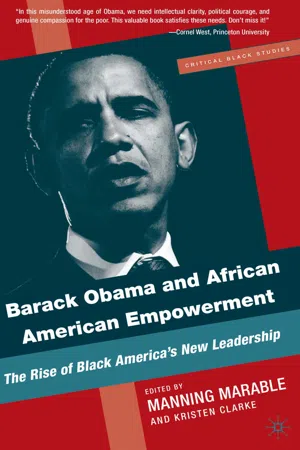 eBook - PDF
Barack Obama and African American Empowerment
The Rise of Black America's New Leadership
- M. Marable, M. Marable, Kenneth A. Loparo, Kristen Clarke(Authors)
- 2009(Publication Date)
- Palgrave Macmillan(Publisher)
Indeed, voting patterns that emerged from the Deep South states of Louisiana, Alabama, Mississippi, Georgia, and South Carolina suggest that Barack Obama’s status as an African American candidate played a strong role in shaping candidate choice at the polls during the 2008 election as these were the very states where Obama yielded the lowest levels of support among white voters. These patterns also suggest that racial discrimination remains par- ticularly entrenched and intractable in this region of the country. Moreover, this politi- cal reality complicates the story that a number of commentators have offered suggesting that Obama’s victory marks the beginning of a “postracial” era in our country. 2 Indeed, the 2008 Presidential Election presents a number of complexities for those concerned about issues that lie at the intersection of race and politics. Moreover, the election also poses significant questions for those who seek to enforce the guarantees The author wishes to thank Dr. Manning Marable, Kareem Crayton, Nathaniel Persily, John Payton, Pamela Karlan, Samuel Spital, Laughlin McDonald, Leslie Proll, Dale Ho, Desiree Pipkins, and attendees at the University of Maryland Law School’s October 2008 Election Law Symposium for feedback and comments on earlier drafts and presentations of this chapter. Kristen Clarke 242 and realize the full promises of the Voting Rights Act of 1965—one of our nation’s most successful federal civil rights laws. 3 In particular, this election raises questions about the way to best analyze and wrestle with ongoing problems of voting discrimi- nation at a time when many may be inclined to discount or discredit evidence that such problems persist given the election of a minority candidate to our nation’s high- est office. eBook - ePub
Bringing Race Back In
Black Politicians, Deracialization, and Voting Behavior in the Age of Obama
- Christopher T. Stout(Author)
- 2015(Publication Date)
- University of Virginia Press(Publisher)
While Clinton outperformed Obama on Super Tuesday, including winning the popular vote in large states such as California, New York, and Massachusetts, the proportional division of delegates allowed Obama to remain competitive. Clinton’s campaign invested heavily in defeating whoever their opponent would be by Super Tuesday. Thus her campaign had less cash on hand and had poorer organizations in the post-Super Tuesday states. The fact that Obama remained competitive put Clinton at a disadvantage. Following Super Tuesday, Obama won ten consecutive contests, including primaries in Virginia and Wisconsin. The Clinton campaign was able to win in Ohio and Texas in early March, and later in Indiana and Pennsylvania, but she was not able to win by large enough margins to overcome Obama’s delegate advantage. Clinton officially ended her presidential bid on June 7, 2008. With Clinton’s resignation, Obama became the first African American to be nominated by a major party for the office of president.Do the Different Campaign Styles Influence Vote Choice or Turnout?To assess whether the dissimilar campaign styles of Jesse Jackson and Barack Obama had a differential impact on turnout and electoral support, I utilize two sets of surveys. The first set is primary state exit polls that were collected after each state’s presidential primary in 1988 and 2008. The 1988 primary state exit polls were collected by CBS in collaboration with the New York Times. The 2008 primary state exit polls were conducted by another group including CNN, ABC, and CBS. I use these polls to estimate vote choice in the Democratic presidential primaries. The polls have the advantage of not only having a large number of respondents of all races, but are also weighted to mirror the actual state population. The large, diverse sample size provides for greater variation in vote choice among individuals of different races/ethnicities, which allows for a more nuanced assessment of voters’ preferences.Unfortunately, exit polls do not record information on nonvoters. To assess voter turnout in the two elections, I turn to the 1988 and 2008 American National Election Studies (ANES). In both years, the surveys ask respondents whether they voted in the presidential primaries. The 1988 and 2008 ANES provide the perfect opportunity to determine whether black and white voter turnout was influenced differently by the campaigns of Jesse Jackson and Barack Obama.17 eBook - PDF
Nigeria’s 2015 General Elections
Continuity and Change in Electoral Democracy
- Ladi Hamalai, Samuel Egwu, J. Shola Omotola(Authors)
- 2017(Publication Date)
- Palgrave Macmillan(Publisher)
CHAPTER 10 The 2015 Presidential Election INTRODUCTION This chapter focuses on the 2015 presidential election. Although some of the issues involved have been partially highlighted in earlier chapters, focusing on them separately gives the benefits of in-depth examinations of the salient issues underlying the presidential election. This is the pri- mary purpose of this chapter, the aim of which is to critically examine the conduct of the 2015 presidential election, with a view to identifying its high and low points. Pursuant to this goal, the chapter addresses, first and foremost, why the 2015 presidential election matters. In the second sec- tion, the chapter examines salient issues in the presidential election, namely party primaries and candidates selection, with emphasis on the two leading political parties, the PDP and APC, electioneering campaigns, election administration and election integrity, voting patterns and election results, as well as post-election reactions. Across these subsections, we reflected on important ethno-regional and religious forces as intervening variables in the voting pattern. We also underscored the key factors in the improved administration and integrity of the election, and accounts for the success and failure of the winning and losing candidates/parties using the same explanatory themes. The analyses that run through these themes reinforced that despite noticeable gaps in certain aspects, the 2015 pre- sidential election seemed more effectively administered, resulting in dee- per democratic qualities of competition, participation and legitimacy. We drew on the reports of both local and international election observers © The Author(s) 2017 L. Hamalai et al., Nigeria’s 2015 General Elections, DOI 10.1007/978-3-319-54096-2_10 203
Index pages curate the most relevant extracts from our library of academic textbooks. They’ve been created using an in-house natural language model (NLM), each adding context and meaning to key research topics.

