Psychology

Genetical Research on Testosterone
Genetical research on testosterone explores the genetic basis of testosterone levels and its impact on behavior and psychological traits. This research aims to understand how genetic variations influence testosterone production and its effects on aggression, dominance, and other behavioral traits. By studying the genetic underpinnings of testosterone, researchers seek to gain insights into the complex interplay between genetics, hormones, and behavior.
Written by Perlego with AI-assistance
Related key terms
1 of 5
5 Key excerpts on "Genetical Research on Testosterone"
 No longer available |Learn more
Costly and Cute
Helpless Infants and Human Evolution
- Wenda R. Trevathan, Karen R. Rosenberg, Wenda R. Trevathan, Karen R. Rosenberg(Authors)
- 2016(Publication Date)
149 Chapter eIght Testosterone, Fatherhood, and Social Networks Lee t. gettLer E volutionary perspectives on male life histories and the physiological mechanisms that facilitate life history trade-offs often center on the steroid hormone testosterone (T) because it plays a role in many basic repro-ductive processes. For example, healthy T production is necessary for sper-matogenesis, although the required levels are relatively low (McLachlan et al. 1996). More critically, T contributes to physical characteristics (e.g., skeletal musculature, ornamentation) and social interactions (e.g., competition with conspecifics for territory, resources, dominance, and hierarchy status as well as diverse interactions with females, etc.) that likely shape reproductive suc-cess for many vertebrate males (Ketterson et al. 1992; Bribiescas 2001; Ellison 2001a; Gettler et al. 2010; Archer 2006; Gettler and Oka 2016). However, such T-influenced traits can also adversely impact survival, such as through increased risk of injury and mortality via conflicts with other males as well as increased exposure to pathogens. Males with elevated T likely have reduced capacities to fight off infection and to rapidly heal wounds as a conse-quence of T’s many immunosuppressive effects, although the extent to which this is true probably varies based on a number of factors, for example, age, energetic condition, psychosocial stress (Muehlenbein and Bribiescas 2005), and the specific pathogenic challenge and required immune factors (e.g., Gettler et al. 2014). In the context of vertebrate males’ capabilities or inclina-tions toward paternal care, high T might also facilitate phenotypes character-ized by unreliable (e.g., investing heavily in extra-pair matings), volatile (e.g., being intolerant of or negatively responsive to young), or aggressive behaviors.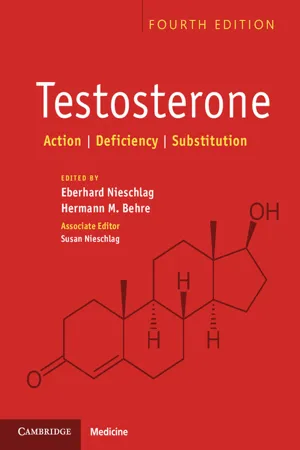 eBook - PDF
Testosterone
Action, Deficiency, Substitution
- Eberhard Nieschlag, Hermann M. Behre(Authors)
- 2012(Publication Date)
- Cambridge University Press(Publisher)
In an interesting study of 301 adolescent males (mean age 14.4 years) in which non-aggressive and aggres- sive risk taking, dominance, depression, and self- Chapter 5: The behavioral correlates of testosterone 111 esteem were among the variables assessed, Ver- meersch et al. (2010) found that free testosterone was more strongly related to both non-aggressive and aggressive risk taking in boys with shorter CAG repeat lengths, and was only related to dominance in boys with short CAG lengths. They also found that free testosterone was negatively associated with depressive symptoms and self-esteem in boys with longer CAG lengths. Simmons and Roney (2011) considered the contrast between “mating effort” and “survival” in men and commented that “an expanding body of research suggests that circulating androgens regulate the allocation of energy between mating and survival effort in human males, with higher androgen levels promoting greater investment in mating effort.” They studied 138 undergraduate students, measuring upper body strength, BMI, measures of dominance (a subscale of the Self-Perceived Social Status Scale; N. R. Buttermore and L. A. Kirkpatrick (unpublished) “Distinguishing dominance and prestige: two distinct pathways to status”) and the Sociosexual Orientation Inventory (SOI; Simpson and Gangestad 1991), which gives a measure of propensity for casual sex. Subjects with shorter CAG repeat lengths had greater upper body strength and scored higher on measures of dominance and prestige. Plasma testosterone levels were not predictive of any of these measures, nor of SOI. The authors suggested that long-term testoster- one exposure interacting with the AR gene poly- morphisms would account for more of the variance in these measures than current testosterone levels, and concluded that such effects related to long-term mating effort rather than casual sex. eBook - PDF
- Peter T. Ellison, Peter B. Gray, Peter T. Ellison, Peter B. Gray(Authors)
- 2012(Publication Date)
- Harvard University Press(Publisher)
advantageous. Informative research is conducted under the aegis of the challenge hypothesis (Wingfield et al., 1990), in which high T in males is associated with more challenge behaviors (for example, aggression) and fewer behaviors indicating parental investment (for example, mate de-fense). Another perspective is the testosterone trade-off framework (van Anders and Watson, 2006b) in which high T in women and men is asso-ciated with more competitive behaviors (for example, infant defense, searching for partners) and fewer bond maintenance behaviors (for ex-ample, caring for partners or offspring). Additionally, researchers from various disciplines bring different viewpoints to similar questions, in-cluding state effects (how partnering affects hormones), trait effects (how hormones affect partnering), and reciprocal effects. The variety of per-spectives allows for questioning and complementary insights. Research that includes diverse human populations can benefit our un-derstandings of the associations between androgens and partnering even for those not interested in diversity per se. Including these groups re-quires recognizing the value of diversity and inclusive research practices. Since individuals in these groups are often minority holders in power structures, it is crucial that research does not contribute to their margin-alization or disempowerment. One reason is admittedly selfish: groups that are distrustful of science and scientists are unlikely to volunteer to participate in scientific studies. How could research continue in this case? Others are less so: the information gathered will hopefully further our understanding of human behavior and wonder at the complexity of hu-man nature. eBook - ePub
- Gail Anderson(Author)
- 2019(Publication Date)
- CRC Press(Publisher)
Understanding these interactions is critical, not only for our understanding but also for developing tools and intervention strategies to help individuals. If we could use a simple non-invasive test such as saliva or hair to assess hormone levels and possible future risk, it would be much easier to prioritize individuals, particularly children, for intervention and could help us choose the correct intervention strategy. For example, in the rather drastic use of castration to reduce sexual recidivism, a reduction in testosterone production allowed offenders to successfully participate in treatment programs in which they had previously been unable to engage. At the same time, using such a simple test when so many other factors are at play runs the risk of labeling.Questions for further study and discussion
1. Discuss the possible evolutionary benefits of risk-taking. 2. Is it ethical to offer a prisoner the option of either castration or indefinite incarceration? Why or why not? 3. Violence is abhorred in our society, so why does it still exist, from an evolutionary perspective? 4. From an evolutionary perspective only, why might rape be an evolutionary strategy? Think of this in the context of early humans rather than our modern society. 5. Discuss the relationship between negative eugenics and lengthy incarceration. 6. What are some of the ethical issues raised by the arguments about premenstrual tension and crime? 7. Why is baseline testosterone so much less useful than acute testosterone levels to explain behavior?References
1 . Ellis, L. and Hoskin, A.W. 2015. Criminality and the 2D:4D ratio: Testing the prenatal androgen hypothesis. Int. J. Offender Ther. Comp. Criminol. 59(3): 295–312.2 . Coates, J.M. and Herbert, J. 2008. Endogenous steroids and financial risk taking on a London trading floor. Proc. Nat. Acad. Sci. USA 105(16): 6167–6172.3 . Boyd, N. 2000. The testosterone connection, In: The Beast Within: Why Men Are Violent. New York: Greystone Books. pp. 115–138.4 . Haller, J. 2014. Neurobiological Bases of Abnormal Aggression and Violent Behaviour. London: Springer. 220 p.5 . Brain, P.B. and Haug, M. 1992. Hormonal and neurochemical correlates of various forms of animal “aggression.” Psychoneuroendocrinology 17(6): 537–551.6 . Harris, J.A., Vernon, P.A., and Boomsma, D.I. 1998. The heritability of testosterone. Behav. Genet eBook - ePub
Sex Differences in Cognitive Abilities
4th Edition
- Diane F. Halpern(Author)
- 2013(Publication Date)
- Psychology Press(Publisher)
Of course, hormone manipulations are unethical for human subjects. But, in at least one study, researchers were able to persuade Institutional Review Boards (IRBs) that it was safe to administer a single dose of testosterone to women in a double-blind, placebo-controlled, cross-over study (Aleman, Bronk, Kessels, Koppeschaar, & van Honk, 2004). “Double-blind” means that neither the participants nor the researchers who collected the data knew who was in the experimental treatment group or who was in the control group. “Placebo-controlled” means that the control group received a similar treatment as the experimental group except that instead of being injected with testosterone, they were injected with an inert substance that would not affect cognition. Finally, the term “cross-over study” means that some participants first received the testosterone and then the placebo and other participants first received the placebo and then the testosterone. The participants who received testosterone showed significantly better performance on a three-dimensional version of the mental rotation test than those who did not (all the participants were women). These are very powerful results that raise several ethical questions that will be addressed in the final chapter. For example, if women achieve higher visuospatial scores after just one injection of testosterone, then is it ethical to allow women (or men) to inject testosterone prior to taking high stakes examinations such as the SATs or Graduate Record Examinations or perhaps surgeons prior to performing delicate surgery or pilots making a difficult air plane maneuver? Rapid advances in the biological underpinnings of cognition raise many new ethical questions.Theories Relating Sex Hormones to Cognitive Abilities
Four theories (or theoretical approaches) about the relationship between hormone levels and cognition have spurred much of the research in this area. Theories are important because they provide the explanation or answer to questions about why cognitive abilities may be dependent on sex hormones or why some seemingly strange relationships among variables would make sense.Geschwind–Galaburda Theory of Prenatal Hormones Effects
Norman Geschwind was an early pioneer in the study of hormone effects on behavior, a field that is called “behavioral neurology.” An influential theory proposed by Geschwind and his colleagues, most notably Galaburda, is based on the underlying assumption that prenatal hormones have a pervasive effect on cognition (e.g., Geschwind, 1983, 1984; Geschwind & Galaburda, 1987). This theory posits that the prenatal sex hormones that both direct and reflect the sexual differentiation of the fetus also exert powerful influences on the central nervous system of developing organisms. In humans, the right hemisphere (half of the brain) normally develops at a faster rate than the left. Because of this differential rate of development, the left hemisphere is at risk for possible negative effects for a longer period of time than the right, and therefore is more likely to be affected by an adverse intrauterine environment. Proponents of this theory assert that high levels of testosterone slow the growth of neurons in the left hemisphere. The result is right hemisphere dominance, which means that the right hemisphere has greater control than the left hemisphere for many cognitive and motor functions.
Index pages curate the most relevant extracts from our library of academic textbooks. They’ve been created using an in-house natural language model (NLM), each adding context and meaning to key research topics.

