Psychology

Lev Vygotsky
Lev Vygotsky was a pioneering psychologist known for his sociocultural theory of cognitive development. He emphasized the role of social interaction and cultural influences in shaping a child's learning and development. Vygotsky's work has had a significant impact on educational practices and has influenced our understanding of how children acquire knowledge and skills.
Written by Perlego with AI-assistance
Related key terms
1 of 5

12 Key excerpts on "Lev Vygotsky"
 eBook - PDF
Child Psychology
Development in a Changing Society
- Robin Harwood, Scott A. Miller, Ross Vasta(Authors)
- 2012(Publication Date)
- Wiley(Publisher)
In the cultural/historical context, individual development unfolds in a particular cultural and historical niche that itself is dynamic and changing. As noted earlier, socioculturalists believe that individual development must be studied in its cultural context. Moreover, so- cioculturalists study how changes in cultural practices and institutions (such as the intro- duction of formal schooling, move to a market economy, or invention of new technologies) shape the human mind. The Social Origins of Thought In addition to emphasizing the cultural contexts of knowledge and intelligence, Vygotsky focused on the role of social interaction in learning. According to Vygotsky, children acquire knowledge and cognitive skills by participating in cultural activities with more experienced partners. By participating in culturally meaningful activities with more knowl- edgeable members of their society, children internalize the values, customs, beliefs, and skills of their culture and, over time, come to use them independently. Vygotsky believed that the most productive interactions occur in what he termed “the zone of proximal (potential) development.” The zone of proximal development is the dis- tance between what a child can accomplish on his or her own and what the child can achieve under the guidance of an adult or in collaboration with a more capable peer. The zone of proximal development involves activities that are slightly beyond the child’s cur- rent capabilities but can be accomplished with help. Interactions within the zone of prox- imal development promote cognitive development because the social support allows children to extend their current skills to a higher level of competence. Vygotsky and the Sociocultural Approach 257 Scaffolding A method of teaching in which the adult adjusts the level of help provided in relation to the child’s level of performance, the goal being to encourage independent performance.
- Janette B. Benson, Marshall M. Haith(Authors)
- 2010(Publication Date)
- Academic Press(Publisher)
However, Vygotsky did not view individual psychology or human cognition as a direct consequence of social experience, that is, socially determined. He proposed that human development, including cognitive develop-ment, is socially constructed. That is, in the course of social interaction, the cultural context of development, as instan-tiated in social behavior and cultural artifacts, and the biological aspects of the human system, including genetic, maturational, and neurological characteristics, create new understandings and capabilities. In other words, individual psychological functioning is an emergent property of the sociocultural experiences of the human organism. This means that psychological development is a dynamic and constructive process, the outcome of which cannot be known beforehand or by examining the individual and the social context separately from one another. Rather, devel-opment is generated by the processes that transpire over the course of human social experience in cultural context. Vygotsky was particularly interested in social interac-tions involving more and less experienced members of a culture. As these partners collaborate in solving a problem, the more experienced partner assists the less experienced partner, the learner, in ways that support the learner’s engagement in actions that extend beyond the learner’s current individual capabilities. In an effective learning situation, this engagement occurs in what Vygotsky called the learner’s zone of proximal or poten-tial development, the region of sensitivity for learning. The more experienced partner supports the learner’s activity through the use of signs and tools of the culture. As the learner gains competence at the activity, the more experienced partner gradually withdraws support and, in time, the learner comes to function on his or her own in a more advanced intellectual way. eBook - ePub
Developmental Psychology
Revisiting the Classic Studies
- Alan M Slater, Paul C Quinn, Alan M Slater, Paul C Quinn(Authors)
- 2020(Publication Date)
- SAGE Publications Ltd(Publisher)
Despite having been written nearly a century ago, Vygotsky’s critique of other theoretical views about learning and development and the ideas he introduces in this paper are relevant today. When his ideas became known, his perspective about the culturally organized and socially mediated nature of learning and intellectual development was not previously available in developmental science (Schaffer, 2006). His view overcomes some of the limitations of approaches that focus on cognitive development as determined solely by mechanisms inside the individual. It is true that Vygotsky’s assertion that development occurs at the “child-society border” has been difficult for some Western-trained scientists to understand after years of doing research aimed at separating the individual child and the external world (Kessen, 1979). Yet Vygotsky’s view has been useful in helping to direct the attention of researchers to the social and cultural origins of thinking along with the historical-cultural context of intellectual growth. These ideas are relevant to studying many of the concerns raised in today’s world.Vygotsky’s ideas about learning and development have also increased awareness of the role of the immediate social context in learning and cognitive development, and challenged developmental researchers to explore the role of context in greater depth. His emphasis on collaborative problem solving with more skilled partners has been influential in the learning sciences (Göncü & Gauvain, 2012; Sawyer, 2014) and developmental researchers have demonstrated the value of this approach in studies of children’s learning in many areas of cognition including attention, memory, problem-solving skills, and planning (Gauvain, 2001). This research shows that children’s understanding and cognitive skills can indeed be improved when adults or more skilled peers provide them with appropriate support for learning. His notion of the zone of proximal development, in particular, has given rise to several important concepts such as scaffolding (Wood, Bruner, & Ross, 1976) and guided participation (Rogoff, 1990). In addition, it coincides with the growing interest in microgenetic change that occurs over a learning experience (National Academies of Sciences, Engineering, and Medicine, 2018; Siegler, 2006). Vygotsky’s ideas are also relevant to studying child development during cultural change, a topic that is garnering significant interest during this period of rapid societal change in the context of globalization (Gauvain & Munroe, 2018). eBook - PDF
Vygotsky and Education
Instructional Implications and Applications of Sociohistorical Psychology
- Luis C. Moll(Author)
- 1990(Publication Date)
- Cambridge University Press(Publisher)
The difference for Vygotsky is that the context in which the interaction occurs is of crucial importance. Vygotsky proposed that each child, in any domain, has an "actual developmental level," which can be assessed by testing him or her individually, and an immediate Peer collaboration in the ZPD 157 potential for development within that domain. Vygotsky termed this difference be- tween the two levels the zone of proximal development, which he defined as "the distance between the actual developmental level as determined by independent problem solving and the level of potential development as determined through problem solv- ing under adult guidance or in collaboration with more capable peers" (Vygotsky, 1978, p. 86). Vygotsky gave the concept a clearly maturational slant: The zone of proximal development defines those functions that have not yet ma- tured but are in the process of maturation, functions that will mature tomorrow but are currently in an embryonic state. These functions could be termed the "buds" or "flowers" of development rather than the "fruits" of development. (1978, p. 86) Vygotsky also provided some indication of a seemingly teleological view of the developmental process, a process in which children come to be socialized into the dominant culture. Just as Marx wrote that the first use of tools mediated human beings' experience of the physical environment and had a huge impact on social relations among people, Vygotsky used the notion of "psychological tools" to ex- plain the developmental revolution from "natural" processes to higher mental pro- cesses. Thus language, a tool of immense power, ensures that linguistically created meanings are shared meanings, social meanings. Words that already have meaning for mature members of a cultural group come to have those same meanings for the young of the group in the process of interaction. eBook - PDF
- Don Lytle(Author)
- 2003(Publication Date)
- Praeger(Publisher)
American Psychologist, 41, 264–274. Kozulin, A. (1990). Vygotsky’s psychology: A biography of ideas. Cambridge, MA: Har- vard University Press. Lambert, E. B., & Clyde, M. (2000). Rethinking early childhood theory and practice. Katoomba, NSW: Social Science Press. Lamborn, S., & Fischer, K. (1988). Optimal and functional levels in cognitive devel- opment: The individual’s developmental range. Newsletter of the International Society for the Study of Behavioural Development, 2, 1–4. Low Deiner, P. (1997). Infants and toddlers: Development and program planning. Or- lando, FL: Harcourt, Brace, & Co. McLeod, L. (1997). Young children and metacognition: Do we know what they know they know? And if so what do we do about it? Australian Journal of Early Childhood, 22, 6–11. McLune, L. (1986). Symbolic development in normal and atypical infants. In G. Fein & M. Rivkin (Eds.), The young child at play: Reviews of research: Volume 4 (pp. 45–62). Washington, DC: National Association for the Education of Young Children. Meadows, S. (1993). The child as thinker. New York: Routledge. 96 Vygotskian Theory and Scaffolding Miller, P. (1989). Theories of developmental psychology (2nd ed). New York: Freeman & Co. Minick, N. (1987). The development of Vygotsky’s thought: An introduction. In K. Rieber & S. Carton (Eds.), The collected works of L. S. Vygotsky: Volume 1 (pp. 17–36). New York: Plenum Press. Moss, E. (1992). The socio affective context in joint activity. In L. Winegar & L. Valsiner (Eds.), Children’s development within social context: Volume 2: Research and Methodology (pp. 117–154). Hillsdale, NJ: Erlbaum. Murray, F. (1991). Questions a satisfying developmental theory would answer: The scope of a complete explanation of developmental phenomena. In H. Reese (Ed.), Ad- vances in child development and behaviour (vol. 23, pp. 39–48). Hillsdale, NJ: Erlbaum. Nuthall, G. (1996). Commentary: Of language and learning and understanding the com- plexity of the classroom. eBook - PDF
- Colette Gray, Sean MacBlain(Authors)
- 2015(Publication Date)
- SAGE Publications(Publisher)
Through these relationships and interactions, children collaborate towards a shared goal. Vygotsky’s theory on the process of child development is summed up in the following comment: In the process of development, children begin to use the same forms of behaviour in rela- tion to themselves and others initially used in relation to them. Children master the social forms of behaviour and transfer these forms to themselves … It is through others that we develop into ourselves and … this is true not only with regard to the individual but with regard to the history of every function. (Wertsch 1981, p. 164) Like Piaget, he believed that infants are born with the basic building blocks of cognition: these include visual recognition, memory, attention and speed of pro- cessing. This enables the child to develop higher-order thinking skills such as problem solving, reasoning, planning and remembering (Rose et al. 2003). The child also has an innate ability to learn through instruction, a characteristic complemented by the adult’s willingness to help and instruct. Thus, the cultural norms (accepted practices) of a society begin at the external level and, through experience and mediated learning, become internalized as thought. Every function in the child’s cultural development appears twice: first, on the social level, and later on the individual level; first, between people (interpsychological), and then inside the child (intrapsychological). This applies equally to voluntary attention, to logical memory, and to the formation of concepts. All the higher functions originate as actual relations between human individuals. (Vygotsky, 1978, p. 57) Exercise Consider the above quote carefully. What does Vygotsky mean when he claims that learning involves two levels: a social and an individual level? Learning Theories in Childhood 94 CULTURE AND SOCIETY As previously suggested, Vygotsky’s life and views were shaped by the social and political forces which revolutionized Russia.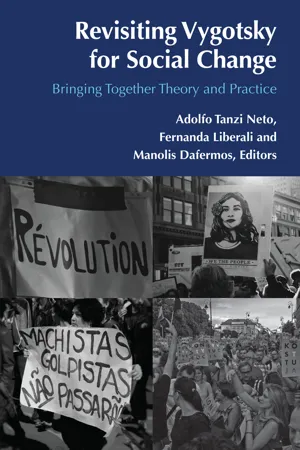 eBook - PDF
Revisiting Vygotsky for Social Change
Bringing Together Theory and Practice
- Adolfo Tanzi Neto, Fernanda Liberali, Manolis Dafermos, Márcia Aparecida Amador Mascia, Silvia Grinberg, Michalis Kontopodis(Authors)
- 2021(Publication Date)
Before introducing a few of these activists for development, I will summa- rize some of the key features of the Vygotsky they are inspired by and make use of, a revolutionary Vygotsky who (1) was searching for method; (2) saw learning and development as a dialectical unity; (3) described the develop- mental features of play and (4) posited that speaking completes thinking. The Developmentalist Vygotsky Method as Tool-and-Result In Vygotsky’s psychology, the unique feature of human individual, cultural and species development is human activity, which is qualitative and trans- formative (unlike behavior change, which is particularistic and cumulative). Human beings do not merely respond to stimuli, acquire societally deter- mined and useful skills, and adapt to the determining environment. The uniqueness of human social life—and in this Vaygotsky followed Marx—is that we ourselves transform the determining circumstances. Human develop- ment is not an individual accomplishment but a socio-cultural activity. 114 LOIS HOLZMANS Vygotsky’ understanding of development and learning is a forerunner to the Institute’s psychology of becoming and its methodology of social therapeu- tics, in which people experience the social nature of their existence and the power of collective creative activity in the process of making new tools for growth (Holzman, 2016/2009). As a cultural approach to human life, the psychology of becoming relates to human beings as the creators of our cul- ture and ensemble performers of our lives; and to human and community learning and development as the social-cultural activity of creating “devel- opment zones/stages” where people can “become” through performing, as Vygotsky says, “a head taller” (Vygotsky, 1978). For Vygotsky, the uniqueness of human psychological activity required a new method designed specifically for that task. eBook - ePub
Catching Readers Before They Fall
Supporting Readers Who Struggle, K-4
- Pat Johnson, Katie Keier(Authors)
- 2023(Publication Date)
- Routledge(Publisher)
We believe that Vygotsky’s theory is important and applicable enough to warrant its own chapter. Over the past five years or so, we, and many of the teachers we work with, have delved deeper into Vygotsky’s work and layered our thinking. Through conversations with colleagues and our work with struggling readers, we now have a better grasp of terms such as zone of actual development, zone of proximal development, and social speech, private speech, and inner speech. This understanding has caused a slight shift in our teaching and impacts the way we plan, instruct, and use language with struggling readers. In this chapter we will be sharing those understandings.As you read in this chapter the examples of teachers and students working together, we hope you will reflect on the following questions:- What is Vygotsky’s theory and why should I take time to learn about it?
- When is my teaching most effective?
- How do children learn best?
- What is the zone of proximal development (ZPD)?
- What does the gradual release of responsibility model have to do with ZPD?
- How will understanding ZPD make me a better teacher of reading?
- What are the benefits for struggling readers?
What Are the Basics of Vygotskian Theory?
Lev Vygotsky was born in Russia in 1896 and died of tuberculosis in 1934 at the age of 37. In his short lifetime he published 180 works, with unpublished manuscripts totaling 300. His works were banned by Stalin and were not allowed to be read and circulated until after Stalin’s death in 1953. Americans were slow to accept his theories because of the popularity of Piaget’s work and behaviorist theories. More detailed information on Vygotsky’s life and work can be found in Scaffolding Children’s Learning: Vygotsky and Early Childhood Education by Berk and Winsler (1995 ).In the last twenty years or so, Vygotsky’s theories of how children learn have found their way into nearly every college curriculum for teacher training. Listed below are three major ideas about which he wrote extensively (Vygotsky 1978 , 1986 eBook - PDF
- Jennifer A. Vadeboncoeur(Author)
- 2017(Publication Date)
The holism derived from the principles of dialectical materialism, and in particular the unity of opposites, is relevant to learning, developing, and teaching and distinguishes Vygotsky’s view from the view of other psycholo- gists. Though Vygotsky applied the principle of unity in a number of differ- ent ways, four relational unities with profound implications for education are highlighted here. vygotsky’s unifying approach 15 The Unity of Individual and Social Environment Vygotsky (1960/1997b) argued that individuals live in a mutually constitutive relationship with their social environment; both contributing to the social environment and being shaped by it. Children grow into the social environ- ments around them—as they move across home, school, and community— and their presence transforms these environments as well (Cole, 1996). Social environments are constituted in part by relationships and social practices, or everyday routines and the culturally created tools, like language, that enable participation. This social and cultural web enables infants to learn how to participate in worlds that have long preceded them; it anchors their growth as they move toward toddlerhood, childhood, youth, and adulthood and expands their participation in more complex practices. Vygotsky formulated the inter- dependence of the individual and social environment in the general genetic law of cultural development: the idea that the development of mind is a social process and that the social and cultural practices that a child is mentored into, as well as the meaning the child constructs of participation in these practices, form the foundation for individual consciousness. As social institutions, schools structure environments for children and adults. Specific to the social environment in schools is the relationship between a child as a student and an adult who is her teacher. eBook - PDF
- Ronald Miller(Author)
- 2011(Publication Date)
- Cambridge University Press(Publisher)
360 vygotsky in america In order to understand the connection between the levels of development that are of interest to us in child psychology, we must briefly take into account the kind of relation that exists among them. The relations are of a dialectical character . . . Every subsequent stage in the development of behavior, on the one hand, negates the preceding stage, negates it in the sense that properties present in the first stage of behavior are removed, eliminated, and sometimes converted into an opposite, higher stage . . . Thus every subsequent stage affects the change or negation of properties of the preceding stage. (p. 111) . . . every new form of cultural experience is not simply external, regardless of the state of the organism at a given moment of development, but the organism, assimilating external influences, assimilates a whole series of forms of behavior, and assimilates them depending on the degree of his mental development. Something occurs that resembles what is called nourishment with respect to body growth, that is, assimilation of certain external substances, external material, that is processed and assimilated into the organism itself. (p. 109) If there is any doubt that the above passages reflect Vygotsky’s adherence to a conception of qualitative sequential stages, the following passage from the previous chapter (chapter 4) should serve to dispel the uncertainty. We now move to the problem of elucidating the genesis of cultural forms of behavior. We will present a short outline of this process as it was noted in our experimental studies. We shall try to show that cultural development of the child proceeds, if we can believe the artificial conditions of the experiment, through four basic stages or phases sequentially replacing each other and arising one from another. Taken as a whole, these stages describe the circle of cultural development of any mental function. eBook - PDF
Child Psychology
A Canadian Perspective
- Alastair Younger, Scott A. Adler, Ross Vasta(Authors)
- 2014(Publication Date)
- Wiley(Publisher)
These include the use of tools such as language, and social-cognitive abilities that support learning in social contexts. • Cultural/historical development occurs over decades and centuries and leaves a legacy of tools and artifacts, value systems, institutions, and practices. Individual development unfolds in a particular cultural and historical niche that itself is dy- namic and changing. Socioculturalists believe that individual development must be studied in its cultural context. Moreover, socioculturalists study how changes in cultural practices and institu- tions (e.g., the introduction of formal schooling, moving to a market economy, invention of new technologies) shape the human mind. TOOLS AND ARTIFACTS A third theme in Vygotsky’s writings is that human thought and action are mediated by material and symbolic tools (Vygotsky, 1981). Tools and artifacts, in this context, refer to all the means individu- als have at their disposal to achieve desired goals, from simple objects (such as sticks and rope) to complex technological devices (such as smartphones and laptop and tablet computers). Tools and artifacts also include representations (such as maps), sign and symbol systems (such as language), and social practices (such as routines and rituals that organize and structure human activity). Children learn how to use these cultural tools through interactions with parents, teachers, and more experienced peers. As a result of using these tools—first in cooperation with others and later independently—the child develops higher mental functions: complex mental processes that are intentional, self-regulated, and mediated by language and other sign systems. Examples include focused attention, deliberate memory (consciously using strategies for remembering things), and verbal thinking (thought using words that denote abstract concepts). Vygotsky believed that the particular structure and content of higher mental functions vary with social experience. eBook - ePub
- Irving B. Weiner, William M. Reynolds, Gloria E. Miller(Authors)
- 2012(Publication Date)
- Wiley(Publisher)
James Lantolf has played a central role in developing a sociocultural approach to the study of second-language acquisition (SLA) and second-language teaching/learning. He and his students and colleagues have developed a methodological approach to researching second-language acquisition based on the work of Vygotsky using mediation; inner speech, private speech, and internalization; the regulatory function of language; the zone of proximal development and scaffolding; testing, including dynamic assessment. (Lantolf, 2000; Lantolf & Appel, 1994; Lantolf & Poehner, 2008; Lantolf & Thorne, 2006). Lantolf and Beckett (2009) reviewed sociocultural research investigating SLA from 1985 to the present. Mahn (2013) similarly describes aspects of Vygotsky's methodology and theory that have guided sociocultural approaches to SLA research.Vygotsky's Influence on Literacy Research
In the same way that Vygotsky's work helped provide a sociocultural foundation for second-language research, it also provides a foundation for first language literacy studies. Writing theorists such as Emig (1971), Britton (1987), Langer and Applebee (1987), and Moffett (1981) constructed a new approach to literacy that relied on Vygotsky's key ideas. His influence has also been important in the development of reading theories by Clay (1991), Holdaway (1979), K. Goodman and Goodman (1990), and Taylor (1998). Among the topics explored by these literacy researchers are sociocultural considerations of the literacy socialization process (Panofsky, 1994).In the “Prehistory of Written Language,” Vygotsky (1978) examined the roles of gesture, play, and drawing in the socialization for literacy. He analyzed the developmental processes children go through before schooling as a foundation for literacy learning in school. He argued that gestures lay the groundwork for symbol use in writing: “The gesture is the initial visual sign that contains the child's future writing as an acorn contains a future oak. Gestures, it has been correctly said, are writing in the air, and written signs frequently are simply gestures that have been fixed” (Vygotsky, 1978, p. 107). In a study on parent-child book reading, Panofsky (1994) also emphasized the importance of connecting visual signs with verbal representations. She suggested that children need assistance in interpreting pictures in books, a process that contributes to the move from signs to representations. An example of such a move is a parent's saying, “See that tear? He is crying” (Panofsky, 1994, p. 232). Anne Dyson (1989), who has shown the importance of dramatic play, drawing, and writing in the development of child writers, also emphasized the multidimensionality of literacy.
Index pages curate the most relevant extracts from our library of academic textbooks. They’ve been created using an in-house natural language model (NLM), each adding context and meaning to key research topics.

