Psychology

Personality Scales
Personality scales are assessment tools used to measure and quantify individual differences in personality traits. They typically consist of a series of questions or statements to which individuals respond, and the results are used to categorize and describe an individual's personality. These scales are widely used in psychological research and clinical practice to understand and evaluate personality characteristics.
Written by Perlego with AI-assistance
Related key terms
1 of 5
10 Key excerpts on "Personality Scales"
 eBook - PDF
- C. G. Costello, Hugh L. Freeman(Authors)
- 2016(Publication Date)
- Pergamon(Publisher)
In the next chapter of this book, Infrequently Used Assessment Techniques, we shall be considering some of the lesser known measuring devices in psychology which may replace the questionnaire approach to the assessment of personality. Rating Scales Rating scales are often used for assessments within psychiatric settings. We shall therefore consider briefly some of the problems connected with them. There are a number of types of rating scales. The most common are: (1) Numerical rating scales in which the rater assigns to each person a numerical value for each trait. He may, for instance, assign to a person on a trait of honesty a score of 1, meaning that the person is completely dishonest, or a score of 7, meaning that he is most honest. (2) Graphic rating scales, in which a judgment is made by making a mark or a line, rather than by giving the subject a number. (3) Check list rating scale, in which a number QUESTIONNAIRES AND RATING SCALES 233 of trait names, such as selfish, cruel, etc., are given to the judges, and the judges have to check every word that they feel applies to the subject being rated. (4) Forced choice rating scales, in which the rater is required to choose between two favorable qualities, or between two unfavorable qualities, when rating a person. In some of the forced rating scales, the rater is presented with a tetrad which is composed of two popular trait descriptions and two unpopular ones. One of the popular ones and one of the unpopular ones are known to be valid on the basis of empirical data, for indicating the trait dimension to be evaluated, but the others are not. The rater has to choose the one of the four qualities in the tetrad that he thinks describes the person best, and also the one that describes him least. The rater may know which qualities are popular or unpopular, but he is unlikely to know which ones are valid. No longer available |Learn more
The Psychology Research Handbook
A Guide for Graduate Students and Research Assistants
- Frederick T. L. Leong, James T. Austin(Authors)
- 2005(Publication Date)
- SAGE Publications, Inc(Publisher)
One of the graduate students in our psychology department is developing a “sexual extraversion” scale to measure extraversion in the context of sexual dynamics (which had not been developed previously). It is easy to imag-ine how different sexual extraversion scales could be developed for males and females, hetero- and homosexuals, college students and midlife adults, and individuals identifying with different ethnic groups, or how one could develop a Big Five scale for sexual behavior. There are endless possibilities for developing contextualized measures of existing scales, and in our view, contextualization of scales to mea-sure a wide variety of constructs is a rapidly emerging area in the field of assessment. P URPOSE OF A P SYCHOLOGICAL S CALE Most scales are developed as research tools to measure a construct reliably so that validity relationships can be tested within a theoretical framework. Scale reliability is a threat to the integrity of your scale that should be considered at the outset. Often college students respond to the scale, usually along with several other scales, for class credit or to fulfill a course requirement. From the standpoint of the person taking the scale, there are usually no contingencies for answering items carelessly or even randomly. There is no incentive for honest, accurate responding, other than acting in accord with one’s personal standards or trying to help the researcher. The really busy student concerned with efficient time management may be moti-vated to simply complete a scale quickly by not reading the items and answering all items the same way, or answering randomly. We have found that in some cases when college students take our scales for extra credit, up to 10% of the sample answered in a way that was so careless or random that their entire set of answers had to be scrapped. We will return to some ways to detect such careless responders later in this chapter. eBook - ePub
Personality and Disease
Scientific Proof vs. Wishful Thinking
- Christoffer Johansen(Author)
- 2018(Publication Date)
- Academic Press(Publisher)
When measuring personality we are, again according to Lazarus (1971), referring to a quantitative dimension in the same way as we consider intelligence to be a psychological trait. In clinical psychiatry we have the term personality disorders, which we describe qualitatively as types rather than traits. Feighner et al. (1972) introduced the typological use of algorithms in psychiatric research and used Antisocial Personality Disorder (ASPD) as an example. The ASPD was defined as a chronic disorder requiring a minimum of five out of nine manifestations to be definitely present. In diagnostic and statistical manual of mental disorders. Fifth edition (DSM-5) (American Psychiatric Association, 2013) personality disorders are still considered as being derived from categorical algorithms. However, in the DSM-5 the five-factor model (Costa & Widiger, 2001) is included as an alternative proposal. This five-factor model lists five personality traits or factors, namely (1) neuroticism, (2) extraversion, (3) openness, (4) agreeableness, and (5) conscientiousness. The DSM-5 decision to officially delete personality dimensions when describing personality disorders is based on the fact that we have no acceptable sharp cutoff between personality traits and personality disorders. Among the five personality traits identified by the five-factor model, the traits of neuroticism and extraversion are the most distinct and best studied as regards the measurement of personality dimensionality (Bech, 2016). The psychometric measurement of neuroticism and extraversion is therefore the focus of this chapter on how to measure personality. Psychometrics The emergence of psychometrics is ascribed to Wilhelm Wundt (1820–1920) who is regarded as the first experimental psychologist (Bech, 2012). He founded the psychological laboratory at the University of Leipzig in 1879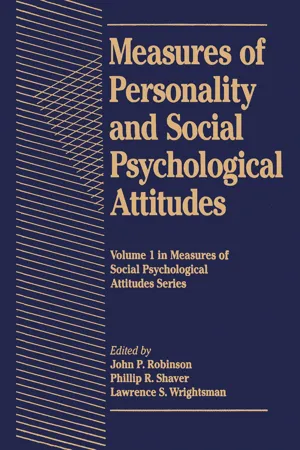 eBook - PDF
Measures of Personality and Social Psychological Attitudes
Measures of Social Psychological Attitudes
- John P. Robinson, Phillip R. Shaver, Lawrence S. Wrightsman, John P. Robinson, Phillip R. Shaver, Lawrence S. Wrightsman(Authors)
- 2013(Publication Date)
- Academic Press(Publisher)
CHAPTER 1 Criteria for Scale Selection and Evaluation John P. Robinson, Phillip R. Shaver; and Lawrence S. Wrightsman The original idea for this handbook of attitude and personality measures came from Robert Lane, a political scientist at Yale University. Like most social scientists, Lane found it difficult to keep up with the proliferation of social attitude measures. In the summer of 1958, he attempted to pull together a broad range of scales that would be of interest to researchers in the field of political behavior. Subsequently, this work was continued and expanded at the Survey Research Center of the University of Michigan under the general direction of Philip Converse, with support from a grant by the National Institute of Mental Health. The result was a three-volume series, the most popular of which was the last, Measures of Social Psychological Attitudes. That is the focus of our first update of the original volumes. Readers will note several differences between this work and its predecessors. Most important, we have given responsibility for each topic to experienced and well-known researchers in each field rather than choosing and evaluating items by ourselves. These experts were also limited to identifying the 10 or 20 most interesting or promising measures in their area, rather than covering all available instruments. This new structure has resulted in more knowledgeable review essays, but at the expense of less standardized evaluations of individual instruments. There are many reasons for creating a volume such as this. Attitude and personality measures are likely to appear under thousands of book titles, in dozens of social science journals, in seldom circulated dissertations, and in the catalogues of commercial pub- lishers, as well as in undisturbed piles of manuscripts in the offices of social scientists. This is a rather inefficient grapevine for the interested researcher. eBook - PDF
Psychological Foundations of Education
Learning and Teaching
- B. Claude Mathis, John W. Cotton, Lee Sechrest(Authors)
- 2013(Publication Date)
- Academic Press(Publisher)
Few persons would quarrel seriously with such a position, but psychologists differ in their opinions about the best place to begin studying personality, e.g., with the elements or the overall structure, and about whether the ap-proaches to the study of structure which have been developed thus far have any scientific value. Assessment of Personality Obviously if any systematic use is to be made of personality variables, they must be in some way measurable. To say that personality variables must be measurable does not imply any particular method or any special level of precision. But at least we must be able to say with some con-sistency and with some fidelity that a certain person is high or low on Personality 485 some dimension. That is the basic measurement operation, and everything beyond that is a refinement. Moreover, the basic quantitative statement can come from casual observations of a bystander or from a very sophisticated, technically advanced scientific instrument. Ordinarily in psychology casual observations of bystanders are not relied on because they prove to be inconsistent and to lack fidelity. But it should not be supposed that there are any intrinsically unacceptable ways of assessing personality, nor any intrinsically desirable ways. Just as distance can be measured by visual inspection, pacing, tape measures, sound delays, triangulation methods, and the like, so personality can be assessed in a myriad of ways, all perhaps useful in particular situations and for par-ticular purposes. The same point about measurement of personality must be made at the outset as will be made later about measurement of attitudes. The only way to know about personality is from the way it manifests itself in behavior. To the extent that our personality variables go beyond mere description of some behavior, they are based on inferences. There are no ways of tapping directly into the personality.
- Philip J. Corr, Gerald Matthews(Authors)
- 2009(Publication Date)
- Cambridge University Press(Publisher)
This may not be the case for shorter, more narrowly focused measures of single or a few attributes where extensive developmental research on a measure may not have been completed before an instrument appeared in the research literature. Of course, users of such instruments should always investigate the methods by which a scale was 114 personality description and measurement developed and the reported psychometric properties of personality measures before using them, but detailed information on the development of scales may not be widely available. One issue that test developers must address is the question of gender differ- ences. The recent tendency towards production of neutral (‘unisex’) personality inventories (by removing items that exhibit significant sex differences) makes it well nigh impossible to obtain complete and accurate personality profiles that distinguish between males and females. One example of such an instrument is Morey’ s (1991) Personality Assessment Inventory (PAI), for which a decision was made to minimize gender differences and not only remove items that showed a gender difference, but also not to report gender-based norms. One justification for the decision derives from the nature of the PAI as a measure of psychopathology where a stronger argument can be made for less emphasis upon the direct assess- ment of gender differences. Measures of normal personality must address the matter of there being notable gender differences in psychological functioning resulting from differences in genes, brain anatomy and sex hormone levels, in addition to significant differences in acculturation and social conditioning in some way. The most common method is the provision of separate norms for males and females. Other scales, such as those of Comrey, include scales that reflect behav- ioural and attitudinal differences between males and females. eBook - PDF
- Spencer Rathus, , , (Authors)
- 2021(Publication Date)
- Cengage Learning EMEA(Publisher)
Research evidence suggests that people who maintain their tradi-tional customs and also assume behavior patterns that allow them to do well in their new country often have the highest self-esteem. 10-6 MEASUREMENT OF PERSONALITY Physicians have an easy time of it measuring heart rate and blood pressure. Psychologists, biologists, and neuroscientists find it easier to measure electricity in the brain or substances in the blood than to measure psychological concepts acculturation the process of adaptation in which immigrants and native groups identify with a new, dominant culture by learning about that culture and making behavioral and attitudinal changes such as intelligence, depression, extraversion, or emotional stability. It may take time, money, Copyright 2022 Cengage Learning. All Rights Reserved. May not be copied, scanned, or duplicated, in whole or in part. Due to electronic rights, some third party content may be suppressed from the eBook and/or eChapter(s). Editorial review has deemed that any suppressed content does not materially affect the overall learning experience. Cengage Learning reserves the right to remove additional content at any time if subsequent rights restrictions require it. 288 CHAPTER 10: Personality: Theory and Measurement Measures of personality are used to make important decisions, such as whether a person is suited for a cer-tain type of work, a particular class in school, or a drug to reduce agitation. As part of their admissions process, graduate schools often ask professors to rate prospective students on scales that assess traits such as intelligence, emotional stability, and cooperation. Students may take tests to measure their aptitudes and interests to gain insight into whether they are suited for certain occupa-tions. It is assumed that students who share the aptitudes and interests of people who function well in certain posi-tions are also likely to function well in those positions. eBook - PDF
- Rocio Fernandez-Ballesteros(Author)
- 2002(Publication Date)
- SAGE Publications Ltd(Publisher)
Based upon factor analyses of person-ality data (including behavioural descriptions as well as questionnaire data), Cattell initially concluded that 16 obliquely related source traits formed the basis for most observable personality differences, and constructed a questionnaire to measure these source traits directly. Subsequent investigations have generally found that the 16 scales are not factorially independent, and efforts to replicate Cattell’s results tend to find fewer factors than 16. One of the most popular models of normal personality in contemporary research, the ‘five-factor model’, resembles the higher order factors of Cattell’s theory. The five factors include Neuroticism (worry/insecurity vs. calm/ self-satisfied), Extroversion (sociable/affectionate vs. sober/reserved), Openness (imaginative/inde-pendent vs. conforming/orderly), Agreeableness (trusting/helpful vs. suspicious/exploitative), and Conscientiousness (organized/disciplined vs. care-less/weak-willed). The utility and robust nature of the five-factor model has been supported in a number of research studies, and these five characteristics appear to persist throughout much of adult life. There are a number of instruments available for measuring these five dimensions, with one of the most popular being the NEO Personality Inventory (Costa & McCrae, 1992). Construct Validation Approach Construct validity represents the extent to which a test reflects a theoretical construct. Within this 868 Self-Report Questionnaires framework, test development cannot proceed without a specification and elaboration of the construct to be measured. Cronbach and Meehl (1955) suggested that assigning variability in behaviour to a hypothetical construct requires a theory comprised of an interconnected system of laws (a ‘nomological network’) relating hypothe-tical constructs to one another and to observable behaviour. eBook - PDF
- Robert Hogan, John Johnson, Stephen Briggs(Authors)
- 1997(Publication Date)
- Academic Press(Publisher)
Within the field of personality, there appears to be greater agreement concerning how concepts should be measured (e.g., Fiske, 1971) than on what CHAPTER 4 IN DEFENSE OF TRAITS 99 concepts should be measured (e.g., Levy, 1970). Thus, achievement of a working consensus on the nature of the trait concept would be a large first step toward a psychology of personality. Most previous discussions of the trait concept in psychology have focused on traits as attributes of persons. Thus, the first task of psychometrics has been consid-ered that of developing scales and inventories to measure the tendencies of persons to act in certain ways on certain occasions (e.g., Edwards, 1970). But this logically presupposes a clear conception of which particular actions are to be accounted for on what particular occasions. To say that a person is aggressive is to say that the person has behaved or is likely to behave aggressively on certain occasions. But what is an aggressive action? And how would we quantify the aggressiveness of an action? I intend to distinguish among statements expressing: quaUties ot actions (John pushed the boy aggressively), (2) properties of persons (John is aggressive), and (3) aspects of future occurrences (If frustrated, John is likely to behave aggres-sively). I will argue that the first statement conveys an institutional fact; the second, a categorical summary of the general trend of a person's conduct to date; and the third, a hypothetical proposition that is inferred, but not deduced, from statements of the second type. In the specialized terminology of the psychometric-trait approach to personality, these distinctions correspond roughly to those sometimes made among observation, assessment, and prediction. n. TRAITS AS ATTRIBUTES OF BEHAVIOR John pushed the boy describes an action or sequence of behavior.
- Philip J. Corr, Gerald Matthews(Authors)
- 2020(Publication Date)
- Cambridge University Press(Publisher)
The most common method is the provision of separate norms for males and females. Other instruments, such as the Comrey Personality Scales (CPS) include scales that specifically reflect behav- ioral and attitudinal differences between males and females. Measures of psychopathology often include the term “personality” in their title in order to reduce possible negative reactions among respondents. As with measures of normal personality, similar contrasts within the psycho- pathological domain are apparent, depending on the par- ticular test construct approach adopted. Prior to release of the PAI instrument, the factor-analytically constructed Clinical Analysis Questionnaire (CAQ, Krug, 1980) had been constructed to provide a Q-data measure of abnor- mal (psychopathological) personality traits. Part 1 of the CAQ measured the usual 16PF normal personality primary trait factors, while Part 2 of the instrument provided meas- ures of twelve abnormal personality trait dimensions. Part 2 of the CAQ was constructed from an extensive series of factor analyses that included the entire MMPI item pool, together with many additional items pertaining to depres- sion and other aspects of psychopathology with the aim of measuring fundamental, underlying source-trait dimen- sions (Boyle, 1990, 2006; Boyle & Comer, 1990; Smith, 1988). Factor analysis was employed to empirically derive scales that reflect areas of content presumed to be present in the initial pool of items, for example, in constructing the CAQ (now renamed the PsychEval Personality Ques- tionnaire (see Boyle & Barton, 2008; Krug, 2008). Use of factor analysis also was prominent in constructing the Basic Personality Inventory (BPI, Jackson, 1989) wherein psychopathological dimensions were identified through a combined factor analysis of the MMPI scales and Jack- son’s Differential Personality Inventory (DPI, Jackson & Messick, 1971).
Index pages curate the most relevant extracts from our library of academic textbooks. They’ve been created using an in-house natural language model (NLM), each adding context and meaning to key research topics.

