Psychology

Personality Types
Personality types refer to the categorization of individuals based on their characteristic patterns of thoughts, feelings, and behaviors. These types are often used to understand and predict how people are likely to respond in various situations. They can be assessed through various personality tests and theories, such as the Myers-Briggs Type Indicator and the Big Five personality traits.
Written by Perlego with AI-assistance
Related key terms
1 of 5
9 Key excerpts on "Personality Types"
 eBook - ePub
Be A Better Leader
Personality Type and Difference in Ministry
- Graham Osborne(Author)
- 2016(Publication Date)
- SPCK Publishing(Publisher)
Part 1 INTRODUCING PSYCHOLOGICAL TYPE THEORY Passage contains an image
Psychological type theory
It would seem sensible to start with what psychological type is all about. If you would rather pass over the different theories and go straight to the type profiles, please feel free to go on to Part Two of this book, pausing at p. 31 if you would like to discover, or check, your own type.The British Psychological Society defines ‘psychology’ as ‘the science of mind and behaviour’. Psychology is a very wide field and my focus in this book is on personality psychology, so how does one define ‘personality’? The definitions listed here are from both the academic world and generally available dictionaries.
Passage contains an image
Psychological type theory
It would seem sensible to start with what psychological type is all about. If you would rather pass over the different theories and go straight to the type profiles, please feel free to go on to Part Two of this book, pausing at p. 31 if you would like to discover, or check, your own type.The British Psychological Society defines ‘psychology’ as ‘the science of mind and behaviour’. Psychology is a very wide field and my focus in this book is on personality psychology, so how does one define ‘personality’? The definitions listed here are from both the academic world and generally available dictionaries.- Gordon Allport, who focused his studies on psychologically healthy individuals: ‘Personality is the dynamic organization within the individual of those psychophysical systems that determine his characteristic behavior and thought.’1
- Robert Stephen Weinberg and Daniel Gould in Foundations of Sport and Exercise Psychology : ‘the characteristics or blend of characteristics that make a person unique’.2
- Oxford Dictionaries online: ‘The combination of characteristics or qualities that form an individual’s distinctive character’.
- The Collins English Dictionary : ‘the sum total of all the behavioural and mental characteristics by means of which an individual is recognized as being unique’.
- Merriam-Webster online dictionary: ‘the set of emotional qualities, ways of behaving, etc., that makes a person different from other people’.
- American Psychological Association: ‘Personality refers to individual differences in characteristic patterns of thinking, feeling and behaving. The study of personality focuses on two broad areas: One is understanding individual differences in particular personality characteristics, such as sociability or irritability. The other is understanding how the various parts of a person come together as a whole.’3
 No longer available |Learn more
- (Author)
- 2014(Publication Date)
- The English Press(Publisher)
Personality Types are distinguished from personality traits, which come in different levels or degrees. For example, according to type theories, there are two types of people, introverts and extraverts. According to trait theories, introversion and extraversion are part of a continuous dimension, with many people in the middle. The idea of psychological types originated in the theoretical work of Carl Jung and William Marston, whose work is reviewed in Dr. Travis Bradberry's Self-Awareness . Jung's seminal 1921 book on the subject is available in English as Psychological Types . Building on the writings and observations of Jung, during World War II, Isabel Briggs Myers and her mother, Katharine C. Briggs, delineated Personality Types by constructing the Myers-Briggs Type Indicator. This model was later used by David Keirsey with a different understanding from Jung, Briggs and Myers. In the former Soviet Union, Lithuanian Aušra Augustinavičiūtė independently derived a model of personality type from Jung's called Socionics. The model is an older and more theoretical approach to personality, accepting extraversion and introversion as basic psychological orientations in connection with two pairs of psychological functions: • Perceiving functions: sensing and intuition (trust in concrete, sensory-oriented facts vs. trust in abstract concepts and imagined possibilities) ________________________ WORLD TECHNOLOGIES ________________________ • Judging functions: thinking and feeling (basing decisions primarily on logic vs. considering the effect on people). Briggs and Myers also added another personality dimension to their type indicator to measure whether a person prefers to use a judging or perceiving function when interacting with the external world. Therefore they included questions designed to indicate whether someone wishes to come to conclusions (judgment) or to keep options open (perception).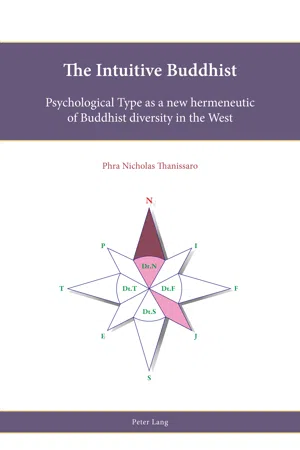 eBook - PDF
The Intuitive Buddhist
Psychological Type as a new hermeneutic of Buddhist diversity in the West
- Phra Nicholas Thanissaro(Author)
- 2020(Publication Date)
- Peter Lang Group(Publisher)
Chapter 2 Psychological Type and Individual Differences Introduction With this chapter we embark on our subject matter by assessing Psychological Type as a tool for understanding individual difference. After giving the reader the opportunity to explore their own Psychological Type, the chapter moves on to show how the theory has been applied to individual differences in the general population, connecting with Psychological Type literature for non-Buddhist religiosity. Personality psychologists have been relatively slow to accord the same kind of esteem to the Jungian model of Psychological Type that they have given to the Cattells’ (1993) sixteen-factor model of personality, Eysencks’ (1991b) three-dimensional model of personality or the more recent Big Five factor model of personality (Costa and McCrae, 1985). However, the Jungian model of Psychological Type is widely applied by researchers in religious personality as it already features regularly in clergy profes- sional development in Australasia (Dwyer, 1995), North America (Baab, 2000) and the United Kingdom (Duncan, 1993). There are three key ideas which make Psychological Type theory particularly relevant to religious research compared to other models of personality – the use of categories rather than a sliding scale, exclusive emphasis on healthy personality and the possibility to profile populations rather than individuals on the basis of Type distribution ratios. 24 The Intuitive Buddhist Categories of personality rather than a sliding scale The first important characteristic of Psychological Type theory is the way it differs from personality dimensions that use a sliding scale. Although the Eysenck Personality Questionnaire (EPQ) (Eysenck and Eysenck, 1991b) shares some of its terminology with Jungian Psychological Type, it simply rates individuals as scoring higher or lower on a sliding scale between Introversion and Extraversion – so-called ‘ambiversion’. eBook - PDF
- Nancy Ogden, Michael Boyes, Evelyn Field, Ronald Comer, Elizabeth Gould(Authors)
- 2021(Publication Date)
- Wiley(Publisher)
Chances are good that you know people who provide examples of each of these traits. Personality traits are stable characteristics or qualities that people show in a variety of situations over a long period of time, even a lifetime. They describe our tendencies to act in a particular way. personality traits tendencies to behave in certain ways that remain relatively constant across situations. TABLE 12.3 Which Trait Best Describes You? Friendly Kind Self-confident Undemanding Tricky Introverted Unsympathetic Iron-hearted Distant Crafty Meek Firm Unargumentative Outgoing Tender Nervous Curious Shy Calm Unsophisticated Source: Adapted from Waugh, M. H., Hopwood, C. J., Krueger, R. F., Morey, L. C., Pincus, A. L., & Wright, A. G. (2017). Psychological assessment with the DSM–5 Alternative Model for Personality Disorders: Tradition and innovation. Professional Psychology: Research and Practice, 48(2), 79. 502 CHAPTER 12 Personality The area within personality psychology that focuses on traits is called, not surprisingly, the trait approach. Trait researchers are interested in cataloguing traits and determining how many are needed for an adequate picture of human diversity. From this point of view, the traits that individuals possess (how many and to what degree) determine their personality. Thus, personality traits are said to be dimensional. This means that trait terms define spectrums that traits can be found along, ranging from people displaying very little to a lot of trait-consistent behaviour. Most traits don’t emerge full-blown—they develop gradually over time. Some per- sonality psychologists believe personality is not completely formed, or crystallized, until the late teens all the way to the early thirties, depending on an individual’s experiences (McAdams, Shiner, & Tackett, 2018; Wolff, 2017). But this doesn’t mean that traits are necessarily carved in stone. We all have the ability to modulate or change our behaviours over time. No longer available |Learn more
Psychology Applied to Modern Life
Adjustment in the 21st Century
- Wayne Weiten, Dana Dunn, Elizabeth Hammer(Authors)
- 2014(Publication Date)
- Cengage Learning EMEA(Publisher)
In summary, we use the idea of personality to explain (1) the stability in a person’s behavior over time and across situations (consistency) and (2) the behavioral differences among people reacting to the same situation (distinctive- ness). We can combine these ideas into the following defi- nition: personality refers to an individual’s unique con- stellation of consistent behavioral traits. Let’s look more closely at the concept of traits. What Are Personality Traits? We all make remarks like “Melanie is very shrewd ” or “Doug is too timid to succeed in that job” or “I wish I could be as self-assured as Antonio.” When we attempt to describe an individual’s personality, we usually do so in terms of specific aspects, called traits. A personality trait is a durable disposition to behave in a particular way in a variety of situations. Adjectives such as honest, depend- able, moody, impulsive, suspicious, anxious, excitable, domineering, and friendly describe dispositions that represent personality traits. Most trait theories of personality assume that some traits are more basic than others. Ac- cording to this notion, a small number of funda- mental traits determine other, more superficial traits. For example, a person’s tendency to be I magine that you are hurtling upward in an elevator with three other persons when suddenly a power blackout brings the elevator to a halt forty-five stories above the ground. Your companions might adjust to this predicament differently. One might crack jokes to relieve tension. Another might make ominous predictions that “we’ll never get out of here.” The third might calmly think about how to escape from the elevator. These var- ied ways of coping with the same stressful situation oc- cur because each person has a different personality. Personality differences significantly influence people’s patterns of adjustment. Thus, theories intended to ex- plain personality can contribute to our effort to under- stand adjustment processes. eBook - PDF
Personality
Theory and Research
- Daniel Cervone, Lawrence A. Pervin(Authors)
- 2018(Publication Date)
- Wiley(Publisher)
Likewise, personality researchers associated with the trait approach consider traits to be the major units of personality. Obviously, there is more to per- sonality than traits, but traits have loomed large throughout the history of personality psychology. The Trait Concept What, then, is a trait? Personality traits refer to consistent patterns in the way individuals behave, feel, and think. If we describe an individual with the trait term kind, we mean that this individual tends to act kindly over time (weeks, months, maybe years) and across situations (with friends, family, strangers, etc.). In addition, if we use the word kind, we usually mean that the person is at least as kind as the average person. If one believed that the person was less kind than average, he or she would not be described as “kind.” Trait terms, then, have two connotations: consistency and distinctiveness. By consistency, we mean that the trait describes a regularity in the person’s behavior. The person seems predisposed to act in the way described by the trait term; indeed, traits often are referred to as “dispositions” or “dispositional constructs” (e.g., McCrae & Costa, 1999, 2008) to capture the idea that the person appears predisposed to act in a certain way. The idea of disposition highlights an impor- tant fact about trait terms as used by trait theorists of personality. If a trait theorist uses a trait term—for example, sociable—to describe someone, she does not mean that the person always will act sociably, across all settings of life. As the Dutch trait psychologist De Raad (2005) has emphasized, trait terms implicitly refer to behaviors in a type of social context. The trait theorist would expect the sociable person to be consistently sociable across settings that involve other Trait Theory’s View of the Science of Personality 183 people and in which sociable behavior is allowed by prevailing social norms. eBook - PDF
The Counsellor's Guide to Personality
Understanding Preferences, Motives and Life Stories
- Rowan Bayne(Author)
- 2017(Publication Date)
- Red Globe Press(Publisher)
Discovering your preferences, through counselling or other means, is usually reported to be like ‘coming home’, though it is sometimes more difficult to switch from non-preferences than it sounds (as discussed later in this chapter, in the section on personality change) . The concept of ‘psychological type’ A person’s ‘type’, as this term is used in current standard psychological type theory, includes one from each of the four pairs of preferences, for example ENTP or ESTJ. There are 16 such combinations and therefore 16 types. The term ‘type’ can be a problem because it is readily associated with charlatans, mysticism and pseudo-science and because it is often dismissed as too simple and therefore insulting to individuality. My view is that it’s dismissed too easily. First, there have consistently been prominent Table 1.3 Brief descriptions of the preferences (when developed) E More outgoing and active More reflective and reserved I S More practical, interested in facts and details More interested in possibilities and an overview N T More logical and reasoned More agreeable and appreciative F J More planning and coming to conclusions More easy-going and flexible P 12 THE COUNSELLOR’S GUIDE TO PERSONALITY researchers who take it seriously (e.g., John & Robins, 1994; Dahlstrom, 1995; Vollrath & Torgersen, 2002; Haslam, 2007). Second, it can convey more information about a person’s personality with greater economy than traits. For example, an animal can be described as quick, medium size and quite furry (traits) or a leopard (type). This is not to say that people are types in the same way as animals are species; for a start, we are more able to pretend to have qualities which we don’t have and more prone to self-deception. However, differences in personality are profound to the extent that the different types can seem like different species. eBook - PDF
The Psychology of Culture
A Course of Lectures
- Edward Sapir, Judith T. Irvine(Authors)
- 2011(Publication Date)
- De Gruyter Mouton(Publisher)
Jung makes the mistake of identifying [his types] with thought tendencies [alone, without reference to cultural form]. 2. Jung's Functional Types Jung also classifies [personality] according to functional types, a term that is not actually very suitable for them. [He proposes four of these types:] the thinking, feeling, intuiting, and sensational, [grouped into] rational vs. irrational, 5 thus: Figure 1 : Thinking Ί Feeling / Intuiting Ί Sensational J Jung's Psychological Types Rational Irrational The Problem of Personality Types: A Review and Critique of Jung 159 [Like introversion and extraversion,] this personality classification is applicable at an early age. These classifications are based not on the realm [of one's interests or activities,] but in the authoritative [psychological] function [governing their value]. Thought, feeling, sense, and intuition are concepts to indicate the type of [psychological] control, authority, or underpinning which is advanced for holding one's professed interests. For example, [one might compare] these four authorities as four different [reasons, or] desires, for learning a new language. One [person has a] love for play with words [(this is the sensational type)]; another desires to know about the life, material culture, and so on of the people [who speak the language]. One [person] learns languages which are symbols of authority for belonging to certain groups; [and another has] an intuitive sense of form as such, or an intuition that the language may later become important [to him. Each person engages in the same activity, but under the sway of a different authority.] Each authority derives its strength from compensated or sublimated libido impulses — [presumably] in a genetic fashion, [although we do not know exactly how this works.] 6 Jung's classification into functional types has been criticized, and justly so. [Taken] at face value the classification is absurd, because its criteria are not comparable. eBook - PDF
- Ronald Comer, Elizabeth Gould, Adrian Furnham(Authors)
- 2014(Publication Date)
- Wiley(Publisher)
If people are generally enthu- siastic, for example, they may show enthusiasm by doing their homework with gusto or singing as they walk down the street. We can describe personality traits at different levels: as a trait/domain (i.e. extraversion) or as a facet (activity, sociability, risk taking) or a habit (going to parties, playing practical jokes). In doing so we can understand the structure of personality and try to get some idea of the mechanisms and processes involved. Many of today’s personality theories are based on the premise that people ’s personalities are made up of collections of traits. There is general agreement now, after many years of debate, about the Big Five dimensions of personality and inter- est in their origins. personality traits ten- dencies to behave in certain ways that remain relatively con- stant across situations. Before You Go On What Do You Know? 5. What is self-actualization? 6. According to Rogers, what happens if children fail to regularly receive unconditional positive regard? 7. What is a key criticism of humanistic theory? What Do You Think? What do you think are the key qualities of a fully self-actualized person? Who would match your characterization? THE TRAIT PERSPECTIVE 443 Human beings are natural trait theorists. It appears, though, that we are likely to explain our own behaviour in situational terms and others’ behaviour in terms of personality traits. (This tendency, called the fundamen- tal attribution error, is discussed further in Chapter 16) For example, you did not finish your paper because you were busy studying for two tests in your other classes. That guy over there did not finish his paper because he was uninterested or disorganized. Thinking about others’ behaviour in terms of traits helps make their behaviour predictable and gives us a sense of how our interactions with them may go.
Index pages curate the most relevant extracts from our library of academic textbooks. They’ve been created using an in-house natural language model (NLM), each adding context and meaning to key research topics.

