Psychology

Positive Psychology
Positive Psychology is a branch of psychology that focuses on the study and promotion of positive emotions, strengths, and well-being. It seeks to understand and cultivate human flourishing, resilience, and optimal functioning. Unlike traditional psychology, which often focuses on pathology and dysfunction, positive psychology emphasizes the positive aspects of human experience and aims to enhance individuals' quality of life.
Written by Perlego with AI-assistance
Related key terms
1 of 5
12 Key excerpts on "Positive Psychology"
 eBook - PDF
Virtues and Vices in Positive Psychology
A Philosophical Critique
- Kristján Kristjánsson(Author)
- 2013(Publication Date)
- Cambridge University Press(Publisher)
Its official manifesto as a movement appeared three years later (Seligman & Csikszentmihalyi, 2000), and soon afterwards eminent University of Michigan professor Christopher Peterson was drafted as the movement’s ‘director of virtue’. To put it as succinctly as possible, Positive Psychology is the study of human happiness: ‘the conditions and processes that contribute to the flour- ishing or optimal functioning of people, groups, and institutions’ (Gable & Haidt, 2005, p. 104), with special emphasis on the moral virtues and character strengths that sustain a thriving, well-rounded life. Recent years have witnessed an exponential growth in the output and influence of Positive Psychology, a growth that amazes even its most ardent supporters. The movement has drawn hundreds of millions of dollars in research grants, and an international conference on its ideology, held in Philadelphia during the summer of 2009, attracted fifteen hundred delegates from fifty-two countries. Some commentators say that Seligman and his colleagues are already the greatest entrepreneurs in the history of psychol- ogy and that Positive Psychology is the largest growth industry in psychol- ogy. At such top universities as Harvard, the Positive Psychology class has become the most popular psychology course offered. In an age of increasing academic fragmentation and grand narrative scepticism, in which we have been told in no uncertain terms by postmodernists that ‘Leviathans’ are out and ‘Lilliputians’ are in, there is suddenly a strong sense of a major social scientific movement in the making, with its own steering committee and manifesto. The Contexts of Positive Psychology 3 Positive Psychology is a theory with enormous scope, and it leaves few of life’s stones unturned. It aims not only at revolutionising the way academic psychologists look at their subject, but also at the way we bring up our kids and how we educate them in the home and at school. eBook - PDF
What Is the Good Life?
Perspectives from Religion, Philosophy, and Psychology
- Drew Collins, Matthew Croasmun, Drew Collins, Matthew Croasmun(Authors)
- 2023(Publication Date)
- Baylor University Press(Publisher)
Positive Psychology also argues that these strengths and virtues can be successfully and sustainably cultivated, and that their development and realization is conducive to human flourishing. As a consequence, a most particular aim for Positive Psychology is to develop and test interventions to build these strengths. These ideas of a common core nature for all human beings and of the continuous development and realization of these human potentials as the source of well-being and happiness constitute the central agenda for Positive Psychology. For Positive Psychology, in congruence with the Aristotelian model, goodness and morality, to sum up, do not come 210 Robert A. Emmons and Roxanne N. Rashedi from outside the person. They do not arise from cultural sources or from the moral rules of society, but from the potentials of the human being him- or herself. It is up to the individual to realize his or her full potential. People have an inherent capacity for constructive growth, for kindness, generosity, and so on. But it needs to be continuously exercised. Fostering these virtues is a central aim for Positive Psychology, because measuring and building human flourishing is the mission of Positive Psychology. PERMA: The Elements of Flourishing The questions addressed in this volume are: What does it mean for us to lead our lives well? Under what circumstances should we hope to live? What does the good life feel like? The field of Positive Psychology is well positioned to answer these sorts of questions. If these questions are to be pursued produc- tively by PP, “living well” in psychological terms needs to be defined. There are multiple definitions and theories surrounding human flourishing, but it can generally be defined as feeling good and functioning well in life. 16 Yet psychology has not spoken with a single voice. There is no single, coherent, or unchanging account of the good life. eBook - ePub
Positive Psychology
The Basics
- Rona Hart(Author)
- 2020(Publication Date)
- Routledge(Publisher)
The field of Positive Psychology at the subjective level is about valued subjective experiences: Wellbeing, contentment, and satisfaction (in the past); hope and optimism (for the future); and flow and happiness (in the present). At the individual level, it is about positive individual traits: the capacity for love and vocation, courage, interpersonal skill, aesthetic sensibility, perseverance, forgiveness, originality, future mindedness, spirituality, high talent, and wisdom. At the group level, it is about the civic virtues and the institutions that move individuals toward better citizenship: Responsibility, nurturance, altruism, civility, moderation, tolerance, and work ethic.(p. 5)In line with this depiction, Gable and Haidt (2005) defined Positive Psychology more concisely as “the study of the conditions and processes that contribute to the flourishing or optimal functioning of people, groups, and institutions ” (p. 104).Finally, Lomas, Hefferon, and Ivtzan (2014a) concentrated on its applied side and defined Positive Psychology as “the science and practice of improving wellbeing ” (p. ix).As can be seen from these definitions, there are repeated core themes around which there is consensus among scholars, particularly regarding its focus on wellbeing, its scientific grounding, and targeting people who are considered psychologically healthy.However there are also some variations in emphasis, mainly around the depiction of its remit, which is still an area of disagreement.The mission of Positive Psychology
The grand vision of Positive Psychology was highly ambitious: “To catalyse a change in the focus of psychology from preoccupation only with repairing the worst things in life to also building positive qualities” (Seligman & Csikszentmihalyi, 2000, p. 5). eBook - ePub
Positive Art Therapy Theory and Practice
Integrating Positive Psychology with Art Therapy
- Rebecca Ann Wilkinson, Gioia Chilton(Authors)
- 2017(Publication Date)
- Routledge(Publisher)
as a result of them . In fact, one could paradoxically be quite ill and impaired in some ways and yet thriving in others.Disconcerted but also intrigued by the disruption of some of our fundamental assumptions about therapy, change, and human nature, we set about exploring Positive Psychology more deeply. This included looking at current literature in Positive Psychology, but also relevant material emerging in art therapy, education, and other related fields. It also involved looking back over the historical context surrounding the formation of this “new” field and the theoretical foundations upon which it is grounded.In the next few chapters, we share some of what we discovered. We have tried to distill what, for us, has taken over ten years to learn. For some of you, this material may be redundant. On the other hand, perhaps it can serve as a useful refresher and set the stage for exploring art therapy from a Positive Psychology perspective. We felt that that could best be done by first describing the circumstances around which Positive Psychology emerged. Especially because, despite being seasoned clinicians as well as art therapy educators ourselves, we were often surprised by gaps in our knowledge or misconceptions that we had about the historical, social, economic, cultural, and political factors that led to development of different psychological schools of thought and that shaped mental health practices today, in general, let alone in the field of Positive Psychology.p.10 Positive Psychology DefinedPositive Psychology, also known as the science of wellbeing , is the study of human potential and optimal functioning. It is an in-depth exploration of the conditions and processes that allow individuals and communities to flourish and thrive (Seligman & Csíkszentmihályi, 2000). The field was christened in 1998 when Martin Seligman (1999), in his role as the president of the APA, identified that although we had made tremendous advances in understanding mental illness and reducing suffering, we had not devoted equal resources to exploring what is positive and functional in our lives. Positive psychologists have set about correcting this imbalance—not to diminish or replace the importance of addressing and attending to pathology and pain—but to complement this with an exploration of healthy, adaptive functioning. They wanted to establish for mental health the same depth and breadth of research, theory, and practical application as has been done for mental illness eBook - PDF
Well-Being
Individual, Community and Social Perspectives
- J. Haworth, G. Hart, J. Haworth, G. Hart(Authors)
- 2007(Publication Date)
- Palgrave Macmillan(Publisher)
Part 1 1 Positive Psychology and the Development of Well-Being Jane Henry Positive Psychology Positive Psychology burst onto the stage in 1999. It focuses on the positive side of life studying well-being, positive experiences such as flow, positive emotions such as satisfaction and happiness, positive strengths such as courage and wisdom, positive explanatory styles such as optimism and hope, positive coping such as resilience and post- traumatic growth and positive development such as creativity and positive ageing. The charge is that since World War Two psychology and indeed most of the rest of social science, education, health and business have focused on the negative side of life and neglected research into ways in which normal people can learn to function particularly well in the world. In organizational studies there are lots of papers on stress, burnout and the glass ceiling and few on organizational well-being; health psychology is almost entirely devoted to the study of illness; adult development draws on strategies borrowed from psychotherapeutic techniques designed to help neurotics; and education is currently dominated by a model centred around inputting competencies that individuals are deficient in rather than building on people’s natural talents. New movements rarely take place in isolation. A shift in interest in the positive side of life is seen in other areas: in counselling, for example, solution-focused therapy is popular, and cognitive-behavioural ther- apists are becoming interested in mindfulness; in education we find a renewed interest in creativity; and business is beginning to see increasing interest in appreciative inquiry (AI) and allied approaches. With US estimates that about a quarter of the population are languishing compared to only a fifth who could be judged as flourishing 25
- Stephen F. Davis, William Buskist, Stephen F. Davis, William F. Buskist(Authors)
- 2007(Publication Date)
- SAGE Publications, Inc(Publisher)
202 73 P OSITIVE P SYCHOLOGY M ATTHEW W. G ALLAGHER AND S HANE J. L OPEZ University of Kansas, Lawrence P ositive psychology is the scientific examination of that which makes life worth living. Cutting across traditional boundaries of clinical, social, and devel-opmental psychology, Positive Psychology examines the nature of happiness, the power of hope, and fundamental human strivings such as the search for meaning. As a subfield of psychology that has received much attention recently, it is particularly fitting to discuss the shape posi-tive psychology may take in the 21st century. We will begin this discussion by providing a brief review of the history of the Positive Psychology initiative before defining Positive Psychology as it stands at the beginning of the 21st cen-tury. We will then review three areas of positive psychol-ogy that have been emphasized in recent years: positive emotions, character strengths, and positive mental health. We will conclude with a brief glimpse of some recent fas-cinating findings, a discussion of the current limitations of Positive Psychology, and a perspective on where Positive Psychology may go as the 21st century unfolds. HISTORY OF Positive Psychology Positive Psychology is not a new field. For decades, psy-chologists have examined topics such as the nature of positive mental health (Jahoda, 1958), the effects of hope (Menninger, 1959) and the correlates of happiness (Wilson, 1967). The reason that Positive Psychology is often char-acterized as a new subfield is that these early pioneers of Positive Psychology were few and far between. For much of the 20th century, the focus of psychology, particularly clinical psychology, was on understanding that which can go wrong with people in order to alleviate symptoms of distress.
- Jennifer S. Cheavens, David B. Feldman(Authors)
- 2021(Publication Date)
- Cambridge University Press(Publisher)
In short, Positive Psychology is interdisciplinary. In fact, Positive Psychology isn’t fully a discipline in itself, because the vast majority of people doing research in pos- itive psychology come from other disciplines within psychology. Although both au- thors of this textbook are clinical psychologists, for instance, we study and contribute to Positive Psychology. Figure 1.2 Psychology’s subdisciplines and the level of human functioning they typically study. Difficulty Functioning Normal Functioning Optimal Functioning Clinical Psychology Social, Personality, and Developmental Psychology Positive Psychology 9 1 WHAT IS Positive Psychology? Why We Need Positive Psychology There are at least two important reasons to study Positive Psychology. First, it’s a counterbalance to our natural human tendency to pay more attention to the negative than the positive. In one classic study, researchers interviewed three groups of peo- ple: some who had won the lottery approximately a year prior to the interview, some who had experienced a serious injury-producing car accident also about a year ear- lier, and a control group of people who had experienced neither outcome (Brickman et al., 1978). Given that a year had passed, the lottery winners didn’t report being any happier than those in the control group. The positive emotions that undoubtedly existed soon after the win had already diminished. On the other hand, the accident survivors’ negative feelings persisted. In other words, negative events appear to in- fluence people in a longer-lasting way than positive ones. But this is just one of many examples of research demonstrating that negative emotions and events may be stronger than positive ones. Writing in the journal Re- view of General Psychology, Roy Baumeister and his colleagues (2001) document- ed this phenomenon in numerous areas of life, including our financial decisions, friendships, and even our most intimate relationships. eBook - ePub
Frameworks for Practice in Educational Psychology, Second Edition
A Textbook for Trainees and Practitioners
- Barbara Kelly, Lisa Marks Woolfson, James Boyle(Authors)
- 2016(Publication Date)
- Jessica Kingsley Publishers(Publisher)
CHAPTER 14 Positive Psychology as a Framework for Practice Stephen Joseph IntroductionThe aim of this chapter is to discuss the application of the Positive Psychology framework to educational psychology, and in particular to reflect on how Positive Psychology leads us to reflect on the fundamental assumptions underpinning practice. There have always been psychologists who have been interested in understanding optimal functioning, most notably the humanistic psychologists, but it is only within the past two decades that interest in this has developed among a new generation of psychological practitioners and scholars who identify themselves as positive psychologists. The term ‘Positive Psychology’ was used by Martin E.P. Seligman in his presidential address to the American Psychological Association (APA) (Seligman 1999) in order to describe his vision for the future of psychological science. Seligman realised that psychology had largely neglected the latter two of its three pre-Second World War missions: curing mental illness, helping all people to lead more productive and fulfilling lives, and identifying and nurturing high talent. It was with that realisation that Seligman stated: ‘The aim of Positive Psychology is to begin to catalyze a change in the focus of psychology from preoccupation only with repairing the worst things in life to also building positive qualities’ (Seligman and Csikszentmihalyi 2000, p.5).In this chapter I will consider the implications of Positive Psychology for educational psychologists (EPs). I will begin by discussing, first, practical applications of Positive Psychology to educational psychology – in particular, how Positive Psychology can inform the everyday practice of educational psychology through its explicit focus on the positive side of human experience. I will then go on to consider theoretical perspectives about how Positive Psychology provokes re-examination of the fundamental assumptions underpinning the practice of educational psychology. eBook - ePub
Positive Psychology
The Science of Well-Being
- John Zelenski(Author)
- 2019(Publication Date)
- SAGE Publications Ltd(Publisher)
Founders of the Positive Psychology movement emphasized its differences from traditional psychology (Seligman & Csikszentmihalyi, 2000). This was useful in defining and growing their movement (Yen, 2010), but was also met with some ambivalence, irritation, and critique (Held, 2005; Taylor, 2001). Some felt unfairly excluded, and others pointed to a much longer history of positive topics in psychology. It is clear that Positive Psychology overlaps considerably with other areas, and many who contribute to it are ambivalent about identifying (exclusively) as positive psychologists. For example, a few years into the movement even its proponents Gable and Haidt (2005) expressed the sentiment, “We do not think of ourselves as rebels, and many of us rarely if ever refer to ourselves as ‘positive psychologists.’ We merely find that the Positive Psychology movement helps us study our topics more effectively” (p. 107). Many who contribute to Positive Psychology see themselves as belonging more to other areas, while having an interest in studying the good life.Nearly every sub-discipline in psychology rubs up against Positive Psychology. For example, personality psychology studies the characteristics that differentiate very happy from less happy people. Like Positive Psychology, health psychology is concerned with human wellness. Both areas share the core notion that health is more than absence of illness, and both have an interest in how prevention can keep people well (e.g. offering support before something goes wrong). Social psychologists have long studied cooperative and prosocial (e.g. helping) behaviour. Cognitive psychology, with its work on creativity, intelligence, and optimal learning strategies, has learned much about clearly positive, valued topics. Developmental psychologists are interested in how all these things unfold over the lifespan. Organizational psychologists and educational psychologists study and apply positive topics in their institutional contexts. Indeed, Positive Psychology seems to draw from and interact with all areas.Distinguishing Positive Psychology from Humanistic Psychology
The comparison with humanistic psychology, as a similar movement and sub-discipline, deserves special mention. You may have heard of Maslow’s (1943) hierarchy of needs, typically depicted in a pyramid-shaped diagram and topped by the uniquely human need to self-actualize. Carl Rogers (2007) similarly emphasized people’s individual uniqueness and the importance of unconditional acceptance from others (‘positive regard’) in fostering healthy development of the true self. Maslow and Rogers are well-known leaders in humanism, an approach to psychology that shares much with Positive Psychology. That is, both are prone to an optimistic perspective on human nature. Both focus on helping people thrive, going beyond merely alleviating suffering. Thus, some have argued that Positive Psychology merely re-branded a long tradition that includes humanistic psychology (Taylor, 2001). Similarly, existential psychology, with a focus on how people find meaning in their lives, is an important predecessor to central topics in Positive Psychology.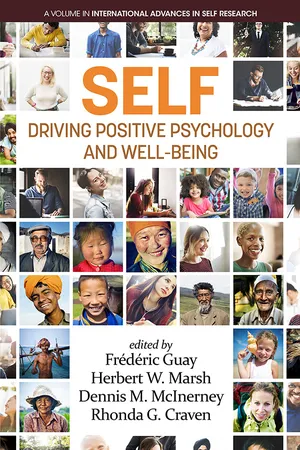
- Frédéric Guay, Herbert Marsh, Dennis M. McInerney, Frédéric Guay, Herbert W. Marsh, Dennis M. McInerney, Rhonda G. Craven(Authors)
- 2017(Publication Date)
- Information Age Publishing(Publisher)
Self—Driving Positive Psychology and Well-Being, pages 233–255 Copyright © 2017 by Information Age Publishing All rights of reproduction in any form reserved. 233 CHAPTER 9 LEVERAGING SELF PSYCHOLOGY TO STRENGTHEN POSITIVE PSYCHOLOGY Conceptual Analysis of Three Paths to Well-Being Danu Anthony Stinson University of Victoria William B. Swann Jr. University of Texas at Austin Clap along if you feel like happiness is the truth. —Pharrell Williams, 2013 Pharrell Williams’ song “Happy” recently became one of the most popular songs of all time. Its up-tempo beat and sing-along chorus are quite infec- tious. But its success may also stem from the song’s near-perfect attunement with the current zeitgeist of psychological positivity in the United States and abroad. People in Western cultures around the world long for happiness, 234 D. A. STINSON and W. B. SWANN self-acceptance, a sense of purpose, and belonging, and Americans alone spend over $10-billion annually pursuing these laudable goals (Self-Help, 2015). Within psychological science, these priorities have given rise to the burgeoning field of Positive Psychology. This movement has both a long and short history. Maslow (1954) coined the term “Positive Psychology” over 60 years ago, but it was just 17 years ago that Positive Psychology went main- stream. As president of the American Psychological Association, Martin Seligman (1998) lamented psychology’s failure to focus on cultivating the positive aspects of human existence—optimism, happiness, gratitude, vir- tue, resilience, and strength. It was time, he insisted, to expand psychol- ogy’s horizons by shifting attention onto these positive aspects and develop- ing strategies for improving well-being. Seligman’s (1998) exhortations struck a chord. Today, dozens, perhaps even hundreds, of psychological scientists are developing new strategies for cultivating positive psychological states, or adapting existing interventions to the task of improving well-being. eBook - ePub
- Acacia Parks(Author)
- 2014(Publication Date)
- Routledge(Publisher)
Finally, encouraging students to be vigilant of signs of client strengths and abilities, as well as indicators of psychosocial and environmental resources, and to point these out to clients as they arise is recommended. Students typically do not miss the weaknesses or struggles that clients report, but often overlook entirely positive functioning, assuming that the goals of therapy are to address issues or problems that clients have identified. Teaching them right from the start that the positive is just as important as the negative is essential. Indeed, from a positive psychological perspective, doing therapy without attending to the positive is just as ludicrous as doing therapy without attending to the negative. The goal is to strike a balance, and helping students to understand this in the early phases of learning to be a helper is crucial.Positive Psychology in personality psychology coursesPositive Psychology can be applied within the context of courses on personality when reviewing humanistic theories. Indeed, Positive Psychology has many roots in humanistic psychology (Seligman & Csikszentmihalyi, 2000). More specifically, the humanistic tenets that people are basically good and that they naturally strive toward personal growth, full functioning, and self-actualization fit very well with the premises of Positive Psychology.Although they are not identical, Maslow’s (1970) concept of peak experiences is related to Csikszentmihalyi’s (1990) flow theory. Peak experiences are defined as especially joyous and exciting moments in life, involving sudden feelings of intense happiness and awe that are often inspired by deep meditation, intense feelings of love, exposure to great art or music, or the overwhelming beauty of nature. When peak experiences are especially powerful, the sense of self dissolves into an awareness of a greater unity (Maslow, 1970). Flow, also referred to as optimal experience, is defined as a psychological experience in which one is fully immersed in what he or she is doing. In order for flow to occur, one must perceive a challenge or opportunity for action that stretches (without overmatching or underutilizing) his or her existing skill level. This is referred to as the challenge-skills balance (Jackson & Csikszentmihalyi, 1999). In addition, flow becomes more likely when such challenging activities are intrinsically rewarding, require concentration, and have clear goals coupled with immediate feedback on progress. Under these conditions, people often enter into a subjective state in which there is a merging of action and awareness, deep, effortless involvement in the task at hand, intense focus in the moment, a loss of self-consciousness, a sense of control, and distortion of time (Jackson & Csikszentmihalyi, 1999). While peak and flow experiences can be one in the same, flow experiences require a challenge-skills balance, whereas peak experiences do not. Likewise, peak experiences are often achieved via extraordinary life moments, whereas flow can be achieved through more routine activities (Jackson & Csikszentmihalyi, 1999). eBook - ePub
Education and Schmid's Art of Living
Philosophical, Psychological and Educational Perspectives on Living a Good Life
- Christoph Teschers(Author)
- 2017(Publication Date)
- Routledge(Publisher)
Chapter 5 , can broaden this understanding and provide a more holistic view on the topic.4.1 The relevance of Positive Psychology for an art of living
Psychology is traditionally a science concerned with the question of what is wrong with people. The art of living, on the other hand, is more concerned about how to get it right. Therefore, it seems necessary to give a short introduction about how these two areas are connected and why this connection is important for an educational approach.Beginning in the middle of the 20th century an increasing number of psychologists shifted their focus of research from the pathological question of “What is wrong with humans?” to the more positive research question of “What is right?”. This new focus became known later as the field of Positive Psychology, which was introduced under this name around the year 2000 by Martin Seligman and Mihaly Csikszentmihalyi, who have since been known as the founders of this new area of psychological research. The term Positive Psychology subsumes a range of areas, including flow, positive emotions, wisdom and knowledge, happiness and well-being, creativity, strengths and values, (life) goals, positive coping strategies, humour and many more (Boniwell 2008, 1–6). As this area of research has grown significantly in the last 15 years, the focus in this chapter lies on Martin Seligman’s (2010) book Authentic Happiness, which provides a good overview of Positive Psychology, and the book Flow from Michael Csikszentmihalyi (2008), which offers insights in one of the main theories for happiness and well-being. Csikszentmihalyi also includes some thoughts about the history and development of happiness in humanity.The contribution Positive Psychology can make to an educational approach to the art of living is manifold and singular at the same time. The main focus of Positive Psychology lies in explaining and increasing happiness and positive emotions, which appears to be a singular topic. On the other hand, research shows that such an increase has a positive effect on health, performance, creativity and coping with negative emotions, and it also prolongs life1
Index pages curate the most relevant extracts from our library of academic textbooks. They’ve been created using an in-house natural language model (NLM), each adding context and meaning to key research topics.

