Psychology

Restorative Justice
Restorative justice is a theory and practice that focuses on repairing harm caused by criminal behavior. It emphasizes the needs of victims and the community, as well as the responsibilities of offenders to make amends. This approach aims to promote healing and reconciliation, rather than solely punishing the offender.
Written by Perlego with AI-assistance
Related key terms
1 of 5
11 Key excerpts on "Restorative Justice"
 eBook - PDF
- William J. Chambliss(Author)
- 2011(Publication Date)
- SAGE Publications, Inc(Publisher)
215 16 Restorative Justice William R. Wood California State University, Fullerton/University of Auckland R estorative justice is both a philosophy and loosely aligned set of interventions that focus less on crime as the breaking of laws than as the harming or breaking of human relationships. Emerging in the 1970s and 1980s as an alternative to more traditional youth and adult justice practices, Restorative Justice interventions such as victim–offender mediation, sentencing circles, and family group conferencing are largely organized around the principles of victim participation and redress, offender accountability and reintegration, and community participation in local justice practices. Such practices are thought to meet the needs of these three groups more directly and comprehensively than more tradi-tional rehabilitative or punitive approaches, and these three groups are seen as the primary social actors through which both crime redress and crime reduction can be best achieved. Primarily, Restorative Justice seeks to include victims in their own cases, ideally in settings that afford them the possibility of meeting with those who have harmed them, and more generally toward the goal of repairing these harms. Restorative Justice also seeks to provide opportunities for offend-ers to be accountable for these harms; to make amends to those they have harmed, when possible; and to reintegrate into their communities after they have made amends. Finally, Restorative Justice seeks to include local commu-nities into justice processes to the extent that they may help support victims, 216 Courts, Law, and Justice provide opportunities for offender reintegration, and when possible, partici-pate in the shaping of justice policies and community approaches to crime. eBook - PDF
- V. Lakshmikantham, Donato Trigiante, Lee E. Ross(Authors)
- 2014(Publication Date)
- Routledge(Publisher)
Understanding this principle is paramount in addressing the plight of both victims of domestic violence and the offenders responsible for their victimization. One way to guarantee the safety of domestic violence victims is to assure a reduced likelihood of the continued violence that occurs at the hands of perpetrators. A Restorative Justice approach provides one potential framework for achieving this result. What Is Restorative Justice? The Restorative Justice perspective seeks to address and balance the needs of crime victims, criminal offenders, and the communities from which they come. This justice perspective provides a unique paradigm for understanding and responding to crime and victimization and is unique in that it respects victims, traditionally a forgotten constituent in the criminal justice system. In the process, a Restorative Justice framework holds offenders accountable to their victims, and often allows the community and other supporters to take an active role in the justice process. Albert Eglash is credited for coining the phrase Restorative Justice in his 1977 article “Beyond Restitution: Creative Restitution,” where he identifies three types of justice. The first, retributive justice is a foundation for punish-ment and a perspective that views crime as simply the violation of the law. The second, rehabilitative justice also views the state as the victim (because its 342 Continuing the War Against Domestic Violence laws were broken), but is based on the therapeutic treatment of offenders. In this view the emphasis is on accountability through punishment. The third, Restorative Justice is an alternative to both retributive justice and rehabilita-tive justice. Restorative Justice, rooted in biblical principles, differs from the previous two paradigms in that crime is viewed not only as a violation of law, but also as a violation of people and relationships. eBook - PDF
- Brian Williams(Author)
- 2005(Publication Date)
- Jessica Kingsley Publishers(Publisher)
In essence, it involves trying to restore victims, offenders and the wider commu-nity to something like the position they were in before the offence was com-mitted, ideally by involving them all in the decision-making process and, where possible, attempting to reconcile their conflicts of interest through informal discussion. The classic definition was Marshall’s (1996, p.37): he 57 argued that Restorative Justice is ‘a process whereby all the parties with a stake in a particular offence come together to resolve collectively how to deal with the aftermath of the offence and its implications for the future’, but this defini-tion is not fully inclusive of all the possible approaches to Restorative Justice. For example, it leaves out shuttle mediation and written apologies (discussed below). It also implies an individualistic model of restoration, which arguably excludes possibilities such as truth and reconciliation commissions with a national remit (Dignan 2005). Some commentators use the phrase ‘Restorative Justice’ more generally to cover any intervention which aims to hold offenders to account by providing opportunities to make amends to victims, either directly or indirectly. However, it is questionable to what extent interventions can be regarded as restorative when, for example, offenders do not know that community work they undertake compulsorily as part of a court sentence is of indirect or symbolic benefit to victims, and the term can be used so loosely as to be almost meaningless (see Curry et al . 2004). Zehr and Mika (2003, pp.41–2) provide a helpful list of what they regard as the essential characteristics and principles of Restorative Justice. eBook - PDF
Criminal Justice Processes NQF4 SB
TVET FIRST
- M Johnson, J Lotz J van Vuuren(Authors)
- 2019(Publication Date)
- Macmillan(Publisher)
The following are some of the significant descriptions of the most important principles of Restorative Justice. l Crime is a broader concept than breaking the law or deviating from a regulation. l Crime is a disruption in the three-dimensional relationship between victim, offender and community. l Because crime harms the victim and the community, restoring the damage and healing the victim and the community ought to be a primary objective. l The victim, offender and community must be involved in establishing the content of the reaction to crime; the state must give up the monopoly in this area. l Case disposition must be based on victim and community needs, not only on the offender’s needs, responsibility, danger to society or criminal past. Figure 5.4: Restorative Justice in action Learning activity 5.4 1. Approach an organisation in your area, for example your local church, and ask about their involvement in the Restorative Justice process. 2. Compile a half-page summary about your discussion with the representative. 3. Challenge your class with a short proposal to get involved in the process in their community. Unit 5.2: The processes in the restorative stage 5.2.1 Victim-offender mediation (VOM) The first victim-offender reconciliation programme (referred to here as VOM ) began as an experiment (the Kitchener experiment) in Canada in the early 1970s when a youth probation officer convinced a judge that two youths convicted of vandalism should meet the victims of their crimes. After the meetings, the judge ordered the two youths to pay restitution to those victims as a condition of probation. Thus, VOM began as a probation-based, post-conviction sentencing alternative, inspired by a probation officer’s belief that victim-offender meetings could be helpful to both parties. VOM: victim-offender mediation New word eBook - PDF
Reimagining Restorative Justice
Agency and Accountability in the Criminal Process
- David O'Mahony, Jonathan Doak(Authors)
- 2017(Publication Date)
- Hart Publishing(Publisher)
53 Mainstreaming Restorative Justice within Criminal Justice 203 Clamp and Doak (2012); Kohen (2009). 204 Shapland et al (2006b). 205 Zehr (2005), 27. 206 Kohen (2009), 407. 207 Zehr and Mika (1998). 208 Bazemore and Schiff (2005), 51. 209 Bazemore and Schiff (2005); Shapland et al (2011). 210 Campbell (1984), 343. 211 See eg Ashworth (1993), (2002); Ashworth and Von Hirsch (1993); Morris (1968). be repaired. 203 In such circumstances, the Restorative Justice event comprises just one element of a longer interactional chain between the parties in which it may be appropriate to think of ways in which the status quo ante . 204 However, in other cases, no prior relationship between the victim and offender will have existed at all; the relationship itself only arises through the occurrence of a harmful act. 205 In such a scenario, ‘reconciliation’ blurs into a rather nebulous concept of restoring whatever (non)-relationship existed in the first place, or else appears to presume that the victim and offender want to develop an ongoing relationship in the after-math of the offence. 206 In addition to restoring the relationship with the victim and the community, offenders on an individual level are also in need of restora-tion, since their lives have been negatively affected by the offence. 207 Reintegration and rehabilitation are achieved through ensuring offenders are held account-able by accepting responsibility on an individual level and through ‘earning their redemption’ by completing their obligations to ‘make good’ the damage they have caused. 208 In this way, the offender’s ‘human capital’ can be maximised, resulting in overall higher levels of social capital which may subsequently help offenders to desist from future offending. eBook - PDF
The Penal Crisis and the Clapham Omnibus
Questions and Answers in Restorative Justice
- Cornwell, David J.(Authors)
- 2009(Publication Date)
- Waterside Press(Publisher)
85 Could Restorative Justice Give Victims of Crime a Better Deal? The state also has needs for crime reduction, lower penal system costs, reduced recidivism and lesser use of prisons. An increase in the use of community sanc-tions can meet these needs and provide reparation for victims of crime by using the resources that offenders can bring to community sanction projects. More construc-tive use of custodial corrections also contributes significantly to community well-being and the needs of government. Restorative Justice might be said to be the ‘fuel’ that could add a motive force to this collaborative enterprise in a number of different respects. First, the ethos of Restorative Justice, as we have already seen in Chapters 2, 3 and 4 , enables a different conceptual approach to be taken towards the punishment of offenders, the use of custodial and community corrections, the reparation of crime victims and the involvement of communities in delivery of justice. Secondly, the various forms of Restorative Justice dialogue (victim: offender mediation (VOM), conferencing and the use of circles) provide a means of communication between the stakeholders in an attempt to meet their needs and employ their resources to best effect. Third, these same forms of dialogue enable a more inclusive form of justice to be envisaged by making diversion from the full and formal criminal justice process possible in relation to less serious crime where victims and communities are reconciled with offenders who accept guilt, apologise and make appropriate reparation. And perhaps most important of all, these forms of dialogue reveal both high offender and victim satisfaction rates combined with reductions in recidivism. eBook - PDF
Urban Crime Prevention, Surveillance, and Restorative Justice
Effects of Social Technologies
- Paul Knepper, Jonathan Doak, Joanna Shapland(Authors)
- 2017(Publication Date)
- Routledge(Publisher)
Often, however, reha-bilitation has been an other-imposed process, where offenders have been “persuaded” to undertake activities that will rehabilitate them. Here we are indicating that offenders offering to change their lives can also be seen as symbolic reparation to victims. It is a way of offering to pay back that does not involve direct monetary or work payment but that in many ways may Key Elements of Restorative Justice Alongside Adult Criminal Justice 139 be far more costly than direct reparation. Indeed, in some ways, it is much closer to the philosophy of reform rather than rehabilitation because it is the offender indicating that he or she has different ideas about offending. We need to note that talking about possibilities for the offender in the future is also potentially empowering and democratizing decision making— if reports arising from the Restorative Justice process reach criminal justice decision makers. This was a characteristic of JRC’s and CONNECT’s pre-sentence conferences. Modern Western criminal justice decision making has tended to be concentrated within a small group of professionals, with lay people—even the offender—rarely being consulted about what should be done. Criminal justice decision making itself, at least for adult offenders and serious offenses, needs to be undertaken by duly appointed criminal justice personnel. So, for example, sentencing, to be seen as legitimate by the public and to reflect the public interest, needs to be decided by judges. However, decision makers cannot make good decisions unless informed by relevant, up-to-date information. The perceived need for more victim input and hence better information on the effects on victims has driven the adoption of victim impact statements in Australia and the United States (Erez & Rogers, 1999) and the adoption of victim personal statements in England and Wales (Morgan & Sanders, 1999).
- Shlomo Giora Shoham, Ori Beck, Martin Kett(Authors)
- 2007(Publication Date)
- Routledge(Publisher)
The acceptance of the offer by the victim and the approval by the beloved ones are expected to have an impact on his or her ethical identity as being basically a respectable person. There is a real chance that he or she is able to leave the offense and its consequences behind (after meeting the conditions), and that he or she is not fixed in the role of “irredeemable criminal” (Maruna 2001). Moreover, the whole process, in a nonadversarial climate, may facilitate the offender’s and his or her family’s awareness that things are going wrong, and that something must be done to stop the negative development. It may be the occasion to search actively for treatment or help, or to accept such an offer. This outline of the emotional dynamics that might be expected in a Restorative Justice conference is an ideal typical sketch. Reality is, of course, much more complicated. There are differences and nuances in each confer-ence, depending on the nature of the crime and of those with a stake in its aftermath, and on many specific circumstances and conditions. However, the outline points to the central importance of empathy as the gate opener to the process. Therefore, the context in which it should occur is crucial. Respectful and reintegrative processes enable offenders to feel empathy. This climate is probably the key to understand the communicational and inter-actional plus value of restorative processes. It is as an experienced confer-encing facilitator said: “Conferences bring the good in the people out” (Macrae 2000). 19.3.2.5 Public Dimensions of Restorative Justice As crime is also a public event, the public dimensions of the Restorative Justice impact are also important. Restorative Justice theory says that implementing restorative practices is beneficial for building stronger communities (McCold 2004b). A direct influence is expected by the decrease of reoffending in the offenders who have been involved in restorative programs. eBook - PDF
Restorative Justice and Criminal Justice
Competing or Reconcilable Paradigms
- Andreas von Hirsch, Julian V Roberts, Anthony E Bottoms, Kent Roach, Mara Schiff, Andreas von Hirsch, Julian V Roberts, Anthony E Bottoms, Kent Roach, Mara Schiff(Authors)
- 2003(Publication Date)
- Hart Publishing(Publisher)
They govern the participation of individual victims and offenders and the process through which agreement is sought to be reached on the indi-vidual case. Restorative Justice is clearly now a movement. My argument in this paper is that it has not yet set its boundaries and emphases as a movement. In particular it has not fixed its position in relation to traditional or formal crimi-nal justice. The uncertainty is mutual. Formal, state-run criminal justice has not yet decided what to do about Restorative Justice. The power to choose what to do has, so far, largely lain with the state. The state has the potential supply of cases, which it can decide to refer to Restorative Justice processes. Individuals and commun-ities have tended to provide referrals only in rare circumstances, where there is considerable distrust of state criminal justice. In addition, the state has funding to employ co-ordinators and train volunteers. The state has the ability to fund and recognise evaluation, to measure reconviction (by, of course, the state’s own criminal justice system), and to undertake cost-benefit analyses (where restora-tive justice is compared with the state’s own processes). So far, states have gener-ally decided to keep Restorative Justice at arm’s length, as a bit player. But the state has its own problems with criminal justice. Twenty to thirty years ago, in most countries, state criminal justice could bask in the approval of its people and communities. They might be concerned at individual cases; they might regard criminal justice agencies with fear rather than love; but state criminal justice was criminal justice. The courts were not challenged. A number of factors have now conspired to sow doubts in people’s regard for their state criminal justice system. Some of them are general social and economic Restorative Justice and Criminal Justice: Just Responses to Crime? 213 214 Joanna Shapland trends expressed in the move from a modern to a late modern society. eBook - ePub
Restorative Justice
Ideas, Values, Debates
- Gerry Johnstone(Author)
- 2013(Publication Date)
- Routledge(Publisher)
Bazemore 1996 : 40). Hence an important point of contrast is that, in the restorative process, offenders are required to play an active role and are expected to accept responsibility for their acts and for making reparation.As I have argued elsewhere, many proponents of therapeutic interventions into the lives of offenders themselves reject such a highly medicalised model of treatment (Johnstone 1996a , 1996b ). What they tend to prefer are socio-therapeutic programmes in which offenders are encouraged to play a highly active role rather than remain passive recipients of expert help, and to develop a sense of personal responsibility for their behaviour. If we examine these programmes and the assumptions which underpin them in detail, it becomes quite clear that they overlap in many ways with restorative interventions and that the two processes are more complementary than incompatible. Moreover, it is arguable that, in many cases, the goal of reintegrating offenders into the law-abiding community has a better chance of being achieved if both therapeutic and restorative interventions are employed, in a coordinated programme, rather than if we rely upon one to the exclusion of the other.Notes
- 1 Zehr’s argument that the retributive understanding of justice, which we tend to take for granted, is in fact just one paradigm (and one that is increasingly unable to solve our problems) is modelled on Thomas Kuhn’s famous study The Structure of Scientific Revolutions (1970) andLeshan and Margenau’s less well-known, Einstein’s Space and Van Gogh’s Sky: Physical Reality and Beyond (1982). Kuhn challenged the then conventional notion that science was a continual accumulation of knowledge, suggesting instead that it consisted of a series of peaceful interludes interrupted by revolutions in which one way of constructing reality was replaced by another. Kuhn’s work focused on the physical sciences but was enormously influential in the social sciences and beyond. Before Zehr, Barnett (1977
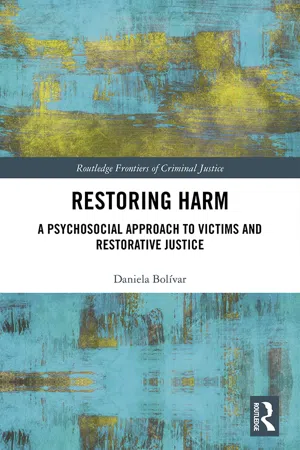 eBook - ePub
Restoring Harm
A Psychosocial Approach to Victims and Restorative Justice
- Daniela Bolívar(Author)
- 2019(Publication Date)
- Routledge(Publisher)
A second assumption is related to the definition of restoration adopted in this study. In the current research I aimed to adopt a psychosocial view of restoration. I have understood ‘restoration’ as a dynamic and multi-determined phenomenon, in which any external intervention (e.g. therapy, victim support, victim–offender mediation) will interact with individual characteristics and contextual factors (e.g. victim’s social networks, victim– offender relationship, and so on). This view also assumes that individuals may present variability in their responses to situations of violence. Victims may react by experiencing trauma, but also by experiencing growth. For all these reasons, ‘restoration’ has been studied in this research by (a) paying attention to the victim’s perception of him- or herself, the offender, the crime and its consequences as well as of his or her immediate social environment and (b) incorporating a ‘positive view’ of restoration, that is focusing not on psychological symptoms but on (positive or negative) emotions and meanings.A third and final assumption of this study is associated with its methodology. A mixed methodology with predominance of qualitative study was understood to offer the possibility of, on the one hand, strengthening results and, on the other, offering an in-depth view of victims’ meanings and perceptions about mediation and restoration. In addition, the longitudinal aspect of the methodology design (with assessments before and after mediation), as well as the incorporation of non-participants in mediation, was expected to offer some insights into the discussion about possible bias that positive findings on RJ may show, in particular, due to the voluntary nature of RJ and its motivational pre-requirements (e.g. Latimer, Dowden & Muise, 2005). It is important to remember, however, that taking such methodological decisions implies important costs. Prioritising the longitudinal aspect of the study importantly restricted the access to a large sample. The main reason for this was that only those victims contacted by the mediation services during the period of the fieldwork could be invited to take part in this study. In addition, a victim’s will acted as a ‘filter’ in the selection of respondents.
Index pages curate the most relevant extracts from our library of academic textbooks. They’ve been created using an in-house natural language model (NLM), each adding context and meaning to key research topics.

