Social Sciences

Industrialisation
Industrialisation refers to the process of transforming an economy from primarily agricultural and handicraft-based to one dominated by manufacturing and industry. This typically involves the introduction of new technologies, the growth of urban centers, and changes in social and economic structures. Industrialisation has historically been associated with significant shifts in employment patterns, living standards, and societal organization.
Written by Perlego with AI-assistance
Related key terms
1 of 5

3 Key excerpts on "Industrialisation"
 eBook - PDF
- Marinus Ossewaarde(Author)
- 2013(Publication Date)
- Bloomsbury Academic(Publisher)
C HAPTER 5 The Industrialization of European Societies A second aspect of the modernization process is industrialization, which refers to the radical transformation of the ancient European economy. The latter process was triggered by what is known as the Industrial Revolution, the unprecedented large-scale industrial application of steam and electricity-based energy to replace human or animal power. The revolutionary technology that enabled such a trans-formation owed its birth to the modern physics of scientists such as Isaac Newton and Robert Boyle. Industrialization brought radical changes to the ancient European agrarian (first-sector) economy with its peasants and aristocratic land-lords into a modern Europe of factories owned by entrepreneurs and kept running by workers and machines. This process had drastic implications for the lives of all Europeans, and its legacy can still be discerned in present-day European societies. In this chapter, the sociological endeavour is to highlight the core elements of this revolution that brings about not only a modern production and consumption system, but also a new political climate. The focus therefore will be on the transi-tion from the social order of an agrarian economy to one dominated by factory life; on the changes that the identity of the peasant underwent; on the industrial forms and sources of inequalities; and on the division of power in industrializing European societies. While division (and specialization) of labour and the accumu-lation of capital are very much part of modern, contemporary Europe, industrial factories no longer dominate the landscape in most parts of Europe today. Hence the final part of the chapter is devoted to sociological views regarding the changed and changing contemporary socio-economic landscape. The social order of industrializing European societies Europe’s antiquity and modernity are also separated by different socio-economic structures. eBook - PDF
A Hybrid Imagination
Technology in Historical Perspective
- Andrew Jamison, Steen Hyldgaard Christensen, Lars Botin(Authors)
- 2022(Publication Date)
- Springer(Publisher)
The economically-minded tend to see it as a mechanization process by which the infusion of machines and the mechanical philosophy with which they were associated turned the economy into something fundamentally different than it had been before. The socially-minded have tended to emphasize the “social innovations” that characterized industrialization, in particular, the factory system and the new kinds of governmental institutions and social organizations that emerged in the course of the 19 th century to shape an industrial society. In this chapter, we try to show how both 52 4. SCIENCE, TECHNOLOGY AND INDUSTRIALIZATION the economic and social changes that are associated with industrialization can be seen as part of a broader cultural transformation, a change in attitudes and behavior from rural communities to an industrial way of life. As we noted in chapter two, the most important foundational narrative for the economic story-line was provided by the philosopher-turned-political economist Karl Marx and his long-time friend and collaborator Friedrich Engels, who identified technological development as the main factor behind the growth of what they termed modern industry. Already in 1845, in The Condition of the Working Class in England, Engels had written of how the technical inventions of the late 18 th century “gave the impulse to an industrial revolution, a revolution which at the same time changed the whole of civil society” (Engels, quoted in Williams, R. , 1977, p. 138).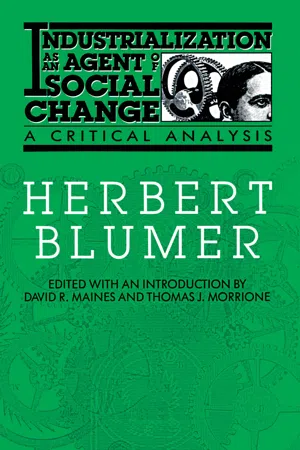 eBook - ePub
Industrialization as an Agent of Social Change
A Critical Analysis
- Herbert Blumer(Author)
- 2018(Publication Date)
- Routledge(Publisher)
chapter I have sought to identify the makeup of industrialization as an agent of social change. That identification was guided by the principle that the industrializing process must be seen and caught in terms of its points of contact with group life. Any depiction of industrialization as an agent of social change that merely aligns it alongside group life without showing its lines of entry into group life must be recognized as inadequate and highly suspect. We need a depiction that will allow us to see industrialization at work, instead of a depiction that merely leads the student to jump to alleged end effects. Guided by this need, I specified nine major lines along which the industrializing process seems, clearly, to play into group life, setting the need or occasion for social change. The question now arises as to how the industrializing process operates and functions along these lines of its entry into group life. The present chapter is addressed to this question, although unavoidably only in a preliminary way. The full consideration of the role of industrialization as an agent of social change can be given only through a series of stages that permit an orderly addition of new sets of observations for which analysis calls. The themes that runs through and dominates the chapter are (a) that there is a wide range of alternative developments along each line of entry of the industrializing process into group life, and (b) that the industrializing process does not determine the given alternative development that comes into being. In this sense industrialization is indeterminate or neutral with regard to what happens socially in its wake. This theme is so markedly in opposition to the premise of scholarly thought in this area that it needs to be developed very carefully.To avoid all possibility of misinterpretation it should be understood very clearly that the industrializing process is an agent of social change. To speak of it as being neutral or indeterminate does not mean that it is inconsequential or lifeless. To the contrary, its introduction leads always to some degree and some form of social change. Usually, the influence of industrialization is very extensive and profound. In introducing or expanding a new kind of economy it sets a different kind of framework inside of which collective life has to fit. In fitting into this new framework, people may be wrenched loose from a previous structure, subjected to the play of disorganizing forces of great power in the period of transition, and led to reorganize life and institutions along radically different lines. Mere causal reflection on the nine lines of entry into group life should make it vividly clear that the industrializing process necessarily introduces and induces social changes—changes that may assume great magnitude. In introducing a new occupational structure, in inaugurating ways of manning it, in launching migratory movements and a new ecological arrangement of people, in leading to systems of organizing and controlling people in their manifold industrial relationships, in bringing new groups into existence, in forming new collective interests around which the lives and pursuits of people become organized, in favoring valuations of life along monetary and contractual lines, in introducing new goods and products that may undermine existing industry and result in new patterns of consumption, and in providing for new patterns of income—in these ways, the industrializing process forces change in the lives and relations of people. Further, the changes that are started at each of the nine initial points of contact are almost certain to induce changes in other and most distant areas of group life; the initial changes may set off ramified chains of transformation that extend into all parts of group life. Thus, such diverse parts of group life as religion, education, moral codes, political organization, home life, village life, law, literature, and philosophy may reflect the impact of industrialization. Anyone with an eye to changes taking place in our contemporary world or familiar with those which have occurred historically to peoples and lands subject to industrialization must recognize the industrializing process for what it is, namely, a most powerful agent of social change.
Index pages curate the most relevant extracts from our library of academic textbooks. They’ve been created using an in-house natural language model (NLM), each adding context and meaning to key research topics.

