Social Sciences

International Development Theories
International development theories are frameworks that seek to explain the processes and factors that contribute to the economic, social, and political development of countries. These theories include modernization theory, dependency theory, and world-systems theory, each offering different perspectives on the causes and solutions for global inequality and underdevelopment. They are used to guide policies and interventions aimed at promoting development in different parts of the world.
Written by Perlego with AI-assistance
Related key terms
1 of 5

10 Key excerpts on "International Development Theories"
 eBook - PDF
- David Jaffee(Author)
- 1998(Publication Date)
- Praeger(Publisher)
Explaining development is further complicated by the fact that each discipline is composed of subdisciplines, subareas, and subfields that tend to emphasize one particular slice of social reality. Social scientists tend to focus upon one or a small number of factors as the key to understanding socio-economic devel- 2 Levels of Socio-economic Development Theory opment. The purpose of this book is to review some of the most prominent contemporary theories of development. It is important to understand the way theory shapes our interpretation of all social events, including socio-economic development. Theories provide a frame- work for making sense of the world. Most things we observe, experience, and study are extremely complex and are caused by a variety of factors. Each and every factor responsible for some event or process cannot be taken into account. We therefore, often unconsciously, rely on a theoretical framework that directs our attention to a very small part of the larger reality. In this way theories serve to simplify complex processes by offering a set of concepts that allows us to select, categorize, and label various forms of action and change, and to make inferences about cause and effect. The process of socio-economic development, which is complex and wide- ranging, has given rise to a multitude of theories, explanations, arguments, and assertions. Students of development are often perplexed by the vast assortment of explanatory models. There are so many theories, perspectives, and ap- proaches, all claiming to explain development; yet they conflict with and con- tradict one another. How is one to choose among competing explanations? Are there correct and incorrect theories? What evidence can be used to determine the empirical validity of the various models of development? These questions hound all areas of scientific inquiry, but they are especially problematic for the social sciences. No longer available |Learn more
International Development
Issues and Challenges
- Damien Kingsbury, John McKay, Janet Hunt(Authors)
- 2016(Publication Date)
- Red Globe Press(Publisher)
Still other commentators have suggested that in the development debate there has been far too much reliance on economic factors alone, and that in fact processes of political and social change are equally rel-evant. Indeed, many would argue that for effective development to take place it is usually essential to consider a range of social and political factors. This chapter will explore these major currents of thought and will evaluate some of the major theories that have been advanced. However, the main focus will be on what we have learned from the last 60 years of development theory and how this might be reflected in the design of more effective policy approaches. The global context for development ideas and policies Ideas in development theory and practice cannot be divorced from the broader assumptions, aspirations and beliefs of any age. These more general modes of thought set the scene for more specific discussions of what development is, or should be, and the most appropriate policies and methods that can be harnessed in the search for this elusive prom-ised land of happiness and prosperity. It could be argued that debate about development, its nature and how to achieve it, is the central issue in the whole of Western social science. The early towering figures in the field, writers such as John Stuart Mill and Karl Marx, were essentially theorizing about development. The Enlightenment was fundamentally concerned with progress towards an ideal society, and how the harness-ing of rational thoughts, policies and actions might allow the realiza-tion of this goal. But similar ideas of progress can be found in other non-Western modes of thought. In Japan, for example, a distinctive approach to the philosophy of economics was developed with a focus Reassessing Development Theory 53 on ‘administering the nation and relieving the suffering of the people’ (Morris-Suzuki 1989 ), a notion close to the concerns of development. eBook - PDF
- Justice Nyigmah Bawole, Farhad Hossain, Asad K. Ghalib, Christopher J. Rees, Aminu Mamman(Authors)
- 2016(Publication Date)
- Routledge(Publisher)
It is also about getting potential beneficiaries involved from the design of development intervention to their implementation. Theories of development From the agrarian society to the industrial society and the current global techno-logical world, society has been developing and progressing as the goals of society keep changing based on its needs and aspirations. From the assumptions of efficient 12 Bawole, Hossain, Ghalib, Rees and Mamman management of resources, exportation of raw materials to the industrialized world, and the building of infrastructure, the direction of development policy has changed to industrialization and the importation of ideas from the developed world to the underdeveloped one as the theory of development. Therefore, the emphasis on development in the past was on the transmission of social, economic and political structures to the less developed countries to reflect Western ideals (Zafarullah and Huque, 2012). Later this assumption was considered as fallacious as economic pro-gress led to unanticipated social consequences. The challenges of development and the causes of underdevelopment were later attributed to the role of the Western world in manipulating the less developed countries. Thus, dependency theory argued that the causes of underdevelopment are to be found outside the arena of third-world countries. Similarly, geographical explanations have been used to explain the causes of underdevelopment in poor countries. Many other theories and approaches have been used to explain the con-ditions and the reasons for the underdevelopment of poor countries. Whereas a number of theories have been discussed in relation to development over the years, this section will mainly concentrate on a few development theories: moderniza-tion theory, dependency theory, economic theories of development, geographical explanations and institutional theories.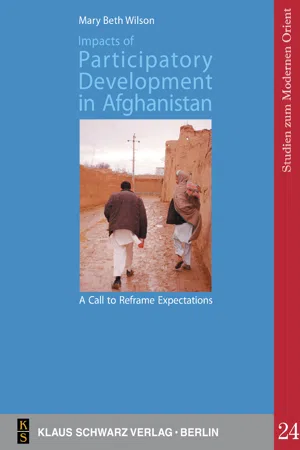 eBook - PDF
Impacts of Participatory Development in Afghanistan: A Call to Reframe Expectations
The National Solidarity Programme in the Community of Shah Raheem
- Mary Beth Wilson(Author)
- 2020(Publication Date)
- De Gruyter(Publisher)
This made room for different understandings and conceptual-izations of development to emerge over the past four decades. It, how-ever, still used other countries’ historical modernization as a development model, keeping the concept of development unilinear, with a clearly defined path. Additionally, dependency theorists looked upon the population of the State, and especially the rural population, as units of workforce. Their worth was in being a workforce, and nothing else. The popula-tion was not recognized as a development actor, this role remained at the State level. This would change dramatically as participatory ap-proaches gained favor. As has been shown, though seen as fundamentally opposing theo-ries, modernization theory and dependency theory are based upon many of the same assumptions: there is a path towards development that leads towards imitation of North American and European coun-tries, the State is the main actor, and economic development is the main indicator of success. These two theories, and the forthcoming world system theory, which is based upon the tenets of dependency theory, 51 can be categorized as classical approaches to development. Though the theories of course differ regarding some of the understandings of why a country is undeveloped, they still evaluate this based upon economic indicators and hope to resolve it through the implementation of top-down development approaches that engage the State, but not the peo-ple of the State. These classical approaches continue to inform many development projects and programs worldwide today, but they now share time and money with alternative development approaches that have emerged in response to the failures of these classical approaches. 1.2.5 Expanding the Definition of Development beyond Economics: Shifts towards Participation These alternative development approaches begin with the emergence of different understandings of the indicators used to measure develop-ment. eBook - PDF
Reconstructing Development Theory
International Inequality, Institutional Reform and Social Emancipation
- E.A. Brett(Author)
- 2009(Publication Date)
- Red Globe Press(Publisher)
Some have resolved their problems, many have not. The global system is also now threatened by the environmental crisis, the fragility of the global monetary and credit system, and the threat of international terrorism. Chapter 2 The Basic Assumptions of Development Theory This chapter will respond to the disagreements identified in Chapter 1 by arguing that many of them can be transcended by using a compara-tive institutional theory, which assumes that social outcomes depend on the nature of the authority, incentive and accountability mechanisms that characterize different kinds of institutions and organizations, and that these are likely to operate very differently in DCs than in LDCs. We will show that the primary goal of the liberal market-based institutions in the former are designed to turn technological and organizational innovation into an automatic, even compulsory process; that those in pre-modern societies were generally designed to maintain existing arrangements and therefore discouraged change; and finally that the classical traditions in development theory emerged to deal with a distinct array of market failures which confront LDCs and not DCs because LDCs are still attempting to build modern institutions. These failures make it difficult for them to adopt orthodox policy solutions in the short run, and call for a variety of second-best alternatives that take account of local understandings, value systems and endowments. The idea of development and structural change The idea of development, and the possibility of social progress that it supports, has normative, prescriptive and teleological implications. eBook - ePub
Political Development Theory
The Contemporary Debate
- Richard Higgott(Author)
- 2005(Publication Date)
- Routledge(Publisher)
per se.Considerations of space require that Chapter 2 restrict its coverage of modernisation theory. While recognising that modernisation theory represents in fact a combination of the social science disciplines— specifically economies, sociology, psychology and political science— Chapter 2 ‘isolates out’ political science from the social sciences for particular consideration. This is done for several reasons, First, the political science of political development provides in its own right the necessary background to look at the wide intellectual origins and ideological underpinnings of modernisation theory in general. Second, political science provides a quite specific and clearly defined intellectual community and body of literature, virtually institutionalised by the American Social Science Research Council Committee on Comparative Politics, which makes itself amenable to cohesive treatment. Perhaps a third reason for focusing on political science is that the changes that have taken place within this particular discipline reflect what is perhaps the major trend of the social sciences over the last decade—namely a rediscovery of the importance of economics.The study of development and underdevelopment as a ‘cutting edge’ of the social sciences has played no small part in the growing fashionability of political economy. Not the least of political economy’s attracttions for orthodox development theorists, in the first instance, is the belief that it presents some kind of integrated alternative to the previously distinct social sciences. We might in fact suggest that the problems of the developing world have provoked an academic return of sorts to nineteenth-century political economy—prior to the beginnings of that process of social science compartmentalisation that Gouldner suggests took place a hundred or so years ago (Gouldner 1971 and also Garson 1978:204). In no area of the study of developing countries is the economy any longer seen as an independent variable to be analysed separately from other socio-political or cultural variables. eBook - PDF
From Technology Transfer to Intercultural Development
Understanding Technology and Development in a Globalising World
- van der Stoep, Jan, Strijbos, Sytse(Authors)
- 2012(Publication Date)
- UJ Press(Publisher)
PART 2 Intercultural Development – Theoretical Reflections Part II: Intercultural Development – Theoretical Reflections 99 8 The Problem of Development: The Decontextualisation of Technology in a Global World 1 Sytse Strijbos Two paradigms In discussions of the social structure of world society, two views or paradigms stand out, namely, ‘modernisation theory’ and ‘worldsystem theory’. Each sheds quite a different light on the relation between rich countries and poor countries and the problem of development (see Wolterstorff 1983: ch. 2). The modernisation paradigm portrays the world as a collection of a great number of societies, each at a different point of development. At the heart of this view is the notion that third-world countries are ‘behind’ the rich countries and that they can fight ‘their’ poverty through modernisation. In other words: (1) it is in principle possible for all countries to attain a high level of modernisation without a need for farreaching structural changes in the countries that are already developed; and (2) the reason for their lagging behind in modernisation must be sought within the developing countries themselves – in their lack, for example, of modern technology. While according to theorists of the modernisation paradigm the world is thus comprised of a number of different societies in various stages of development (exemplarily for modernisation theory is Toffler’s (1980) conception of first-, second- and third-wave societies) ‘worldsystem’ theorists, in contrast, approach today’s world as a single social system and seek the cause of inequality in relations within the world system. Now, according to each of these two paradigms, what is the role of technology? To the modernisationists who attribute the lag in development to a lack, among other things, of modern technology, development aid should consist of programmes for ‘technology transfer’. eBook - PDF
Theorising Development in Africa
Towards Building an African Framework of Development
- Munyaradzi Mawere(Author)
- 2017(Publication Date)
- Langaa RPCIG(Publisher)
It is a United States of America and Europe-centric positive model of development whose main thrust is to spread features of capitalism around the globe. The focus of globalisation theory is communications and international ties, with these ties directed at cultural and economic factors in communication systems. The globalisation theory explains poverty and inequality by identifying cultural and economic factors in global connection. In explicating the theory of globalisation, Reyes (2001: 2) claims there are two major meanings of the word “globalisation”. One deals with the word as an event when a sense of interdependence occurs 37 throughout different countries of the world in different aspects of communication, trade, and finance. The other meaning that has been applied to the concept of globalisation considers it as a theory of economic development with the supposition of widespread unification among different countries. This integration is believed to have an effective influence on the development of economies and on the improvement in social indicator. The question that remains unanswered even today is whether globalisation really contributes to the socio-economic development of economies of developing countries. For Zineldin (2002), unlike the thinking displayed by pro-globalisation theorists, one can witness the problems that have been produced by globalisation in developing countries. He, like other scholars such as Akandele (2002) and Aborishade (2002), traces the origin of such globalisation related problems to developing countries competing rather than cooperating with each other. Zineldin, however, focuses more on religion other than culture as Aborishade and Akandele do. Religion, (Zineldin 2002) argues, can affect globalisation in exactly the same way that culture can, as demonstrated by the instruction in the Quran that cooperation is based on piety and goodness and shuns malice and devilish deeds (Qur'an, verse 2 in sura 5; Zineldin 2002: 39). eBook - PDF
- James Midgley(Author)
- 1997(Publication Date)
- SAGE Publications, Inc(Publisher)
It is, in particu-lar, inspired by the insights of political economy that focus on economic and political issues within a broad macroframework. This macroframework reflects social development's inclusive or universalistic scope. Instead of focusing on needy individuals, social development is concerned with communities, regions, and societies. While it is particularly concerned with the inner-city poor, impov-erished rural dwellers, ethnic minorities, and women who are neglected by eco-nomic growth or excluded from participation in the economy, its concern for these groups takes place within a wider universalistic context of interventions that promote the welfare of all. Social development's political economy approach also addresses values, beliefs, and ideologies explicitly. This permits the articulation of different strategies for attaining social development goals. Another feature of social development is its concern with process. This notion elicits a commitment to growth and change and is, therefore, explicitly progressive in nature. Advocates of social development believe that it is through progressive social change engendered by economic development that people's welfare can be promoted. Although the ideal of social progress is often ridiculed in intellectual circles today, social development advocates believe in the prospect of human betterment. They reject the nihilism, cynicism, and despair that have characterized many assessments of global social conditions. However, they are not complacent and believe that much needs to be done to improve the human condition. Despite the challenges ahead, they believe that social development offers a viable prospect of enhancing social welfare around the world. It is in this regard that the social development approach can be viewed as offering an alternative to the policies and programs of the radical right. As was shown in Chapter 6, the right's electoral successes have undermined conventional social policy approaches. eBook - PDF
- Gedeon M. Mudacumura, M. Shamsul Haque, Gedeon M. Mudacumura, M. Shamsul Haque(Authors)
- 2004(Publication Date)
- Routledge(Publisher)
Such a perspective motivates the government to plan and execute programs not only for national security but also for other types of security. Economic and Political Development Approaches Theories of Economic Development The theory of development has always remained at the center stage of economics and political science. Far from treating development as a spontaneous evolution, econ-omists and political scientists view it as a goal-oriented activity. While among classical economists—Adam Smith and others—the champions of laissez-faire equated economic development with capital formation, Marx iden-tified it with the socialist system ushered in through the revolutionary overthrow of the capitalist state. Such neoclassical economists as Alfred Marshall and Pareto identified it with the stability and continuity of the capitalist system and the positive role of the state in the regulation of the market economy. Joseph Schumpeter, who like Marx predicted the decline of capitalism and its succession by socialism, distinguished between economic growth and economic development. Growth is a product of cumulative changes brought about by the material and nonmaterial forces of production. It is steady, continuous, and slow, whereas development, which is the effect of technological and social factors and to some extent economic growth, is discontinuous, disharmonious, uneven, cyclical, and unstable. Technological change is the determining factor and the entrepreneur is the propelling force of economic development. In the 1950s and 1960s the economic development theories that were based on the experience of Western developed countries viewed development as economic growth measured by increasing GNP per capita. This limited definition and ethno-centric conceptualization of economic development became the dominant approach Development as Multidimensional Concern 139 to the development policies pursued by both developing nations and the United Nations in the 1950s and 1960s.
Index pages curate the most relevant extracts from our library of academic textbooks. They’ve been created using an in-house natural language model (NLM), each adding context and meaning to key research topics.

