Social Sciences

New Right View of the Family
The New Right view of the family emphasizes traditional family values, such as the nuclear family structure and the importance of marriage for raising children. It advocates for limited state intervention in family affairs and promotes the idea of self-reliance and personal responsibility within the family unit. This perspective often aligns with conservative political ideologies and emphasizes the role of the family in maintaining social order and stability.
Written by Perlego with AI-assistance
Related key terms
1 of 5


4 Key excerpts on "New Right View of the Family"
 eBook - ePub
Changing Family Values
Difference, Diversity and the Decline of Male Order
- Gill Jagger, Caroline Wright(Authors)
- 2003(Publication Date)
- Routledge(Publisher)
On a social constructionist view of the family, the New Right’s emphasis on biological relationships is part of an attempt to control ties that do actually exist within society through shaping people’s discourse about, and evaluation of, them. If the account I have given of the way the family and nation play crucially related roles in New Right thinking is correct, then the reasons why families and nations so structured and conceived should exist is reasonably clear. The existence of the nuclear family with its private sphere of responsibility justifies a minimal state that allows maximum scope for the accumulation and application of private capital. But it also reproduces and legitimises the nation-state, which otherwise either lacks a long term basis or threatens to become more than minimal. The social agents responsible for the family’s discursive formation are those who hold political power—the power to control government in their own interests, which, in this instance, are supposedly secured by nation-states of a minimalist tendency. In that case, though, the family’s attractions look decidedly suspect, the values it offers questionable.It is the naturalism, and more especially the biologism, of the New Right’s conception of the family that is unacceptable, and in any case, nothing follows from merely biological facts about our drives and their outcomes as to what it is good or right to do.17 Yet it is on such foundations that the New Right constructs a conception of paternal responsibility that derives wholly from biology and owes nothing to a mother’s claim on behalf of her child, a claim arising from the presumption of a supportive relationship surrounding the act of conception.18 Notice how crucial for the New Right is the ascription of responsibility for child support to biological fathers. The male line must be maintained, even when the traditional families that sustained it have been irredeemably shattered. For if the male line is undermined then women eBook - ePub
- Maurice Mullard, Paul Spicker(Authors)
- 2005(Publication Date)
- Routledge(Publisher)
The New Right uses individualistic arguments in relation to the market, but often uses conservative arguments when considering social relationships, like the position of the family or the importance of social order. It does not seem to matter very much that the positions are based in different intellectual premises, or that they conflict in practice, because they are consistent in another way: both are used to support an idealised status quo, to resist people who argue for social change, and most importantly to object to intervention by government or the state.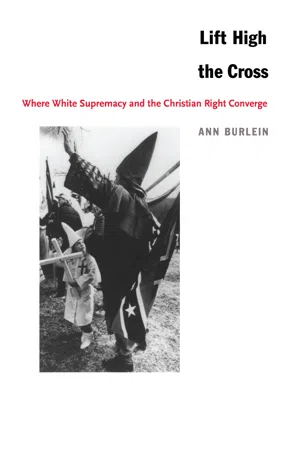 eBook - PDF
Lift High the Cross
Where White Supremacy and the Christian Right Converge
- Ann Burlein(Author)
- 2002(Publication Date)
- Duke University Press Books(Publisher)
Invoking the family to speak eco-nomic fears while eliding the structural nature of economic inequality, the new right represents market discipline as morality-inducing, thereby en-abling the nation to write o√ whole segments of the population in the name of human connection. Religion plays a key role in the new right’s ability to hold this contradic- 160 / Lift High the Cross tory alliance together and render its paradoxes productive. By investing ‘‘the family’’ with the aura of the sacred, the Christian right idealizes the family as a moral frontier that rides the juncture between national heritage and domestic memories. Mapped onto the national landscape as a moral topography, the Bible-based family underscores the hope of pri-vatism with fears of urban apocalypse, thereby entangling economics with race, gender, sexuality, and children in a poetics of control. Confronted with this tangle, what I want to do more than anything else is untangle it: separate religion from family from gender from sex from economics. Yet the power is in the tangle, in the larger cultural framework of privatism whose individual threads coproduce each other. The ques-tion posed by such a politics of family values is: Do we open and rethink this tangle? Or do we allow this tangle to rethink us? ∑ For rethink us it will. I conclude this chapter by demonstrating how Pete Peters invokes the variegated strands of this tangle to mainstream Chris-tian Identity by constructing convergences with more mainstream sec-tions of the right-wing continuum. Calling the Christian right on its blu√, Peters derives power for white supremacy by respinning the structural ignorance at work in privatism’s mythic geography of urban apocalypse to promote militias as simply the logical extension of a politics that mobilizes people to protect the Bible-based family. Better Homes and Gardens: Capitalism and the Construction of Intimate Identity It used to be you turned to a neighbor for help and support. eBook - PDF
- R. Woods(Author)
- 2007(Publication Date)
- Palgrave Macmillan(Publisher)
1 What is the New Right? Definitions and their uses There is little agreement among observers or representatives of the New Right about what it is. This lack of agreement is partly due to the varying motives of writers on the subject, but it is partly also due to the tensions and ambiguities within the New Right itself. Surveying the definitions of the New Right that have been advanced in recent years and reconsidering the nature and the boundaries of the New Right will help to define the critic’s task. Defining the New Right in terms of its general beliefs sheds light on the movement, but this approach also illustrates a problem. The New Right in Germany is frequently defined as an anti-democratic movement 1 dating back to the late sixties or early seventies and variously referred to as the ‘Young Right’, ‘young conservatism’ or ‘neo-conservatism’. 2 For this reason it has attracted the attention of the Federal Office for the Protection of the Constitution which defined the New Right in the mid-nineties as an ‘intellectual current or ideology that looks to the ideas of the Conservative Revolution and seeks to limit or abolish completely the principles of the free democratic basic order’. 3 Political scientists rightly home in on its rejection of universalism, pluralism, liberalism, parliamentarianism, equality, and multi-culturalism, on its ranking of the collective above the individual, on its wish to see a strong state and a strong leader instead of political decision-making through negotiation and compromise. Many observers define the New Right by pointing to its rejection of the French Revolution and the associated principles 7 of freedom, equality and fraternity. 4 In their place the New Right seeks to establish a ‘Volksgemeinschaft’ (community of the people), based on a supposed natural inequality of races and on the rule of an elite. 5 The New Right is also said to reject neo-Nazism and racism but is committed to the related concept of ethnopluralism.
Index pages curate the most relevant extracts from our library of academic textbooks. They’ve been created using an in-house natural language model (NLM), each adding context and meaning to key research topics.

