Technology & Engineering

Application of Calculus in Engineering
Calculus is used in engineering to model and analyze physical systems. It helps engineers to understand and predict how systems will behave under different conditions. Calculus is used in a variety of engineering fields, including mechanical, electrical, and civil engineering.
Written by Perlego with AI-assistance
Related key terms
1 of 5

3 Key excerpts on "Application of Calculus in Engineering"
 eBook - PDF
Computer Models of Process Dynamics
From Newton to Energy Fields
- Olis Harold Rubin(Author)
- 2022(Publication Date)
- Wiley-IEEE Press(Publisher)
4 Calculus and the computer The study of mathematics is primarily concerned with the manipulation of equa- tions. We will create models on a computer that manipulates arrays of numbers. “The Analytical Engine weaves algebraic patterns just as the Jacquard loom weaves flowers and leaves.” Ada, Countess of Lovelace, 1834 (Source: In the Public Domain, Rights Holder Augustus Ada King) It is better to use more than one approach when studying a problem. A mathematical solution and a computed result will show us two faces of the same coin. We thereby gain more insight than we would by finding a single result. 4.1 Introduction While scientists were investigating the nature of the world around us mathema- ticians were developing methods for analyzing its behavior. While Newton ima- gined that the orbit of the Moon around the Earth was governed by his laws of motion, he also developed the calculus to verify his hypothesis. This started a “gold rush” where mathematicians sought to tabulate the derivatives and integrals of countless functions. The next phase was to find ways of solving differential equa- tions. This intellectual exercise also had applications in science and engineering, which prompted engineers to design mechanical “models” that mechanized the solution. These were then implemented on electronic analog computers, which initiated the search for practical digital simulation. Chapter 2 discusses numerical techniques that can be used to approximate the integral of a variable. Advances in this area went hand-in-hand with improvements in computer graphics, to produce 57 Computer Models of Process Dynamics: From Newton to Energy Fields, First Edition. Olis Rubin. © 2023 The Institute of Electrical and Electronics Engineers, Inc. Published 2023 by John Wiley & Sons, Inc. simulation platforms such as MATLAB and Scilab. This chapter gives examples that show how it may be easier to find a numerical solution to a mathematical problem than to use classical analysis. eBook - PDF
- Lokesh Pandey(Author)
- 2023(Publication Date)
- Arcler Press(Publisher)
APPLICATIONS OF ENGINEERING ACROSS VARIOUS FIELDS CHAPTER7 CONTENTS 7.1. Introduction .................................................................................... 188 7.2. Types of Engineering ....................................................................... 188 7.3. Mechanical Engineering ................................................................. 197 7.4. Electrical Engineering ..................................................................... 205 7.5. Computer Science and it Engineering ............................................. 212 7.6. Application of Computer Science and it Engineering....................... 215 7.7. Conclusion ..................................................................................... 223 References ............................................................................................. 225 The Basics of Engineering 188 To develop, design, and analyze solutions engineering is a profession in which people apply scientific theory. Engineering consists of major basic branches which all have numerous subdisciplines in general. Civil, chemical, software, mechanical, electrical, and industrial are the major branches of engineering. To solve problems engineering is the application of science and mathematics. For scientific discoveries engineers figure out how things work and find practical uses. For innovations that advance the human condition, scientists, and inventors often get the credit, but in making those innovations available to the world it is engineers who are instrumental. 7.1. INTRODUCTION Much of the modern society depends on engineered artifacts to function, but many members of modern society are not aware of the engineering techniques and practices that have developed the technology and infrastructure. Engineers’ designs and creations are iPods, cell phones, airplanes, bridges, buildings, vehicles, computers, etc.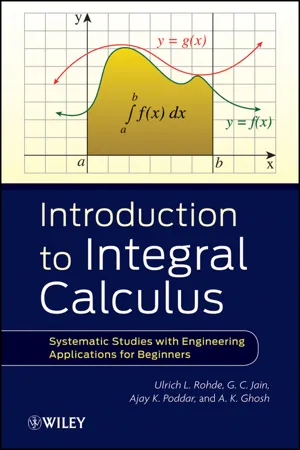 eBook - PDF
Introduction to Integral Calculus
Systematic Studies with Engineering Applications for Beginners
- Ulrich L. Rohde, G. C. Jain, Ajay K. Poddar, A. K. Ghosh(Authors)
- 2011(Publication Date)
- Wiley(Publisher)
In fact, we might define calculus as the study of limits. It is therefore important that we have a deep understanding of this concept. Although, the topic of limit is rather theoretical in nature, it has been presented and discussed in a very simple way, in the Chapters 7(a) and 7(b) of Part-I (i.e. Differential Calculus) and in Chapter 5 of Part-II (i.e. Integral Calculus). Around the year 1930, the increasing use of Calculus in engineering and sciences, created a necessary requirement to encourage students of engineering and science to learn Calculus. During those days, Calculus was considered an extremely difficult subject. Many authors came up with introductory books on Calculus, but most students could not enjoy the subject, because the basic concepts of the Calculus and its interrelations with the other subjects were probably not conveyed or understood properly. The result was that most of the students learnt Calculus only as a set of rules and formulas. Even today, many students (at the elementary level) “learn” Calculus in the same way. For them, it is easy to remember formulae and apply them without bothering to know: How the formulae have come and why do they work? The best answer to the question “Why study Calculus at all?” is available in the book: Calculus from Graphical, Numerical and Symbolic Points of View by Arnold Ostebee and Paul Zorn. There are plenty of good practical and “educational” reasons, which emphasize that one must study Calculus: . Because it is good for applications; . Because higher mathematics requires it; . Because its good mental training; . Because other majors require it; and . Because jobs require it. Also, another reason to study Calculus (according to the authors) is that Calculus is among our deepest, richest, farthest-reaching, and most beautiful intellectual achievements. This manu- script differs in certain respects, from the conventional books on Calculus for the beginners.
Index pages curate the most relevant extracts from our library of academic textbooks. They’ve been created using an in-house natural language model (NLM), each adding context and meaning to key research topics.

