Technology & Engineering

Creep in Metals
Creep in metals refers to the gradual deformation of a material under constant stress at elevated temperatures. It is a time-dependent process that occurs over an extended period, leading to the material's elongation or distortion. Creep is a critical consideration in engineering applications, particularly in high-temperature environments, as it can affect the structural integrity and performance of metal components.
Written by Perlego with AI-assistance
Related key terms
1 of 5
11 Key excerpts on "Creep in Metals"
 eBook - PDF
Metal Failures
Mechanisms, Analysis, Prevention
- Arthur J. McEvily, Jirapong Kasivitamnuay(Authors)
- 2013(Publication Date)
- Wiley-Interscience(Publisher)
9 Creep I. INTRODUCTION The time-dependent deformation of materials under stress is known as creep. In metals, it is primarily an elevated-temperature diffusion-controlled process that is terminated by rupture. This chapter reviews the creep mechanisms and creep lifetime prediction procedures. The several failure mechanisms are also discussed. II. BACKGROUND At temperatures above 0.4T M , where T M is the melting point in K, time-dependent deformation, that is, creep and rupture processes of materials, are primary design con- siderations. In many applications—for example, the aircraft gas turbine engine—the operating temperature, and hence the efficiency, are limited by the creep charac- teristics of materials, so that there is therefore an economic incentive to develop alloys with superior creep resistance. Designs are usually based on a maximum permissible amount of creep, such as 0.1 or 1% during the expected lifetime of a particular component. These service lives can vary from minutes for a rocket engine component, to tens of thousands of hours for jet engine components, to hundreds of thousands of hours for high-pressure steam lines. At elevated temperatures, creep deformation may not be the only mechanism governing service lifetime, for alloys have been found to fracture after very limited extension (1) or after unexpectedly short service lifetimes. However, today creep rupture is not a common occur- rence. This is because of advances in alloy development, particularly in the aircraft 216 III. CHARACTERISTICS OF CREEP 217 field, inspection procedures, and the development of codes such as the American Society of Mechanical Engineers (ASME) Boiler and Pressure Vessel Code and the recommended rules of the American Petroleum Institute (API). Creep problems with carbon steels can be avoided by limiting their use to temperatures below 0.4T m, that is, below the creep range.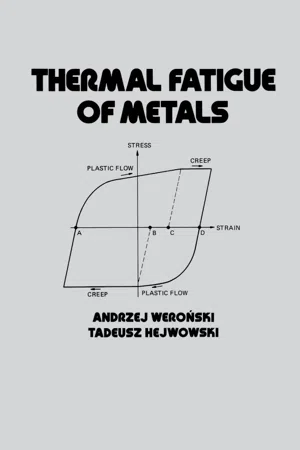 eBook - PDF
- Andrzej Weronski(Author)
- 1991(Publication Date)
- CRC Press(Publisher)
Creep 2 2.1 INTRODUCTION The term creep denotes slowly proceeding deformation of solid matter under a maintained load. The first systematic studies providing some quantitative informa-tion on the nature of creep were those of Andrade (1910). During World War I, research on creep became more urgent. Impetus was given by the rapid increase in steam admission temperatures in power plants (to about 670 K in the 1920s), approaching the creep range of low-alloy steels. Early researchers were concerned with finding the limiting stress below which creep would not occur, but using more accurate experimental techniques, this idea was subsequently shown to be false. The temperature at which creep becomes important for the designer is about 0.4 of the melting temperature of the material considered, but numerous exceptions bring this rule into question. For example, creep is observed in titanium at lower temperatures than in iron-based alloys, despite the higher melting point of the former. Stress levels under which creep is observable are always much lower than the strength of the material. A creep curve, which is the graphical presentation of the dependence of the strain on time under constant stress and temperature, is shown in Fig. 2.1. The strain £ 0 is developed immediately upon loading; the period of time between £ 0 and is called primary creep. Between ex and e2 the creep rate remains almost constant; this portion of the curve is termed secondary (or steady-state) creep: • * 2 S i £f = -----h ~ h The creep rate increases beyond £ 2 » an<3 this period is called tertiary creep. It is convenient to obtain experimental data under a constant tensile load. As creep proceeds, the true stress increases continually, giving rise to a pronounced change in the creep rate. The tertiary creep, where necking is appreciable, is certainly also 54 Creep 55 Time Figure 2.1 Schematic representation of a creep-rupture curve. eBook - PDF
- Arthur P. Boresi, Richard J. Schmidt(Authors)
- 2019(Publication Date)
- Wiley(Publisher)
626 CHAPTER 18 CREEP: TIME-DEPENDENT DEFORMATION In this chapter, we are concerned mainly with mathematical equations used to represent creep strain (Figure 18.1) as a function of stress, temperature, and time and the use of these equations to study the effects of creep. Therefore, we assume that an elevated temperature for a material exists so that the material may creep. A phenomenological approach is taken to describe the physical processes that alter the metallurgical structure of a material, allowing creep to occur. Furthermore, we do not attempt to describe in any detail various creep models (viscoelastic, elastic–plastic, etc.) that have been proposed. Rather, we base our study on the typical creep curve (plot of strain versus time; Figure 18.1) and mathematical modeling of the creep curve. Creep curves are ordinarily obtained by tests of bars subjected to sustained axial tension (Loveday, 1988). Standards for creep tests have been established by several technical organizations (ASTM, 1983; BSI, 1987; ISO, 1987). In Section 18.2, we briefly describe the tension creep test for metals. In Sections 18.3 and 18.4, we present one-dimensional creep formulas for metals subjected to stress and elevated temperature. In Sections 18.5 and 18.6, the creep of metals subjected to multidi- mensional states of stress is considered. Some applications to simple problems in creep of metals are discussed in Section 18.7. In Section 18.8, a few observations relative to creep of nonmetals are given. 18.2 THE TENSION CREEP TEST FOR METALS The creep behavior of various materials is often based on a one-dimensional (tension) test. Various standards for creep testing specify the geometric design of test specimens (ASTM, 1983; BSI, 1987; ISO, 1987). Careful control of machined dimensions is specified (Love- day, 1988). During the test, the tension specimen is subjected to sufficiently high stress and temperature T to produce time-dependent inelastic strain (creep). eBook - PDF
- Marc André Meyers, Krishan Kumar Chawla(Authors)
- 2008(Publication Date)
- Cambridge University Press(Publisher)
If a mechan-ical component of a structure is subjected to a constant tensile load, the decrease in cross-sectional area (due to the increase in length resulting from creep) generates an increase in stress; when the stress 654 CREEP AND SUPERPLASTICITY reaches the value at which failure occurs statically (ultimate tensile stress), failure occurs. The temperature regime, in kelvins, for which creep is important in metals and ceramics is 0.5 T m < T < T m , the melting of the material. This is the temperature range in which dif-fusion is a significant factor. A thermally activated process, diffusion shows an exponential dependence on temperature. Below 0.5 T m , the diffusion coefficient is so low, that any deformation mode exclusively dependent on it can effectively be neglected. In glasses and polymers, creep becomes important at temperatures above T g , the glass transition temperature. At T > T g , these materials turn rubbery or leathery, and viscoelastic and viscoplastic effects become important. Section 13.3 presents the various mechanisms responsible for creep. The critical temperature for creep varies from material to material; lead creeps at ambient temperature, whereas in iron creep becomes important above 600 ◦ C. In general, the phe-nomenon of creep is important at high temperatures. Some nickel-based superalloys can withstand temperatures as high as 1,500 K, and ceramics have temperature capabilities that are considerably higher (up to 2,000 K). Ice, on the other hand, also undergoes creep, which is responsible for the slow flow of glaciers. 1 Even the earth’s mantle is subjected to creep, giving it an effective viscosity. Creep in rocks has been at the center of controversy concerning the nature of geological processes on the planet Venus. The maxi-mum height of mountains on Venus has been calculated on the basis of rock creep, assuming a certain temperature and period of time.
- Rajiv Asthana, Ashok Kumar, Narendra B. Dahotre(Authors)
- 2006(Publication Date)
- Butterworth-Heinemann(Publisher)
From the material and component design perspectives, the steady-state creep rate (d ε s / dt ) is of considerable importance. The steady-state creep rate depends on the magnitude of applied stress, σ , and temperature, T, according to d ε s dt = K σ n exp − Q RT , (1-12) where Q is the activation energy for creep, K and n are empirical constants, and R is the gas constant. The exponent n depends on the dominant mechanisms of creep under a given set of experimental conditions, which include vacancy diffusion in a stress field, grain boundary migration, dislocation motion, grain boundary sliding, and others. The materials used in modern aircraft engines provide a classic example of how high-temperature creep resistance is enhanced through microstructure design in Ni-base alloys by dispersing nanometer-size oxide particles; this is discussed in Chapter 6. Time, t t r Creep strain, e Instantaneous deformation Primary Tertiary Rupture Secondary ∆t ∆e FIGURE 1-29 Schematic creep curve showing strain versus time at constant stress and temper- ature. The minimum creep rate is the slope of the linear region in the secondary creep regime. (W. D. Callister, Jr., Materials Science & Engineering: An Introduction, 5th ed., Wiley, New York, 2000, p. 226). 34 MATERIALS PROCESSING AND MANUFACTURING SCIENCE Deformation Processing A large number of manufacturing processes employ solid-state deformation of hot or cold metals and alloys to shape parts. Hot-working is the mechanical shaping operation that is per- formed at temperatures high enough to cause the processes of recovery and recrystallization to keep pace with the work hardening due to deformation. In contrast, cold-working is performed below the recrystallization temperature of the metal; however, both hot- and cold-working are done at high strain rates. Cold-working strain hardens a metal, and excessive deformation without intermediate annealing causes fracture.
- Yichun Zhou, Li Yang, Yongli Huang(Authors)
- 2013(Publication Date)
- CRC Press(Publisher)
The deformation and fracture at high temperature is related to the hold time of the load. The description of mechanical behavior at high temperature must consider two mechanical and temporal parameters: creep rate and failure life. It is not necessary to consider the time factor for the case at room temperature. In addition, chemical or electrochemical reactions accelerate at high temperatures. Thus, the environment has a significant influence on the deformation and fracture of materials at high temperatures.The theory of high-temperature deformation and fracture is based on diffusion theory and dislocation theory, and involves the disciplines of solid physics, metallography, elasto-plastic mechanics, fracture mechanics, and damage mechanics. It is an important branch of materials science. Internationally, high temperature deformation, fatigue failure, and fracture are among the hottest fields in materials science and engineering. In this chapter, we first introduce the fundamental knowledge on high temperature creep of metallic materials, the physics basis of creep, and the basic models of creep failure. We then introduce the fundamental knowledge of fatigue of metallic materials, mechanisms of fatigue failure, and models to predict fatigue life. Finally, we introduce the interaction mechanisms of high temperature creep and fatigue of metallic materials.7.1 Introduction to Creep of Metallic Materials
7.1.1 Concept of Creep
In Chapter 1 , we discussed elasticity and plasticity in detail. We know that there is a determined corresponding relationship between stress and strain; that is, the strain is determined once the stress is known. In practice, as shown in Figure 4.14 a, although the stress is fixed, the deformation or strain increases with time. How do we describe this phenomenon mathematically? Since time plays an important role, we introduce time t as an independent variable in the relationship of stress and strain, so that the degree of deformation is described by the strain rateε ˙, which is the derivative of strain with respect to time. For simplicity, we assume that the stress σ is proportional to the strain rateε ˙ eBook - PDF
- George Z. Kyzas, Athanasios C. Mitropoulos, George Z. Kyzas, Athanasios C. Mitropoulos(Authors)
- 2018(Publication Date)
- IntechOpen(Publisher)
Thus, even in the case of the uniaxial stress state, it is necessary to consider the four macroquantities — temperature, stress, time and strain. Creep characteristics determined in the experiments at constant temperatures can also often be used when evaluating the efficiency of structures at varying temperatures. To determine the dependences describing the creep process, it is usually necessary to use the data obtained in the standard uniaxial tension tests. Creep is mostly common with metals and alloys at absolute temperatures T higher than (0.4 – 0.5) T * ( T * is the melting point on the absolute scale, i.e., in Kelvin (K)). In the creep test, a cylindrical specimen with thermocouples attached to it is secured in the clamps of the loading machine and placed in the furnace. The temperature of the specimen is controlled using the thermocouples, and the results are sent to a tracking system. This system ensures heating of the specimen to the required level, and the temperature is then maintained constant with a specific accuracy. After complete heating of the furnace area, a tensile force is applied to the specimen. This force changes with time under a given law (in most cases, this force is constant or a fractional-constant time function). A strain measurement device is used to record the variation of the length of the specimen with time during continuous recording of the deformation diagram. The elongation of the specimen as a result of the creep of the material is accompanied by a decrease in the cross-sectional area and, consequently, the tensile stress increases continuously at a constant load. In the tests of the materials characterised by high creep strains (of 4 – 5% order or more), there are used systems where the load is self-compensated so that the stress in the specimen remains constant. When testing a number of creep-resistant alloys, it appears that the creep strains remain relatively small (approximately 1 – 2%) up to the moment of fracture.
- Hugh J. McQueen, Stefano Spigarelli, Michael E. Kassner, Enrico Evangelista(Authors)
- 2016(Publication Date)
- CRC Press(Publisher)
“inflection”.is.observed . .Thus,.care.must.sometimes.be.exercised.in.concluding.a. mechanical.steady.state.(ss) . The.term.“creep”.as.applied.to.plasticity.of.materials.likely.arose.from.the.obser-vation. that. at. modest. and. constant. stress,. at. or. even. below. the. macroscopic. yield. stress.of.the.metal.(at.a.“conventional”.strain.rate),.plastic.deformation.occurs.over. time.as.described.in.Figure.9 .1a. .This.is.in.contrast.with.the.general.observation,. such.as.at.ambient.temperature,.where,.a.material.deformed.at,.for.example,.0 .1–0.3 . T M . shows.very.little.plasticity.under.constant.stress.at.or.below.the.yield.stress,.again,.at. “conventional”.or.typical.tensile.testing.strain.rates.(e .g., .10 − 4 –10 − 3 .s − 1 ). .The.equation. notations.in.this.chapter.are.highly.specialized.for.creep.and.are.not.the.same.as.used. in.the.rest.of.the.book.that.are.listed.in.the.Table.of.Symbols.and.Acronyms . .The. analysis.makes.many.fine.distinctions.that.have.not.been.applied.in.hot.working,. although.knowledge.of.their.existence.broadens.the.insights.into.dislocation.. behavior. at.high. T . 302 Hot Deformation and Processing of Aluminum Alloys The. variation. in. the. steady-state. creep. rate. with. the. applied. stress. is. often. described.by.the.steady-state.stress.exponent,. n ,.defined.by . n T = ∂ ∂ uni239B uni239D uni239C uni239E uni23A0 uni239F ln ln . dotnosp ε ss σ ss . (9.1) The.“constant.structure”.stress-sensitivity.exponent,. N ,.is.defined.by . N = ∂ ∂ uni239B uni239D uni239C uni239E uni23A0 uni239F ln , dotnosp ε σ ln , T s . (9.2) where. T . and. s . refer. to. temperature. and. the. substructural. features,. respectively . . Sometimes,.the.sensitivity.of.the.creep.rate.to.changes.in.stress.is.described.by.a. constant.structure.strain-rate.sensitivity.exponent,. m . = .(1/ N ). .Generally,. N .is.rela-tively.high.at.lower.temperatures.[1],.which.implies.that.significant.changes.in.the. eBook - PDF
- C. L. Briant(Author)
- 2013(Publication Date)
- Academic Press(Publisher)
TREATISE ON MATERIALS SCIENCE AND TECHNOLOGY, VOL 25 4 Embrittlement of Ferrous Alloys under Creep Conditions D. P. POPE Department of Materials Science and Engineering and Laboratory for Research on the Structure of Matter University of Pennsylvania Philadelphia, Pennsylvania I. Introduction 125 II. Effects of Temperature, Strain Rate and Stress State 127 A. Test Temperature and Strain Rate 127 B. Stress State 129 III. Effects of Microstructure 134 A. Creep Strength 134 B. Transformation Product 136 C. Grain Size and Austenitization Temperature 139 D. Second Phases 143 IV. Grain-Boundary Impurity Effects 143 A. Cavity Nucleation Mechanisms 144 B. Cavity Growth Mechanisms . 145 C. Experimental Studies 146 V. Summary 151 References 152 I. Introduction It is well known that at the strain rates of mechanical processing opera-tions the deformability and ductility of metals increases as the tempera-ture is increased. However, if the strain rate is reduced to that of the creep range, there is a dramatic change in behavior. As the deformation rate is decreased and/or the deformation temperature is increased, the ductility tends to drop and the failure changes from a transgranular to an intergranular mode. The intergranular failure occurs by the nucleation, growth, and eventual coalescence of grain-boundary voids, as was first 125 Copyright © 1983 by Academic Press, Inc. All rights of reproduction in any form reserved. ISBN 0-12-341825-9 126 D. P. POPE reported by Greenwood (1952). The mechanism of void growth, at least for the initial stages of growth, appears to be stress-directed vacancy diffusion (Hull and Rimmer, 1959). The emphasis of this chapter will be on describing those factors that are known to affect the transition from a trans- to an intergranular failure mode in ferrous materials, and where appropriate, the results will be ra-tionalized in terms of the failure mechanism. eBook - PDF
The Study of Metal Structures and Their Mechanical Properties
Pergamon Unified Engineering Series
- W. A. Wood, William F. Hughes, Arthur T. Murphy, William H. Davenport(Authors)
- 2014(Publication Date)
- Pergamon(Publisher)
Because the primary or transient creep depends sensitively on the initial loading and structural state its rate, in practice varies from metal to metal. However, in general, as pointed out by Cottrell (Ref. 14), the variations fall within limits obtained by giving n particular values in the relation ! ocf-n. Thus n = 1 gives one limit, so-called logarithmic creep which dies away most rapidly; n = § gives the somewhat slower but commonly observed Andrade β-flow; and n = 0 would give the final constant rate of a steady state. Before further discussing the various laws it will be convenient to refer to the other variables. (ii) Stress Laws In practical specifications it is only necessary to know that a given stress σ should not produce more than a specified strain in a specified time, for example, not more than 1 percent in 10,000 hours for jet-engine alloys or in 100,000 hours for steam-turbine alloys. Whether the strain occurs by primary creep or by secondary creep is immaterial. However, for theoretical study it would be useful to know how stress affects each type of creep separately. Unfortunately, how it affects primary creep is difficult to deal with in detail; this creep depends too much on the initial condition of the metal and the effect of initial loading or extension e 0 . But how stress affects secondary creep has been reduced to general rules such as the following: € °c σ (when σ is small), e oc o-m (when σ is medium), € oc exp (Βσ) (when σ is large). 331 The Study of Metal Structures and their Properties The rules are sometimes summarized by e oo sinhZkr, which approximates to the others at appropriate ranges of σ. Typical illus-trations of the linear law will be found in work by Chalmers (Ref. 15) on tin; of the power law in work by Weertmann(Ref. 16), Dorn (Ref. 17), and their co-workers, who show too that m tends to 3 for dilute alloys and to 4 for pure fee and cph metals; and of the hyperbolic sine law in work by Harper and Dorn (Ref. 18). eBook - PDF
High Temperature Strain of Metals and Alloys
Physical Fundamentals
- Valim Levitin(Author)
- 2006(Publication Date)
- Wiley-VCH(Publisher)
Other factors affecting creep behavior include grain size, which can be attributed to the annealing temperature (Fig. 8.11). Many studies have been devoted to the search for potential strengtheners of refractory metals. Incoherent or semi-coherent particles have been the most commonly investigated. These precipitates are based on carbides. Hafnium Tab. 8.3 Nominal composition of some refractory alloys. Data from [53]. Curve Alloy Mo Ti Zr Nb Ta W Hf Re C 1 Mo-TZM bal. 1.0 0.75 – – – – – – 2 Nb-1Zr – – 1.0 bal. – – – – – 3 PWC-11 – – 1.0 bal – – – – 0.10 4 T-111 – – – – bal 8.0 2.0 – – 5 ASTAR-811C – – – – bal. 8.0 0.7 1.0 0.025 152 8 Deformation of Some Refractory Metals Fig. 8.10 Applied stress to produce 1% creep strain in some refractory alloys. Composition of alloys given in Table 8.3. Reprinted from Ref. [53] with permission from Elsevier Science Ltd. carbide possesses the highest melting point. Tungsten–rhenium–hafnium carbide alloys seem to be promising for operation at high temperatures. Fig. 8.11 Effect of annealing temperature on applied stress to produce 1% creep in ASTAR-81C alloy. 1, annealed at 1923 K; 2, annealed at 2273 K. Reprinted from Ref. [53]. 8.2 Alloys of Refractory Metals 153 Fig. 8.12 Logarithm steady-stage creep rate versus the logarithm stress for W–4Re–0.32HfC alloy. The testing temperatures are B, 2200; C, 2300; D, 2400 K. Experimental data from Ref. [54]. Park [54] compares some creep models with the experimental data on the creep behavior of W–4Re–0.32HfC alloy. He obtained strain–time creep curves of the tested alloy at 2200 K. Three regions of a creep curve are nor- mally observed: primary, secondary and tertiary strain. The secondary creep rate is assumed by the author to be expressed as ˙ ε ∼ σ n [see Eq. (1.1)]. Three straight parallel lines were obtained from this log ˙ ε − log σ plot, Fig. 8.12, im- plying that the secondary creep rate and the applied stress have a power-law relationship.
Index pages curate the most relevant extracts from our library of academic textbooks. They’ve been created using an in-house natural language model (NLM), each adding context and meaning to key research topics.

