Technology & Engineering

Propulsion
Propulsion refers to the process of generating force to move an object forward. In the context of technology and engineering, propulsion typically involves the use of engines or motors to produce thrust, which propels vehicles such as aircraft, spacecraft, and ships. This can be achieved through various means, including combustion, electric propulsion, and jet propulsion.
Written by Perlego with AI-assistance
Related key terms
1 of 5

9 Key excerpts on "Propulsion"
 eBook - PDF
- Paul G. A. Cizmas(Author)
- 2021(Publication Date)
- Cambridge University Press(Publisher)
Part I Basic Fluid Mechanics and Thermodynamics for Propulsion 1 Jet Propulsion Principle 1.1 Introduction 3 1.2 Propulsion Systems Classification 3 1.3 Brief History of Jet Propulsion 5 1.4 Jet Propulsion Principle 11 1.1 Introduction This introductory chapter starts with a classification of Propulsion systems. This allows us to get familiar with some of the nomenclature used in this text. A brief history of jet Propulsion is presented in order to understand the evolution of Propulsion systems. The jet Propulsion principle is then presented, and the expression of jet engine thrust is introduced using elementary arguments. A rigorous derivation of the thrust expression will be presented in Chapter 6. 1.2 Propulsion Systems Classification Propulsion, according to the Merriam-Webster Dictionary, is the action or process of driving a body forward or onward. A Propulsion system is the device that accomplishes this task. The force generated by the Propulsion system that produces the locomotion is called thrust. There are numerous ways to classify Propulsion systems because there are numerous criteria that can be used. One option is to classify Propulsion systems based on the means used for thrust generation. Several options are possible for thrust generation: jet, propeller, fan, and combinations of these, as shown in Table 1.1. The entire thrust generated by turbojet and ramjet engines is produced by the jet. In a turboprop engine, most of the thrust is generated by the propeller and a small fraction by the jet. In a turbofan engine, most of the thrust is generated by the fan and a small fraction by the jet. The entire thrust generated by the piston engine used on airplanes is produced by the propeller. A second way of classifying Propulsion systems is based on the source of energy used to produce the thrust. The most common source of energy used by today’s Propulsion systems is chemical energy. No longer available |Learn more
- (Author)
- 2014(Publication Date)
- Learning Press(Publisher)
________________________ WORLD TECHNOLOGIES ________________________ Chapter- 1 Spacecraft Propulsion A remote camera captures a close-up view of a Space Shuttle Main Engine during a test firing at the John C. Stennis Space Center in Hancock County, Mississippi ________________________ WORLD TECHNOLOGIES ________________________ Spacecraft Propulsion is any method used to accelerate spacecraft and artificial satellites. There are many different methods. Each method has drawbacks and advan-tages, and spacecraft Propulsion is an active area of research. However, most spacecraft today are propelled by forcing a gas from the back/rear of the vehicle at very high speed through a supersonic de Laval nozzle. This sort of engine is called a rocket engine. All current spacecraft use chemical rockets (bipropellant or solid-fuel) for launch, though some (such as the Pegasus rocket and SpaceShipOne) have used air-breathing engines on their first stage. Most satellites have simple reliable chemical thrusters (often mono-propellant rockets) or resistojet rockets for orbital station-keeping and some use momentum wheels for attitude control. Soviet bloc satellites have used electric Propulsion for decades, and newer Western geo-orbiting spacecraft are starting to use them for north-south stationkeeping. Interplanetary vehicles mostly use chemical rockets as well, although a few have used ion thrusters and Hall effect thrusters (two different types of electric Propulsion) to great success. Need Artificial satellites must be launched into orbit, and once there they must be placed in their nominal orbit. Once in the desired orbit, they often need some form of attitude control so that they are correctly pointed with respect to the Earth, the Sun, and possibly some astronomical object of interest. No longer available |Learn more
- (Author)
- 2014(Publication Date)
- The English Press(Publisher)
________________________ WORLD TECHNOLOGIES ________________________ Chapter- 4 Spacecraft Propulsion A remote camera captures a close-up view of a Space Shuttle Main Engine during a test firing at the John C. Stennis Space Center in Hancock County, Mississippi ________________________ WORLD TECHNOLOGIES ________________________ Spacecraft Propulsion is any method used to accelerate spacecraft and artificial satellites.There are many different methods. Each method has drawbacks and advan-tages, and spacecraft Propulsion is an active area of research. However, most spacecraft today are propelled by forcing a gas from the back/rear of the vehicle at very high speed through a supersonic de Laval nozzle. This sort of engine is called a rocket engine. All current spacecraft use chemical rockets (bipropellant or solid-fuel) for launch, though some (such as the Pegasus rocket and SpaceShipOne) have used air-breathing engines on their first stage. Most satellites have simple reliable chemical thrusters (often mono-propellant rockets) or resistojet rockets for orbital station-keeping and some use mome-ntum wheels for attitude control. Soviet bloc satellites have used electric Propulsion for decades, and newer Western geo-orbiting spacecraft are starting to use them for north-south stationkeeping. Interplanetary vehicles mostly use chemical rockets as well, although a few have used ion thrusters and Hall effect thrusters (two different types of electric Propulsion) to great success. Need Artificial satellites must be launched into orbit, and once there they must be placed in their nominal orbit. Once in the desired orbit, they often need some form of attitude con-trol so that they are correctly pointed with respect to the Earth, the Sun, and possibly some astronomical object of interest.
- Robert Osiander, M. Ann Garrison Darrin, John L. Champion, Robert Osiander, M. Ann Garrison Darrin, John L. Champion(Authors)
- 2018(Publication Date)
- CRC Press(Publisher)
Technologies discussed here include (a) chemical Propulsion systems, such as hydrogen peroxide thrusters, cold gas thrusters, solid micro rockets and (b) electric Propulsion systems, such as pulsed plasma thrusters, laser-driven plasma thrusters, field effect thrusters, ion engines, and resistojets. While many publications about these types of Propulsion systems cite performance specifications of the Propulsion device (i.e., the micro-manufactured emission array or the MEMS-valve), this chapter tries to take a look at the complete system, thereby providing information that is needed to successfully design a satellite. Improvements to existing systems and new Propulsion technolo-gies will emerge and may well be superior to those mentioned, which also implies that the numbers cited here are by no means absolute limitations. In this light, I would also like to refer to other review articles on microPropulsion, with the most important and complete one authored by Ju ¨rgen Mu ¨eller from NASA JPL. 8 Regarding the formality of this chapter, I took the liberty of referring to most publications used in the beginning of each chapter, instead of placing the citations in the body of the text. By doing so, it became much easier to read, digest, and summarize. I hope that none of the original authors will take offense even if a certain thought in the body of the text may have come from a single paper only. Enjoy! 11.2 ELECTRIC Propulsion DEVICES In this review, electric Propulsion systems are defined as those where the majority of the energy needed for operation is electrical energy. MicroPropulsion Technologies 233 11.2.1 P ULSED P LASMA T HRUSTER Conventionally scaled pulsed plasma thrusters have been used in the past success-fully and are fully space qualified. 9–16 Thrust is produced by ablating and acceler-ating a solid insulator, such as Teflon, using a surface discharge initiated by high voltage.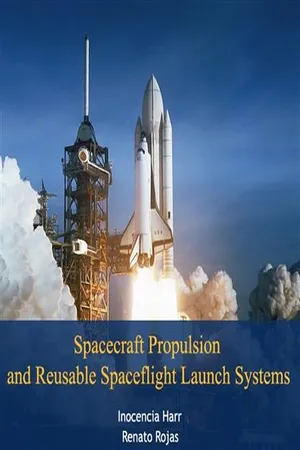 No longer available |Learn more
- (Author)
- 2014(Publication Date)
- College Publishing House(Publisher)
________________________ WORLD TECHNOLOGIES ________________________ Chapter 1 Introduction to Spacecraft Propulsion A remote camera captures a close-up view of a Space Shuttle Main Engine during a test firing at the John C. Stennis Space Center in Hancock County, Mississippi Spacecraft Propulsion is any method used to accelerate spacecraft and artificial satellites. There are many different methods. Each method has drawbacks and advantages, and spacecraft Propulsion is an active area of research. However, most spacecraft today are propelled by forcing a gas from the back/rear of the vehicle at very high speed through a supersonic de Laval nozzle. This sort of engine is called a rocket engine. ________________________ WORLD TECHNOLOGIES ________________________ All current spacecraft use chemical rockets (bipropellant or solid-fuel) for launch, though some (such as the Pegasus rocket and SpaceShipOne) have used air-breathing engines on their first stage. Most satellites have simple reliable chemical thrusters (often monopro-pellant rockets) or resistojet rockets for orbital station-keeping and some use momentum wheels for attitude control. Soviet bloc satellites have used electric Propulsion for decades, and newer Western geo-orbiting spacecraft are starting to use them for north-south stationkeeping. Interplanetary vehicles mostly use chemical rockets as well, although a few have used ion thrusters and Hall effect thrusters (two different types of electric Propulsion) to great success. Need Artificial satellites must be launched into orbit, and once there they must be placed in their nominal orbit. Once in the desired orbit, they often need some form of attitude control so that they are correctly pointed with respect to the Earth, the Sun, and possibly some astronomical object of interest. eBook - PDF
- T. W. Lee, Peter Belobaba, Jonathan Cooper, Allan Seabridge, Peter Belobaba, Jonathan Cooper, Allan Seabridge(Authors)
- 2013(Publication Date)
- Wiley(Publisher)
The author introduces the reader to the principles of thrust and the gas turbine engine before providing a comprehensive mathematical treatment of the major components of the Propulsion mechanism and the complex aerodynamic and thermodynamic processes within various engine types – both air-breathing and rocket. This is to provide a basis for developing an understanding of Propulsion systems and the modeling tools that can be used to provide a comprehensive and practical knowledge for use in research and industry. MATLAB 1 models are provided to reinforce the explanations, and exercises are also set for the diligent student to pursue. The book covers gas turbine (aeronautical) systems and rocket Propulsion (astronautic) systems and is hence of interest to engineers working in the fields of aircraft, missiles and space vehicles. Some novel Propulsion systems are also described, that may be pertinent to emerging fields of aerospace transportation systems, setting out to meet environmental objectives. This is a book for those engineers who wish to understand the fundamental principles of aerospace Propulsion systems. Peter Belobaba, Jonathan Cooper and Allan Seabridge Preface Aerospace Propulsion devices embody some of the most advanced technologies, ranging from materials, fluid control and heat transfer and combustion. In order to maximize performance, sophisticated testing and computer simulation tools are developed and used. In undergraduate or introductory graduate courses in aerospace Propulsion, we only cover the basic elements of fluid mechanics, thermodynamics, heat transfer and combustion science, so that either in industry or in research labs the students/engineers can address some of the modern design and development aspects. Compressor aerodynamics, for example, is a dynamic process involving rotating blades that see different flows at different radial and axial locations. eBook - PDF
- Thawar T. Arif(Author)
- 2010(Publication Date)
- IntechOpen(Publisher)
12 Low-thrust Propulsion Technologies, Mission Design, and Application John W. Dankanich Gray Research Inc. U.S.A. 1. Introduction Electric Propulsion has been widely accepted for station-keeping and final orbit insertion of commercial satellites. NASA, JAXA, and ESA have all used primary electric Propulsion systems for science missions. Electric Propulsion systems have been recently developed with a significant increase in performance and ability to process large amounts of onboard solar power. While the use of electric Propulsion offers significant performance gains, it is not appropriate for all missions, has limitations, and the trajectories have characteristics that may be counterintuitive to those unfamiliar with low-thrust trajectory design. This chapter describes recent U.S. technology investments in electric Propulsion thrusters with emphasis on mission application and low-thrust mission design for interplanetary trajectories and geosynchronous transfer using primary electric Propulsion. 2. Overview of electric Propulsion technologies Unlike chemical Propulsion, which is limited to the energy available through the decomposition or combustion of molecular compounds, electric Propulsion makes use of energy from an external source, typically solar power, to electrically accelerate the propellant to higher energies. The efficiency of momentum transfer is often described in terms of specific impulse which is proportional to the average exhaust velocity in the thrust direction. ܫ ௦ ൌ ݒ ா ௫௨௦௧ ݃ (1) The three basic types of electric Propulsion systems are electrothermal, electrostatic, and electromagnetic. The types are categorized by the method of accelerating the propellant. Resistojets, arcjets, pulsed plasma, gridded-ion and Hall thrusters have significant flight experience. Electrothermal thrusters are the most widely used electric Propulsion systems to date, but electrostatic systems are the industry’s state-of-the-art (SOA) with higher specific impulses. No longer available |Learn more
- (Author)
- 2014(Publication Date)
- White Word Publications(Publisher)
____________________ WORLD TECHNOLOGIES ____________________ Chapter- 1 Introduction to Spacecraft Propulsion ____________________ WORLD TECHNOLOGIES ____________________ A remote camera captures a close-up view of a Space Shuttle Main Engine during a test firing at the John C. Stennis Space Center in Hancock County, Mississippi Spacecraft Propulsion is any method used to accelerate spacecraft and artificial satellites. There are many different methods. Each method has drawbacks and advantages, and spacecraft Propulsion is an active area of research. However, most spacecraft today are propelled by forcing a gas from the back/rear of the vehicle at very high speed through a supersonic de Laval nozzle. This sort of engine is called a rocket engine. All current spacecraft use chemical rockets (bipropellant or solid-fuel) for launch, though some (such as the Pegasus rocket and SpaceShipOne) have used air-breathing engines on their first stage. Most satellites have simple reliable chemical thrusters (often monopropellant rockets) or resistojet rockets for orbital station-keeping and some use momentum wheels for attitude control. Soviet bloc satellites have used electric Propulsion for decades, and newer Western geo-orbiting spacecraft are starting to use them for north-south stationkeeping. Interplanetary vehicles mostly use chemical rockets as well, although a few have used ion thrusters and Hall effect thrusters (two different types of electric Propulsion) to great success. Need Artificial satellites must be launched into orbit, and once there they must be placed in their nominal orbit. Once in the desired orbit, they often need some form of attitude control so that they are correctly pointed with respect to the Earth, the Sun, and possibly some astronomical object of interest. eBook - PDF
- Stephen D. Heister, William E. Anderson, Timothée L. Pourpoint, R. Joseph Cassady(Authors)
- 2019(Publication Date)
- Cambridge University Press(Publisher)
For example, thrust levels of these devices are usually measured in millipounds with power requirements in the kilowatt to megawatt range. In spite of the low thrust, these devices are attractive for satellite maneuvering and possibly interplanetary travel applications. Use of a nuclear generator has been proposed to supply the large amounts of power to these types of thrusters. 1.3.6 Summary of Today ’ s Rocket Propulsion Systems It is dif fi cult to make an overall quantitative assessment of the various Propulsion options discussed above, although it is obviously useful to the reader. Both the speci fi c impulse and mass fraction of a given system are strongly dependent on its size, the propellant combinations employed, and the materials and structural technologies folded into the fabrication of the device. Having said that, Table 1.2 provides a rough comparison compiled from a database of existing systems mainly in the space Propulsion area. There are certainly examples that lie outside the quoted ranges, but the information can be used by students to provide a rough assessment of their computed results and to give a perspective on the relative performance of various Propulsion options. As mentioned Propellant Injected Propellant Injected Propellant Propellant Tank To Propellant Tank To Power Supply Heated Grid Ions Large Voltage Difference High Speed Ion Accelerating Grid To Power Supply To Power Supply Positive Electrode Negative Electrode Nozzle Heated Arc Figure 1.13 Electric rockets. 1.3 Classi fi cation of Rocket Propulsion Systems 17 previously, both performance ( I sp ) and weight ( λ ) are important to any system designs and the overlapping characteristics of various design options make for interesting trades in many instances. 1.3.7 Advanced Concepts The subsections above discussed the most common rocket Propulsion concepts available today. There are many other advanced concepts, which have been theorized or demonstrated on a laboratory basis.
Index pages curate the most relevant extracts from our library of academic textbooks. They’ve been created using an in-house natural language model (NLM), each adding context and meaning to key research topics.

