Technology & Engineering

Sectional View
A sectional view is a representation of an object as if it has been sliced in half, revealing the internal features. It is commonly used in technical drawings and engineering to provide a clear understanding of an object's internal structure and components. This type of view helps to visualize complex designs and understand how different parts fit together.
Written by Perlego with AI-assistance
Related key terms
1 of 5
7 Key excerpts on "Sectional View"

- Dennis Lieu, Sheryl Sorby(Authors)
- 2016(Publication Date)
- Cengage Learning EMEA(Publisher)
Different portions of the plane are used to reveal the interior details of different features of interest. removed section: The section view produced when a cutting plane is used to hypothetically remove an infinitesimally thin slice of an object for viewing. revolved section: The section view produced when a cutting plane is used to hypothetically create an infinitesimally thin slice, which is rotated 90 degrees for viewing, on an object. section lines: Shading used to indicate newly formed or cut surfaces that result when an object is hypothetically cut. section view: A general term for any view that presents an object that has been hypothetically cut to reveal the interior details of its features, with the cut surfaces perpendicular to the viewing direction and filled with section lines for improved presentation. viewing direction: The direction indicated by arrows on the cutting plane line from the eye to the object of interest that corresponds to the tail and point of the arrow, respectively. 1 0 . 1 5 G L O S S A R Y O F K E Y T E R M S Copyright 2017 Cengage Learning. All Rights Reserved. May not be copied, scanned, or duplicated, in whole or in part. Due to electronic rights, some third party content may be suppressed from the eBook and/or eChapter(s). Editorial review has deemed that any suppressed content does not materially affect the overall learning experience. Cengage Learning reserves the right to remove additional content at any time if subsequent rights restrictions require it. 10-30 section three Setting up an Engineering Drawing 1. In the problem shown in Figure P10.1, the views indicated by the balloons are to be changed to full section views taken along the centerline in the direction indicated by the arrows in the remaining view. For each set of views, select the correct section view from the 24 proposed views shown at the right. A section view choice may be used more than once. A correct answer may not be available as a choice.
- David Goetsch, Raymond Rickman, William S. Chalk, , David Goetsch, Raymond Rickman, William S. Chalk, , David Goetsch, Raymond Rickman, William S. Chalk(Authors)
- 2015(Publication Date)
- Cengage Learning EMEA(Publisher)
Due to electronic rights, some third party content may be suppressed from the eBook and/or eChapter(s). Editorial review has deemed that any suppressed content does not materially affect the overall learning experience. Cengage Learning reserves the right to remove additional content at any time if subsequent rights restrictions require it. Technical Drawing Fundamentals section 2 250 Half sections are best used when the object is sym-metrical—that is, the same shape and size on both sides of the cutting-plane line. A half-section view is capable of illustrating both the inside and the outside of an object in the same view. In this example, the top half of the right side illustrates the interior; the bottom half illustrates the exterior. A center line is used to separate the two halves of the half section (refer back to Figure 7-17). A solid line would indicate the pres-ence of a real edge, which would be false information. Broken-out Section Sometimes, only a small area needs to be sectioned in order to make a particular feature or features easier to understand. In this case, a broken-out section is used ( Figure 7-19 ). As drawn, the top section is somewhat confusing and could create a question. To clarify this area, a portion is removed ( Figure 7-20 ). The finished drawing would be drawn as illustrated in Figure 7-21 . The broken line is put in freehand and is drawn as a visible thick line. The actual cutting-plane line is usually omitted. Revolved Section (Rotated Section) A revolved section, sometimes referred to as a rotated section, is used to illustrate the cross section of ribs, webs, bars, arms, spokes, or other similar features of an object. Figure 7-22 is a two-view drawing of an arm. The cross-sectional shape of the center por-tion of the arm is not defined. In drafting, no feature should remain questionable, and a section through the center portion of the arm would provide the complete information. eBook - PDF
Engineering Design Graphics
Sketching, Modeling, and Visualization
- James M. Leake, Molly Hathaway Goldstein, Jacob L. Borgerson(Authors)
- 2022(Publication Date)
- Wiley(Publisher)
CHAPTER 1 202 8 CHAPTER ❚ SECTION VIEWS Introduction Parts like the ones shown in Figure 8-1 contain sev- eral internal features. These interior construction details show up as hidden lines when in a stan- dard multiview projection. Because hidden lines can be difficult to interpret and visualize, section views are frequently used to expose the internal features of a part. Section View Process In a section view, an imaginary cutting plane is passed through a part, often along a part’s plane of symmetry. The portion of the part between the viewer and the plane is removed, and the part is then viewed normal to the cutting plane (see Figure 8-2). A section lining, or hatch pattern, is applied to the surfaces that make contact with the cutting plane. The cutting plane on edge appears in a view adjacent to the section view, and shows the loca- tion of the section. The cutting-plane edge is typ- ically represented as a thick dashed line. Note that a cutting-plane line has precedence over a centerline, should the two coincide. The viewing direction is indicated by arrows drawn perpen- dicular to the cutting plane. Lines that would be visible after making a cut are also shown in a section view; see Figure 8-3. By convention, hidden lines are normally not shown in a section view. Exceptions are occasion- ally made, however, if it is felt that the clarity of the drawing is improved. Section views are typically labeled using indexed capital letters—for example, Section SECTION AND AUXILIARY VIEWS Figure 8-1 Views of a part with multiple internal features SECTION VIEWS 203 A-A, Section B-B, and so on. The capital letters are also used to label the cutting-plane line and to clearly associate the two views, as shown in Figure 8-4. Section Lining (Hatch Patterns) As we have already seen, section lining is applied to solid areas on the part that have been exposed by the cutting plane. As shown in Figure 8-5, types of section lining are often associated with different materials.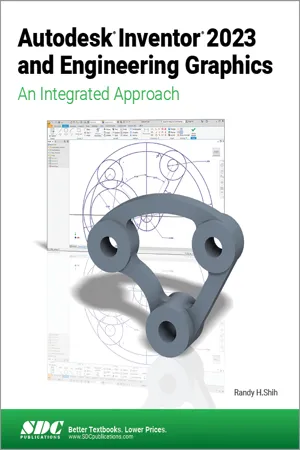 eBook - PDF
Autodesk Inventor 2023 and Engineering Graphics
An Integrated Approach
- Randy H. Shih(Author)
- 2022(Publication Date)
- SDC Publications(Publisher)
..................................................12-36 Centered Pattern .........................................................12-40 Arrowheads Inside .....................................................12-41 Single Dimension Line ..............................................12-41 Centerline Bisector.....................................................12-42 Autodesk Inventor Certified User Reference Guide Section Views & Symmetrical Features in Designs 12-3 Introduction In the previous chapters, we have explored the basic CAD methods of creating orthographic views. By carefully selecting a limited number of views, the external features of most complicated designs can be fully described. However, we are frequently confronted with the necessity of showing the interiors of parts, or when parts are assembled, that cannot be shown clearly by means of hidden lines. In cases of this kind, to aid in describing the object, one or more views are drawn to show the object as if a portion of the object had been cut away to reveal the interior. This type of convention is called a section, which is defined as an imaginary cut made through an object to expose the interior of a part. Such kind of cutaway view is known as a section view. Hidden features can be difficult to visualize 12-4 Autodesk Inventor and Engineering Graphics In a section view, the place from which the section is taken must be identifiable on the drawing. If the place from which the section is taken is obvious, as it is for the below figure, no further description is needed. If the place from which the section is taken is not obvious, as it is for the below figure, a cutting plane is needed to identify the section. Two arrows are also used to indicate the viewing direction. A cutting plane line is drawn with the phantom or hidden line.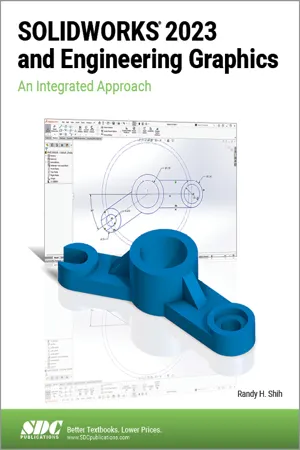 eBook - PDF
SOLIDWORKS 2023 and Engineering Graphics
An Integrated Approach
- Randy H. Shih(Author)
- 2023(Publication Date)
- SDC Publications(Publisher)
Center Mark, Circular Option ....................................11-37 Certified Associate Reference Guide Section Views & Symmetrical Features in Designs 11-3 Introduction In the previous chapters, we have explored the basic CAD methods of creating orthographic views. By carefully selecting a limited number of views, the external features of most complicated designs can be fully described. However, we are frequently confronted with the necessity of showing the interiors of parts, or when parts are assembled, that cannot be shown clearly by means of hidden lines. In cases of this kind, to aid in describing the object, one or more views are drawn to show the object as if a portion of the object had been cut away to reveal the interior. This type of convention is called a section, which is defined as an imaginary cut made through an object to expose the interior of a part. This kind of cutaway view is known as a section view. Hidden features can be difficult to visualize 11-4 SOLIDWORKS 2023 and Engineering Graphics In a section view, the place from which the section is taken must be identifiable on the drawing. If the place from which the section is taken is obvious, as it is for the figure below, no further description is needed. If the place from which the section is taken is not obvious, as it is for the below figure, a cutting plane is needed to identify the section. Two arrows are also used to indicate the viewing direction. A cutting plane line is drawn with the phantom or hidden line. Section Views & Symmetrical Features in Designs 11-5 General Rules of Section Views Section views are used to make a part drawing more understandable, showing the internal details of the part. Since the sectioned drawing is showing the internal features there is generally no need to show hidden lines. A section view still follows the general rules of any view in a multiview drawing. eBook - PDF
- R L Timings(Author)
- 2014(Publication Date)
- Butterworth-Heinemann(Publisher)
Orthographic projection is used for detail drawings and assembly drawings where they will be read by engineers skilled in their interpretation. Section views The hidden detail in hollow components can often be shown more clearly by use of a section view. Figure 9.14 shows how drawings are sectioned. Imagine that the cutting plane actually cuts through the component along a specified plane. The unwanted portion of the component is removed and the remaining portion shows the sectioned view. Note that cut surfaces are sec-tioned shaded (hatched) to indicate where the component has been cut. 9.6 Conventions Standard conventions are used to avoid the de-tailed drawing of common features in frequent use. These conventions are a form of drawing shorthand. They may be to company standards, national standards and international standards. Those generally used in the UK are the conven-tions specified in BS 308: 'Engineering drawing practice'. These, in turn, are harmonized with ISO standards, and are therefore international as well as national. Examples of standard lines and their uses are shown in Figure 9.15. Examples of conventions for common features are shown in Figure 9.16. 160 BASIC ENGINEERING TECHNOLOGY Face A Top face I Face B View of face B View of face A Plan view of top face (a) FIRST ANGLE Plan view of top face View of face A Face A Top face Face B View of face B (b) THIRD ANGLE Figure 9.13 Orthographic projection INTERPRETING DRAWINGS, SPECIFICATIONS AND DATA 161 SECTION A -A ^ ^ ^ 1 l l ^ ^ ^ s s sss Solid shafts not sectioned ^ _ ^ L k_^4^§S> Webs not sectioned Nuts, bolts and pins not sectioned Figure 9.14 Section drawings eBook - PDF
Engineering Design Graphics
Sketching, Modeling, and Visualization
- James M. Leake, Jacob L. Borgerson(Authors)
- 2012(Publication Date)
- Wiley(Publisher)
Section View Process In a section view, an imaginary cutting plane is passed through a part, often along a part’s plane of symmetry. The portion of the part between the viewer and the plane is removed, and the part is then viewed normal to the cutting plane (see Figure 5-13). A section lining, or hatch pattern, is applied to the surfaces that make contact with the cutting plane. The cutting plane on edge appears in a view adjacent to the section view, and shows the loca- tion of the section. The cutting-plane edge is typically represented as a thick dashed line. Note that a cutting-plane line has precedence over a centerline, should the two coincide. The viewing direction is indicated by arrows drawn perpen- dicular to the cutting plane. Viewing direction Cutting plane Discarded half Edge view of cutting plane Section lining Figure 5-13 Section view process Lines that would be visible after making a cut are also shown in a section view; see Figure 5-14. By convention, hidden lines are normally not shown in a section view. Exceptions are occasion- ally made, however, if it is felt that the clarity of the drawing is improved. Section views are typically labeled using indexed capital letters—for example, Section A-A, Section B-B, and so on. The capital letters are also used to label the cutting-plane line and to clearly associate the two views, as shown in Figure 5-15. Section Lining (Hatch Patterns) As we have already seen, section lining is applied to solid areas on the part that have been exposed by the cutting plane. As shown in Figure 5-16, types of section lining are often associated with different materials. The most commonly
Index pages curate the most relevant extracts from our library of academic textbooks. They’ve been created using an in-house natural language model (NLM), each adding context and meaning to key research topics.

