Technology & Engineering

Triple Integrals
Triple integrals are mathematical tools used to calculate the volume of a three-dimensional object. They involve integrating a function over a three-dimensional region, with each integral representing a different dimension. Triple integrals are commonly used in fields such as physics, engineering, and computer graphics.
Written by Perlego with AI-assistance
Related key terms
1 of 5

6 Key excerpts on "Triple Integrals"
 No longer available |Learn more
- (Author)
- 2014(Publication Date)
- Orange Apple(Publisher)
It is based on a limiting procedure which approximates the area of a curvilinear region by breaking the region into thin vertical slabs. Beginning in the nineteenth century, more sophisticated notions of integrals began to appear, where the type of the function as well as the domain over which the integration is performed has been generalised. A line integral is defined for functions of two or three variables, and the interval of integration [ a , b ] is replaced by a certain curve connecting two points on the plane or in the space. In a surface integral, the curve is replaced by a piece of a surface in the three-dimensional space. Integrals of differential forms play a fundamental role in modern differential geometry. These generalizations of integral first arose from the needs of physics, and they play an important role in the formulation of many physical laws, notably those of electrodynamics. There are many modern concepts of integration, among these, the most common is based on the abstract mathematical theory known as Lebesgue integration, developed by Henri Lebesgue. History Pre-calculus integration Integration can be traced as far back as ancient Egypt ca. 1800 BC, with the Moscow Mathematical Papyrus demonstrating knowledge of a formula for the volume of a pyramidal frustum. The first documented systematic technique capable of determining integrals is the method of exhaustion of Eudoxus ( ca. 370 BC), which sought to find areas and volumes by breaking them up into an infinite number of shapes for which the ________________________ WORLD TECHNOLOGIES ________________________ area or volume was known. This method was further developed and employed by Archimedes and used to calculate areas for parabolas and an approximation to the area of a circle. Similar methods were independently developed in China around the 3rd century AD by Liu Hui, who used it to find the area of the circle.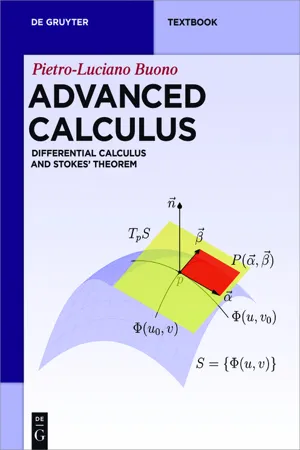 eBook - ePub
Advanced Calculus
Differential Calculus and Stokes' Theorem
- Pietro-Luciano Buono(Author)
- 2016(Publication Date)
- De Gruyter(Publisher)
7 Double and Triple Integrals
This chapter is concerned with the definitions of double and Triple Integrals as well as practical formulae for their computation. However, we begin with a section introducing a new concept called the wedge product which we apply to differentials. The wedge product is useful to compute areas and volumes and form the backbone of the definitions of double and Triple Integrals. The second section is about the double integral and may be considered as review for some readers, except for the last part of the section where we discuss Green’s theorem. This theorem links the computation of line integrals of 1-forms to double integrals and is considered one of the fundamental theorems of vector calculus, the second presented in this text after Theorem 4.3.5. The final section discusses the triple integral over boxed and more general domains.7.1 Area and Volume Forms
We show in Chapter 1 , Section 1.5 that curves can be given an orientation. We generalize the construction to higher dimensional spaces and surfaces. We say that ℝ2 is positively (negatively) oriented if angles increase when rotating around the origin in the counterclockwise (clockwise) direction. This means that when defining polar coordinates in the typical way, we are giving ℝ2 a positive orientation.Orientations of ℝ3 are obtained as follows. Choose a positive orientation of ℝ2 with axes x and y and let the z axis be perpendicular to the x, y -plane. If the positive numbers of the z axis point up, we say that ℝ3 has positive orientation, otherwise, it has negative orientation. One can give a positive and negative orientation to ℝn for any n inductively by choosing a positive orientation for ℝn-1 , then the orientation of thexnaxis determines a positive or negative orientation of ℝn . However, it is not possible to visualize the orientation in dimensions higher than three. In Chapter 10 , we define orientations for two-dimensional surfaces in ℝ3 eBook - PDF
- G. M. Fikhtengol'ts, I. N. Sneddon, M. Stark, S. Ulam(Authors)
- 2014(Publication Date)
- Pergamon(Publisher)
Because a whole series of propositions established for double integrals carries over, together with their proofs, to the case of Triple Integrals, we will usually consider it sufficient simply to formulate these propositions, leaving it to the reader to rewrite the previous proofs. 376. A triple integral and the conditions for its existence. In the construction of a general definition for the new integral form, the triple integral, a fundamental part is played by the concept of the volume of a solid, in the same way as the area of a plane figure forms the foundation for the definition of a double integral. We are already familiar with the concept of a volume and we have often encountered it. The conditions for the existence of the volume for a given solid are contained in the fact that the surface bounding it must have volume equal to zero [Sec. 197]. We will only consider such surfaces as these, so that the existence of the volumes in all the cases we need is guaranteed. We note that, in particular, the smooth and piece-wise smooth surfaces belong to this class of surface. Now in some space domain ( F ) let there be given a function / ( x , J , z). We divide up this domain by means of a net of surfaces into a finite number of parts (Fi), ( F g ) , w h i c h have the volumes F g , r „ , respectively. Within the limits of the /th element (F;) we choose an arbitrary point (1;, ηι, ζι), multiply the value of the function at this point / ( f i , ?7i ,Ci) by the volume Vi and form the integral sum „ ^ = Y^f(?i,Vi.CdVi. § 1. TRIPLE INTEGRAL AND ITS EVALUATION 359 l i m ^ α >,·Κ.· - 0, i= 1 where ωι = Μι~~ is the oscillation of the function/in the domain (Vi). [We note that when the integral exists both the sums s and S have it as their limits.] From this it follows immediately that every continuous function f is integrable. eBook - PDF
Calculus
Concepts and Contexts, Enhanced Edition
- James Stewart(Author)
- 2018(Publication Date)
- Cengage Learning EMEA(Publisher)
Cengage Learning reserves the right to remove additional content at any time if subsequent rights restrictions require it. 874 CHAPTER 12 MULTIPLE INTEGRALS fixed), and finally we integrate with respect to . There are five other possible orders in which we can integrate, all of which give the same value. For instance, if we integrate with respect to , then , and then , we have Triple integral over a box Evaluate the triple integral , where is the rectangular box given by SOLUTION We could use any of the six possible orders of integration. If we choose to integrate with respect to , then , and then , we obtain Now we define the triple integral over a general bounded region E in three-dimensional space (a solid) by much the same procedure that we used for double integrals (12.3.2). We enclose in a box of the type given by Equation 1. Then we define a function so that it agrees with on but is 0 for points in that are outside . By definition, This integral exists if is continuous and the boundary of is “reasonably smooth.” The triple integral has essentially the same properties as the double integral (Properties 6–9 in Section 12.3). We restrict our attention to continuous functions and to certain simple types of regions. A solid region is said to be of type 1 if it lies between the graphs of two continuous func-tions of and , that is, where is the projection of onto the -plane as shown in Figure 2. Notice that the upper boundary of the solid is the surface with equation , while the lower boundary is the surface . eBook - ePub
Two and Three Dimensional Calculus
with Applications in Science and Engineering
- Phil Dyke(Author)
- 2018(Publication Date)
- Wiley(Publisher)
The last part of the question asks for the expectation values. One could evaluate the two integrals: and that are the statistical equivalent to the centre of mass in mechanics, but those with knowledge of this area of statistics will know that is the average waiting time and the average dining time. Both of these are given in the question, so without any further calculation min and min. You are welcome to check these using elementary integration by parts. Figure 9.16 The triangular region is shaded. The time has come to extend integration to three dimensions. 9.3 Triple Integration Figure 9.17 The triple integral over the volume domain showing the limits as surfaces, as the left and right borders of the projection of on to the plane and, finally, as the final limits. The extension of double integration to triple integration is reasonably straightforward. The triple integral is displayed in Figure 9.17 and is written With triple integration, there is even more choice of order of integration; above it is first, then and finally. The technicalities are the same as for double integrals; however, it is often difficult to visualise let alone draw the three-dimensional domain. In particular, it is sometimes hard to see whether or not the region is convex. Mathematical packages such as MAPLE or MATLAB can be useful; or there is the old, tried-and-tested method of looking at slices through the solid domain. Each of these will be done in the examples that follow. If the function being integrated, then it is the volume of the domain that is being calculated. Integrating over a cuboid will be left to the exercises as it does not present anything very new, instead let us start with a tetrahedron shape solid with a vertex at the origin. Example 9.13 Determine the volume of the solid bound by the planes and in the positive octant. Solution The plane cuts the three co-ordinate axes and at the points and respectively eBook - PDF
Calculus
Single Variable
- Howard Anton, Irl C. Bivens, Stephen Davis(Authors)
- 2022(Publication Date)
- Wiley(Publisher)
273 CHAPTER 5 Applications of the Definite Integral in Geometry, Science, and Engineering In the last chapter we introduced the definite integral as the limit of Riemann sums in the context of finding areas. However, Riemann sums and definite integrals have applications that extend far beyond the area problem. In this chapter we will show how Riemann sums and definite integrals arise in such problems as finding the volume and surface area of a solid, finding the length of a plane curve, calculating the work done by a force, finding the center of gravity of a planar region, finding the pressure and force exerted by a fluid on a submerged object. Although these problems are diverse, the required calculations can all be approached by the same procedure that we used to find areas—breaking the required calculation into “small parts,” making an approximation for each part, adding the approximations from the parts to produce a Riemann sum that approximates the entire quantity to be calculated, and then taking the limit of the Riemann sums to produce an exact result. Alexander Tolstykh/Shutterstock.com 3D printers generate objects by stacking horizontal layers of the object. A calculus analogue computes the volume of a solid from the areas of its cross sections. 5.1 Area Between Two Curves In the last chapter we showed how to find the area between a curve y = f (x) and an interval on the x-axis. Here we will show how to find the area between two curves. A Review of Riemann Sums Before we consider the problem of finding the area between two curves it will be helpful to review the basic principle that underlies the calculation of area as a definite integral.
Index pages curate the most relevant extracts from our library of academic textbooks. They’ve been created using an in-house natural language model (NLM), each adding context and meaning to key research topics.

