Technology & Engineering

Triple Product
The triple product is a mathematical operation used in vector calculus to calculate the scalar product of three vectors. It is the product of the dot product of two vectors and the cross product of one of those vectors with a third vector. The triple product is used in physics and engineering to calculate moments, torque, and angular momentum.
Written by Perlego with AI-assistance
Related key terms
1 of 5

4 Key excerpts on "Triple Product"
 No longer available |Learn more
- (Author)
- 2014(Publication Date)
- White Word Publications(Publisher)
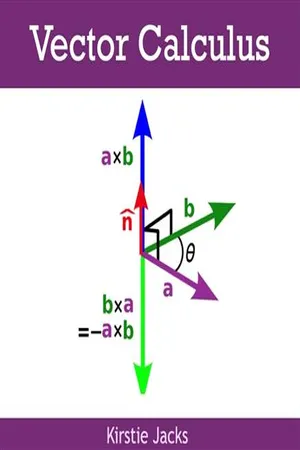
________________________ WORLD TECHNOLOGIES ________________________ Chapter 5 Cross Product In mathematics, the cross product , vector product , or Gibbs vector product is a binary operation on two vectors in three-dimensional space. It results in a vector which is perpendicular to both of the vectors being multiplied and normal to the plane containing them. It has many applications in mathematics, engineering and physics. If either of the vectors being multiplied is zero or the vectors are parallel then their cross product is zero. More generally, the magnitude of the product equals the area of a parallelogram with the vectors for sides; in particular for perpendicular vectors this is a rectangle and the magnitude of the product is the product of their lengths. The cross product is anticommutative, distributive over addition and satisfies the Jacobi identity. The space and product form an algebra over a field, which is neither commutative nor associative, but is a Lie algebra with the cross product being the Lie bracket. Like the dot product, it depends on the metric of Euclidean space, but unlike the dot product, it also depends on the choice of orientation or handedness. The product can be generalized in various ways; it can be made independent of orientation by changing the result to pseudovector, or in arbitrary dimensions the exterior product of vectors can be used with a bivector or two-form result. Also, using the orientation and metric structure just as for the traditional 3d cross product, one can in n dimensions take the product of n - 1 vectors to produce a vector perpendicular to all of them. But if the product is limited to non-trivial binary products with vector results it exists only in three and seven dimensions. ________________________ WORLD TECHNOLOGIES ________________________ The cross-product in respect to a right-handed coordinate system eBook - ePub
- Alan Durrant(Author)
- 2019(Publication Date)
- CRC Press(Publisher)
A special case is when two of the three vectors are equal or collinear, a = α b for example. We then have α b × b. c = 0. Thus a scalar Triple Product is zero whenever one vector appears more than once. 2.6.2 The vector Triple Product We can take the vector product of the vector a × b with a vector c to give the vector (a × b) × c. This Triple Product is called a vector Triple Product (a × b) × c (vector triple product) (2.36) The brackets are necessary here because (a × b) × c is not equal to a × (b × c). Note that the vector (a × b) × c is normal to a × b, and a × b is itself normal to a and b. It follows that (a × b) × c is a vector in the plane of a and b and so it can be expressed as a linear combination, αa + βb. It can be shown that α = – b. c and β = a. c, but we shall not show the details here. Thus we have the identity (a × b) × c = (a . c) b − (b . c) a (2.37) This is a useful result because the right-hand side contains scalar products only and it is often easier to work out the scalar products than the vector products on the left-hand side. Summary of section 2.6 The Triple Product a × b. c is a scalar called a scalar Triple Product. Its magnitude represents the volume of the parallelepiped formed by the three vectors. It is zero when the three vectors are coplanar thus providing a test for coplanar vectors. The scalar Triple Product is unchanged by any cyclic permutation of the three vectors or by interchange of the dot and cross symbols a × b . c = c × a . b = b × c . a (2.33) a × b . c = a . b × c (2.35) The Triple Product (a × b) × c is a vector called a vector Triple Product ; it lies in the plane of a and b and can be expanded to give the identity (a × b) × c = (a . c) b − (b . c) a (2.37) Example 6.1 (Objective 12) Describe where possible each of the following expressions in terms of. scaled vectors, scalar products, vector products, and Triple Products, and state whether the expression represents a scalar or a vector or is meaningless: (p. q) r A eBook - PDF
- Daniel A. Fleisch(Author)
- 2011(Publication Date)
- Cambridge University Press(Publisher)
Stated another way, if the projection of A onto the direction of B × C is not zero, then A cannot lie in the same plane as B and C . Thus A ◦ ( B × C ) = 0 (2.13) is both a necessary and a sufficient condition for vectors A , B , and C to be coplanar. Equating A ◦ ( B × C ) to the volume of the parallelepiped formed by vectors A , B , and C should also help you see that any cyclic permutation of the vectors (such as B ◦ ( C × A ) or C ◦ ( A × B ) ) gives the same result for the triple scalar product, since the volume of the parallelepiped is the same in each of these cases. Some authors describe this as the ability to interchange the dot and the cross without affecting the result (since ( A × B ) ◦ C is the same as C ◦ ( A × B ) ). One application in which the triple scalar product finds use is the determi-nation of reciprocal vectors, as explained in the sections in Chapter 4 dealing with covariant and contravariant components of vectors. 2.4 Triple vector product The triple scalar product described in the previous section is not the only use-ful way to multiply three vectors. An operation such as A × ( B × C ) (called the “triple vector product”) comes in very handy when you’re dealing with certain problems involving angular momentum and centripetal acceleration. Unlike the triple scalar product, which produces a scalar result (since the sec-ond operation is a dot product), the triple vector product yields a vector result 2.4 Triple vector product 33 (since both operations are cross products). You should note that A × ( B × C ) is not the same as ( A × B ) × C ; the location of the parentheses matters greatly in the triple vector product. The triple vector product is somewhat tedious to calculate by brute force, but thankfully a simplified expression exists: A × ( B × C ) = B ( A ◦ C ) − C ( A ◦ B ). eBook - PDF
Calculus
Early Transcendentals
- Howard Anton, Irl C. Bivens, Stephen Davis(Authors)
- 2016(Publication Date)
- Wiley(Publisher)
It is not necessary to compute the dot product and cross product to evaluate a scalar Triple Product—the value can be obtained directly from the formula u · (v × w) = u 1 u 2 u 3 v 1 v 2 v 3 w 1 w 2 w 3 (9) the validity of which can be seen by writing u · (v × w) = u · v 2 v 3 w 2 w 3 i − v 1 v 3 w 1 w 3 j + v 1 v 2 w 1 w 2 k = u 1 v 2 v 3 w 2 w 3 − u 2 v 1 v 3 w 1 w 3 + u 3 v 1 v 2 w 1 w 2 = u 1 u 2 u 3 v 1 v 2 v 3 w 1 w 2 w 3 Example 5 Calculate the scalar Triple Product u · (v × w) of the vectors u = 3i − 2 j − 5k, v = i + 4 j − 4k, w = 3 j + 2k Solution. u · (v × w) = 3 −2 −5 1 4 −4 0 3 2 = 49 TECHNOLOGY MASTERY Many calculating utilities have built-in cross product and determinant opera- tions. If your calculating utility has these capabilities, use it to check the computations in Examples 1 and 5. Figure 11.4.5 GEOMETRIC PROPERTIES OF THE SCALAR Triple Product If u, v, and w are nonzero vectors in 3-space that are positioned so their initial points coincide, then these vectors form the adjacent sides of a parallelepiped (Figure 11.4.5). The following theorem establishes a relationship between the volume of this parallelepiped and the scalar Triple Product of the sides. 706 Chapter 11 / Three-Dimensional Space; Vectors 11.4.6 THEOREM Let u, v, and w be nonzero vectors in 3-space. It follows from Formula (10) that u · (v × w) = ±V The + occurs when u makes an acute angle with v × w and the − occurs when it makes an obtuse angle. (a) The volume V of the parallelepiped that has u, v, and w as adjacent edges is V = |u · (v × w)| (10) (b) u · (v × w) = 0 if and only if u, v, and w lie in the same plane. PROOF (a) Referring to Figure 11.4.6, let us regard the base of the parallelepiped with Figure 11.4.6 u, v, and w as adjacent sides to be the parallelogram determined by v and w.
Index pages curate the most relevant extracts from our library of academic textbooks. They’ve been created using an in-house natural language model (NLM), each adding context and meaning to key research topics.

