- Offers a comprehensive survey from the earliest to the most recent works
- Features an impressive range of well-known international contributors
- Examines contemporary additions to the Arthurian canon, including film and computer games
- Underscores an understanding of Arthurian literature as fundamental to western literary tradition
- English
- ePUB (mobile friendly)
- Available on iOS & Android
eBook - ePub
A Companion to Arthurian Literature
About this book
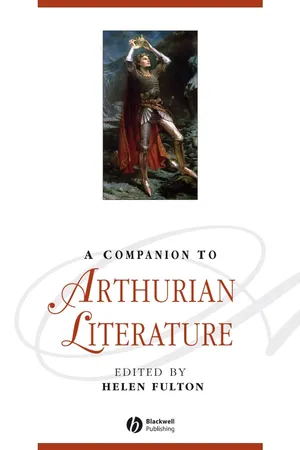
This Companion offers a chronological sweep of the canon of Arthurian literature - from its earliest beginnings to the contemporary manifestations of Arthur found in film and electronic media. Part of the popular series, Blackwell Companions to Literature and Culture, this expansive volume enables a fundamental understanding of Arthurian literature and explores why it is still integral to contemporary culture.
Information
Part I: The Arthur of History
1
The End of Roman Britain and the Coming of the Saxons: An Archaeological Context for Arthur?
The last time an archaeologist seriously engaged with the matter of Arthur was in 1971 with the publication of Leslie Alcock’s book Arthur’s Britain. Subtitled History and Archaeology AD 367–634, this was a rigorous academic attempt to put the historical evidence for Arthur alongside the archaeology for the period in which he might have existed. It was written in the context of the late Professor Alcock’s excavations between 1966 and 1973 at Cadbury Castle, Somerset, where he had investigated the major Iron Age hill fort identified by Leland as the alleged site of Camelot (Alcock 1972). Alcock’s work was a detailed account of the archaeology, framed by a critical discussion of the early historical evidence for the period and the few sparse “early” references to Arthur. Aimed at both students and an interested public, it ranged over both Anglo-Saxon and Celtic evidence throughout the British Isles.
Arthur’s Britain offered an analysis of the supposed Arthurian evidence but was perhaps unfortunate in coinciding with an upsurge in Arthurian iconoclasm whereby most historians decided Arthur was either a myth or at best unknowable. Alcock concluded that one reference – that to Arthur in the Annales Cambriae (“Welsh Annals”) for 537, “The battle of Camlann, in which Arthur and Medraut fell” – was “the irreducible minimum of historical fact” and that this assured us “that Arthur was an authentic person” (Alcock 1971: 88). However, in 1977 David Dumville published a trenchant review paper in the journal History, which rejected the claim that any of the references to Arthur, including those in the Welsh annals, were contemporary and concluded: “This is not the stuff of which history can be made. The fact of the matter is that there is no historical evidence about Arthur; we must reject him from our histories and, above all, from the titles of our books” (1977: 188).
This view that there is no reliable historical evidence for Arthur is one held by all serious historians of the period. Thus in 1991 Thomas Charles-Edwards’ discussion of the ninth-century Historia Brittonum concluded that: “At this stage of the enquiry, one can only say there may well have been an historical Arthur,” but “the historian can as yet say nothing of value about him” (1991: 29). The skepticism of historians about Arthur was matched by a general rejection of the fifth- and sixth-century historical sources for Britain as a whole. Previous credibility given to Bede and the Anglo-Saxon Chronicle has now been replaced by a conclusion that little historical material pre-600 can be relied upon, and Dumville’s view that a “historical horizon” of credibility begins sometime in the mid- to late sixth century for some Irish, English, and British sources seems to be widely accepted (1977: 189–92; Yorke 1993; see also chapter 2, this volume).
But if historians cannot agree on evidence for a historical Arthur, what can archaeology say? Since Dumville’s 1977 paper, no serious archaeologist has tried to combine archaeology and Arthur. There is of course an archaeology of Arthurian folklore and fakes – the numerous Arthur’s Stones (often megalithic tombs, such as Arthur’s Stone on the Gower peninsula in south Wales); other Arthurian place names in the landscape (Higham 2002: figs 16 and 18); and fakes ranging from the twelfth-century “discovery” of Arthur’s body at Glastonbury (Barber 1972: 59–65) to the more recent claims often expressed on the internet and in popular books (Higham 2002: 34–5) as well as in otherwise reputable daily newspapers (see for example the Sunday Telegraph newspaper of October 16, 1994). Indeed, Oliver Padel has argued that the earliest references to Arthur in the ninth century indicate that he was already a mythical figure attached to dramatic features of the landscape and that, by analogy with the Fionn cycle in Ireland, no historical Arthur ever existed (1994).
However, if we wanted to portray an archaeological context for a notional Arthur, where and when would that be? Barber has pointed to four genuine historical figures called Arthur who appear in reliable sources. These are all associated with Irish/Scottish colonies and show that the name was current in Dál Riata and Dyfed in the later sixth and seventh centuries. Barber suggests that Arthur, son of Áedán mac Gabráin, the late-sixth-century king of Dál Riata who was killed fighting the Picts in the 590s, may be the original historical figure to whom subsequent legends were attached (1972: 29–38). However, the attachment of Arthur’s name to the battle of Badon and the battle list in the Historia Brittonum, together with his prominence in later British/Welsh sources, has led to him being regarded as a British hero associated with the native resistance to the Germanic conquest of southern and eastern Britain which gave rise to the creation of the Anglo-Saxon kingdoms of England.
As to date, Arthur’s absence from British genealogies and reliable historical sources before the ninth or tenth centuries means that most attempts to place him historically have to push him back to the later fifth or earlier sixth century. After about 550 the historical silence about Arthur becomes more damning. In 500 British political units would probably still have ruled much of Britain from the Forth–Clyde line in Scotland south to the English Channel, though the extent of Anglo-Saxon territorial control is not historically documented at this period. Consequently the archaeological context for a notional British Arthur might be thought to be the post-Roman British kingdoms of the fifth and sixth centuries between Edinburgh in the north and Cornwall in the southwest. This chapter, then, will look at some current debates on the fifth- and sixth-century history and archaeology of the British kingdoms.
Gildas and the History of Britain in the Fifth and Sixth Centuries
Opinions about the nature of fifth-century and early sixth-century Britain have varied since Alcock wrote in 1971. In 400 Britain was still part of the Roman Empire, which, though politically divided between a western emperor in Ravenna and an eastern emperor in Constantinople, still stretched from Hadrian’s Wall in the north to an eastern frontier in modern Turkey and Syria. By 476, with the deposition of the last western emperor, successor Germanic barbarian kingdoms were increasingly coming to dominate the whole of the Western Empire (Cameron et al. 2000). The fate of the British provinces is not well documented after 400. If the late-sixth-century Byzantine historian Zosimus is to be believed, the British rebelled against Roman rule and laws, but the exigencies of the sources are such that no secure narrative of fifth-century Britain is possible.
Historians are much more wary now of using either Bede’s Historia Ecclesiastica (eighth century) or the Anglo-Saxon Chronicle to date the adventus Saxonum (Sims-Williams 1983). However, in contrast to Alcock’s view, it is now recognized that Gildas’s De excidio Britanniae (“Concerning the ruin of Britain,” hereafter abbreviated to DEB) is the only real source for much of fifth-century and early sixth-century British history. Whereas Alcock was rather scathing about Gildas, revisionist views now place him firmly as the key source from which the entire traditional account of the English conquest derives (Dumville 1977; Lapidge & Dumville 1984). The difficulty with Gildas is of course the absence of names and dates which would allow us to calibrate his narrative against continental sources. As is well known, after the death of Magnus Maximus in 388 Gildas probably names only one independently dated person – Agitius (Aetius), who was consul for the third time in 446–52. However, attempts to date the fifth-century sequence of events in DEB are less convincing and the contradiction between Gildas’s sequence and that in Bede has led to several distinct versions of fifth-century history being posited by modern scholars (Sims-Williams 1983; Higham 1994).
Gildas is conventionally dated to the early sixth century, with DEB written in the mid-sixth century. Higham has tried to push him back into the fifth century (1994: 118–45) and although this has not been met with general assent, scholars such as Wood seem to allow an early date (1984: 23). Gildas describes a long series of disasters for the Britons after 388: attacks and threats of attack from Pictish and Irish raiders, the rise of kings and civil wars, the invitation of Saxon mercenaries to fight the Picts and Irish, the rebellion of the Saxon federates and the wholesale destruction that ensues. Following all this, an apparently long process of warfare ensues until a British resistance led by Ambrosius Aurelianus has some success (Sims-Williams 1983). The battle of Badon is cited by Gildas as a major British victory, although one which leaves much of the former Roman provinces of Britain in Germanic hands. One difficulty in interpreting Gildas is that the areas where he describes, and denounces, surviving British kingdoms and the “tyrants” who rule them seem limited to the extreme south and west of Britain. This has led Higham to posit Germanic control either directly or as overlords over most of lowland England by the mid- or late fifth century (1994: 190–93).
The Archaeology of Britain in the Fifth and Sixth Centuries
The degree of survival of Roman material culture and the nature of fifth-century British material culture are still contested issues. On the basis of archaeological evidence, it is undeniable that the most obvious features of Roman archaeology – mass coinage, mass-produced pottery and other goods, villas, walled towns, masonry buildings, mosaics, hypocausts, sculpture – had ceased to be significant features of Britain in the sixth century. Our problem of course is the poverty of evidence for the continuation of Romano-British material culture after the late fourth century. Unlike some parts of the Western Empire, the evidence for the continuation of Roman technology in Britain is poor (Esmonde Cleary 1989). Opinion on the speed of change in Britain – how quickly Roman technology and lifestyle was lost, and why – has therefore been a long-term matter of debate, with two central positions emerging. On the one hand, some scholars have seen the disappearance of Roman culture from Britain as swift, catastrophic, and violent (Faulkner 2000). Gildas is one of the sources of this interpretation. On the other hand, an argument has been made for substantial continuities in material culture well into the fifth, sixth, and seventh centuries, ironically, perhaps, also using Gildas as evidence (Dark 1994, 2000).
This difference of opinion is of course linked to theories about the date, scale, and speed of Germanic takeover and the thorny issue of British survival in lowland England. In recent years this debate has focused on what is sometimes called the “late antiquity” paradigm. This is an influential historical view which emphasizes the cultural continuities in Europe from the third to the eighth centuries – the period of “late antiquity” – and downplays both the significance of the “fall” of the Western Empire and the warfare and displacement that may have accompanied it (Ward-Perkins 2005). Until recently, this paradigm had relatively little influence in Britain since it was difficult to see pagan Anglo-Saxon England having much late-antique flavor, while the Celtic west was visualized as comprising heroic, rather than “barbarian,” societies (Alcock 1971). However, in recent years the concept of a late-antique culture of continuity has been applied to the Celtic west of Britain, in particular in the work of Ken Dark (2000: 15).
The interest in the concept of late antiquity, with its implication of continuity and relative stability, has cross-fertilized with other theoretical ideas current in British academia, in particular the rejection of invasion and migration as significant forces for change in the historical and archaeological record. The rejection of the “invasion hypothesis,” which dominated older British archaeological interpretations, can be seen particularly in prehistoric studies from the 1960s onwards. Initially, invasions or settlements by Anglo-Saxons, Vikings, and perhaps Irish immigrants were accepted as significant, alongside a dominant pattern of endogenous change, since these could be supported by historical sources, and, at least in the Anglo-Saxon case, by substantial archaeological evidence of burials and settlements (Clark 1966). However, historical skepticism about the reliability of early sources, coupled with a desire by archaeologists to write “history-free” interpretations, led to the downgrading of even these few remaining invasions (Harke 1998). Continuity and population survival became de rigueur and the impression was given that violence or population displacement were not convincing explanations of cultural change and could be rejected except perhaps for small-scale elite replacement.
The hitching of the Celtic west to the “late antique” bandwagon may, however, be a step too far, especially at a time when its general applicability to the Western Empire, at least in its more extreme pacifist manifestations, is being questioned. Ward-Perkins’ recent book on The Fall of Rome (2005) makes a strong case for understanding how dramatic and painful the collapse of the Western Empire was for many who experienced it. Likewise Peter Heather’s Fall of the Roman Empire cites evidence for the destructiveness of barbarian armies and the massive decline in productivity caused by warfare (2005). The completeness of the disappearance of Roman material culture in Britain should not be underestimated. It is arguable that by 500, and probably a lot earlier, there were no towns, villas, coinage, wheel-made pottery, or other mass-produced goods. Virtually all the physical manifestations of Roman material culture had gone (Esmonde Cleary 1989; Wickham 2005: 306–12). No one built a mortared masonry structure, tiled a roof, threw a pot on a fast wheel, or fired a pottery kiln from sometime in the fifth century until the seventh century.
Views about the speed of material collapse in Britain and its explanation vary. Some Romanists see decline having set in substantially in the fourth century and the break from the Western Empire in 406–10 merely finishes off a weakened elite superstructure. Esmonde Cleary suggested that decline on Roman sites could be traced through the later fourth century and that collapse followed within a few decades in the fifth (1989). A similar pattern is traced by Faulkner, who argues that the Roman state was parasitic, and that speedy collapse was inherent in its internal social contradictions. He argues vehemently against the “late antique” paradigm and suggests that “overall the Romanised settlement pattern and associat...
Table of contents
- Cover
- Blackwell Companions to Literature and Culture
- Title page
- Copyright page
- List of Illustrations
- Notes on Contributors
- Introduction: Theories and Debates
- Part I: The Arthur of History
- Part II: Celtic Origins of the Arthurian Legend
- Part III: Continental Arthurian Traditions
- Part IV: Arthur in Medieval English Literature
- Part V: From Medieval to Medievalism
- Part VI: Arthur in the Modern Age
- Part VII: Arthur on Film
- Index
Trusted by 375,005 students
Access to over 1.5 million titles for a fair monthly price.
Study more efficiently using our study tools.
Frequently asked questions
Yes, you can cancel anytime from the Subscription tab in your account settings on the Perlego website. Your subscription will stay active until the end of your current billing period. Learn how to cancel your subscription
No, books cannot be downloaded as external files, such as PDFs, for use outside of Perlego. However, you can download books within the Perlego app for offline reading on mobile or tablet. Learn how to download books offline
We are an online textbook subscription service, where you can get access to an entire online library for less than the price of a single book per month. With over 1.5 million books across 990+ topics, we’ve got you covered! Learn about our mission
Look out for the read-aloud symbol on your next book to see if you can listen to it. The read-aloud tool reads text aloud for you, highlighting the text as it is being read. You can pause it, speed it up and slow it down. Learn more about Read Aloud
Yes! You can use the Perlego app on both iOS and Android devices to read anytime, anywhere — even offline. Perfect for commutes or when you’re on the go.
Please note we cannot support devices running on iOS 13 and Android 7 or earlier. Learn more about using the app
Please note we cannot support devices running on iOS 13 and Android 7 or earlier. Learn more about using the app
Yes, you can access A Companion to Arthurian Literature by Helen Fulton in PDF and/or ePUB format, as well as other popular books in Letteratura & Critica letteraria inglese. We have over 1.5 million books available in our catalogue for you to explore.