- 668 pages
- English
- ePUB (mobile friendly)
- Available on iOS & Android
eBook - ePub
About this book
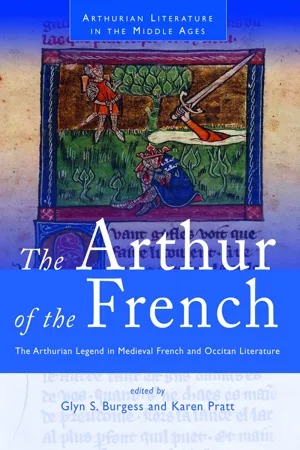
This major reference work is the fourth volume in the series "Arthurian Literature in the Middle Ages". Its intention is to update the French and Occitan chapters in R.S. Loomis' "Arthurian Literature in the Middle Ages: A Collaborative History" (Oxford, 1959) and to provide a volume which will serve the needs of students and scholars of Arthurian literature. The principal focus is the production, dissemination and evolution of Arthurian material in French and Occitan from the twelfth to the fifteenth century. Beginning with a substantial overview of Arthurian manuscripts, the volume covers writing in both verse (Wace, the Tristan legend, Chretien de Troyes and the Grail Continuations, Marie de France and the anonymous lays, the lesser known romances) and prose (the Vulgate Cycle, the prose Tristan, the Post-Vulgate Roman du Graal, etc.).
Information
Publisher
University of Wales PressYear
2020Print ISBN
9780708321966
9780708319642
eBook ISBN
9781786837448
NOTES
Introduction
Acknowledgements
The editors of this book owe many debts of gratitude – to its contributors (and especially those who submitted on time) for their forbearance; to Douglas Kelly, Elspeth Kennedy and Jane Taylor for organizing the material of multi-authored chapters into molt beles conjointures; to Simon Gaunt, Roger Middleton and above all to Elaine Polley for their advice, reference-checking and careful proofreading; to Linda Gowans for her expert indexing; to the University of Wales Press for its continued interest in our project; to the Vinaver Trust for much-needed financial and moral support; and to the late Ray Barron, general editor of the series, who sadly did not live to see this volume brought to fruition. Finally, we should like to express our sorrow that three of our distinguished contributors, Emmanuèle Baumgartner, Elspeth Kennedy and Roy Owen, died during the lengthy publication process. Arthurian Studies are much diminished by their loss.
Notes
1 Thoughout this book chapter references in roman numerals relate to the present volume.
2 See Barron ed. 1999*, 22–32. Items accompanied by an asterisk are to be found in the General Bibliography.
3 See Lacy, Kelly and Busby eds 1987–8*, but also the review by R. Middleton (MLR, 85 (1990), 438–9).
4 See Bromwich, Jarman and Roberts eds 1991*, chapters 6–8 and Lacy, Kelly and Busby eds 1987–8*, I, 337–42.
5 Greek and Serbo-Russian versions of the Arthurian Compilation by Rustichello of Pisa (Rusticien de Pise) have survived (see chapter IX).
6 See B. Schmolke-Hasselmann, ‘Henri II Plantagenêt, roi d’Angleterre, et la genèse d’Erec et Enide’, CCM, 24 (1981), 241–6.
7 See B. N. Sargent-Baur, ‘Dux bellorum/rex militum/roi fainéant: la transformation d’Arthur au XIIe siècle’, MA, 90 (1984), 357–73.
I. The Manuscripts
Notes
1 Editions of texts are often the best sources of information on individual manuscripts, and bibliographical details can be obtained from the chapters that deal with the texts that they contain.
2 Detailed information on the manuscripts that contain works by Chrétien can be found in the Catalogue compiled by Terry Nixon (1993b), with what is known of their history being given in the Index of Former Owners and its accompanying Additional Notes (Middleton 1993). The count of sixty-seven includes the small fragment added to BNF, fr. 1429 (mentioned in the description of fr. 1429, but not separately numbered in the Catalogue of Manuscripts) and also the ‘fragments’ preserved as extracts by Fauchet and Borel (mentioned briefly in the Index of Former Owners). Further information on ownership has come to light since publication. Princeton, University Library, MS Garrett 125 was item 227 in the sale catalogue of the Baron d’Heiss in 1785 (information kindly supplied by William and Meradith McMunn). BNF, fr. 1429 came to Colbert from the collection of Habert de Montmor in 1682, being ‘Le Roman du St. Graal’ in the list preserved in BNF, MS Baluze 100, fol. 153. The potential ambiguity of the title is not a problem since all the other candidates owned by Colbert can be traced to other provenances, and the wording is in fact that of the seventeenth-century title on the flyleaf of the manuscript itself (‘Li Romans du Saint Graal, composé par Chrestiens’). The manuscripts of Nicolas-Joseph Foucault (including BNF, fr. 1450 and the Edinburgh Perceval) appear in the sale catalogue of Jean-Jacques Charron, marquis de Ménars (The Hague: Abraham de Hondt, 1720). This sale took place in June 1720, proving conclusively that Foucault’s library was dispersed before his death (on 7 February 1721). The Edinburgh Perceval (NLS, Adv. 19. 1. 5) appears in a very rare Foulis catalogue of 1740, and was subsequently borrowed for many years by Bishop Thomas Percy (see Middleton 2006).
3 None of the arguments advanced for a more precise dating for Thomas, Marie or Erec can be considered reliable. For what it is worth, it seems to me that Erec may not have been written until the later 1170s. Caradigan, a place with no Arthurian pedigree, may have been better known to poets with Welsh or Breton connections after the supposedly well-publicized ‘eisteddfod’ of 1176, and the name Yvain de Cavaliot seems to reflect that of the historical Owein Cyfeiliog, who may have been a more suitable model after he was on good terms with King Henry II, particularly after his loyalty in 1173 (during the revolt of the king’s sons) and after his attendance at such gatherings as the Council of Oxford in 1177. We could also suggest that Erec goes unrecognized by Kay and Gauvain because he is wearing a closed helm (usually said to have been introduced c.1180, but probably a little earlier). In the end, however, these points are of no great weight, and each could be explained in various different ways.
4 This question requires a new examination of the documents, which are differently transcribed by almost all who have published them. The record of the payment to Jacques Raponde is apparently dated 21 February 1405 (meaning 1406 by modern reckoning), but it is entered amongst accounts for 1407 (Cockshaw 1969, no. 67). There is also some doubt over the amount, either because there is a discrepancy in the original or because there have been errors of transcription. The payment is sometimes given as 400 francs, sometimes as 400 escus. The difference is relevant because 400 francs would correspond exactly to the 300 escus paid by the Duke of Berry for BNF, fr. 117–20. A further problem is that the description of the book paid for by John the Fearless does not quite match the description of the book in the inventory of 1420 (Doutrepont 1906, item 68), which is undoubtedly the present Arsenal MSS 3479–80.
5 Much detailed work remains to be done on this sale, but amongst the manuscripts that are identifiable with reasonable certainty there are more than a dozen with the ex-libris of Jacques d’Armagnac. In the original catalogue (Anet 1724) the entries are not numbered, but this deficiency is made good in Bauchart (1886), and some of the manuscripts have these numbers written on them in pencil. Two of the copies of Tristan now in Vienna, Österreichische Nationalbibliothek, were in this sale: MS 2542 with the ex-libris of Jacques d’Armagnac was lot 135, and MS 2537 with the exlibris of Jean de Berry was lot 134.
6 The leaf with the transcription (and Douce’s marginal note) is reproduced in the Scolar Press facsimile of the Douce volume (Pickford 1978, Appendix II). Douce’s note is transcribed (not very accurately) by Vinaver (1925). Neither Vinaver, nor Pickford in the Scolar reprint, realized that Douce must be referring to the manuscript that is now British Library, MS Egerton 989, and they have also misread the second letter of Douce’s reference, which they both transcribe without explanation (Pickford has ‘M. h. B. II. 116’; Vinaver has ‘M. H. B. II. 116’). This should in fact be ‘M. N. B. II. 116’ (as given above), being Douce’s standard abbreviation for the volumes that are now Bodleian Library, MSS Douce e. 9–15. These contain Douce’s notes on manuscripts in the British Museum (where he was an Assistant Curator from 1807 to 1811), and pp. 116–19 of vol. 2 (MS Douce e. 10) have his comments on MS Royal 20 D. ii (as specified in his note). His ‘Ms. of the Mort de Tristan’ is Bodleian Library, MS Douce 189, obtained at the Soubise sale of 1789 (probably lot 5351).
7 I have seen examples, though not all in quite the...
Table of contents
- Cover
- Title Page
- Copyright Page
- Contents
- Preface
- The Contributors
- Abbreviations
- Introduction
- I. The Manuscripts
- II. The Arthur of the Chronicles
- III. The Tristan Legend in Old French Verse
- IV. Chrétien de Troyes
- V. Arthur in the Narrative Lay
- VI. Perceval and the Grail: The Continuations, Robert de Boron and Perlesvaus
- VII. Lancelot with and without the Grail: Lancelot do Lac and the Vulgate Cycle
- VIII. The Prose Tristan
- IX. Rewriting Prose Romance: The Post-Vulgate Roman du Graal and Related Texts
- X. Arthurian Verse Romance in the Twelfth and Thirteenth Centuries
- XI. Manuscript Compilations of Verse Romances
- XII. Late Medieval Arthurian Literature
- XIII. The Arthurian Tradition in Occitan Literature
- XIV. Arthur in Modern French Fiction and Film
- Notes
- General Bibliography
Trusted by 375,005 students
Access to over 1.5 million titles for a fair monthly price.
Study more efficiently using our study tools.
Frequently asked questions
Yes, you can cancel anytime from the Subscription tab in your account settings on the Perlego website. Your subscription will stay active until the end of your current billing period. Learn how to cancel your subscription
No, books cannot be downloaded as external files, such as PDFs, for use outside of Perlego. However, you can download books within the Perlego app for offline reading on mobile or tablet. Learn how to download books offline
Perlego offers two plans: Essential and Complete
- Essential is ideal for learners and professionals who enjoy exploring a wide range of subjects. Access the Essential Library with 800,000+ trusted titles and best-sellers across business, personal growth, and the humanities. Includes unlimited reading time and Standard Read Aloud voice.
- Complete: Perfect for advanced learners and researchers needing full, unrestricted access. Unlock 1.5M+ books across hundreds of subjects, including academic and specialized titles. The Complete Plan also includes advanced features like Premium Read Aloud and Research Assistant.
We are an online textbook subscription service, where you can get access to an entire online library for less than the price of a single book per month. With over 1.5 million books across 990+ topics, we’ve got you covered! Learn about our mission
Look out for the read-aloud symbol on your next book to see if you can listen to it. The read-aloud tool reads text aloud for you, highlighting the text as it is being read. You can pause it, speed it up and slow it down. Learn more about Read Aloud
Yes! You can use the Perlego app on both iOS and Android devices to read anytime, anywhere — even offline. Perfect for commutes or when you’re on the go.
Please note we cannot support devices running on iOS 13 and Android 7 or earlier. Learn more about using the app
Please note we cannot support devices running on iOS 13 and Android 7 or earlier. Learn more about using the app
Yes, you can access The Arthur of the French by in PDF and/or ePUB format, as well as other popular books in Literature & Ancient & Classical Literary Criticism. We have over 1.5 million books available in our catalogue for you to explore.