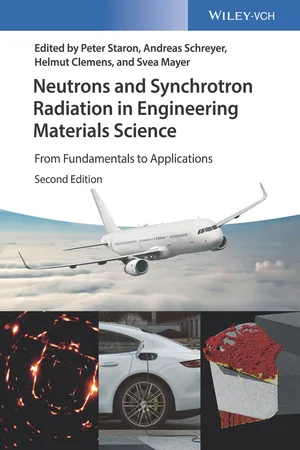
Retaining its proven concept, the second edition of this ready reference specifically addresses the need of materials engineers for reliable, detailed information on modern material characterization methods.
As such, it provides a systematic overview of the increasingly important field of characterization of engineering materials with the help of neutrons and synchrotron radiation. The first part introduces readers to the fundamentals of structure-property relationships in materials and the radiation sources suitable for materials characterization.
The second part then focuses on such characterization techniques as diffraction and scattering methods, as well as direct imaging and tomography. The third part presents new and emerging methods of materials characterization in the field of 3D characterization techniques like three-dimensional X-ray diffraction microscopy. The fourth and final part is a collection of examples that demonstrate the application of the methods introduced in the first parts to problems in materials science.
With thoroughly revised and updated chapters and now containing about 20%
new material, this is the must-have, in-depth resource on this highly relevant topic.
eBook - ePub
Neutrons and Synchrotron Radiation in Engineering Materials Science
From Fundamentals to Applications
- English
- ePUB (mobile friendly)
- Available on iOS & Android
eBook - ePub
Neutrons and Synchrotron Radiation in Engineering Materials Science
From Fundamentals to Applications
About this book
Information
Part I
General
Chapter 1
Microstructure and Properties of Engineering Materials
Helmut Clemens, Svea Mayer and Christina Scheu
1.1 Introduction
In general, engineering materials are grouped into four basic classifications: metals, ceramics, polymers, and semiconductors. While semiconductors represent exclusively functional materials, the remaining three – depending on their application – can be assigned to the group of either structural or functional materials. Independent of the group they belong to, the important properties of solid materials depend on the geometrical atomic arrangement and also the type of bonding that exists between the constituent atoms. The three types of primary or chemical bonds that are found in engineering materials – covalent, ionic, and metallic – and the main contributions to the individual groups are shown in Figure 1.1. Metals and their alloys possess primarily metallic bonding; semiconductors have mainly covalent bonds, whereas many ceramics exhibit a mixture of covalent and ionic bonding. In engineering polymers, weak secondary forces of attraction (van der Waals forces) exist between the extended covalently bound hydrocarbon chains (Figure 1.1). In general, the nature of bonding depends on the electronic structure of the constituent atoms forming the solid and arises from the tendency of atoms to obtain stable electron configurations.
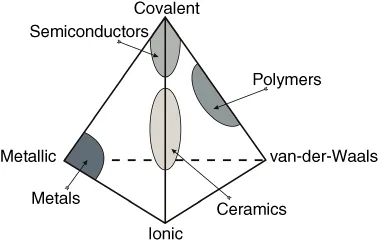
Figure 1.1 Bonding behavior present in different groups of engineering materials. (After [1].) Covalent, ionic, and metallic bonds represent strong primary bonds, whereas van der Waals attraction is a weak secondary bond.
The structure of engineering materials relates to the arrangement of its internal components. On an atomic level, a structure is understood as the organization of atoms relative to each other. In crystalline materials, the atoms are arranged in periodically repeating arrays which are termed crystal or lattice structures. Metals, for instance, have particularly simple crystal structures: (i) face-centered cubic (fcc), (ii) body-centered cubic (bcc), (iii) hexagonal closed-packed (hcp), and (iv) tetragonal. Many metals and their alloys exist in more than one crystal structure depending on the temperature and composition, but, in most cases, transitions are between these four crystal structures. In contrast, semiconductors usually crystallize either in the diamond structure (silicon, germanium) or often in the zincblende structure (e.g., gallium arsenide).
The next larger structural level is the microscopic level. Here, large groups of atomic arrangements are considered as components of the microstructure, which determines most of the properties of the material. The microstructure of engineering materials is described by the grain size, types of phases present, and description of their structure, shape, and size distributions. In addition, two-dimensional defects such as grain boundaries and heterophase interfaces, one-dimensional defects such as dislocations, and zero-dimensional defects such as point defects are important microstructural features that often control the resulting properties.
In this introductory chapter, the microstructure of engineering materials is explained with focus on structural metallic materials, showing a polycrystalline multiphase assembly. The most important microstructure parameters are presented and their influence on mechanical properties is briefly discussed. Table 1.1 roughly summarizes the influence of atomic arrangement, atomic defects, and microstructure upon the properties of metallic materials. In addition, the most important methods for microstructural characterization on a nanometer and micrometer scale will be outlined in this chapter with emphasis on analytical electron microscopy. At the end of the chapter, a selection of textbooks and journal articles is listed, which might be helpful for the reader to deepen his/her understanding of the microstructure and properties of engineering materials [1–15] as well as of methods used for microstructural characterization [7, 16–23].
Table 1.1 Influence of atomic arrangement and microstructure on the properties of engineering metallic materials
| Property | Influence of atomic arrangements and atomic defects | Influ... |
Table of contents
- Cover
- Title Page
- Copyright
- Table of Contents
- List of Contributors
- Preface to Second Edition
- Part I: General
- Part II: Methods
- Part III: New and Emerging Methods
- Part IV: Applications
- Index
- End User License Agreement
Trusted by 375,005 students
Access to over 1.5 million titles for a fair monthly price.
Study more efficiently using our study tools.
Frequently asked questions
Yes, you can cancel anytime from the Subscription tab in your account settings on the Perlego website. Your subscription will stay active until the end of your current billing period. Learn how to cancel your subscription
No, books cannot be downloaded as external files, such as PDFs, for use outside of Perlego. However, you can download books within the Perlego app for offline reading on mobile or tablet. Learn how to download books offline
Perlego offers two plans: Essential and Complete
- Essential is ideal for learners and professionals who enjoy exploring a wide range of subjects. Access the Essential Library with 800,000+ trusted titles and best-sellers across business, personal growth, and the humanities. Includes unlimited reading time and Standard Read Aloud voice.
- Complete: Perfect for advanced learners and researchers needing full, unrestricted access. Unlock 1.5M+ books across hundreds of subjects, including academic and specialized titles. The Complete Plan also includes advanced features like Premium Read Aloud and Research Assistant.
We are an online textbook subscription service, where you can get access to an entire online library for less than the price of a single book per month. With over 1.5 million books across 990+ topics, we’ve got you covered! Learn about our mission
Look out for the read-aloud symbol on your next book to see if you can listen to it. The read-aloud tool reads text aloud for you, highlighting the text as it is being read. You can pause it, speed it up and slow it down. Learn more about Read Aloud
Yes! You can use the Perlego app on both iOS and Android devices to read anytime, anywhere — even offline. Perfect for commutes or when you’re on the go.
Please note we cannot support devices running on iOS 13 and Android 7 or earlier. Learn more about using the app
Please note we cannot support devices running on iOS 13 and Android 7 or earlier. Learn more about using the app
Yes, you can access Neutrons and Synchrotron Radiation in Engineering Materials Science by Peter Staron, Andreas Schreyer, Helmut Clemens, Svea Mayer, Peter Staron,Andreas Schreyer,Helmut Clemens,Svea Mayer in PDF and/or ePUB format, as well as other popular books in Technology & Engineering & Materials Science. We have over 1.5 million books available in our catalogue for you to explore.