This concise introduction to the gastrointestinal system encapsulates the fundamental facts and principles of this rapidly growing and changing specialty. Written by experienced clinicians and teachers, the text covers the basic concepts of both the science surrounding the gastrointestinal system and the basics of clinical practice in an accessible, lucid format.
Now fully supported by a companion website at www.ataglanceseries.com/gastro containing interactive MCQs and downloadable digital flashcards, The Gastrointestinal System at a Glance is the ideal revision aid for medical and allied health students, and provides valuable insight for anyone seeking a comprehensive and concise guide to this subject area.
Fully revised and updated to include further coverage of diagnostic and therapeutic endoscopy, revised liver chapters and a new chapter on embryology
Now in full colour throughout
Supported by a companion website containing interactive self-assessment and digital flashcards - perfect for both study and revision
Provides an integrated approach to both the basic and clinical science of this core specialty
The mouth and teeth admit food into the gastrointestinal tract. They cut and break large pieces, chop, grind and moisten what can be chewed, and prepare a smooth, round bolus that can be swallowed and passed on to the rest of the system. Of course, the lips and mouth also serve other functions.
Structure
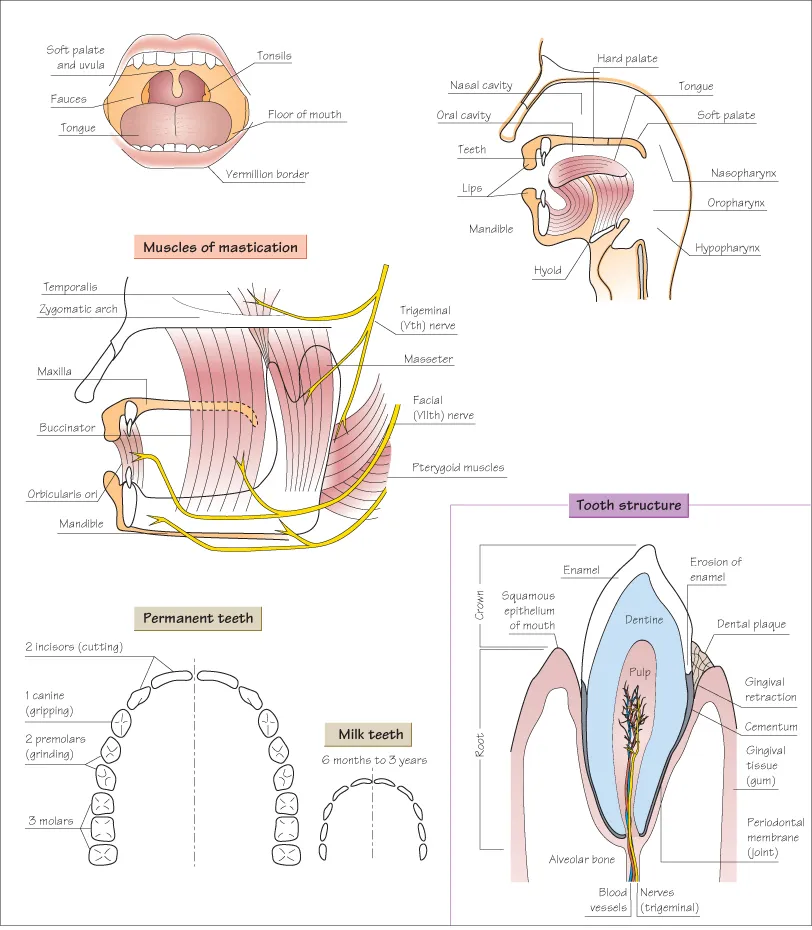
The sensitive, flexible, muscular lips that form the anterior border of the mouth can assess food by palpation, and their flexibility enables them to seal off the oral cavity and form variously a funnel, suction tube or shallow ladle to ingest fluids and food of varying consistency. The main muscles of the lips are orbicularis ori.
The maxilla and mandible support the roof and floor of the mouth, respectively. The arch of the mandible supports a sling of muscles that forms the floor, including the tongue. The maxilla is continuous with the rest of the skull and forms the roof of the mouth anteriorly and, simultaneously, the floor of the nasal cavity and paranasal maxillary sinus. Posteriorly, the roof is formed by the soft palate, composed of connective tissue.
The sides of the mouth comprise the cheek muscles, chiefly the buccinator, and supporting connective tissue. Posteriorly, the oral cavity opens into the oropharynx, and the tonsils are situated between the fauces laterally, marking the posterior limit of the oral cavity.
The entire mouth, including the gingivae or gums, is lined with a tough, mainly non-cornified stratified squamous epithelium, which changes to skin (cornified stratified squamous epithelium) at the vermillion border of the lips.
Teeth arise in the alveolar bone of the mandible and maxilla. Infants are born without external teeth and with precursors within the jaw. A transient set of 20 ‘milk’ teeth erupts through the surface of the bone between 6 months and 3 years of age. They are shed between 6 and 13 years of age, and permanent teeth take their place. There are 32 permanent teeth and the most posterior molars, also known as wisdom teeth, may only erupt in young adulthood.
Teeth are living structures with a vascular and nerve supply (derived from the trigeminal, or Vth cranial, nerve) in the centre of each tooth, which is termed the pulp. Surrounding the pulp is a bony layer called dentine, and surrounding this is an extremely hard, calcified layer called cementum within the tooth socket, the enamel crown protruding into mouth. Teeth lie in sockets within the alveolar bone, and the joint is filled with a layer of tough fibrous tissue (the periodontal membrane) allowing a small amount of flexibility. The margins of the tooth joint are surrounded by gingivae, which are a continuation of the mucosal lining of the mouth.
Function
The lips, cheeks and tongue help to keep food moving and place it in the optimal position for effective chewing. The main muscles of chewing or mastication are the masseter and temporalis, which powerfully bring the lower jaw up against the upper jaw, and the pterygoids, which open the jaws, keep them aligned, and move them sideways, and backwards, and forwards for grinding. The trigeminal (Vth cranial) nerve controls the muscles of mastication.
Teeth are specialized for different tasks as follows:
Incisors have flat, sharp edges for cutting tough foods, such as meat and hard fruits.
Canines have pointed, sharp ends for gripping food, particularly meat, and tearing pieces away.
Premolars and molars have flattened, complex surfaces that capture tiny bits of food, such as grains, and allow them to be crushed between the surfaces of two opposed teeth. As people get older, the grinding surfaces of the molars are gradually worn down.
Certain drugs can be absorbed across the oral mucosa and may be prescribed sublingually (under the tongue). In this way, the need to swallow is avoided and the absorbed drug bypasses the liver and avoids hepatic first-pass metabolism. Glyceryl trinitrate is one of the most common drugs administered in this way.
Common Disorders
Herpes simplex infection of the mouth is very common, causing cold sores, which often erupt on the lips when people have other illnesses. Serious oral infections, usually caused by a mixture of anaerobic bacteria, are less common.
The corners of the mouth may be ulcerated or fissured in patients who cannot take care of their mouths, for example after a stroke, so careful oral hygiene is important in these cases. Nutritional deficiency, particularly of B complex vitamins and iron, is also associated with fissures at the edge of the mouth, known as angular stomatitis.
Shallow ‘aphthous’ ulcers in the mouth are common and are usually not associated with a more serious condition. Rarely, squamous cell carcinoma can develop in the mouth. Risk factors for this include smoking and chewing tobacco or betel nut, which is particularly common on the Indian subcontinent.
Dental caries is the commonest disorder of teeth, resulting in tooth loss with advancing age. It is caused by the action of bacteria, producing acids that demineralize the teeth. There is also infection of the gums and periodontal membrane, encouraged by carbohydrate and sugar-rich food residues left in the mouth. Bacteria grow in the gap between the tooth enamel and gums, forming a layer called plaque, within which they multiply. Their metabolic products, including organic acids, damage tooth enamel. Gradual erosion of enamel and retraction of the gingivae weakens the tooth joint. Infection can penetrate the pulp causing an abscess, and chronic infection can destroy and devitalize the pulp.
Dental hygiene, including brushing and flossing and having fluoride in drinking water, which strengthens tooth enamel, reduces the incidence of caries.
2 Salivary Glands
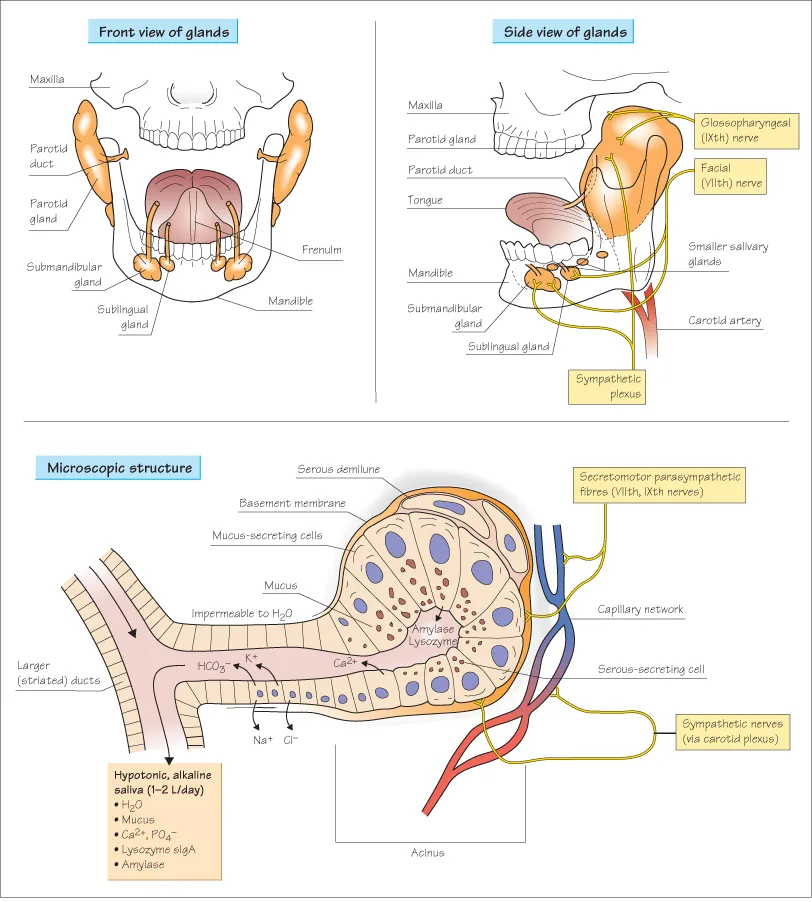
Saliva lubricates the mouth and teeth, provides antibacterial and digestive enzymes, and maintains the chemical balance of tooth enamel. Salivary glands are structurally similar to exocrine glands throughout the gastrointestinal tract a...
Table of contents
Cover
Table of Contents
Preface
Introduction and Overview
1 Mouth and Teeth
2 Salivary Glands
3 Tongue and pharynx
4 Oesophagus
5 Stomach
6 Duodenum
7 Pancreas
8 Liver
9 Biliary System
10 Hepatic Portal System
11 Jejunum and Ileum
12 Caecum and Appendix
13 Colon
14 Rectum and Anus
15 Embryology
16 Enteric Motility
17 Enteric Endocrine System
18 Enteric and Autonomic Nerves
19 Mucosal Immune System
20 Digestion and Absorption
21 Digestion of Carbohydrates, Proteins and Fats
22 Digestion of Vitamins and Minerals
23 Nutrition
24 Fluid and Electrolyte Balance
25 Hepatic Metabolic Function
26 Hepatic Synthetic Function
27 Hepatic Detoxification and Excretion
28 Nausea and Vomiting
29 Diarrhoea
30 Constipation
31 Functional Disorders and Irritable Bowel Syndrome
32 Gastro-Oesophageal Reflux and Hiatus Hernia
33 Peptic Ulcer and Helicobacter pylori
34 Gastroenteritis and Food Poisoning
35 Gastrointestinal System Infections
36 Ulcerative Colitis and Crohn’s Disease
37 Coeliac Disease
38 Obesity and Malnutrition
39 Colon and Rectal Cancer
40 Gastrointestinal, Pancreatic and Liver Tumours
41 Haemorrhoids and Anorectal Disease
42 Gallstones and Pancreatitis
43 Hepatitis and Acute Liver Disease
44 Cirrhosis and Chronic Liver Disease
45 History, Examination and Tests
46 Diagnostic Endoscopy
47 Therapeutic Endoscopy
48 Radiology and Imaging
49 Functional Tests
50 Pharmacotherapy
51 Gastrointestinal Surgery
Index
End User License Agreement
Trusted by 375,005 students
Access to over 1.5 million titles for a fair monthly price.
Study more efficiently using our study tools.
Frequently asked questions
Yes, you can cancel anytime from the Subscription tab in your account settings on the Perlego website. Your subscription will stay active until the end of your current billing period. Learn how to cancel your subscription
No, books cannot be downloaded as external files, such as PDFs, for use outside of Perlego. However, you can download books within the Perlego app for offline reading on mobile or tablet. Learn how to download books offline
Perlego offers two plans: Essential and Complete
Essential is ideal for learners and professionals who enjoy exploring a wide range of subjects. Access the Essential Library with 800,000+ trusted titles and best-sellers across business, personal growth, and the humanities. Includes unlimited reading time and Standard Read Aloud voice.
Complete: Perfect for advanced learners and researchers needing full, unrestricted access. Unlock 1.5M+ books across hundreds of subjects, including academic and specialized titles. The Complete Plan also includes advanced features like Premium Read Aloud and Research Assistant.
Both plans are available with monthly, semester, or annual billing cycles.
We are an online textbook subscription service, where you can get access to an entire online library for less than the price of a single book per month. With over 1.5 million books across 990+ topics, we’ve got you covered! Learn about our mission
Look out for the read-aloud symbol on your next book to see if you can listen to it. The read-aloud tool reads text aloud for you, highlighting the text as it is being read. You can pause it, speed it up and slow it down. Learn more about Read Aloud
Yes! You can use the Perlego app on both iOS and Android devices to read anytime, anywhere — even offline. Perfect for commutes or when you’re on the go. Please note we cannot support devices running on iOS 13 and Android 7 or earlier. Learn more about using the app
Yes, you can access The Gastrointestinal System at a Glance by Satish Keshav,Adam Bailey in PDF and/or ePUB format, as well as other popular books in Medicine & Gastroenterology & Hepatology. We have over 1.5 million books available in our catalogue for you to explore.