Essential Neonatal Medicine
eBook - ePub

Essential Neonatal Medicine

  1. English
  2. ePUB (mobile friendly)
  3. Available on iOS & Android
eBook - ePub

Essential Neonatal Medicine

About this book

Essential Neonatal Medicine combines the depth and breadth of a textbook with the clarity and efficiency of a learning consolidator. ProvidingĀ a solid referenceĀ for traineeĀ doctors,Ā neonatal nurses and midwives, this full colour edition has been extensively updated withĀ a range of new illustrations, clinical tips, cross-references to Wiley title Nursing the Neonate (2010, 9781405149747),Ā and end-of-chapter summaries for quick study or revision.

Essential Neonatal Medicine is ideal for all trainee health professionals experiencing neonatology for the first time and looking for a readable and comprehensive resource to support them. It is now accompanied byĀ the enhanced Wiley Desktop Edition (the interactive digital version of the book featuring downloadable text and images, highlighting and note-taking facilities, book-marking, cross-referencing, in-text searching, and linking to references and glossary terms), and a companion websiteĀ at www.essentialneonatalmed.com featuring figures from the book to download in PowerPoint, further reading, and self-test questions for each chapter.

This title is also available as a mobile App from MedHand Mobile Libraries. Buy it now from iTunes, Google Play or the MedHand Store.

Ā 

Frequently asked questions

Yes, you can cancel anytime from the Subscription tab in your account settings on the Perlego website. Your subscription will stay active until the end of your current billing period. Learn how to cancel your subscription.
No, books cannot be downloaded as external files, such as PDFs, for use outside of Perlego. However, you can download books within the Perlego app for offline reading on mobile or tablet. Learn more here.
Perlego offers two plans: Essential and Complete
  • Essential is ideal for learners and professionals who enjoy exploring a wide range of subjects. Access the Essential Library with 800,000+ trusted titles and best-sellers across business, personal growth, and the humanities. Includes unlimited reading time and Standard Read Aloud voice.
  • Complete: Perfect for advanced learners and researchers needing full, unrestricted access. Unlock 1.4M+ books across hundreds of subjects, including academic and specialized titles. The Complete Plan also includes advanced features like Premium Read Aloud and Research Assistant.
Both plans are available with monthly, semester, or annual billing cycles.
We are an online textbook subscription service, where you can get access to an entire online library for less than the price of a single book per month. With over 1 million books across 1000+ topics, we’ve got you covered! Learn more here.
Look out for the read-aloud symbol on your next book to see if you can listen to it. The read-aloud tool reads text aloud for you, highlighting the text as it is being read. You can pause it, speed it up and slow it down. Learn more here.
Yes! You can use the Perlego app on both iOS or Android devices to read anytime, anywhere — even offline. Perfect for commutes or when you’re on the go.
Please note we cannot support devices running on iOS 13 and Android 7 or earlier. Learn more about using the app.
Yes, you can access Essential Neonatal Medicine by Sunil Sinha,Lawrence Miall,Luke Jardine in PDF and/or ePUB format, as well as other popular books in Medicine & Pediatric Medicine. We have over one million books available in our catalogue for you to explore.

Information

Year
2012
Print ISBN
9780470670408
eBook ISBN
9781118286487
Edition
5
CHAPTER 1
Fetal Well-Being and Adaptation at Birth
Key topics
  • Placental function
  • Fetal homeostasis
  • Fetal circulation
  • Assessment of fetal well-being
  • Screening during pregnancy
  • Fetal monitoring during labour
  • Fetal compromise

Introduction

The discipline of ā€˜perinatal medicine’ spans the specialties of fetal medicine and neonatology. The obstetrician must have a thorough knowledge of pregnancy and its effects on the mother and fetus, as well as fetal development and physiology. The neonatologist specializes in the medical care of the infant immediately after birth but must also have a thorough understanding of fetal development and physiology. This chapter reviews fetal assessment and physiology to provide the paediatrician and neonatal nurse with a better understanding of normal perinatal adaptation and the adverse consequences arising from maladaptation.

Placental Function

The placenta is a fetal organ that has three major functions: transport, immunity and metabolism.
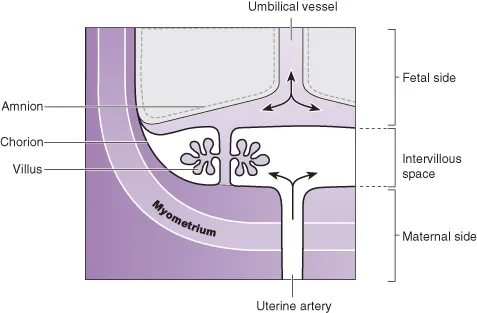
The uterus is supplied with blood from the uterine arteries, which dilate throughout pregnancy, increasing blood supply 10-fold by term. Maternal blood bathes the intervillous space and is separated from fetal blood by the chorionic plate. Transport of nutrients and toxins occurs at this level. Oxygenated fetal blood in the capillaries of the chorionic plate leaves the placenta via the umbilical vein to the fetus (Fig. 1.1).
Figure 1.1 Diagram of placental structures showing blood perfusion.
c01f001

Transport

The placenta transports nutrients from the mother to the fetus, and waste products in the other direction. This occurs in a number of ways, including simple diffusion (for small molecules) and active transport, which is used for larger molecules. The placenta is crucially also responsible for gaseous exchange of oxygen and carbon dioxide. Oxygen diffuses from the mother (PO2 = 10–14 kPa, 75–105 mmHg) to the fetus (PO2 = 2–4 kPa, 15–30 mmHg) where it binds to fetal haemoglobin. This has a higher affinity for oxygen than maternal haemoglobin for a given PO2. This off-loading of maternal haemoglobin is also facilitated by a change in maternal blood pH.

Immunity

The placenta trophoblast prevents the maternal immune system from reacting against ā€˜foreign’ fetal antigens. Rejection does not occur because the trophoblastic cells appear to be non-antigenic, although it is known that fetal cells can cross into the maternal circulation where they can trigger an immune reaction (e.g. rhesus haemolytic disease). Maternal IgG antibody, the smallest of the immunoglobulins, can cross the placenta where it provides the newborn with innate immunity to infectious diseases. These IgG antibodies can also cause perinatal disease such as transient hyperthyroidism (see Chapter 21).
CLINICAL TIP: Because IgG antibody crosses the placenta, the presence of IgG antibody in the newborn’s blood does not mean it has been exposed to the disease. This is of particular relevance when testing newborns for HIV infection or syphilis, where a positive IgG may just reflect maternal exposure. Instead, direct tests (e.g. viral RNA by PCR) are required (see Chapter 10).

Metabolism

The placenta is metabolically active and produces hormones, including human chorionic gonadotropin (hCG) and human chorionic thyrotropin (hCT). It also detoxifies drugs and metabolites. Oestriol cannot be produced by the placenta alone. This is done by the fetal liver and adrenal glands. The metabolites are then sulphated by the placenta to form oestrogens, one of which is oestriol.
Because of its metabolic activity, the placenta has very high energy demands and consumes over 50% of the total oxygen and glucose transported across it.

Fetal Homeostasis

The placenta is an essential organ for maintaining fetal homeostasis but the fetus is capable of performing a variety of physiological functions:
  • The liver produces albumin, coagulation factors and red blood cells.
  • The kidney excretes large volumes of dilute urine from 10–11 weeks’ gestation, which contributes to amniotic fluid.
  • Fetal endocrine organs produce thyroid hormones, corticosteroids, mineralocorticoids, parathormone and insulin from 12 weeks’ gestation.
  • Some immunoglobulins are produced by the fetus from the end of the first trimester.

Fetal Circulation

The fetal circulation is quite different from the newborn or adult circulation. The umbilical arteries are branches of the internal iliac arteries. These carry deoxygenated blood from the fetus to the placenta where it is oxygenated as it comes into close apposition with maternal blood in the intervillous spaces. Oxygenated fetal blood is carried in the single umbilical vein which bypasses the liver via the ductus venosus to reach the inferior vena cava. It then passes into the inferior vena cava and enters the right atrium as a ā€˜jet’, which is shunted to the left atrium across the foramen ovale (Fig. 1.2). From here it passes into the left ventricle and is pumped to the coronary arteries and cerebral vessels. In this way the fetal brain receives the most oxygenated blood. Some deoxygenated blood is pumped by the right ventricle into the pulmonary artery, but the majority bypasses the lungs via the ductus arteriosus to flow into the aorta where it is carried back to the placenta. Only 7% of the combined ventricular output of blood passes into the lungs. The right ventricle is the dominant ventricle, ejecting 66% of the combined ventricular output.
Figure 1.2 Diagram of the fetal circulation through the heart and lungs, sho...

Table of contents

  1. Cover
  2. Companion website
  3. Title page
  4. Copyright page
  5. Preface to the fifth edition
  6. Acknowledgements
  7. Preface to the first edition
  8. Abbreviations
  9. How to get the best out of your textbook
  10. CHAPTER 1 Fetal well-being and adaptation at birth
  11. CHAPTER 2 Perinatal epidemiology and audit
  12. CHAPTER 3 Multiple births
  13. CHAPTER 4 Neonatal consequences of maternal conditions
  14. CHAPTER 5 Resuscitation at birth
  15. CHAPTER 6 Examination of the newborn
  16. CHAPTER 7 Birth injury
  17. CHAPTER 8 Genetic disorders
  18. CHAPTER 9 Infant feeding and nutrition
  19. CHAPTER 10 Infection
  20. CHAPTER 11 The extreme preterm infant
  21. CHAPTER 12 The low-birthweight infant
  22. CHAPTER 13 Respiratory disorders
  23. CHAPTER 14 Apnoea, bradycardia and upper airway obstruction
  24. CHAPTER 15 Respiratory physiology and respiratory support
  25. CHAPTER 16 Cardiovascular disorders
  26. CHAPTER 17 Gastrointestinal and abdominal disorders
  27. CHAPTER 18 Renal disorders
  28. CHAPTER 19 Jaundice
  29. CHAPTER 20 Haematological disorders
  30. CHAPTER 21 Endocrine and metabolic disorders
  31. CHAPTER 22 Neurological disorders
  32. CHAPTER 23 Neurodevelopmental follow-up and assessment of hearing and vision
  33. CHAPTER 24 Developmental care and the neonatal environment
  34. CHAPTER 25 Organization of perinatal services and neonatal transport
  35. CHAPTER 26 Discharge and follow-up of high-risk infants
  36. CHAPTER 27 Parent–infant attachment and support for parents of critically ill infants
  37. CHAPTER 28 Ethical issues and decision-making process in the treatment of critically ill newborn infants
  38. CHAPTER 29 Practical procedures
  39. Index
  40. Access to accompanying material