![]()
1
Introduction
1.1 INTRODUCTION
Mankind has exploited matter in technology through the ages. For many millenia, we relied on materials like wood or metals that were subject to minimal processing to provide useful objects. It is only within a few minutes of midnight on the proverbial human evolutionary clock that materials have been engineered for ultimate applications based on a deep understanding of molecular properties. Considering substances that have been engineered in a controlled or tailored manner, the nineteenth century was the age of iron and steel. The twentieth century saw the development of new types of engineered materials, especially polymers, which in the form of plastics have, in many applications, usurped many of the traditional ‘hard’ materials. This is not to forget the emergence of an important class of inorganic material, semiconductors, in the second half of this century. These are, of course, the basis for the second industrial revolution, that of information technology. However, it seems fair to say that many properties of hard matter are now well understood whereas we are still on the learning curve with soft matter. For example, inspired by nature, we are only just beginning to be able to engineer complex structures formed by biopolymers or to exploit nanotechnology to make devices based on self-organization of polymers. In our new millennium it seems safe to predict the continued importance of soft materials, engineered in ways we can as yet only dream of.
The idea of a unified approach to ‘soft materials’ has only gained ground recently. It is an interdisciplinary subject, taking in aspects of physics, chemistry and materials science, but also of biochemistry or (chemical, mechanical) engineering in specific cases. A consequence of this interdisciplinarity is that, unfortunately, the subject is not considered in conventional textbooks on physics, physical chemistry or materials science, often being neglected entirely or covered in an inadequate manner. The purpose of this book is to ‘fill the gap’, by providing an up-to-date introductory summary of the thermodynamics and dynamics of soft materials. In each of the six chapters, the basic physical chemistry is covered first, prior to an outline of applications. The material is presented in a coherent fashion across the book. Equations have been kept to the minimum number that capture important relationships. Derivations are included, where they illustrate thermodynamical or statistical mechanical principles in action. The derivation of the Flory–Huggins theory in Section 2.5.6 or of the thermodynamics of micellar equilibria in Section 4.6.5 are good examples. Soft materials are important in many products, such as detergents, paints, plastics, personal care products, foods, clays, plastics and gels. Such uses of soft materials are exemplified throughout this book.
In this book we consider soft materials under the headings of polymers (Chapter 2), colloids (Chapter 3), amphiphiles (Chapter 4), liquid crystals (Chapter 5) and biological soft materials (Chapter 6). The distinctions between these systems are often not strong. For example, amphiphiles in solution and some aspects of polymer science are often considered in books on colloid chemistry. However, here we treat them separately since they are technologically important enough to merit detailed consideration on their own. The chapter on liquid crystals is in fact focused on one class of material, thermotropic liquid crystals, where phase transitions are thermally driven. However, a different class of liquid crystal phase is formed in amphiphile solutions, where concentration is also a relevant variable. These are termed lyotropic liquid crystal phases and are discussed in Chapter 4.
There are a number of texts that deal with aspects of the subjects covered in this book. General texts in the area include those by Evans and Wennerström, Hunter, Larson and Shaw (see Further Reading at the end of the chapter). Detailed textbooks for background reading on each topic are listed in the Further Reading section that follows each chapter. In Chapter 2, polymer science is outlined in a particularly concise form, and after the fundamentals are introduced, attention is paid to applications of polymers in the latter part of the chapter. There are quite a number of monographs concerned with colloids. However, many of these are not suitable for use as undergraduate textbooks. Thus, Chapter 3 fulfills a particularly useful function in providing an up-to-date introduction to the essential physical chemistry. Also emphasized are applications of colloids and colloids in everyday life, such as in foods. Chapter 4 summarizes the important aspects underpinning the self-assembly of amphiphiles, i.e. surfactants and lipids. The action of surfactants as detergents is also considered and the importance of lipids in cell membranes is discussed. Chapter 5 is concerned with thermotropic liquid crystals. Chapter 6 is focused on aspects of self-assembly of biological soft materials. Recommended texts for background reading on these subjects are listed in the Further Reading sections.
In this chapter, intermolecular forces that are the basis of self-assembly are considered in Section 1.2. Section 1.3 outlines common features of structural ordering in soft materials. Section 1.4 deals similarly with general considerations concerning the dynamics of macromolecules and colloids. Section 1.5 focuses on phase transitions along with theories that describe them, and the associated definition of a suitable order parameter is introduced in Section 1.6. Scaling laws are defined in Section 1.7. Polydispersity in particle size is an important characteristic of soft materials and is described in Section 1.8. Section 1.9 details the primary experimental tools for studying soft matter and Section 1.10 summarizes the essential features of appropriate computer simulation methods.
1.2 INTERMOLECULAR INTERACTIONS
The term ‘soft’ matter originates from macroscopic mechanical properties. We mean here materials such as colloids, surfactants, liquid crystals, certain biomaterials and polymers in the melt or solution. Many soft materials can be induced to flow under certain conditions. This weak ordering results from the lack of three-dimensional atomic long-range order found in a crystalline solid. Nevertheless, there is always a degree of local order at least as great as that in a liquid. From the viewpoint of kinetic energy, a crude distinction between ‘soft’ materials and ‘hard’ ones can be made on the basis that the molecular kinetic energy for the former is close to kBT, whereas for the latter it is much less than kBT (when the temperature is near ambient). Here we consider the intermolecular forces responsible for the ordering of soft materials. Our purpose is not to provide a detailed description of these forces, since this is dealt with in many physical chemistry textbooks (for example Atkins, 2006). Here we briefly outline the essential results, especially in the context of self-assembly in soft matter, which is the subject of this book.
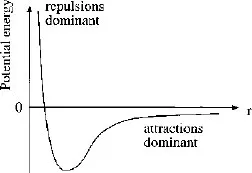
The forces between molecules are a balance of repulsive interactions at short distances and attractive interactions that predominate over larger length-scales. This is illustrated by the curve of potential energy as a function of intermolecular separation in Fig. 1.1. We will now consider the origin of the repulsive and attractive forces. Then we consider Coulombic forces since ions are present in solution in many colloid and surfactant systems, and in this case interactions between charged species predominate.
Figure 1.1 Typical curve of potential energy versus separation of two molecules or atoms. At short distances, repulsive interactions predominate, whilst attractive forces act over a longer range
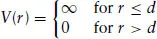
Repulsive interactions are important when molecules are close to each other. They result from the overlap of electrons when atoms approach one another. As molecules move very close to each other the potential energy rises steeply, due partly to repulsive interactions between electrons, but also due to forces with a quantum mechanical origin in the Pauli exclusion principle. Repulsive interactions effectively correspond to steric or excluded volume interactions. Because a molecule cannot come into contact with other molecules, it effectively excludes volume to these other molecules. The simplest model for an excluded volume interaction is the hard sphere model. The hard sphere model has direct application to one class of soft materials, namely sterically stabilized colloidal dispersions. These are described in Section 3.6. It is also used as a reference system for modelling the behaviour of simple fluids. The hard sphere potential, V(r), has a particularly simple form:
where d is the diameter of the hard sphere. The ordering of hard spheres depends only on their volume fraction. The phase diagram has been obtained by computer simulations and experiments on sterically stabilized colloid particles, as discussed in Section 3.6.
The hard sphere model is based on the excluded volume of spherical particles. An excluded volume theory has been developed to account for the orientational ordering of liquid crystal molecules, assuming them to be hard rods. This is the Onsager theory and its variants, outlined in Section 5.5.2. Excluded volume interactions influence the conformation of polymer chains. The conformation of an ideal chain is described by a random walk. However, in this case the chain can cross itself, i.e. it has no excluded volume. Under certain circumstances a polymer chain can behave as if this was the case (see Section 2.3.2). However, it is more usual for excluded volume interactions to lead to a self-avoiding walk, which produces a more extended conformation than that of a random walk (Section 2.3.2).
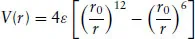
Because there are no attractive interactions in the potential, the hard sphere model does not describe the forces between molecules very well. More realistic potentials include an attractive contribution, which usually varies as − 1/r6 (as discussed shortly) as well as a repulsive term. The latter is chosen to vary as 1/rn, with n > 6, to ensure that repulsions dominate at short distances, n = 12 often being assumed. This combination of attractive and repulsive terms defines the Lennard–Jones (12,6) potential:
Here ε is the depth of the potential energy minimum and 21/6r0 is the intermolecular separation corresponding to this minimum. This potential has a form similar to that shown in Fig. 1.1. It is often used as a starting point for modelling intermolecular interactions, for example it can be chosen as the intermolecular potential in computer simulations (see Section 1.10). It is not completely realistic, though, because for example it is known that the 1/r12 form is not a good representation of the repulsive potential. An exponential form exp(−r/r0) is better because it reproduces the exponential decay of atomic orbitals at large distances, and hence the overlap which is responsible for repulsions.
Attractive interactions in uncharged molecules result from van der Waals forces, which arise from interactions between dipoles. A molecule has a dipole moment if it contains two opposite charges of magnitude q, separated by some distance r. Such a molecule is said to be polar. The dipole moment is then defined by μ = qr. Dipole moments of small molecules are usually about 1 debye (D), where 1D = 3.336 × 10⁻³⁰ C m. Some molecules, such as H2O, possess a permanent dipole moment due to charge separation resulting from the electro-negativity of the oxygen atom. Dipolar molecules can also induce dipole moments in other molecules producing dipole–induced dipole forces. The potential energy between two dipoles can be calculated by summing up the Coulomb potential energy between each of the four charges. Recall that the Coulomb potential energy is given by
where r is the distance between charges q1 and q2 and ε0 is the vacuum permittivity.
Considering two parallel dipoles, the potential can be shown to vary as 1/r3. ...