Written for marketing and finance directors, CEOs, and strategists, as well as MBA students, this practical book explains the principles and practice behind rigorous due diligence in marketing. It connects marketing plans and investment to the valuation of the firm and how it can contribute to increasing stakeholder value. Completely revised and updated throughout, the Second Edition features new case examples as well as a completely new first chapter containing the results of new research into risk and marketing strategies amongst Finance Directors and Chief Marketing Officers.
eBook - ePub
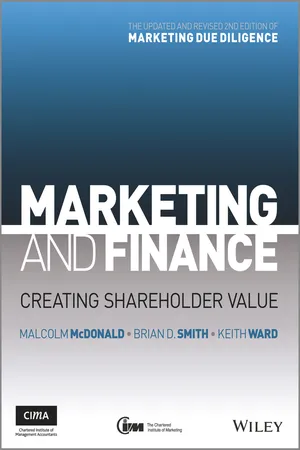
Marketing and Finance
Creating Shareholder Value
- English
- ePUB (mobile friendly)
- Available on iOS & Android
eBook - ePub
Part 1
What is Marketing Due Diligence?
Chapter 1
The Lessons of Experience
‘Diligence is the mother of good fortune’
—Benjamin Disraeli
Fast track
Almost all businesses prepare a business plan and have it reviewed by senior executives. Whatever the business, the plan consists of a request for resources, some description of how they will be used and a promised outcome. Despite the large amount of effort put into preparing, reviewing and revising these plans, they often fail and, in doing so, they destroy shareholder value and waste precious resources. It is dangerous to draw simple conclusions from stories of business success and failure, but the rigorous study of enough cases reveals some useful general patterns. We can see common factors that lie behind success, such as making sure the market is really there and ensuring that the business has and uses a distinctive strength. Similarly, we can see patterns in business failures, such as the failure to identify the target customer correctly or to anticipate where the market is headed. Identifying these common factors is important because traditional metrics of firm performance and marketing accountability can be manipulated easily and, in most cases, look backwards rather than forwards. This chapter introduces a new way at looking at a business strategy and connecting it to firm performance. This approach, known as Marketing Due Diligence, is based on the fundamental factors that underlie almost all successful business strategies.
Introduction
There are few things in business life that are more universal or more ubiquitous than the business plan. From the entrepreneur trying to convince his backers, to the CEO of a multinational trying to assuage a room full of demanding investment analysts, the business plan occupies much of the attention of business leaders, their subordinates and those who invest in the enterprise. A strong business plan may not guarantee commercial success, but a weak one almost certainly guarantees failure, so the ability to craft a strong plan and to differentiate between weak and strong plans is, arguably, one of the core capabilities of any business executive. This book is written for those people – owners, executives, investors – whose career and livelihood depends upon their business planning competence. It does not, however, prescribe methodologies for preparing a plan; there are already many good books that do that. Instead, this book addresses a much more neglected question: How do we know if the business plan is likely to succeed? We think this question is important to every executive but, when we conceived the book, we did have two particular audiences and one particular context in mind; senior finance executives, senior marketers and the interface between them. For both, assessing and insuring the success of a business plan is an essential part of their job but, in our experience, the two professions look at this problem from very different perspectives, often leading to conflict where cooperation is, in fact, most needed. We’ve therefore written this book with the aim of encouraging a shared perspective between senior finance and marketing colleagues, one that combines the distinct value each brings to commercial management, with the intention that cooperation at the marketing/finance interface will lead to stronger business plans and better commercial outcomes.
Business plans appear to vary greatly between different types of company, but when one dissects them, they are in fact remarkably similar in their fundamentals. Whatever the nature of the enterprise, most business plans are, in essence, a request, a description and a promise. They request the allocation of some resources, describe how those resources will be used and promise to deliver an objective. Whether the plan is a two-pager for a small business or a 15Mb PowerPoint deck for a strategic business unit of a global multinational, it almost always boils down to that fundamental structure of a request, a description and a promise. This is no coincidence. It is an obvious and direct corollary of the simple reality that almost all businesses require investment in order to achieve their goals and almost all investors want to know how their money is going to be spent.
With well over a century of executive experience and academic research behind us, the three authors of this book have been involved in more business plans than we like to be reminded of. We’ve prepared them, presented them, analysed them and followed up on their outcomes. We have written them ourselves and been through the plan presentation and approval ritual many times; and we’ve coached hundreds, perhaps thousands, of executives through the process in industries ranging from consumer goods to pharmaceuticals and from high technology to incontinence products. By and large, we find the business plan review process, as it is practised in most companies, to be ineffective or at least inefficient. It is supposed to produce agreement on a plan that has a high probability of delivering its promises. In practice, it often does the opposite. Executives, operating in a highly uncertain environment, write plans that they think will work but in which the risks are poorly understood. They anticipate the challenges of their leaders and build in spare resources and soft targets. Their leaders, without their subordinates’ knowledge of the market environment but with long experience of how executives behave, counter these tactics by instinctively demanding better outcomes and less expenditure, whatever the initial proposal. Overall, the outcome is a plan in which there is more resigned acceptance than committed agreement and one in which the probability of delivering the objectives is low or, worse, poorly understood. To quote one executive from our research, the business plan review process, rather than being an essential and value-adding activity, is often a game that gets in the way of doing business.
This book is written for those executives who write and assess business plans and who want their time spent planning to create value rather than to be a political game. The bulk of the book, from Chapter 2 onwards, describes a two-part process for improving a business plan: diagnosis of its weaknesses and then therapeutic steps to address them. The process, which we’ve called Marketing Due Diligence, is based on our extensive practical experience and on many years of studying the experience of firms whilst working as professors at some of the world’s leading business schools. Before we become immersed in that, however, this chapter aims to introduce some of the basic ideas in the book by discussing some educative examples of business success and failure.
Success stories
As the English proverb has it, success has many fathers whilst failure is an orphan. This reminds us that it is almost impossible to attribute corporate success to one cause. To succeed, firms need to do the right things, to do them well and, not least, to be blessed with luck. But notwithstanding that, our research has revealed to us a pattern of features that characterize almost every successful business strategy and which can be seen in the following well-known examples.
Starbucks: A holistic offer based on insight and culture
From its humble origins in 1970s Seattle, Starbucks now has about 20,000 outlets worldwide, an annual revenue approaching $12 billion1 and has become an icon of urban life. Much of this success is attributable to its core strategy developed by its CEO Howard D. Schultz, who led both its initial expansionary phase after he acquired the firm in 1988 and, resuming the CEO role, its impressive comeback after the 2007 crash.2
The core of Schultz’s strategy is to create neighbourhood coffee shops with an atmosphere and experience that differentiate them from the multitude of rivals, which include local, single store, coffee shops and other ‘me too’ chains, as well as indirect rivals such as McDonald’s. In his interviews (see, for example, the interview with Howard Schultz3), Schultz talks compellingly about the challenge of balancing growth with maintaining that differentiation. He has even talked of growth itself as a carcinogen to the culture and values that underpin the friendly, high-quality, localized experience that he sees as central to Starbuck’s competitive positioning. And whilst Starbucks, like many global multinationals, has become one of those companies that everyone likes to criticize, its commercial success is one that many companies would like to emulate.
The interesting question is what Starbucks might tell us about strategy. Out of the many things that Starbucks teaches us, two things stand out. Firstly, their 1990s expansion was into a new market. Although there were, of course, local coffee shops it was by no means certain that the market was the size that it turned out to be. Schultz’s insight was to infer, from the presence of other coffee shops and other social meeting places, that there existed a market for a ‘Third Place’ (to use Ray Oldenburg’s term4) between work and home. His second insight was to understand the holistic nature of an offer to the customer required to differentiate Starbucks from its competitors. He could have simply emphasized the quality of the coffee or competed on price but he eschewed both of these traditional approaches because he perceived that product and price (two of the traditional 4 or 7Ps of marketing) were simply components of the experience he wanted to offer to the customer.
In his interviews and in his book,5 Schultz talks about everything from the importance of grinding coffee on the premises to the need to prevent local initiatives diluting the brand experience, but the two lessons that are most generalizable to other businesses are the identification of a new, or at least dormant, market space and the essentially holistic, coherent nature of a strong customer offer.
The Economist: Side stepping in time to the future
It is hard to think of a business more different from Starbucks, an iconic brand of early 21st century consumerism, than The Economist, a global business magazine that was founded in 1843 ‘to take part in a severe contest between intelligence, which presses forward, and an unworthy, timid ignorance obstructing our progress’.6 Owned along with the Financial Times by the Pearson Group, The Economist seems to share little strategic context with Starbucks, other than strong competition; but there are interesting parallels and contrasts. Operating in an established market for business and management information, there is no doubt that the market exists. But the plethora of existing competitors such as Business Week and other newspapers and the explosion of new, web-based, information sources means that The Economist has a huge challenge to be profitable. However, it has established a uniquely attractive brand and, as part of the Economist Group, continues to grow revenues and profit in an environment that might be expected to be especially difficult for what is essentially a premium priced newspaper.
The Economist reinforces a lesson from Starbucks (which of course it predated) and tells us at least two more. Like Schultz’s Starbucks strategy, The Economist attempts a strongly differentiated value proposition. In this case, it is based upon a level of knowledgeable, independent insight with which others struggle to compete. To complement this, it wraps its value proposition in a slightly arrogant, aspirational brand position.
The additional lessons from The Economist strategy are less obvious but just as important. Its choice of position in a very crowded market is based on avoiding or side-stepping its competitors. The Economist chooses to avoid competing, for example, on timeliness, industry specificity or price, as web-based news services, trade magazines and free, loss-leading, consultants’ reports do respectively. This avoidance of head-on competition is one of the characteristics of strong strategy that we will return to.
The third lesson from The Economist concerns change. In a market environment that has been hugely disrupted by technological, political and social trends, a premium, UK-centric, paper newspaper was uniquely vulnerable, as the profit margins of other ‘quality’ newspapers attest. The web and mobile devices threaten paper; email reduces attention spans; and globalization reduces the UK to a secondary country in economic terms. The Economist’s strategy, however, anticipates these changes and makes use of market trends. Its electronic versions complement its paper editions; its content has globalized into regional editions and the quality of its content aims to win share of the reducing amount of quality reading time.
Like all of these examples, The Econom...
Table of contents
- Cover
- Contents
- Title
- Copyright
- Dedication
- Foreword
- Foreword from the First Edition
- A note for busy people: How to get the best out of this book
- List of figures
- List of tables
- Part 1: What is Marketing Due Diligence?
- Part 2: The Marketing Due Diligence Diagnostic Process
- Part 3: The Marketing Due Diligence Therapeutic Process
- Afterword: What to do now
- References and further reading
- Index
Trusted by 375,005 students
Access to over 1.5 million titles for a fair monthly price.
Study more efficiently using our study tools.
Frequently asked questions
Yes, you can cancel anytime from the Subscription tab in your account settings on the Perlego website. Your subscription will stay active until the end of your current billing period. Learn how to cancel your subscription
No, books cannot be downloaded as external files, such as PDFs, for use outside of Perlego. However, you can download books within the Perlego app for offline reading on mobile or tablet. Learn how to download books offline
Perlego offers two plans: Essential and Complete
- Essential is ideal for learners and professionals who enjoy exploring a wide range of subjects. Access the Essential Library with 800,000+ trusted titles and best-sellers across business, personal growth, and the humanities. Includes unlimited reading time and Standard Read Aloud voice.
- Complete: Perfect for advanced learners and researchers needing full, unrestricted access. Unlock 1.5M+ books across hundreds of subjects, including academic and specialized titles. The Complete Plan also includes advanced features like Premium Read Aloud and Research Assistant.
We are an online textbook subscription service, where you can get access to an entire online library for less than the price of a single book per month. With over 1.5 million books across 990+ topics, we’ve got you covered! Learn about our mission
Look out for the read-aloud symbol on your next book to see if you can listen to it. The read-aloud tool reads text aloud for you, highlighting the text as it is being read. You can pause it, speed it up and slow it down. Learn more about Read Aloud
Yes! You can use the Perlego app on both iOS and Android devices to read anytime, anywhere — even offline. Perfect for commutes or when you’re on the go.
Please note we cannot support devices running on iOS 13 and Android 7 or earlier. Learn more about using the app
Please note we cannot support devices running on iOS 13 and Android 7 or earlier. Learn more about using the app
Yes, you can access Marketing and Finance by Malcolm McDonald,Brian D. Smith,Keith Ward in PDF and/or ePUB format, as well as other popular books in Business & Marketing. We have over 1.5 million books available in our catalogue for you to explore.