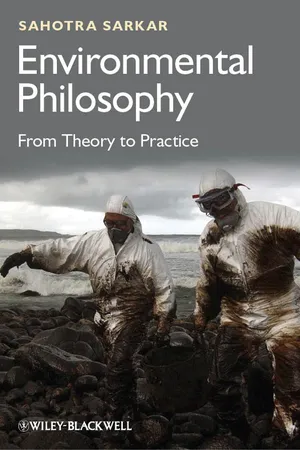
- Encompasses all of environmental philosophy, including conservation biology, restoration ecology, sustainability, environmental justice, and more
- Offers the first treatment of decision theory in an environmental philosophy text
- Explores the conceptions of nature and ethical presuppositions that underlie contemporary environmental debates, and, moving from theory to practice, shows how decision theory translates to public policy
- Addresses both hot-button issues, including population and immigration reform, and such ongoing issues as historical legacies and nations' responsibility and obligation for environmental problems
- Anchors philosophical concepts to their practical applications, establishing the priority of the discipline's real-world importance
- English
- ePUB (mobile friendly)
- Available on iOS & Android
eBook - ePub
About this book
The first comprehensive treatment of environmental philosophy, going beyond ethics to address the philosophical concepts that underlie environmental thinking and policy-making today
Information
Chapter 1
Introduction
The natural world seems to be deteriorating around us largely as a result of our actions. Urban sprawl spreading along the highways of Texas (and elsewhere throughout the North; that is, the “developed” world) has made it harder and harder for us to get to a spot where we can enjoy nature not dominated by human artefacts. Increasing numbers of people driving along these highways are polluting the atmosphere, besides accelerating climate change. Texas is slowly but surely running dry, with less and less water reaching the ocean along its rivers: the current water use patterns cannot be sustained for more than a generation.1 In central Texas, two bird species, the Golden-cheeked Warbler (Dendroica chrysoparia) and the Black-capped Vireo (Vireo atricapilla), are legally designated as endangered (as defined by the United States Endangered Species Act (ESA)) because of loss of their breeding habitat to residential, industrial, and commercial development. A rapidly spreading invasive species, the imported red fire ant (Solenopsis invicta), which thrives on fragmented habitats (a result of human land use choices), is threatening many native species with extinction. For the same reason, Ashe juniper (Juniperus ashei) is aggressively spreading over the landscape, replacing much of the original plant communities. Tallgrass prairie, which originally covered a large part of the region, has almost entirely disappeared, typically replaced by monocultures of planted crops. In southeastern Texas, it has cost millions of dollars to rescue the Whooping Crane (Grus americana), the population of which had declined to perhaps 15 individuals in the late 1930s. In Texas, as elsewhere, cattle, poultry, and other animals are being bred to be killed and consumed, sometimes in appalling conditions in order to keep prices low. These are genuine environmental problems.
There are other problems that may or may not be about the environment (part of the project of environmental philosophy is to help determine whether these problems are environmental problems). Since the 1990s, the Sierra Club in the United States has periodically been torn apart by a minority of members trying to get it to adopt an official stance against immigration into the United States.2 According to this minority, these immigrants would increase the population of the United States and exacerbate already critical environmental problems. Moreover, they claim, immigrants from poorer countries such as México would adopt over-consumptive Northern lifestyles and would thus consume much more of Earth's resources than they would if they remained mired in poverty at home. Whether members of this minority are genuinely motivated by concern for the environment, or whether they are simply paranoid nativists and racists hiding behind the banner of environmentalism, remains a hotly contested issue. There is much to argue over, for instance, whether immigrants from countries such as México would really end up having over-consumptive lifestyles (like those of many white US self-described environmentalists with their oil-guzzling sports utility vehicles) and whether, even if the immigrants were to opt for over-consumption, their descendants, because of cultural changes in their new home, would have sufficiently lower birth rates to vitiate any possible effect of over-consumption. However, there is little reason to doubt that over-consumption of resources is a problem and that it depends both on lifestyle choices and population sizes.
What Is Environmental Philosophy?
Few would deny that environmental problems must be faced, and that solving these problems is essential for humanity to continue to flourish on Earth. But what has philosophy got to do with this? The answer is: a lot, and much more than you would initially expect. How do we distinguish between a genuine environmental problem and one that is not? It depends on how we define what the environment is and that, as we shall see, is a non-trivial philosophical problem (Chapter 2). Defining many other concepts used to discuss environmental issues is equally problematic: these include biodiversity (Chapter 5), ecological integrity (Chapter 6), and sustainability (Chapter 7). Conceptual analysis, as practiced within philosophy, is critical to their clarification. Without clarity and precision we may well make unwise decisions. For instance, if we define biodiversity incorrectly, we may end up wasting resources on biota that do not merit attention while ignoring those that do.
Moreover, should we be concerned only with the flourishing of humanity in the future? Or should we include other species? Ecosystems? What about mountains and rivers? When we choose what to eat or wear, should we worry about the harm to other species? Does it matter whether individuals of those species that we consume have the capacity to feel pain? How do we even know when an animal feels pain? Do we have responsibilities to future generations that will be affected by climate change? Within academic philosophy, environmental ethics has traditionally debated these issues (Chapter 3). The relevant questions are not purely academic. They affect how we frame policy—from what parts of nature we conserve to how we experiment with animals.
Who should be held to blame for our environmental problems? Only the proximate “offenders”; for instance, poor pastoralists in east Africa “encroaching” on a national park to gather fodder? Or should we follow the chain of explanation much further, wondering how such poverty came to be institutionalized in the first place? Is colonialism to blame? Are Northern descendants of colonialists responsible? Environmental philosophy also embraces questions such as these, which lie at the foundation of what is now often called “political ecology” (Chapter 8). Social and political philosophy have much to contribute to these issues.
Scientific questions about the environment are mostly studied within the field of ecology. How are the results of this science to be integrated with the values that frame what we think we should do with the environment? Once again, this is a philosophical problem (Chapter 4). Ecology is rarely good at predicting the future, especially for large, complex systems such as entire continent-sized landscapes. Yet, the uncertain results must be used to inform practical environmental policy. We need to know the quantitative effects of carbon emissions on global warming to set goals for carbon trading regimes. We need to know how reduced water flow will affect downstream fisheries before we approve damming a river. In typical cases, we do not have time to wait before making a decision. Taking time to gather more data is not an option. We almost never have time—or resources—to survey all species in a region before deciding what parts (if any) should be protected. Moreover, many environmental decisions are irreversible. Many ecosystems, once destroyed, may never regenerate. Given all these constraints, can decisions ever be rational? What does it mean to be rational in this context?
Environmental philosophy also studies the sorts of questions broached in the last paragraph, many of which belong to epistemology (the theory of knowledge) and the philosophy of science, and others to decision theory. It should be clear that environmental philosophy is a highly applied discipline, intimately engaged with the world, and may well have much to contribute to the solution of environmental problems.
What's Special about Environmental Philosophy?
First, environmental ethics attempts to enlarge the domain of traditional (that is, human) ethics by extending our moral concern to non-human entities, to individual animals and plants, to entire non-human species, and sometimes even to inanimate objects. We will examine these issues in Chapter 3. Second, as noted earlier, worrying about the effects of the uncertainty of ecological predictions is part of epistemology and the philosophy of science. But the extent of the uncertainty takes us into new conceptual territory, especially when it must be addressed in practical decision contexts. We discuss decision theory and other philosophical issues at the foundations of the environmental sciences in Chapter 4. Third, environmental philosophy embraces interdisciplinarity to an extent that is not matched by any other part of philosophy, not even by the philosophy of science (which is necessarily interdisciplinary because of its contact with the sciences). The environmental sciences, as we shall see in several chapters of this book (especially Chapter 5, Chapter 6, and Chapter 7), are highly interdisciplinary. Environmental philosophy must not only accommodate all this interdisciplinarity but also add to them normative concerns from epistemology, ethics, and aesthetics.
The academic environmental disciplines, such as conservation biology and restoration ecology, are explicitly goal-oriented. For instance, the aim of conservation biology is to maintain biodiversity, the aims of restoration ecology are to achieve historical fidelity and ecological integrity, and a variety of resource management sciences aim to ensure sustainability. As we shall see in Chapter 5, Chapter 6, and Chapter 7, each of these goals—diversity, fidelity, integrity, and sustainability—is imbued with cultural norms. Now discussion of norms—indeed, of normativity in general—is inherently philosophical in the sense that philosophical arguments play the role of adjudicating between the values expressed by the norms. They help identify which values and norms we should embrace and to what extent. The task is not simple: goals may be incompatible. For instance, biodiversity and historical fidelity may be incompatible if a rare and vulnerable species has recently moved into a new habitat. In cases such as these, environmental philosophy is special because what is decided within it is so intimately related to the pursuit of the environmental sciences. Moreover, these sciences are equally intimately connected to practical policy. Environmental philosophy may make a difference to what happens in practice.
Finally, environmental problems raise important issues of equity and justice. Those who benefit most from the unbridled consumption of fossil fuels largely live in the North or in the affluent sections of the South (the poorer countries). (For brevity of exposition, “the North” will from now on be used in this book to include the affluent of the South.) Northern consumption of fossil fuels is a major cause of global climate change. Yet the brunt of the negative effects of climate change will be borne by the South. What does justice demand in this context? Does it require a massive transfer of resources from the North to the South? Moreover, denizens of the South may not share the values of the North; for instance, the protection of charismatic species, especially if such protection must come with the loss or diminution of already precarious livelihoods. Which values are more important? These are also issues in environmental philosophy, as will be discussed in Chapter 8, though they are equally issues in social and political philosophy without any specific concern for the environment.
Why Is Environmental Philosophy Important?
Philosophy has two important functions in almost all applied contexts:
1. It helps clarify what we do: what we perceive as problems, what we set as goals, how we set those goals, and how and why we choose strategies to achieve those goals. For instance, when we argue that a habitat patch should be set aside for nature, are we doing so because of a concern for the species on it, independent of perceived human interests, or because it provides beautiful scenery that we appreciate? When we think about its protection, do we mean we want no human access, less human access, or even restoration of nature at that place? Suppose our focus is on the biota. Does protection mean we want the species to persist or do we care about the welfare of each individual? And why? When we think of strategy, do we want higher ticket prices, community ownership, state intervention, or some combination of all of these? And why?
2. Philosophy helps put things in context. Environmental problems may be connected to socio-political problems. For instance, deforestation may be a result of poverty. Moreover, many of the values we cherish (in nature as well as elsewhere) may be in conflict. (Box 1.1 discusses the wildlife conservation policies that were adopted in east Africa in the late 1980s, and what philosophy could have contributed to the process.)
Box 1.1: Preserving Wildlife: Wildlife Wars in East Africa in the 1980s3
The 1980s saw serious declines in east Africa's elephant populations even as black rhinoceros populations were on the brink of extinction. Concern for the survival of these species—and about other wildlife declines—prompted several international non-governmental organizations (NGOs) to make African wildlife conservation a major priority. Several African governments responded to this pressure by militarizing the enforcement of wildlife laws, in particular access to national parks. Northern NGOs and the media viewed these developments as a “war” for wildlife. In 1985 Zimbabwe began the paramilitary “Operation Stronghold” commanded by former Rhodesian Defense Force officers with a mandate to track down and kill black “poachers.” In 1988 Kenyan President Daniel Arap Moi issued a shoot-on-sight order to thousands of police sent into those national parks that were believed to be suffering the highest elephant losses. These losses were supposed to be due to the activities of foreign “poachers” from Somalia. In 1989, Tanzania launched “Operation Uhai” to remove “poachers,” using a military strike force (of army, police, and Wildlife Division personnel). Military equipment flowing into the region included automatic assault rifles, helicopters, and remote-controlled surveillance aircraft. Virtually all funding came from the North. The British Parliament debated sending British troops to Kenya, Mozambique, and Tanzania to help protect elephants. Millions of dollars came from the United States. While the official policy of the World Wildlife Fund (WWF) at this time was not to provide funds for guns or ammunition, in practice it disbursed such funds in Tanzania in 1987 and funded the purchase of helicopters in Zimbabwe.
Shoot-on-sight orders to kill “poachers” and “bandits” were issued in the Central African Republic, Kenya, Malawi, Tanzania, and Zimbabwe. In the Central American Republic, Bruce Hayes, a co-founder of Earth First! in the United States, hired mercenaries to shoot at “poachers,” again supposedly from Somalia. These mercenaries were also given shoot-on-sight authority. Almost all these African countries declared a “war” on “poachers.” More than a hundred people were killed in each of Kenya and Zimbabwe. More than three hundred were killed in Malawi and an even larger number disappeared. Park rangers in Malawi were routinely accused of systematic rape. Between 20 and 50 people were killed in Tanzania, and between 20 and 96 in Botswana. Not one of those who were killed received a trial. Human rights activists have pointed out...
Table of contents
- Cover
- Title Page
- Copyright
- Dedication
- Acknowledgments
- List of Acronyms
- Chapter 1: Introduction
- Chapter 2: What Is the Environment?
- Chapter 3: Ethics for the Environment
- Chapter 4: From Ethics to Policy
- Chapter 5: Biodiversity and Conservation
- Chapter 6: Environmental Restoration
- Chapter 7: Sustainability
- Chapter 8: Justice and Equity
- Chapter 9: Where Does This Leave Us?
- Glossary
- References
- Index
Trusted by 375,005 students
Access to over 1.5 million titles for a fair monthly price.
Study more efficiently using our study tools.
Frequently asked questions
Yes, you can cancel anytime from the Subscription tab in your account settings on the Perlego website. Your subscription will stay active until the end of your current billing period. Learn how to cancel your subscription
No, books cannot be downloaded as external files, such as PDFs, for use outside of Perlego. However, you can download books within the Perlego app for offline reading on mobile or tablet. Learn how to download books offline
Perlego offers two plans: Essential and Complete
- Essential is ideal for learners and professionals who enjoy exploring a wide range of subjects. Access the Essential Library with 800,000+ trusted titles and best-sellers across business, personal growth, and the humanities. Includes unlimited reading time and Standard Read Aloud voice.
- Complete: Perfect for advanced learners and researchers needing full, unrestricted access. Unlock 1.5M+ books across hundreds of subjects, including academic and specialized titles. The Complete Plan also includes advanced features like Premium Read Aloud and Research Assistant.
We are an online textbook subscription service, where you can get access to an entire online library for less than the price of a single book per month. With over 1.5 million books across 990+ topics, we’ve got you covered! Learn about our mission
Look out for the read-aloud symbol on your next book to see if you can listen to it. The read-aloud tool reads text aloud for you, highlighting the text as it is being read. You can pause it, speed it up and slow it down. Learn more about Read Aloud
Yes! You can use the Perlego app on both iOS and Android devices to read anytime, anywhere — even offline. Perfect for commutes or when you’re on the go.
Please note we cannot support devices running on iOS 13 and Android 7 or earlier. Learn more about using the app
Please note we cannot support devices running on iOS 13 and Android 7 or earlier. Learn more about using the app
Yes, you can access Environmental Philosophy by Sahotra Sarkar in PDF and/or ePUB format, as well as other popular books in Philosophy & Ethics & Moral Philosophy. We have over 1.5 million books available in our catalogue for you to explore.