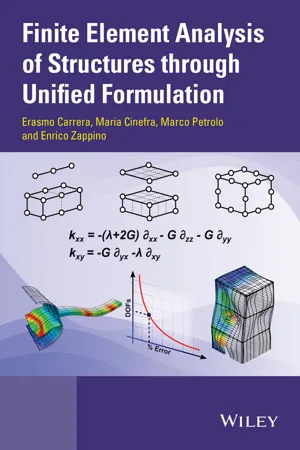
Finite Element Analysis of Structures through Unified Formulation
- English
- ePUB (mobile friendly)
- Available on iOS & Android
Finite Element Analysis of Structures through Unified Formulation
About this book
The finite element method (FEM) is a computational tool widely used to design and analyse complex structures. Currently, there are a number of different approaches to analysis using the FEM that vary according to the type of structure being analysed: beams and plates may use 1D or 2D approaches, shells and solids 2D or 3D approaches, and methods that work for one structure are typically not optimized to work for another.
Finite Element Analysis of Structures Through Unified Formulation deals with the FEM used for the analysis of the mechanics of structures in the case of linear elasticity. The novelty of this book is that the finite elements (FEs) are formulated on the basis of a class of theories of structures known as the Carrera Unified Formulation (CUF). It formulates 1D, 2D and 3D FEs on the basis of the same 'fundamental nucleus' that comes from geometrical relations and Hooke's law, and presents both 1D and 2D refined FEs that only have displacement variables as in 3D elements. It also covers 1D and 2D FEs that make use of 'real' physical surfaces rather than 'artificial' mathematical surfaces which are difficult to interface in CAD/CAE software.
Key features:
- Covers how the refined formulation can be easily and conveniently used to analyse laminated structures, such as sandwich and composite structures, and to deal with multifield problems
- Shows the performance of different FE models through the 'best theory diagram' which allows different models to be compared in terms of accuracy and computational cost
- Introduces an axiomatic/asymptotic approach that reduces the computational cost of the structural analysis without affecting the accuracy
- Introduces an innovative 'component-wise' approach to deal with complex structures
- Accompanied by a website hosting the dedicated software package MUL2 (www.mul2.com)
Finite Element Analysis of Structures Through Unified Formulation is a valuable reference for researchers and practitioners, and is also a useful source of information for graduate students in civil, mechanical and aerospace engineering.
Frequently asked questions
- Essential is ideal for learners and professionals who enjoy exploring a wide range of subjects. Access the Essential Library with 800,000+ trusted titles and best-sellers across business, personal growth, and the humanities. Includes unlimited reading time and Standard Read Aloud voice.
- Complete: Perfect for advanced learners and researchers needing full, unrestricted access. Unlock 1.4M+ books across hundreds of subjects, including academic and specialized titles. The Complete Plan also includes advanced features like Premium Read Aloud and Research Assistant.
Please note we cannot support devices running on iOS 13 and Android 7 or earlier. Learn more about using the app.
Information
Table of contents
- Cover
- Titlepage
- Copyright
- About the Authors
- Preface
- Nomenclature and Acronyms
- 1 Introduction
- 2 Fundamental Equations of 3D Elasticity
- 3 From 3D Problems to 2D and 1D Problems: Theories for Beams, Plates and Shells
- 4 Typical FE Governing Equations and Procedures
- 5 Introduction to the Unified Formulation
- 6 The Displacement Approach via the PVD and FN for 1D, 2D and 3D Elements
- 7 Three-Dimensional FEM Formulation (Solid Elements)
- 8 One-Dimensional Models with Nth-Order Displacement Field, the Taylor Expansion Class
- 9 One-Dimensional Models with a Physical Volume/Surface-Based Geometry and Pure Displacement Variables, the Lagrange Expansion Class
- 10 Two-Dimensional Plate Models with Nth-Order Displacement Field, the Taylor Expansion Class
- 11 Two-Dimensional Shell Models with Nth-Order Displacement Field, the TE Class
- 12 Two-Dimensional Models with Physical Volume/Surface-Based Geometry and Pure Displacement Variables, the LE Class
- 13 Discussion on Possible Best Beam, Plate and Shell Diagrams
- 14 Mixing Variable Kinematic Models
- 15 Extension to Multilayered Structures
- 16 Extension to Multifield Problems
- Appendix A Numerical Integration
- Appendix B CUF FE Models: Programming and Implementation Guidelines
- Index
- End User License Agreement