Wind Effects on Structures
eBook - ePub

Wind Effects on Structures

Modern Structural Design for Wind

  1. English
  2. ePUB (mobile friendly)
  3. Available on iOS & Android
eBook - ePub

Wind Effects on Structures

Modern Structural Design for Wind

About this book

Provides structural engineers with the knowledge and practical tools needed to perform structural designs for wind that incorporate major technological, conceptual, analytical and computational advances achieved in the last two decades.

With clear explanations and documentation of the concepts, methods, algorithms, and software available for accounting for wind loads in structural design, it also describes the wind engineer's contributions in sufficient detail that they can be effectively scrutinized by the structural engineer in charge of the design.

Wind Effects on Structures: Modern Structural Design for Wind, 4 th Edition is organized in four sections. The first covers atmospheric flows, extreme wind speeds, and bluff body aerodynamics. The second examines the design of buildings, and includes chapters on aerodynamic loads; dynamic and effective wind-induced loads; wind effects with specified MRIs; low-rise buildings; tall buildings; and more. The third part is devoted to aeroelastic effects, and covers both fundamentals and applications. The last part considers other structures and special topics such as trussed frameworks; offshore structures; and tornado effects.

Offering readers the knowledge and practical tools needed to develop structural designs for wind loadings, this book:

  • Points out significant limitations in the design of buildings based on such techniques as the high-frequency force balance
  • Discusses powerful algorithms, tools, and software needed for the effective design for wind, and provides numerous examples of application
  • Discusses techniques applicable to structures other than buildings, including stacks and suspended-span bridges
  • Features several appendices on Elements of Probability and Statistics; Peaks-over-Threshold Poisson-Process Procedure for Estimating Peaks; estimates of the WTC Towers' Response to Wind and their shortcomings; and more

Wind Effects on Structures: Modern Structural Design for Wind, 4 th Edition is an excellent text for structural engineers, wind engineers, and structural engineering students and faculty.
Frequently asked questions

Yes, you can cancel anytime from the Subscription tab in your account settings on the Perlego website. Your subscription will stay active until the end of your current billing period. Learn how to cancel your subscription.
At the moment all of our mobile-responsive ePub books are available to download via the app. Most of our PDFs are also available to download and we're working on making the final remaining ones downloadable now. Learn more here.
Perlego offers two plans: Essential and Complete
  • Essential is ideal for learners and professionals who enjoy exploring a wide range of subjects. Access the Essential Library with 800,000+ trusted titles and best-sellers across business, personal growth, and the humanities. Includes unlimited reading time and Standard Read Aloud voice.
  • Complete: Perfect for advanced learners and researchers needing full, unrestricted access. Unlock 1.4M+ books across hundreds of subjects, including academic and specialized titles. The Complete Plan also includes advanced features like Premium Read Aloud and Research Assistant.
Both plans are available with monthly, semester, or annual billing cycles.
We are an online textbook subscription service, where you can get access to an entire online library for less than the price of a single book per month. With over 1 million books across 1000+ topics, we’ve got you covered! Learn more here.
Look out for the read-aloud symbol on your next book to see if you can listen to it. The read-aloud tool reads text aloud for you, highlighting the text as it is being read. You can pause it, speed it up and slow it down. Learn more here.
Yes! You can use the Perlego app on both iOS or Android devices to read anytime, anywhere — even offline. Perfect for commutes or when you’re on the go.
Please note we cannot support devices running on iOS 13 and Android 7 or earlier. Learn more about using the app.
Yes, you can access Wind Effects on Structures by Emil Simiu,DongHun Yeo in PDF and/or ePUB format, as well as other popular books in Technology & Engineering & Civil Engineering. We have over one million books available in our catalogue for you to explore.

Part I
Atmospheric Flows, ExtremeWind Speeds, Bluff Body Aerodynamics

1
Atmospheric Circulations

Wind, or the motion of air with respect to the surface of the Earth, is fundamentally caused by variable solar heating of the Earth's atmosphere. It is initiated, in a more immediate sense, by differences of pressure between points of equal elevation. Such differences may be brought about by thermodynamic and mechanical phenomena that occur in the atmosphere both in time and space.
The energy required for the occurrence of these phenomena is provided by the sun in the form of radiated heat. While the sun is the original source, the source of energy most directly influential upon the atmosphere is the surface of the Earth. Indeed, the atmosphere is to a large extent transparent to the solar radiation incident upon the Earth, much in the same way as the glass roof of a greenhouse. That portion of the solar radiation that is not reflected or scattered back into space may therefore be assumed to be absorbed entirely by the Earth. The Earth, upon being heated, will emit energy in the form of terrestrial radiation, the characteristic wavelengths of which are long (in the order of 10 μ) compared to those of heat radiated by the sun. The atmosphere, which is largely transparent to solar but not to terrestrial radiation, absorbs the heat radiated by the Earth and re‐emits some of it toward the ground.

1.1 Atmospheric Thermodynamics

1.1.1 Temperature of the Atmosphere

To illustrate the role of the temperature distribution in the atmosphere in the production of winds, a simplified version of model circulation will be presented. In this model the vertical variation of air temperature, of the humidity of the air, of the rotation of the Earth, and of friction are ignored, and the surface of the Earth is assumed to be uniform and smooth.
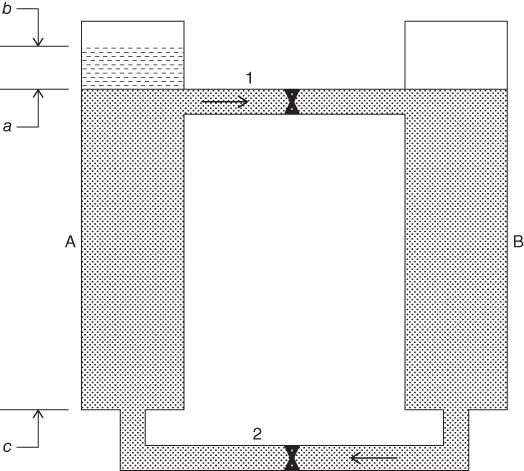
The axis of rotation of the Earth is inclined at approximately 66° 30′ to the plane of its orbit around the sun. Therefore, the average annual intensity of solar radiation and, consequently, the intensity of terrestrial radiation, is higher in the equatorial than in the polar regions. To explain the circulation pattern as a result of this temperature difference, Humphreys [1] proposed the following ideal experiment (Figure 1.1).
Diagrammatic illustration of Circulation pattern due to temperature difference between two columns of fluid.
Figure 1.1 Circulation pattern due to temperature difference between two columns of fluid.
Source: From Ref. [1]. Copyright 1929, 1940 by W. J. Humphreys.
Assume that the tanks A and B are filled with fluid of uniform temperature up to level a, and that tubes 1 and 2 are closed. If the temperature of the fluid in A is raised while the temperature in B is maintained constant, the fluid in A will expand...

Table of contents

  1. Cover
  2. Table of Contents
  3. Dedication
  4. Preface to the Fourth Edition
  5. Introduction
  6. Part I: Atmospheric Flows, ExtremeWind Speeds, Bluff Body Aerodynamics
  7. Part II: Design of Buildings
  8. Part III: Aeroelastic Effects
  9. Part IV: Other Structures and Special Topics
  10. Appendices
  11. Appendix A: Elements of Probability and Statistics
  12. Appendix B: Random Processes
  13. Appendix C: Peaks‐Over‐Threshold Poisson‐Process Procedure for Estimating Peaks
  14. Appendix D: Structural Dynamics
  15. Appendix E: Structural Reliability
  16. Appendix F: World Trade Center Response to Wind
  17. Index
  18. End User License Agreement