The guide to creating engaging web content and building a loyal following, revised and updated
Blogs, YouTube, Facebook, Twitter, Google+, and other platforms are giving everyone a "voice," including organizations and their customers. So how do you create the stories, videos, and blog posts that cultivate fans, arouse passion for your products or services, and ignite your business? Content Rules equips you for online success as a one-stop source on the art and science of developing content that people care about. This coverage is interwoven with case studies of companies successfully spreading their ideas online—and using them to establish credibility and build a loyal customer base.
Find an authentic "voice" and craft bold content that will resonate with prospects and buyers and encourage them to share it with others
Leverage social media and social tools to get your content and ideas distributed as widely as possible
Understand why you are generating content—getting to the meat of your message in practical, commonsense language, and defining the goals of your content strategy
Write in a way that powerfully communicates your service, product, or message across various Web mediums
Boost your online presence and engage with customers and prospects like never before with Content Rules.
About a year or so ago, Ann was thinking of buying a digital camera to take on a trip to Armenia. She’s not an expert photographer, so she didn’t need anything with bells and whistles. She merely wanted something as slim and light as an ATM card to slip in her pocket (and cheap, too, in case it fell out). She wanted it to do nothing more than quickly and easily record the memories she would make there.
The problem, of course, wasn’t that she couldn’t find something to fit the bill. Rather, she couldn’t decide from among the array of choices. Each of the major camera makers (Canon, Kodak, Sony, Nikon, Pentax, and so on) had a product that was suitable. So which was the right camera for her?
A few years ago, she might have flipped through a back issue of Consumer Reports for some advice or consulted a buying guide. But this time, she started her search online, consulting the camera makers’ own websites to compare features and read reviews.
She also sought advice from friends and followers on social networks such as Twitter. Somewhere along the way, her search caught the attention of Kodak’s then–chief marketing officer (CMO), Jeffrey Hayzlett, whose team monitors Twitter for queries such as Ann’s. Jeffrey subsequently reached out to Ann directly on Twitter to suggest his company’s own point-and-shoot pipsqueak, the EasyShare. Oh, and if she had any unanswered queries about point-and-shoot products, Jeffrey added, ask away!
It’s cool that the CMO of a $7.6 billion company reached out to a single consumer. But what’s really going on isn’t just cool; it’s a major shift in how companies are marketing themselves online. Kodak might be on Twitter, but it and other companies are also creating blogs, publishing podcasts and webinars, launching Facebook pages, and more. Kodak knows that it doesn’t have to wait for Consumer Reports to review its latest point-and-shoot; it can publish the specs itself and help customers come to Kodak.
Sears knows this, too, which is why in early 2010 it launched the Sears Yard Guru (www.searsyardguru.com) to help would-be buyers of lawn mowers narrow their search according to their own yard’s size and terrain. So does industrial equipment auctioneer Ritchie Bros. Auctioneers, which publishes and maintains RitchieWiki (www.ritchiewiki.com) to share information about heavy equipment. And MC2 (www.mc-2.com), an exhibit and event marketing company that churns out blogs, e-books, and white papers. And Landon Pollack, who launched his nonprofit StubbyDog (www.stubbydog.org) as an online magazine with a mission: to rebrand the much-maligned American pit bull terrier.
What’s up with that? Why are companies like Kodak and Sears and Ritchie Bros., or any of those profiled in this book, bothering to invest so much in online content? Because it’s both efficient and increasingly imperative that companies create online content as a cornerstone of their marketing—for three reasons:
The notion of marketing to your customers by interrupting them repeatedly with advertising or other marketing messages is simply not enough anymore. Creating brand awareness through buying mass media or begging some attention from the newspapers, magazines, or other media that cover your market is selling your brand short.
In other words, the rules have changed. David Meerman Scott explained this first and best in his seminal book The New Rules of Marketing & PR: “Prior to the web, organizations had only two significant choices to attract attention: buy expensive advertising or get third-party ink from the media. But the web has changed the rules.”
Customer behavior and expectations are shifting. Ann’s approach to buying a point-and-shoot digital camera was neither unusual nor unique; you’ve probably done similar research for your own buying decisions. Likewise, your potential customers are going online to search for information about the stuff you sell: everything from lawn mowers to cameras to consulting services to circuit-board solder paste to what band to go see on a Friday night.
Your customers read blogs, they google their purchases, and they query followers on Twitter or friends on Facebook. They are always educating themselves by researching products online before making purchases.
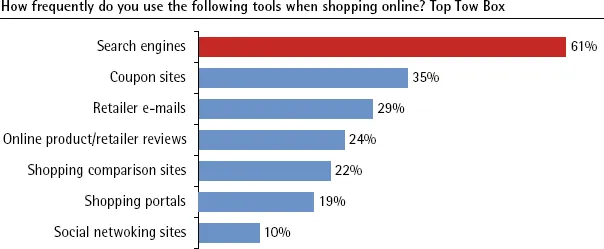
Overwhelmingly, consumers depend on search engines to help them shop online, writes Debra Miller on the Compete.com blog about a February 2010 study of how shoppers buy. “Three out of five shoppers said that they always or often use search engines when shopping online,” reports Miller. “More consumers use search engines than they do coupon sites, retailer e-mails, consumer reviews, or shopping comparison sites.” (See Figure 1.1.)
This means, of course, that your key to igniting sales is to create online content and optimize it so that it appears on the first page of search results when your customers search for you or the products or services you sell.
Everyone is the media. Everyone is a publisher. Technology has enabled connections. There is no longer a high barrier to publishing online. The ease and low cost of publishing via blogs, videos, podcasts, forums, and social networks such as Twitter and Facebook mean that businesses can reach their customers directly with relatively little cost. The idea of publishing material to attract a certain audience isn’t reserved for an elite few who can afford the printing and distribution costs. “As brands, we become media,” says Brian Solis, author of Engage (John Wiley & Sons, 2010). In other words, you are a publisher; you are the media.
What that really means is that you can reach your potential buyers directly. And, of course, they can speak directly to you as well. You now have the ability to engage in direct conversation.
What Is Content, and What Can It Do for You?
So what is content, exactly?
Content is a broad term that refers to anything created and uploaded to a website: the words, images, tools, and other things that reside there. All of the pages of your website, then, are content: the home page, the About Us page, the Frequently Asked Questions (FAQs) page, the product information pages, and so on. All of the things you create as part of those pages or as part of your marketing—your videos, blogs, photographs, webinars, white papers, e-books, podcasts, and so on—are content, too. And finally, all of the things you publish at outposts that are off of your own site—your Facebook page, your Twitter stream, your LinkedIn group page, for example—are forms of content.1
Obviously, you don’t have to publish through all of those channels to have a noticeable online presence. As you’ll see with the companies we profile, your online content can take countless forms, depending on various factors: the needs and preferences of your audience, your goals, your company’s expertise and brand, as well as available time, talent, and budget.
You can use the concepts in this book to infuse all of your web content with energy,...
Table of contents
Cover
Table of Contents
Title
Copyright
Dedication
Foreword
Acknowledgments
Big Fat Overview (Sometimes Called an Introduction)
Part I: The Content Rules
Part II: The How-to Section
Part III: Content That Converts: Success Stories (With Ideas You Can Steal!)
Part IV: This Isn’t Goodbye
About the Illustrator
Index
End User License Agreement
Trusted by 375,005 students
Access to over 1.5 million titles for a fair monthly price.
Study more efficiently using our study tools.
Frequently asked questions
Yes, you can cancel anytime from the Subscription tab in your account settings on the Perlego website. Your subscription will stay active until the end of your current billing period. Learn how to cancel your subscription
No, books cannot be downloaded as external files, such as PDFs, for use outside of Perlego. However, you can download books within the Perlego app for offline reading on mobile or tablet. Learn how to download books offline
Perlego offers two plans: Essential and Complete
Essential is ideal for learners and professionals who enjoy exploring a wide range of subjects. Access the Essential Library with 800,000+ trusted titles and best-sellers across business, personal growth, and the humanities. Includes unlimited reading time and Standard Read Aloud voice.
Complete: Perfect for advanced learners and researchers needing full, unrestricted access. Unlock 1.5M+ books across hundreds of subjects, including academic and specialized titles. The Complete Plan also includes advanced features like Premium Read Aloud and Research Assistant.
Both plans are available with monthly, semester, or annual billing cycles.
We are an online textbook subscription service, where you can get access to an entire online library for less than the price of a single book per month. With over 1.5 million books across 990+ topics, we’ve got you covered! Learn about our mission
Look out for the read-aloud symbol on your next book to see if you can listen to it. The read-aloud tool reads text aloud for you, highlighting the text as it is being read. You can pause it, speed it up and slow it down. Learn more about Read Aloud
Yes! You can use the Perlego app on both iOS and Android devices to read anytime, anywhere — even offline. Perfect for commutes or when you’re on the go. Please note we cannot support devices running on iOS 13 and Android 7 or earlier. Learn more about using the app
Yes, you can access Content Rules by Ann Handley,C. C. Chapman in PDF and/or ePUB format, as well as other popular books in Business & Business General. We have over 1.5 million books available in our catalogue for you to explore.