- A wide-ranging collection of 24 essays exploring film comedy from the silent era to the present
- International in scope, the collection embraces not just American cinema, including Native American and African American, but also comic films from Europe, the Middle East, and Korea
- Essays explore sub-genres, performers, and cultural perspectives such as gender, politics, and history in addition to individual works
- Engages with different strands of comedy including slapstick, romantic, satirical and ironic
- Features original entries from a diverse group of multidisciplinary international contributors
- English
- ePUB (mobile friendly)
- Available on iOS & Android
eBook - ePub
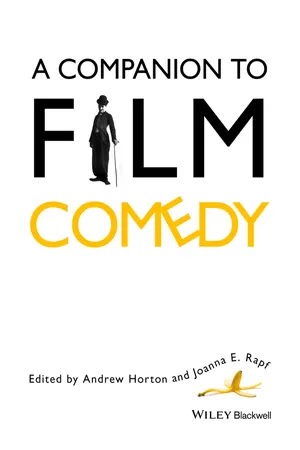
A Companion to Film Comedy
About this book
A wide-ranging survey of the subject that celebrates the variety and complexity of film comedy from the 'silent' days to the present, this authoritative guide offers an international perspective on the popular genre that explores all facets of its formative social, cultural and political context
Information
Part I
Comedy Before Sound, and the Slapstick Tradition
Chapter 1
The Mark of the Ridiculous and Silent Celluloid
Some Trends in American and European Film Comedy from 1894 to 1929

Fred Ott's Infectious Sneeze (1894)
Throughout its history silent film comedy was affected by the technology with which it was produced, the culture and mindset of the filmmakers, and the intended audience's desires. When Thomas Edison expressed interest in combining moving pictures with his phonograph in 1888, other inventors around the world were already experimenting with sequential imaging. Edison's approach to inventing was to encourage his “muckers” (technicians, machinists, and engineers) to come up with new ideas by “playing” with state-of-the art resources at his lab (Spehr 2008: 75–82, 649).
Edison Kinetoscopic Record of a Sneeze/Fred Ott's Sneeze, the studio's nineteenth film, was produced from January 2 to 7, 1894. Fred Ott was an engineer credited with making major contributions to Edison's early Kinetograph movie camera, but most film historians remember him for sneezing in an early motion picture. Initially considered a comic novelty for the way it used technical innovation to make much ado about nothing, the title of this film succinctly informs us of its content. The filming of an entire action from conflict to resolution, although only a few seconds in duration, gives the movie a kind of narrative structure. One reason this documentary is associated with comedy is that the subject's loss of bodily control, a condition that theorist Henri Bergson described as “something mechanical encrusted upon the living,” makes Fred Ott a comic figure characterized by the “mark of the ridiculous” (Bergson 1956: 92).
In his Poetics of 330 BC, Aristotle identified a comic character as someone who bears a “mark of the ridiculous,” which enables the observer to feel superior to this individual. Where the “tragic flaw” of the dramatic hero suffers real pain that brings about the ruin of this protagonist and his followers, the ludicrous condition of the mark of the ridiculous “…may be defined as a mistake or deformity not productive of pain or harm to others; the mask for instance, that excites laughter, is something ugly and distorted without causing pain” (Aristotle 1962: 194). Ott's mark of the ridiculous was not as pronounced as a physical deformity but the loss of control during his sneeze was considered comically incongruous by the filmmakers. As a consequence the playful Fred Ott is not remembered for his accomplishments as an Edison engineer but for being human. According to silent film historian Luke McKernan, “in later years Ott was happy to claim that he was the first ever ‘film star,’ which in a way was true”(McKernan 1996).
A Plot Underfoot: The Lumière Brothers' L'Arroseur arrosé (1895)
L'Arroseur arrosé (The Hoser Hosed) (1895), produced by Louis and Auguste Lumière, is credited with being one of the first comic sketches in the history of the cinema. The sons of a French manufacturer of photographic plates, the Lumière brothers were already versed in imaging technology when they sought to develop an alternative to the Edison Kinetograph. Using Edison's invention as a model, Louis Lumière perfected a workable lightweight camera in 1895 that could also be converted to develop and project the footage. International recognition was achieved on December 28, 1895 when ten Lumière motion pictures, including L'Arroseur arrosé, were projected on a big screen to a paying audience in a rented Paris basement.
While L'Arroseur arrosé, like Fred Ott's Sneeze, is primarily a cinematic depiction of a gag, there is enough of a rudimentary plot to characterize this film as a comic narrative. Because the gardener possesses a “mark of the ridiculous”—an incapacity for ascertaining why a hose might not function, the capacity for becoming curious, and the capability to peer foolishly into a nozzle that can douse him with water—he is susceptible to becoming the victim (comic butt) of a practical joke. When the boy (comic wit) recognizes the gardener's mark of the ridiculous he exploits this deficiency by stepping on the hose, which sets the comic narrative into play. The incongruity of the loss of control suffered by the gardener while sprayed—something mechanical encrusted upon the living—makes this situation humorous.1
L'Arroseur arrosé has been identified as one of the first film narratives, but the Lumières would primarily be associated with non-fiction film during their short career as pioneer producers. The documentary would, in fact, be the prevalent form of motion picture until early filmmakers determined how to use the new medium for storytelling. In the meantime some of the most effective motion picture comedies were documentaries of comic routines already perfected for the stage.
Documentary of a Slap Shoe Hero: Little Tich et ses “Big Boots” (1900)
Shortly after the Lumières developed motion picture technology to compete with Edison's, the French inventor and entrepreneur Léon Gaumont attempted the same. Gaumont was able to devise a workable camera/projector by 1897, and his secretary, Alice Guy-Blaché, became the company's chief film producer from 1897 to 1906. Among the hundreds of films produced by the world's first important female film director is the delightful Gaumont comic short Little Tich et ses “Big Boots” (Little Tich and his Big Boots) (1900), perhaps the best motion picture documentation of a major turn-of-the-century English music-hall act and one of the most interesting early novelty films surviving. The renowned French comedian Jacques Tati claimed that Little Tich et ses “Big Boots” is “a foundation for everything that has been realized in comedy on the screen” (Anthony 1996).
A comedian with a physical “mark of the ridiculous” similar to the type of deformity associated with Aristotle's definition, the diminutive 4 foot 6 inch Little Tich was born with five fingers and a thumb on each hand and web-like flesh between these digits. While our operational definition argues that the “mark of the ridiculous” is not “productive of pain or harm to others,” Harry “Little Tich” Relph was painfully self-conscious of his. Despite this sensitivity regarding his appearance, Little Tich's comic portrayal was that of a “grotesque,” “eccentric,” “red-nosed,” or “baggy-pants” comedian similar to those that fellow English-born comics Charlie Chaplin, Stan Laurel, and Fred “Pimple” Evans performed on stage and later brought to the screen (see Figures 1.1 and 1.2). Tich's comedy contrasted his agility, wit, pronounced musical talents, and proficiency at mime with his incongruous physical appearance and dress. Little Tich was particularly famous for his humorous yet graceful performance in specially modified slap shoes.
Figure 1.1 A frame enlargement from Little Tich et ses “Big Boots” of the popular music hall comedian doing the finale of his famous routine (producer, Clément-Maurice Gratioulet).
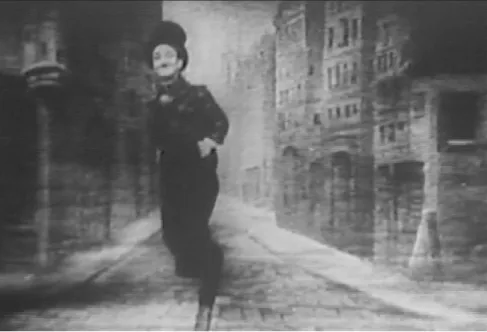
Figure 1.2 Charles Chaplin's famous screen persona doing a variation of Little Tich's big boots routine in his 1919 film A Day's Pleasure (producer, Charles Chaplin).
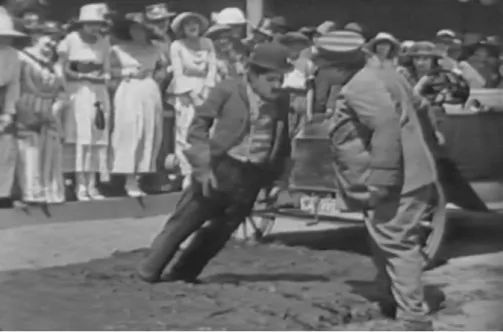
Since slap shoes had been around for centuries, Little Tich literally expanded upon an old idea when he made his comic footwear longer in the 1880s. Through trial and error Tich discovered that when he lengthened his slap shoes to 28 inches he could arch his body, lean forward at a 45-degree angle, balance himself on their tips, and rise to the height of six feet, ten inches. More than a valued documentary of a unique novelty act, the 1900 film Little Tich et ses “Big Boots” reveals how this gifted performer projected a playful attitude in his work while exhibiting a self-conscious but convivial rapport with his audience. The fact that this French film featured an English vaudeville comedian underscores the international cross-fertilization in popular culture of this time. As is true of previous motion pictures discussed, Little Tich et ses “Big Boots” was filmed entirely in one shot.
Little Tich et ses “Big Boots” begins with the performer walking on stage from the wings and making “eye contact” with the camera/audience, which he intermittently continues throughout his performance. By looking directly at the camera Little Tich gives the impression that he is singling out and inviting each viewer to become involved in a mutually shared experience. Tich's interaction with the audience confirms that he knows the situation is silly as he cheerfully takes off his regular shoes, puts on his big boots, and does comic business with his hat. Through his glances Tich checks to see if he is still being watched and encourages the onlooker to enjoy his playful antics. A tight long shot enables the observer to appreciate the performer's body language and facial expression while documenting this music-hall act. The action is filmed on a stage comparable to those where this comedian usually performed, and the tempo of this documentary is associated with the music synchronized to the image. Little Tich plays directly to the camera in a manner similar to the way he related to live music-hall audiences. His intent in both instances was to sell himself and his act by engaging viewers in this event and his playful attitude. At the end of the performance Tich leaves the stage and then returns to take his bow.
Comic appearance and technique aside, it should be noted that it is the engaging personality of Little Tich that sells this picture to the viewer. It should also be noted that one must be careful when making assumptions concerning the role of any surviving film in the evolution of silent film history. Little Tich et ses “Big Boots” is an example of a turn-of-the-century motion picture that explored filmmaking techniques that were set aside before becoming standard practice several years later. It uses an experimental synchronized sound process that would be discontinued after 1908, so the emphasis on having the performer directly address the camera while responding to indigenous music would not be commonly employed in motion pictures until the coming of the talkies in 1926–7. Tati's claim that this film is “a foundation for everything that has been realized in comedy on the screen” does not mean that filmmakers and critics have always recognized Little Tich et ses “Big Boots” as a model throughout film history despite its prototypical qualities.
Little Tich's music hall talents translated exceptionally well to the screen, but he preferred making direct contact with a live audience. It would be left to other artists to modify established forms of popular culture to fit the new film medium. Few were more successful at making stage adaptation cinematic than the magician turned filmmaker, Georges Méliès.
Georges Méliès, “Fantasist Filmmaker” (1896–1902)
The 500 motion pictures that Georges Méliès made between 1896 and 1913 include examples of every film genre known at this time and most of them featured Méliès as a principal performer. Many of his earliest pictures focused upon Méliès doing magic tricks. This interest in magic led to experimentation with cinematic special effects that resulted in Méliès becoming known as “the father of trick photography.” In his biography of Emile Cohl, “the father of animated film,” Donald Crafton cites a 1900 critic of caricature, Adolphe Brisson, as postulating that there were “…four kinds of humorist: the caricaturist proper, the parodist, the satirist, and the fantasist…The fantasist ‘obeys no other rules besides his own caprice. He invents, he combines, he suggests’ ” (Crafton 1990: 307). This could be said of Georges Méliès.
While not exactly a comedian in the sense of a Little Tich, Georges Méliès' playfulness as a magician, his love for fantasy, and capacity for whimsy gave his films a comic atmosphere that can still be appreciated today. The 1902 trick fantasy film L'Homme á la tête de caoutchouc (The Indian Rubber Head) is literally one of hundreds of Méliès motion pictures with this comic touch. Filmed in one shot, Méliès plays an inventor who has created a very animated bodiless rubber head, also performed by Méliès, which is inflatable when connected to a bellows. When the proud inventor demonstrates his expanding and contracting rubber head to an observer, the spectator insists upon operating the bellows himself which results in the head exploding. This troublemaker is literally kicked out of the room by the distraught inventor who is left weeping as the film ends.
Comedy, like Méliès' stage magic, is based upon incongruity—an awareness of a condition outside the accepted norm, a reversal of usual expectation, a situation or development different from what one ordinarily assumes or anticipates. While early film technology impressed viewers with its ability to document “surface reality,” this particular cinematic record consisted of silent two-dimensional black-and-white moving images that were inherently incongruous when compared to the “real world.” Besides being a master of cinematic special effects, Méliès was a pioneer in identifying how the film medium could distort “reality.” Some of the earliest film comedies exploring distortion versus documentation were produced in England.
Fantasist Filmmaking in Britain (1900–1901)
The 1900 Hepworth film How it Feels to be Run Over employs rudimentary trick photography to create an effect very different from Méliès' achievement in L'Homme á la tête de caoutchouc. Initially appearing to be a nonfiction picture, How it Feels to be Run Over opens on a quiet country road filmed opposite from where a horse and carriage, seen in long shot, eventually pass. Through the dust of the departing buggy the viewer is made aware of an approaching horseless carriage. Rather than follow the path of the preceding horse drawn vehicle, the occupants of the car wave for the viewer to get out of their way. The automobile continues to advance towards the camera until, at the “point of impact,” the vehicle is replaced with a black frame. Hand etched question marks and exclamation points appear on this black background followed by a succession of individual words that make up the sentence “Oh! Mother will be pleased.” By giving the impression that it might be a documentary, How it Feels to be Run Over suggests that movie audiences already expected certain cinematic conventions from their motion pictures by 1900. This film challenges the expectation that it is a documentary, and comically attempts to make the relationship between the viewer and screen subject more interactive, by trying to give the appearance that a car has run over the camera. The director of this picture recognizes that trick photography can modify the supposed reality of a documentary record and transform a “real” environment into something as “unreal” as the fantasy world of Georges Méliès.
Fascination with this new medium resulted in some early self-reflexive comedies relating to the motion picture experience itself. One example is R.W. Paul's The Countryman and the Cinematographe (1901), which deals with an unsophisticated film viewer on stage reacting to various movies appearing on the screen next to him. At one point this “rube” gleefully mimics a dancing showgirl only to discover that she has been replaced by an oncoming train. In keeping with the myth that early audiences were afraid they would be run over when viewing the 1896 Lumière picture L'arrivée d'un train en gare de La Ciotat (Train Coming into a Station), the countryman dashes away from the advancing projected locomotive.
James Williamson's 1901 The Big Swallow is a particularly bizarre comedy about subject/camera/viewer relationships and the filmmaking process. The Big ...
Table of contents
- Cover
- Title Page
- Copyright
- Notes on Editors and Contributors
- Comic Introduction: “Make 'em Laugh, make 'em Laugh!”
- Part I: Comedy Before Sound, and the Slapstick Tradition
- Part II: Comic Performers in the Sound Era
- Part III: New Perspectives on Romantic Comedy and Masculinity
- Part IV: Topical Comedy, Irony, and Humour Noir
- Part V: Comic Perspectives on Race and Ethnicity
- Part VI: International Comedy
- Part VII: Comic Animation
- Index
Trusted by 375,005 students
Access to over 1.5 million titles for a fair monthly price.
Study more efficiently using our study tools.
Frequently asked questions
Yes, you can cancel anytime from the Subscription tab in your account settings on the Perlego website. Your subscription will stay active until the end of your current billing period. Learn how to cancel your subscription
No, books cannot be downloaded as external files, such as PDFs, for use outside of Perlego. However, you can download books within the Perlego app for offline reading on mobile or tablet. Learn how to download books offline
Perlego offers two plans: Essential and Complete
- Essential is ideal for learners and professionals who enjoy exploring a wide range of subjects. Access the Essential Library with 800,000+ trusted titles and best-sellers across business, personal growth, and the humanities. Includes unlimited reading time and Standard Read Aloud voice.
- Complete: Perfect for advanced learners and researchers needing full, unrestricted access. Unlock 1.5M+ books across hundreds of subjects, including academic and specialized titles. The Complete Plan also includes advanced features like Premium Read Aloud and Research Assistant.
We are an online textbook subscription service, where you can get access to an entire online library for less than the price of a single book per month. With over 1.5 million books across 990+ topics, we’ve got you covered! Learn about our mission
Look out for the read-aloud symbol on your next book to see if you can listen to it. The read-aloud tool reads text aloud for you, highlighting the text as it is being read. You can pause it, speed it up and slow it down. Learn more about Read Aloud
Yes! You can use the Perlego app on both iOS and Android devices to read anytime, anywhere — even offline. Perfect for commutes or when you’re on the go.
Please note we cannot support devices running on iOS 13 and Android 7 or earlier. Learn more about using the app
Please note we cannot support devices running on iOS 13 and Android 7 or earlier. Learn more about using the app
Yes, you can access A Companion to Film Comedy by Andrew Horton, Joanna E. Rapf, Andrew Horton,Joanna E. Rapf in PDF and/or ePUB format, as well as other popular books in Media & Performing Arts & Film History & Criticism. We have over 1.5 million books available in our catalogue for you to explore.