This book is available to read until 27th January, 2026
- English
- ePUB (mobile friendly)
- Available on iOS & Android
eBook - ePub
Available until 27 Jan |Learn more
About this book
This volume provides a comprehensive introduction to the critical debates around the heritage film, from its controversial status in British cinema of the 1980s to its expansion into a versatile international genre in the 1990s and 2000s. This study explores the heritage film in light of questions of national identity in film and television, industry and funding, and history, gender and representation. Using a wide range of examples and including an in-depth analysis of three case studies – Girl with a Pearl Earring (2003), Joyeux Noël (2005) and The Queen (2006) – this book presents the heritage film as a thriving phenomenon at the centre of contemporary European cinema.
Frequently asked questions
Yes, you can cancel anytime from the Subscription tab in your account settings on the Perlego website. Your subscription will stay active until the end of your current billing period. Learn how to cancel your subscription.
No, books cannot be downloaded as external files, such as PDFs, for use outside of Perlego. However, you can download books within the Perlego app for offline reading on mobile or tablet. Learn more here.
Perlego offers two plans: Essential and Complete
- Essential is ideal for learners and professionals who enjoy exploring a wide range of subjects. Access the Essential Library with 800,000+ trusted titles and best-sellers across business, personal growth, and the humanities. Includes unlimited reading time and Standard Read Aloud voice.
- Complete: Perfect for advanced learners and researchers needing full, unrestricted access. Unlock 1.4M+ books across hundreds of subjects, including academic and specialized titles. The Complete Plan also includes advanced features like Premium Read Aloud and Research Assistant.
We are an online textbook subscription service, where you can get access to an entire online library for less than the price of a single book per month. With over 1 million books across 1000+ topics, we’ve got you covered! Learn more here.
Look out for the read-aloud symbol on your next book to see if you can listen to it. The read-aloud tool reads text aloud for you, highlighting the text as it is being read. You can pause it, speed it up and slow it down. Learn more here.
Yes! You can use the Perlego app on both iOS or Android devices to read anytime, anywhere — even offline. Perfect for commutes or when you’re on the go.
Please note we cannot support devices running on iOS 13 and Android 7 or earlier. Learn more about using the app.
Please note we cannot support devices running on iOS 13 and Android 7 or earlier. Learn more about using the app.
Yes, you can access Heritage Film by Belén Vidal in PDF and/or ePUB format, as well as other popular books in Mezzi di comunicazione e arti performative & Film e video. We have over one million books available in our catalogue for you to explore.
Information
1 THE BRITISH HERITAGE FILM: NATION AND REPRESENTATION
In 2007 the British television institution BBC (British Broadcasting Corporation) aired a seven-part series entitled ‘British Film Forever’ as part of a high-profile ‘Summer of British Film’ co-organised with the UK Film Council. The series combined an educational remit (raising the profile and celebrating the best of British cinema) with a popular edge. Rather than following a historical timeline highlighting key films and filmmakers, each episode of the series focused on one film genre and supported its narrative with a collage of excerpts from films from all periods, interspersed with interview snippets with critics and celebrities. This (necessarily selective) vision of British film history attracted some strong criticism.1 However, the show condensed into an accessible argument some enduring polemics in British film studies and, in particular, the central role of costume drama to definitions of British film. The episode ‘Corsets, Cleavage and Country Houses – The Story of Costume Drama’ combined documentary footage of a 1980s Britain ravaged by conflict (riot police, unemployment, the miners’ strike, the Falklands War) with idyllic countryside and tea-room scenes drawn from some of the most successful British costume dramas of that era. A tongue-in-cheek voice-over narration contrasted the two sets of radically different images with the captions: ‘this was Britain in the 1980s’ (the documentary footage) and ‘this is what of the rest of the world thought we were up to’ (the extracts from the costume films).
The BBC show’s clear-cut opposition between an escapist cinema pitched to international (especially North American) ‘heritage-hungry’ tourism and the harsh socio-economic realities of life in Britain illustrates the normative force of the critical debates surrounding the so-called ‘heritage film’. The series’ presentation of the period film as a comforting antidote to unpalatable yet more urgent images of contemporary Britain is reminiscent of the distinction established by Thomas Elsaesser in 1993 between the projection of a complex ‘social imaginary’ of Britain, and a mythical ‘national imaginary’ – one for ‘us’ (the insider viewer) and one for ‘them’ (the international audiences). Such opposition highlights the ‘Jekyll and Hyde’ quality of British cinema as ‘one of the orthodoxies of academic film studies’ (Elsaesser 2006: 50, 54). This chapter investigates this orthodox discourse through a close look at the debates on the heritage film in the light of issues of myth and national identity, the tradition of quality in British film culture, and the convergence of cinema and television. These key threads provide the context for the analysis of the main case study, Stephen Frears’ The Queen.
History versus heritage: a conservative mode of filmmaking?
The term heritage film gained critical currency with the international success of a set of British period dramas produced in the 1980s and early 1990s, including the historical films Chariots of Fire and Gandhi (Richard Attenborough, 1982) and film adaptations of E. M. Forster’s novels: A Passage To India (David Lean, 1984), A Room With a View (James Ivory, 1986), Maurice (James Ivory, 1987), Where Angels Fear to Tread (Charles Sturridge, 1991) and Howards End (James Ivory, 1992). In 1993, an article by British film historian Andrew Higson, ‘Re-presenting the National Past: Nostalgia and Pastiche in the Heritage Film’ redefined this cycle of quality costume dramas as ‘heritage films’. The heritage film has period settings (typically, Edwardian England or the British Raj), recurrent locations (the English countryside, Oxbridge, colonial India, Italy), slow-paced narratives that enhance character and the authenticity of period detail, and an opulent if static mise-en-scène exhibiting elaborate period costumes, artefacts, properties and heritage sites. The heritage film typically dwells on an iconography of upper-middle class and aristocratic privilege. For Higson, such iconography produces a highly selective vision of Englishness attached to pastoral and imperial values where the past as spectacle becomes the main attraction.
At the basis of this critique we find a tension between the surface of visual splendour and the liberal messages delivered by these character-centred dramas. Audiences are called upon to identify with the dilemmas experienced by characters under social pressure, yet the sumptuous recreation of bygone social milieus invites an appreciative look that undercuts the elements of social criticism. The representations of the past offered by the heritage film carry a glaring contradiction between form and narrative: ‘the past is displayed as visually spectacular pastiche, inviting a nostalgic gaze that resists the ironies and social critiques so often suggested narratively by these films’ (Higson 2006: 91). This becomes manifest in what Higson calls the production of ‘heritage space’: a pictorial film style that showcases sumptuous heritage sites and lavish décor, designed ‘for the display of heritage properties rather than for the enactment of dramas’ (2006: 99). Thus, architectural sites, interior designs, furnishings and, in general, the mise-en-scène of objects, settings and period artefacts become not just a conduit for narrative and characterisation but carry an ideological effect: they help construct a sense of Englishness according to a certain bourgeois ideal of imperial tradition, stability and propriety that belies the subtler ironies of the novels faithfully adapted. The heritage film would thus encourage a nostalgic look back to the certainties and the visual splendour of the national past.
Higson’s critique put the spotlight on the films created by the partnership formed by American director James Ivory and Indian producer Ismail Merchant alongside their frequent collaborator, the German-born, English-educated writer of Polish-Jewish extraction Ruth Prawer Jhabvala. Their independent production company Merchant Ivory, founded in 1961, has distinguished itself through its cosmopolitan films. From its base in New York, Merchant Ivory has shot fiction films variously set in India, United States, England, France, China and Argentina. Throughout the 1960s, their efforts were focused on the production of Indian films shot in English and aimed at the international market, moving to a number of period and contemporary pieces with American themes in the 1970s and early 1980s (for instance, The Bostonians, James Ivory, 1984). However, their pre-1990s work has been eclipsed by the phenomenal success of their English period films, especially A Room with a View, Howards End and The Remains of the Day (James Ivory, 1993) which inserted Merchant Ivory into a tradition of tasteful literary adaptations and historical dramas in British cinema. Higson’s critique of the heritage film highlights the ‘Britishness’ of Merchant Ivory’s British films as a series of reductive images of ‘Englishness’ focused on the traditional values and lifestyles of the upper-middle classes and the aristocratic elite. Merchant Ivory’s trademark emphasis on production values, classicist style and focus on the ‘intimate observation of manners and unspoken desires’ (Hall 2006) earned the company a reputation for quality, tasteful cinema. The internal conflicts that embattle the bourgeois households take place against the imposing background of wealthy country houses; their films recreate with anthropological zeal the fashions and objects of the periods in which the original novels were set. This selective vision of the British past was for some tantamount to the denial of the actual state of fragmentation of the social body, and of alternative versions of a plural national culture (see Corner & Harvey 1991).
Higson’s critique transferred to the domain of film studies the discontent voiced by a section of journalists, historians and sociologists close to the political left, for whom the heritage film reflected the ideological construction of a ‘national heritage’ during Margaret Thatcher’s years as British Primer Minister (1979–1990). Thatcher’s conservative government imposed a top-down vision of heritage through policy (in particular, the National Heritage Acts of 1980 and 1983) and encouraged a culture of private enterprise, including the commerce with the signs and sites of the national past. The success of the cycle of 1980s period dramas coincided with the formation of an anti-heritage discourse (see Wright 1985 and Hewison 1987) which, as noted by Raphael Samuel, reacted against the historicist turn in British culture and the rise of the heritage industries (including the boom in historical tourism) at the onset of economic recession. Samuel describes the sentiment underpinning anti-heritage criticism in the following way:
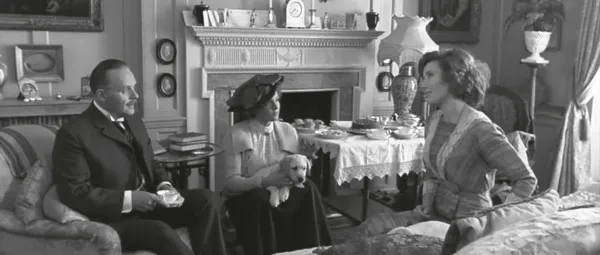
Bourgeois interiors: Anthony Hopkins, Jemma Redgrave and Emma Thompson in Howards End
Heritage prepared the way for, or could be thought as giving expression to, a recrudescence of ‘Little Englandism’ and the revival of nationalism as a force in political life. It anticipated and gave expression to the triumph of Thatcherism in the sphere of high politics. Heritage, in short, was a symbol of national decadence; a malignant growth which testified at once to the strength of this country’s ancien régime and to the weakness of radical alternatives to it. (1994: 261)
The critique of this new heritage culture was particularly trenchant with regard to the role played by film and television. In an early assessment of 1980s period drama Tana Wollen notes that the ‘nostalgic screen fictions’ produced around this time trade on their visual authenticity while co-opting collective memory to suit a conservative political agenda. What was at stake in the popularity of period drama was nothing less than the reconstruction of national identity based on a reactionary vision of the past (Wollen 1991).
These forceful ideological connotations co-exist with fascinating ambiguities of interpretation around the heritage film. The iconic Chariots of Fire is a case in point.2 The film retrieves a forgotten episode of British sports history: the hard-won triumph of the British running team at the 1924 Olympic Games held in Paris. The film focuses on two keen athletes from different ethnic and class backgrounds, and on their individual stories of sacrifice and aspiration as well as their struggle against a reactionary establishment. Eric Liddell (Ian Charleson), a Scottish missionary born in China, is a fervent Sabbatarian who refuses to give up his religious principles for the sake of national pride. Harold Abrahams (Ben Cross), a Lithuanian Jew, struggles to overcome the ingrained racism of Cambridge University and hires Mussabini (Ian Holm), a professional coach of Italian and Arab descent, in an overt challenge to the amateur practice of sport, traditionally regarded as the preserve of the aristocracy. Lord Lindsay (Nigel Havers), the gentleman-sportsman and embodiment of aristocratic privilege, supports Abrahams and gallantly gives up his place in the 400 metres race in favour of Liddell. By relegating Lindsay to a supporting, enabling role and foregrounding Abrahams’ victory as symbolic of his Englishness, Chariots of Fire reinforces the message that national identity and social status are ‘honours that can be earned, not just acquired by inheritance’ (Johnston 1985:101; emphasis in original).
As perceptive analyses of the film point out (see Hill 1999, Chapman 2005) the multi-character narrative is sensitive to the complexities of national allegiance provoked by social exclusion and class privilege. However, the clash of modernity versus tradition that articulates the theme of individual achievement reverts to homogenous images of class, gender and nation that subsume the characters’ differences within a dominant version of Englishness. The film’s languorous mise-en-scène places its struggling heroes amidst imposing Cambridge University settings. In what is perhaps the best-remembered sequence in the film, Abrahams and Lindsay, surrounded by crowds of cheering students, honour the tradition of the college dash by racing around the Great Court in Trinity College.3 The mise-en-scène momentarily infuses the ancient institution with youthful energy and dynamism, whilst cutaways to the masters of Caius and Trinity Colleges, who look down (literally and metaphorically) on Abrahams’ racing exploits from a high window, intimate the hurdles that the Olympic hopeful will have to overcome. Abrahams’ professional attitude towards sport is decidedly anti-establishment. However, the values espoused by the character link with the ideology of entrepeneurialism and competitiviness that also characterised Thatcherism (see Hill 1999).
The film as a whole similarly oscillates between the critique of traditional institutions and an elated celebration of fair play and male bonding that feeds into a conciliatory myth of an inclusive nation. As noted by Sheila Johnston, ‘nationhood in Chariots of Fire is a dynamic thing, challenged by the interloper, yet remaining in essence unchanged’ (1985: 104). Its central story of triumph over adversity is highlighted in the iconic sequence that bookends the film, in which all the protagonists, their class and cultural differences effaced by identical white running gear, train together on an open beach to a soaring theme by Vangelis. Their individual desires and aspirations, represented by their different running styles captured by medium close-ups that glide from one ecstatic face to the next, are reframed by long shots that create a romanticised vision of the group united in the collective effort. The use of non-diegetic electronic music and slow motion endows this idealised image of British masculinity with timeless poignancy. These stylistic flourishes upgrade a story in line with traditions of British realism and pre-1960s classical narrative style with an unmistakable 1980s pop-culture feel.
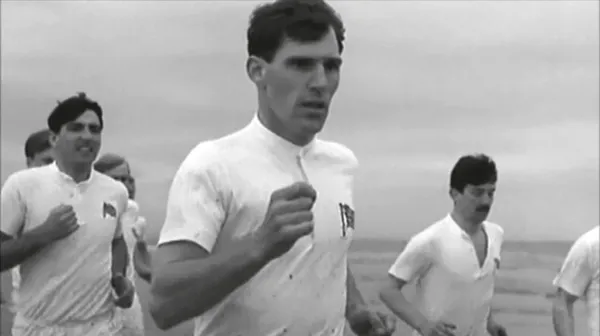
Team spirit and individual stories: Harold Abrahams (Ben Cross) in Chariots of Fire
After a difficult financing process (the film eventually went ahead with backing from Twentieth Century-Fox and Allied Stars when Goldcrest producer David Puttnam failed to secure funding from British sources) Chariots of Fire opened in Britain to disappointing box-office figures. Yet its runaway success in the US, culminating at the 1982 Academy Awards (where it reaped four Oscars, including Best Film) facilitated a successful re-release in Britain later that year. Chariots of Fire triggered a period of confidence in the British film industry and British subject matter, which was subsumed within the Thatcherite discourse of patriotic values and entrepreneurism. The film’s success became part of the triumphalist mood surrounding the British victory in the Falklands War. This context prompts Wollen to note that the film proposes patriotism as the ‘resolution to social division and conflict’ (1991: 182). For Leonard Quart (2006), the victory of the anti-establishment characters in favour of a dynamic and diverse nation is couched in an uncritical sentimentality that exults in nationalistic feeling, thereby implictly endorsing the Thatcherite ethos. Such interpretations were emphatically resisted by the left-leaning Puttnam and scriptwriter Colin Welland (Welland was a Labour Party activist and former collaborator of Ken Loach), who were dismayed at the government’s attempt to capitalise on the success of Chariots of Fire as an opportunity for flag-waving propaganda (see Chapman 2005: 287). However, the film’s strong iconicity and classical story of masculine achievement were easily appropriated by the political right. The praise bestowed on the film by both Thatcher and American president Ronald Reagan fits in with the transformation of Britain into a neo-capitalist nation of ‘national brand names, company logos, icons and slogans: identity under the reign of “The Image”’ (Elsaesser 2006: 49). In spite of its progressive message and leftist credentials, Chariots of Fire was mobilised as a vehicle to shore up support for New Conservatism on both sides of the Atlantic (see Johnston 1985).
The projection of a nostalgic, upper-class version of Englishness solidified into a national myth that found unparalleled success in the international image markets. This imaginary reinvention of the nation could be absorbed within the principles of enterprise and heritage enshrined by the successive Conservative governments of Thatcher and John Major (1991–97). The heritage film was accused of functioning as a selective ‘theme park of the past’ (Craig 2001: 4) perfectly attuned to the ideological principles of a highly divisive political establishment, and to the interests of the heritage industry as a whole. The meanings of heritage promoted by official culture were necessarily contentious. As John Corner and Sylvia Harvey point out,
working behind every use of ‘heritage’ … there is necessarily a sense of an inheritance which is rhetorically projected as ‘common’, whilst at the same time it is implicitly or contextually closed down around particular characteristics of, for instance, social class, gender and ethnicity. (1991: 49; emphasis in original)
The retrieval of an upper-middle-class and predominantly white English past was a manifestation of the rise of a nationalistic ‘folklore from above’ (Dave 1997:117). Other alternative and oppositional heritages, such as the working-class and Black-British experiences, struggled to surface in documentary and experimental work carried out at the margins of the film industry.
In the context of British public culture, the voice of the leftist anti-heritage critics rose with undoubted urgency. The term ‘heritage cinema’ soon became a byword not so much for a style of filmmaking, but for the ideological mode in which a cycle of films and television serials were deemed to be functioning.4 In an overview of the debates, Claire Monk has rightly noted that heritage film criticism ‘needs to be understood as a historically specific discourse, rooted and responsive to particular cultural conditions and eve...
Table of contents
- Cover
- Half title
- Series Page
- Title
- Copyright
- Contents
- Acknowledgments
- Introduction: Placing the Heritage Film
- 1. The British Heritage Film: Nation and Representation
- 2. Production Cycles and Cultural Significance: A European Heritage Film?
- 3. Narrative Aesthetics and Gendered Histories: Renewing the Heritage Film
- Afterword: Tradition and Change
- Filmography
- Bibliography
- Index