- English
- ePUB (mobile friendly)
- Available on iOS & Android
eBook - ePub
About this book
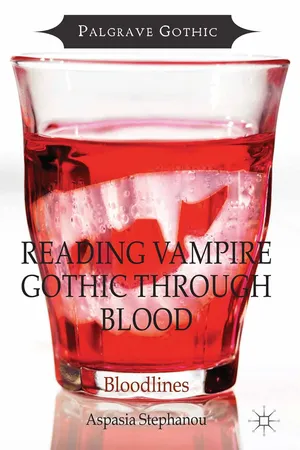
Reading Vampire Gothic Through Blood examines the manifestations of blood and vampires in various texts and contexts. It seeks to connect, through blood, fictional to real-life vampires to trace similarities, differences and discontinuities. These movements will be seen to parallel changing notions about embodiment and identity in culture.
Information
1
A Matter of Life and Death: Transfusing Blood from a Supernatural Past to Scientific Modernity and Vampiric Technology
The truly interesting and profoundly philosophical truth included in the expression, ‘in the blood is the life thereof,’ is admirably verified in the experiment of the ‘transfusion of blood,’ skilfully and successfully performed lately by Mr. Richard Ripley, of Whitby, and his able assistant. The last ebb of life had supervened, and the pulse ceased to beat, when reanimation took place by transfusion of blood from the veins of the sister and husband.1
In Mary Elizabeth Braddon’s ‘Good Lady Ducayne’ (1896) a wealthy old woman is able to extend her life through the help of her personal physician who performs transfusions by secretly draining off the blood of her young and healthy companions. The short story is veiled with an atmosphere of occult mystery and gothic horror that arises from the bite marks and wounds left on the arm of Lady Ducayne’s companion Bella, her unexplained loss of blood and deterioration of health. Science is vampiric, while those who employ it for personal gain and immortality are demonised as predatory and selfish monsters. With the mimicry of bloom upon her lifeless cheeks, Lady Ducayne sucks and drains people’s blood to feed her putrid veins. She is described as ‘a little old figure, wrapped from chin to feet in an ermine mantle; a withered, old face under a plumed bonnet—a face so wasted by age that it seemed only a pair of eyes and a peaked chin’, with ‘Claw-like fingers, flashing with jewels’.2 An old woman of monstrous status and wealth, Lady Ducayne can pay ‘her companion a hundred a year’3 in exchange for strong and healthy blood. Her perverse desire to discover a treatment or elixir that can ‘prolong human life’4 describes not only the narcissism of an old woman, but anxieties about an uncannily undead life that transgresses the limits of the human. In the descriptions of Lady Ducayne’s ‘withered countenance’ ‘with its indescribable horror of death outlived, a face that should have been hidden under a coffin-lid years and years ago’5 arises a fear about an unholy life that should not be living.6 This kind of undead life is that of the vampire, but also of ‘vampiric’ technology that blurs the boundaries between organic and inorganic life. Behind the inert matter of technology and under the wrinkled flesh of Lady Ducayne undulates and writhes an uncanny and ghastly life, spilling out of the confines of natural life. Vampire gothic brings to the fore a play of surfaces and illusion, of mystical occulted depths and inner geographies where the external veils the darkness within. Like the mysterious blood that animates the body of the vampire or the horrifying life hidden within technology’s apparent lifelessness, this uncanny doubling of life questions humanity’s secure boundaries. The short story dramatises the vampiric exchange between science and the supernatural, while bringing to the fore issues and anxieties relating to the limits between living and nonliving, organic and inorganic, and animate and inanimate. It is concerned with conceptions of life itself and a vitalistic view of blood’s nutritive power to reanimate and sustain life beyond death through the use of transfusion. It also questions the ethics of a technology used by those wealthy enough to afford it.
In this chapter I want to map the changing meanings of blood as it circulates from the eighteenth and nineteenth centuries to the present through transfusion and other technologies. First, a historical analysis of blood in vampire literature, film, biotechnology and nanotechnology will reveal the growing understanding of blood as a medical fluid to be donated in blood transfusions and re-produced outside of one’s body to be used in the bodies of others, as well as artificially designed to improve the biological functions of real blood. One of the main arguments here is that science and the supernatural are a constant preoccupation in vampire texts evident through the competing meanings of blood as a symbolic or supernatural fluid and, on the other hand, as an empirical material. The intention is to draw connections between medical technologies and vampirism in order to establish the different ways bodies and identities are constituted and affected by the dangerous circulation of blood. Fears about the alteration of one’s body or loss of identity are not evoked through the dangerous exchange between the vampire and his/her victim, but through blood as a living or polluting agent transgressing the boundaries of bodies. With the development of medical biotechnologies, blood’s symbolics are diluted. Reformulated and divided into its components to be transfused in multiple bodies as fractions, blood cannot be associated with ideas about the gift, generosity, altruism and mutuality. If these values once circulated within the warm body of society creating social relationships among citizens, they are now cancelled by the cold, fragmented and complex circulatory networks of technology and economy.
Secondly, I want to draw attention to vitality and the changing concept of life through analyses of blood, technology and the vampire. Blood is at the heart of questions relating to vitalism and life. Current debates about the status of life itself and the life-like quality of our emergent technologies demand a temporal analysis that takes us back to notions of vitality and the dangerous circulation of blood inside and outside bodies. Eighteenth- and nineteenth-century theories of vitality resurface today through current vitalist ideas of growth and production. On the one hand, there is an inhuman vitalism that embraces inorganic life and life beyond the death of the organised body. On the other hand, the active and energetic vitalism of capitalism seeks to inculcate a model of indefinite production beyond the limits of life. This vitalistic horizon of neoliberal economics coincides with biotechnology’s productivity and innovation. The vampire figure becomes here an eloquent expression of the circulation of undead life within the gothic networks of uncanny technology whose promises of an afterlife feed the insatiate appetite of fanged subjects. Issues surrounding the extension of one’s life and the individual’s freedom to choose and alter his biological condition are exemplary of contemporary strategies of life in a neoliberal era where self-interested subjects can choose to invest their bodies in the future. If transfusion was considered in the nineteenth-century vampire gothic a technology of immortality, today cryonics offers a similarly seductive possibility for the extension of life.
By contextualising blood within a history of biomedicine, developing scientific views about blood and the body from the eighteenth and nineteenth centuries to the present are established. This blood history is then connected to vampire texts as manifestations of anxieties about identity that arise through the symbolic value of blood, but also through its increasing medicalisation. With the reproduction of blood outside the body and its circulation within the bodies of others, as well as the possibility of designing mechanical devices that optimise the function of real blood, not only does blood lose its symbolic power, but life itself is stretched beyond limits. These changing views on life, the body and blood, along with the possibilities offered by new technologies, have transformed the ways individuals imagine and shape their identities. As the status of blood changes, so our status as human beings is reshaped.
Blood and the politics of life
The politics of life in the eighteenth and nineteenth centuries was a politics of health, preoccupied with health and disease, epidemics, birth and death rates, and ways to cure the body itself.7 Blood in this context was a material substance to facilitate the restoration of life. With its use in transfusion blood was a gift, creating and reasserting the bonds of a community. In Bram Stoker’s Dracula (1897), for example, blood becomes the medium to explain and understand vampirism: blood transfusions invite an exchange between the primitive energies of a barbaric past and the technologies of modernity. Victorian scientific positivism and the supernatural were conflicting forces in a changing world that manifested its anxieties about modern science, and faith in the supernatural and religion, through the vampiric and scientific powers of blood. Earlier vampire stories posit mysticism at the centre of the narrative, proving that science is unable to fight the supernatural powers of blood (Dracula), or attribute to science diabolical powers (‘Good Lady Ducayne’). Later, vampire narratives of the twentieth century conversely marginalise the supernatural in favour of science that can provide the truth about blood and vampirism. As John J. Jordan explains, ‘The scientization of myth occurs when scientific discourse ascribes within the culture a proper mode of understanding for mystical objects, allowing them a public, yet regulated and marginalized existence.’8 Scientific discourse then dominates non-scientific discourse in order to discipline and ascribe to it a ‘proper’ and logical meaning. Blood, being inside the body, was believed to carry identity and the individual’s temperament. Without the interference of scientific tools and knowledge, it was invested with magical and occult meanings as a vital rejuvenating fluid. In short, blood was a synecdoche of the body and of the embodied self. However, such meanings were contested by the development of medical discourse and technologies which offered a more rational understanding of blood as a neutral fluid of medical and social significance.
In the first half of the twentieth century the politics of health was shaped by the idea of inherited biological characteristics, and concerns about the mixing of blood. However, the present politics of life is not concerned with disease or health, of understanding and curing diseases in the name of the future of the race, but is concerned with a politics of life itself9 and our increasing ability to control, manage, reshape and engineer the biological capacities of human beings.10 The new ontology of biopolitics that is emerging through the assimilation of cybernetic and molecular knowledge is a ‘recombinant biopolitics’,11 ‘delving deep into the structure of the soma itself’ and ‘reconstituting what it means to be “embodied” ’.12 It is possible now to understand and engineer human life at this molecular level. No longer veiled behind superstition and mysticism, everything about our vitality becomes clear, legible and open to intervention in order to correct or reshape individual bodies and identities and secure the future of generations to come. While vampire narratives enchant and animate an occulted world beyond the human, biology and biomedicine retain a mechanistic view of biological life, plunging deep into the depths of the body and making everything appear intelligible. What we lose is the magic of the forbidden and unknown. If medicine in the nineteenth century was characterised by the clinical gaze focused on the body itself, techno-medicine is now dependent, not on the diagnostic gaze of doctors, but on highly efficient diagnostic and therapeutic equipment. The clinical gaze has now been substituted by a molecular gaze, an understanding of life, not in terms of the visible body, but life at a molecular level.13 While blood in the eighteenth and nineteenth centuries was a stable substance understood as a whole, a part of a bounded body, and invested with mystical meanings, now it is considered as a vital fluid without any mystical powers. From 1975 to the 1990s the status of blood changes drastically. It is used for acquiring DNA samples; it is gradually displaced technically and symbolically by the genome; and synthetic blood and auto-transfusions are seen as the ideal.14 Open to technological interventions, blood is fractioned into a number of components (plasma, red cells, white cell and platelets) that are being manipulated and used for different purposes in biomedicine, and distributed to multiple recipients, at different times and in different places across the world.15 At the same time, we are witnessing the emergence of biocapital and the new relations between pharmaceutical corporations and science. Life itself becomes part of economic relations: it can be traded, exchanged and valued. Biopolitics16 then becomes interrelated with bioeconomics. Within this context, where the biological body can be engineered at the molecular level, and tissues—from blood to organs and any other living matter taken from the body—can be managed, cloned, multiplied, and commodified,17 our understanding of ourselves as corporeal individuals is being reshaped. While body parts can be exploited and exchanged, and human life itself reified, at the same time, as Nikolas Rose argues, we have the choice to intervene and reshape our own biological selves in ways that fundamentally affect our identities. In an era when the biological can be optimised and penetrated by the technological, notions of what is biologically alive or human are reshaped and opened to contestation. In the ‘postvital’18 era of nanobiology, where the uncanny amalgamation of machinic and living matter points towards ‘the afterlife of life’,19 life returns ‘undead, as the absent origin of those very scientific practices—from molecular biology to genomics to artificial life—effecting its dislocation’.20 What is at stake in the present politics where the limits of life are reorganised and extended is exactly this ambiguous zone of life. Life now reverberates through the cracks and between the broken boundaries of life and death.
From the vitality of blood to machinic life
Blood becomes the vital plexus of questions relating to vitalism and life, unsettling the poles of biology and technology, human and machine. Notions about the mystical vitality of blood survive from the late eighteenth century through to the middle of the nineteenth century and influence understandings of transfusion. They are associated with the eighteenth- and nineteenth-century belief in vitalism and the existence of forces or principles in living organisms that could not be explained by the mechanistic approach of physiology based on physical or organic-chemical techniques. It is significant to mention that the idea of life21 was only defined at the end of the eighteenth century by the vitalist Xavier Bichat who wrote that ‘life is the totality of those functions which resist death’.22 Indeed, understandings of the vitality of blood are associated with, and depend on, the concept of life as ‘a motive principle’ that animates and enables living bodies to operate.23 Equally, it is assumed that blood is permeated by a ‘principle which enables it to effect the formative operations of the machine’ and that ‘we must allow the blood to be alive’.24 Vitalism significantly influences the idea of blood as life, and John Hunter’s vitalist definition of blood is referenced and celebrated in the Lancet and various early nineteenth-century medical journals. The principle of life in the blood Hunter calls materia vitae diffusa25 and it is considered a material agent that through the fluidit...
Table of contents
- Cover
- Title Page
- Copyright
- Contents
- Acknowledgements
- Introduction: Blood Bank: A History of the Symbolics of Blood
- 1. A Matter of Life and Death: Transfusing Blood from a Supernatural Past to Scientific Modernity and Vampiric Technology
- 2. The Biopolitics of the Vampire Narrative: Vampire Epidemics, AIDS and Bioterrorism
- 3. ‘ ’Tis My Heart, Be Sure, She Eats for Her Food’: Female Consumptives and Female Consumers
- 4. ‘Race as Biology Is Fiction’: The Bad Blood of the Vampire
- 5. ‘The Sunset of Humankind Is the Dawn of the Blood Harvest’: Blood Banks, Synthetic Blood and Haemocommerce
- 6. ‘Many People Have Vampires in Their Blood’: ‘Real’ Vampire Communities
- Conclusion: The Blood of the Vampire: Globalisation, Resistance and the Sacred
- Notes
- Bibliography
- Index
Trusted by 375,005 students
Access to over 1.5 million titles for a fair monthly price.
Study more efficiently using our study tools.
Frequently asked questions
Yes, you can cancel anytime from the Subscription tab in your account settings on the Perlego website. Your subscription will stay active until the end of your current billing period. Learn how to cancel your subscription
No, books cannot be downloaded as external files, such as PDFs, for use outside of Perlego. However, you can download books within the Perlego app for offline reading on mobile or tablet. Learn how to download books offline
Perlego offers two plans: Essential and Complete
- Essential is ideal for learners and professionals who enjoy exploring a wide range of subjects. Access the Essential Library with 800,000+ trusted titles and best-sellers across business, personal growth, and the humanities. Includes unlimited reading time and Standard Read Aloud voice.
- Complete: Perfect for advanced learners and researchers needing full, unrestricted access. Unlock 1.5M+ books across hundreds of subjects, including academic and specialized titles. The Complete Plan also includes advanced features like Premium Read Aloud and Research Assistant.
We are an online textbook subscription service, where you can get access to an entire online library for less than the price of a single book per month. With over 1.5 million books across 990+ topics, we’ve got you covered! Learn about our mission
Look out for the read-aloud symbol on your next book to see if you can listen to it. The read-aloud tool reads text aloud for you, highlighting the text as it is being read. You can pause it, speed it up and slow it down. Learn more about Read Aloud
Yes! You can use the Perlego app on both iOS and Android devices to read anytime, anywhere — even offline. Perfect for commutes or when you’re on the go.
Please note we cannot support devices running on iOS 13 and Android 7 or earlier. Learn more about using the app
Please note we cannot support devices running on iOS 13 and Android 7 or earlier. Learn more about using the app
Yes, you can access Reading Vampire Gothic Through Blood by Aspasia Stephanou in PDF and/or ePUB format, as well as other popular books in Literature & Literary Criticism Theory. We have over 1.5 million books available in our catalogue for you to explore.