Much of the applied microbiology that a pharmacist or pharmaceutical scientist needs to know is unique: topics like the manufacture of microbiologically sterile medicines and their subsequent protection against microbial contamination and spoilage, the detection of hazardous microorganisms in medicines and antibiotics' manufacture and assay are all covered here. Essential Microbiology for Pharmacy and Pharmaceutical Science Students displays material in an easy to-digest format and concepts are explained using diagrams, tables and pictures wherever possible. The book contains an extensive self-assessment section that includes typical multiple choice, short answer and essay-style examination questions, and a companion website to further test your knowledge from a selection of questions along with further links to relevant sites.
eBook - ePub
Essential Microbiology for Pharmacy and Pharmaceutical Science
- English
- ePUB (mobile friendly)
- Available on iOS & Android
eBook - ePub
Essential Microbiology for Pharmacy and Pharmaceutical Science
About this book
This text is an essential study guide for undergraduates studying microbiology modules on degree courses in pharmacy and the pharmaceutical sciences. Written by two pharmacists each with over 30 years experience of teaching, research and publishing in pharmaceutical microbiology, it distills the subject down into the essential elements that pharmacists and pharmaceutical scientists need to know in order to practice their profession, and it covers all the microbiology components of the Royal Pharmaceutical Society's indicative syllabus that is at the heart of every UK pharmacy degree.
Information
Part I
Characteristics of Microorganisms
Chapter 1
The Microbial World
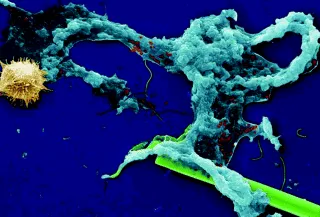
A mixture of bacteria, protozoa and algae in a water sample from a stream
Key Facts
- Microorganisms are all around us in enormous numbers and are present both on and within our bodies. Some, termed pathogens, cause disease; others are beneficial and are of commercial importance but the vast majority are harmless.
- Infectious diseases can be caused by agents which are not living microorganisms: prions are simply ‘rogue’ protein molecules, and viruses usually consist of nucleic acid and protein but have no cellular structure.
- Bacteria represent the simplest living cells. Most of those of pharmaceutical interest can be grown easily in the lab.
- Fungi and protozoa are more complex than bacteria and most of them can exhibit sexual reproduction.
- Relatively few fungi are pathogenic; most are important as contaminants and spoilage organisms in manufactured medicines.
- Protozoa are only of pharmaceutical interest as pathogens; they are not spoilage organisms.
1.1 Microorganisms Around Us
Microorganisms are present in almost every location and environment on earth. They are in the air, soil and water, on all plants and animals and in such extreme environments as Antarctic ice and rocks 3 km below the earth's surface where the temperature is 60° C or more. Besides growing at extremes of temperature and pH, many bacteria survive and grow in the absence of oxygen; for these bacteria, described as anaerobes, oxygen is toxic. Microorganisms are present, too, in huge numbers and variety. The bacteria in the average human gut are estimated to comprise about 500 different species, and their total number, approximately 1014 (one hundred trillion), is about 10 times the number of human cells in the body and more than 10 000 times the human population of the earth. It is impossible to obtain precise data on the relative numbers of harmless and disease-causing (pathogenic) organisms for two main reasons: because new species are being identified all the time, and because of the difficulty of deciding what is harmless and what is not. Organisms that present no threat to a healthy individual might be pathogenic for a person with impaired immunity. Nevertheless, despite the extensive media attention on bioterrorism organisms and the so-called hospital ‘superbugs’, the harmless bacteria, together with those that are actually beneficial, grossly outnumber the pathogens; one estimate is by a ratio of more than 200 000 to 1.
1.2 The Benefits of, and Problems with, Microorganisms
Microorganisms can be essential, passively beneficial or positively useful (Table 1.1). They are essential for the maintenance of life on earth as part of the carbon and nitrogen cycles, for example; without them, dead animals and plants would not decompose and the fertility of soils would fall. Their passive benefits include the protection afforded by probiotic (‘friendly’) bacteria, which compete with disease-causing species for nutrients and attachment sites on body tissue; they also limit opportunities for harmful bacteria to establish infections in the body by producing antimicrobial chemicals. The practical uses of microorganisms include their long-established rôles in the brewing, dairy and food sectors, and their applications in the pharmaceutical industry, which have multiplied enormously in recent years. Bacteria and fungi have been used since the 1940s to make antibiotics, and since the 1950s in the production of contraceptive- and cortico-steroids, but it was the 1980s, a decade which brought major advances in genetic engineering, which saw bacteria used for the manufacture of insulin, human growth hormone, vaccines and many other biotechnology products (see Chapter 20).
Table 1.1 Examples of benefits, uses and problems associated with microorganisms.
| General benefits and uses | Pharmaceutical applications | Problems and disadvantages |
|
|
|
Despite their applications in industry and the increasing recognition of their benefits, it is still the case that the main pharmaceutical interest in microorganisms is in killing them or, at least, restricting their contamination and spoilage of medicines. The reasons for this interest are listed in Table 1.1, and although the first of these – that microorganisms cause infection – is quite obvious, the other problems that microorganisms pose are less well recognized. It is tempting to suppose both that harmless bacteria are irrelevant and that dead bacteria do no harm. Unfortunately, neither supposition is correct: harmless bacteria can carry genes responsible for antibiotic resistance, which they may transfer to disease-causing species, and components of the cell walls of dead bacteria (termed endotoxins) cause fever if they enter the blood stream. Consequently, in order to avoid the risk of fever from residual endotoxins when an injection is administered, it is necessary to ensure that the injection, which must be sterile (free of living organisms) anyway, has not been contaminated with high levels of bacteria during its manufacture. However, it is not only sterile medicines where microorganisms can present a problem: the great majority of medicines are not sterile, and the risk here is that the living organisms they do contain may damage the product, either by altering its physical stability or by breaking down the active ingredient.
1.3 The Different Types of Microorganisms
Living organisms are made up of cells of two types: prokaryotic and eukaryotic. Bacteria used to be considered as the only category of prokaryotic cells, but in 1990 a second group, the archaea, were recognized as having equal status to bacteria. Archaea tend to live in inhospitible conditions (high temperatures, extremes of pH or salinity for example) and often possess unusual modes of metabolism, but because no pathogenic archaea have yet been discovered this group will not be considered further. All other organisms are eukaryotic, so the major groups of microorganisms (fungi, protozoa and algae), as well as parasitic worms and mites, and all plants and animals up to and including humans, are eukaryotes. Viruses do not have a cellular structure and so some scientists do not even regard them as living but merely mixtures of complex chemicals; nevertheless, they are indisputably agents of infection and for that reason are usually considered as part of the micro...
Table of contents
- Cover
- Companion Website
- Title Page
- Copyright
- Preface
- Part I: Characteristics of Microorganisms
- Part II: Microorganisms and the Treatment of Infections
- Part III: Microorganisms and the Manufacture of Medicines
- Index
- Access to Companion Websites
Trusted by 375,005 students
Access to over 1.5 million titles for a fair monthly price.
Study more efficiently using our study tools.
Frequently asked questions
Yes, you can cancel anytime from the Subscription tab in your account settings on the Perlego website. Your subscription will stay active until the end of your current billing period. Learn how to cancel your subscription
No, books cannot be downloaded as external files, such as PDFs, for use outside of Perlego. However, you can download books within the Perlego app for offline reading on mobile or tablet. Learn how to download books offline
Perlego offers two plans: Essential and Complete
- Essential is ideal for learners and professionals who enjoy exploring a wide range of subjects. Access the Essential Library with 800,000+ trusted titles and best-sellers across business, personal growth, and the humanities. Includes unlimited reading time and Standard Read Aloud voice.
- Complete: Perfect for advanced learners and researchers needing full, unrestricted access. Unlock 1.5M+ books across hundreds of subjects, including academic and specialized titles. The Complete Plan also includes advanced features like Premium Read Aloud and Research Assistant.
We are an online textbook subscription service, where you can get access to an entire online library for less than the price of a single book per month. With over 1.5 million books across 990+ topics, we’ve got you covered! Learn about our mission
Look out for the read-aloud symbol on your next book to see if you can listen to it. The read-aloud tool reads text aloud for you, highlighting the text as it is being read. You can pause it, speed it up and slow it down. Learn more about Read Aloud
Yes! You can use the Perlego app on both iOS and Android devices to read anytime, anywhere — even offline. Perfect for commutes or when you’re on the go.
Please note we cannot support devices running on iOS 13 and Android 7 or earlier. Learn more about using the app
Please note we cannot support devices running on iOS 13 and Android 7 or earlier. Learn more about using the app
Yes, you can access Essential Microbiology for Pharmacy and Pharmaceutical Science by Geoff Hanlon,Norman A. Hodges in PDF and/or ePUB format, as well as other popular books in Biological Sciences & Microbiology. We have over 1.5 million books available in our catalogue for you to explore.