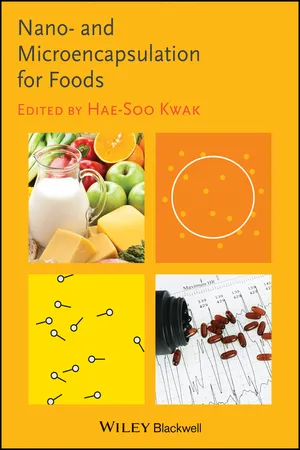
Nano- and Microencapsulation for Foods
eBook - ePub

Nano- and Microencapsulation for Foods

  1. English
  2. ePUB (mobile friendly)
  3. Available on iOS & Android
eBook - ePub

Nano- and Microencapsulation for Foods

About this book

Today, nano- and microencapsulation are increasingly being utilized in the pharmaceutical, textile, agricultural and food industries. Microencapsulation is a process in which tiny particles or droplets of a food are surrounded by a coating to give small capsules. These capsules can be imagined as tiny uniform spheres, in which the particles at the core are protected from outside elements by the protective coating. For example, vitamins can be encapsulated to protect them from the deterioration they would undergo if they were exposed to oxygen. 

This book highlights the principles, applications, toxicity and regulation of nano- and microencapsulated foods.

Section I describes the theories and concepts of nano- and microencapsulation for foods adapted from pharmaceutical areas, rationales and new strategies of encapsulation, and protection and controlled release of food ingredients.

Section II looks closely at the nano- and microencapsulation of food ingredients, such as vitamins, minerals, phytochemical, lipid, probiotics and flavors. This section provides a variety of references for functional food ingredients with various technologies of nano particles and microencapsulation. This section will be helpful to food processors and will deal with food ingredients for making newly developed functional food products.

Section III covers the application of encapsulated ingredients to various foods, such as milk and dairy products, beverages, bakery and confectionery products, and related food packaging materials.

Section IV touches on other related issues in nano- and microencapsulation, such as bioavailability, bioactivity, potential toxicity and regulation. 

Trusted by 375,005 students

Access to over 1.5 million titles for a fair monthly price.

Study more efficiently using our study tools.

Information

Year
2014
Print ISBN
9781118292334
Edition
1
eBook ISBN
9781118292297

Chapter 1
Overview of Nano- and Microencapsulation for Foods

Hae-Soo Kwak
Department of Food Science and Technology, Sejong University, Seoul, South Korea

1.1 Introduction

Nano- or microencapsulation technology is a rapidly expanding technology offering numerous beneficial applications in the food industries. Nano- or microencapsulation technology is the process by which core materials enriched with bioactive compounds are packed within wall materials to form capsules. This method helps to protect many functional core compounds, such as antioxidants, enzyme, polyphenol, and micronutrients, to deliver them to the controlled target site and to protect them from an adverse environment (Gouin, 2004; Lee et al., 2013). Based on the capsule size, the name and the technology of the encapsulation are different: the capsules which range from 3 to 800 µm in size are called microcapsules and the technology is called microencapsulation technology (Ahn et al., 2010). If the particle size ranges from 10 to 1,000 nm, these are called nanospheres and the technology involved to encapsulate the bioactive compounds within the nano size range is termed nanoencapsulation technology (Lopez et al., 2006). Nanocapsules differ from nanospheres when the bioactive systems are dispersed uniformly (Couvreur et al., 1995). The development of the nanotechnology on the nanometer scale has led to the development of many technological, commercial, and scientific opportunities for the industry (Huang et al., 2010).
Application of nanotechnology in the food industry involves many characteristic changes on the macroscale, such as texture, taste, and color, which have led to the development of many new products. This also improves many functions, such as oral bioavailability, water solubility, and the thermal stability of functional compounds (McClements et al., 2009). It is claimed that the functional compounds provide many health benefits in the prevention and treatment of many diseases, and these compounds can easily be seen on the market in various forms. However, the sustainability of the delivery of functional bioactive compounds to the target site is very low, particularly lipophilic compounds. Improving the availability of the functional compounds enhances the absorption of the functional compounds in the gastrointestinal tract, which is a critical requirement. The development of nano- or microencapsulation technologies offers possible solutions to improve the bioavailability of many functional compounds (Chau et al., 2007). The methods used to develop the encapsulation technologies, to enclose the functional compound encapsulated along with its applications in food, and its regulatory framework are described in various chapters in this volume.

1.2 Nano- or microencapsulation as a rich source of delivery of functional components

Nano- or microencapsulation techniques are one of the most interesting fields in that they can act as a carriers or delivery systems for functional components, such as antioxidants, flavor, and antimicrobial agents (Wissing et al., 2004; Sanguansri and Augustin, 2006; McClements et al., 2009; Weiss et al., 2008). The major functional compounds that often need to be incorporated in foods can be divided into four categories: (1) fatty acids (e.g., omega three fatty acids); (2) carotenoids (e.g., β-carotene); (3) antioxidants (e.g., tocopherol); and (4) phytosterols (e.g., stigmasterol). Table 1.1 shows a list of functional compounds that have been encapsulated into nano- or microemulsion systems, their expected benefits, and their fields of application. Applications of the nano- or microencapsulation technologies in the food industries are mainly based on the stability of the capsules. During various environmental conditions, such as chilling, freezing, and thermal processing, which commonly occur during food processing, the capsules are susceptible to instability. The properties of physical stability are at different levels during the encapsulation process, such as stability required in the food ingredients or in the food matrix. Furthermore, stability also varies with the type of food system in which it is incorporated (McClements et al., 2009).
Table 1.1 Nano-encapsulation techniques of various functional materials.
Techniques Functional compounds Coating materials Particle size (nm) References
Emulsification Pine seed oil (L) W: Eudragit L 100-55 457–1,288 Averina and Allémann., 2013
d-Limonene (L) W: maltodextrin; E: modified starch (Hi-Cap 100) 543–1,292 Jafari et al., 2007
Flax seed oil (L) E: Tween-40 135 Kentish et al., 2008
Sunflower oil (L) E: Tween-80, Span-80, and sodium dodecyl sulfate 40 Leong et al., 2009
Salmon oil (L) O: marine lecithin, α-tocopherol, quercetin, chloroform, methanol, diethylic ether, hexane 160–207 Belhaj et al., 2010
Curcumin (L) E: Tween-20, ethyl acetate 125–1083 Souguir et al., 2013
MCT (L) W: OSA starch, chitosan, and lambda-carrageenan 130 Preetz et al., 2008
Inclusion complexation DHA (L) W: beta-lactoglobulin and low methoxyl pectin 100 Zimet and Livney, 2009
Curcumin (L) W: β-cyclodextrin 260–300 Sun et al., 2013
Linoleic acid (L) W: α- and β-cyclodextrin 236 Hadaruga et al., 2006
Emulsification–solvent evaporation α-Tocopherol (L) E: Tween-20 90–120 Cheong et al., 2008
Quercetin W: poly-d,l-lactide 170 Kumari et al., 2010
Quercetin W: poly-d,l-lactide and polyvinyl alcohol 250 Kumari et al., 2011
Phytosterol (L) E: Tween-20; other materials: hexane, isopropyl alcohol, ethanol, and acetone 50–282 Leong et al., 2011
Astaxanthin E: sodium caseinate 115–163 Anarjan et al., 2011
β-carotene (L) E: Tween-20 9–280 Silva et al., 2011
Coacervation Capsaicin (L) W: gelatin, maltodextrin and tannins; E: Tween-60; other material: glutaraldehyde 100 Wang et al., 2008
BSA (H) W: gelatin, acacia, and tannins; E: Tween-60; other material: glutaraldehyde 200–580 Gan and Wang, 2007
Curcumin (L) E: palmitic, myristic <300–500 Chirio et al., 2011
Capsaicin (L) W: gelatin, acacia, and tannins; E: Tween-60; other material: glutaraldehyde 100 Jincheng et al., 2010

1.3 Wall materials used for encapsulation

Nano- or microencapsulation techniques are mainly used in the delivery of functional compounds to the target sites and largely depend on the carrier wall materials used. The effectiveness of the functional compounds wholly depends on the preservation of the compounds (Chen et al., 2006). Microencapsulation greatly helps in the delivery with a suitable wall material, however, reducing the particle size to the nanosize greatly increases the delivery properties due to the increase in surface area per unit volume (S...

Table of contents

  1. Cover
  2. Title Page
  3. Copyright
  4. List of Contributors
  5. Preface
  6. Chapter 1: Overview of Nano- and Microencapsulation for Foods
  7. Part I: Concepts and rationales of nano- and microencapsulation for foods
  8. Part II: Nano- and microencapsulations of food ingredients
  9. Part III: Bioactivity, toxicity, and regulation of nanomaterial, nano- and microencapsulated ingredients
  10. Index
  11. End User License Agreement

Frequently asked questions

Yes, you can cancel anytime from the Subscription tab in your account settings on the Perlego website. Your subscription will stay active until the end of your current billing period. Learn how to cancel your subscription
No, books cannot be downloaded as external files, such as PDFs, for use outside of Perlego. However, you can download books within the Perlego app for offline reading on mobile or tablet. Learn how to download books offline
Perlego offers two plans: Essential and Complete
  • Essential is ideal for learners and professionals who enjoy exploring a wide range of subjects. Access the Essential Library with 800,000+ trusted titles and best-sellers across business, personal growth, and the humanities. Includes unlimited reading time and Standard Read Aloud voice.
  • Complete: Perfect for advanced learners and researchers needing full, unrestricted access. Unlock 1.5M+ books across hundreds of subjects, including academic and specialized titles. The Complete Plan also includes advanced features like Premium Read Aloud and Research Assistant.
Both plans are available with monthly, semester, or annual billing cycles.
We are an online textbook subscription service, where you can get access to an entire online library for less than the price of a single book per month. With over 1.5 million books across 990+ topics, we’ve got you covered! Learn about our mission
Look out for the read-aloud symbol on your next book to see if you can listen to it. The read-aloud tool reads text aloud for you, highlighting the text as it is being read. You can pause it, speed it up and slow it down. Learn more about Read Aloud
Yes! You can use the Perlego app on both iOS and Android devices to read anytime, anywhere — even offline. Perfect for commutes or when you’re on the go.
Please note we cannot support devices running on iOS 13 and Android 7 or earlier. Learn more about using the app
Yes, you can access Nano- and Microencapsulation for Foods by Hae-Soo Kwak in PDF and/or ePUB format, as well as other popular books in Technology & Engineering & Food Science. We have over 1.5 million books available in our catalogue for you to explore.