Applying the ADA
eBook - ePub

Applying the ADA

Designing for The 2010 Americans with Disabilities Act Standards for Accessible Design in Multiple Building Types

  1. English
  2. ePUB (mobile friendly)
  3. Available on iOS & Android
eBook - ePub

Applying the ADA

Designing for The 2010 Americans with Disabilities Act Standards for Accessible Design in Multiple Building Types

About this book

A guide to real-world applications of The 2010 Americans with Disabilities Act Standards for Accessible Design

Applying the ADA helps architects and developers understand better how the rules for eliminating barriers in the built environment apply to everyday life and how to best implement them in the design and construction of a broad variety of buildings and facilities.

By showing how The 2010 Americans with Disabilities Act Standards for Accessible Design have been applied in various contexts and building types, this extensively illustrated guide helps readers quickly understand the requirements of the standards and how to apply them to both new construction and renovation. Written by an architect who consults regularly on accessibility issues for design professionals, building owners, and facility managers, this user-friendly guide features 100 photos and 150 drawings that take the guesswork out of applying the standards to real-world projects. Building types covered include:

  • Healthcare and senior living facilities and hospitals
  • College and university facilities
  • Elementary and high schools
  • Hotels and other transient lodging facilities
  • Amusement parks and play areas
  • Historic preservation and remodels
  • Retail and office spaces

Applying the ADA is an indispensable resource for architects, interior designers, owners, developers, and facility managers. It is also important reading for students of architecture and interior design.

Frequently asked questions

Yes, you can cancel anytime from the Subscription tab in your account settings on the Perlego website. Your subscription will stay active until the end of your current billing period. Learn how to cancel your subscription.
No, books cannot be downloaded as external files, such as PDFs, for use outside of Perlego. However, you can download books within the Perlego app for offline reading on mobile or tablet. Learn more here.
Perlego offers two plans: Essential and Complete
  • Essential is ideal for learners and professionals who enjoy exploring a wide range of subjects. Access the Essential Library with 800,000+ trusted titles and best-sellers across business, personal growth, and the humanities. Includes unlimited reading time and Standard Read Aloud voice.
  • Complete: Perfect for advanced learners and researchers needing full, unrestricted access. Unlock 1.4M+ books across hundreds of subjects, including academic and specialized titles. The Complete Plan also includes advanced features like Premium Read Aloud and Research Assistant.
Both plans are available with monthly, semester, or annual billing cycles.
We are an online textbook subscription service, where you can get access to an entire online library for less than the price of a single book per month. With over 1 million books across 1000+ topics, we’ve got you covered! Learn more here.
Look out for the read-aloud symbol on your next book to see if you can listen to it. The read-aloud tool reads text aloud for you, highlighting the text as it is being read. You can pause it, speed it up and slow it down. Learn more here.
Yes! You can use the Perlego app on both iOS or Android devices to read anytime, anywhere — even offline. Perfect for commutes or when you’re on the go.
Please note we cannot support devices running on iOS 13 and Android 7 or earlier. Learn more about using the app.
Yes, you can access Applying the ADA by Marcela A. Rhoads in PDF and/or ePUB format, as well as other popular books in Architecture & Architecture Design. We have over one million books available in our catalogue for you to explore.

Information

Publisher
Wiley
Year
2013
Print ISBN
9781118027868
eBook ISBN
9781118415887
1
General Guidelines
by Marcela Abadi Rhoads, AIA RAS
GENERAL GUIDELINES
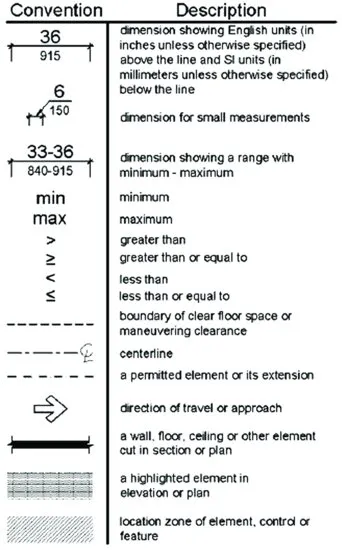
The Americans with Disabilities Act design standards established guidelines to provide accessibility to commercial buildings and public accommodation facilities. The guidelines are general in nature, and even though they address most conditions, each facility is different. This chapter will address the general guidelines that affect the building types that you will find in the remainder of the book. Many of the figures shown in this book were taken directly from the 2010 ADA Standards. As such, their dimensions and nomenclature are shown exactly the way they are depicted in the Standards. The following figure shows the way the ADA delineates dimension and gives measurements.
Figure 104 Graphic Convention for Figures
104.eps
BUILDING BLOCKS
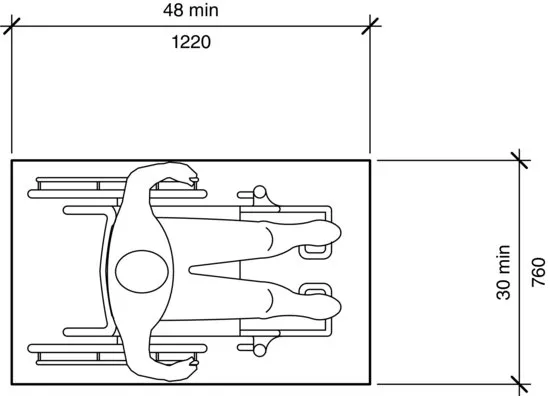
A person with disabilities occupies a certain amount of space. The space is measured both in plan and in section. A person with different disabilities uses certain equipment for either mobility or wayfinding. A person in a wheelchair will require a certain amount of space, typically 30 inches x 48 inches of floor space (see Figure 1.1).
Figure 1.1: ADA Figure 305.3. Clear Floor Space Required [for wheelchairs]. The space required for a wheelchair is a minimum of 30 inches × 48 inches, and when required, it should have a slope of no greater than 2% in all directions.
c01f001.eps
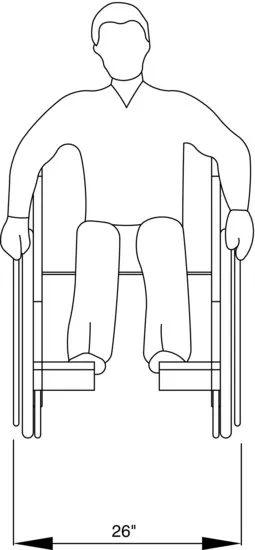
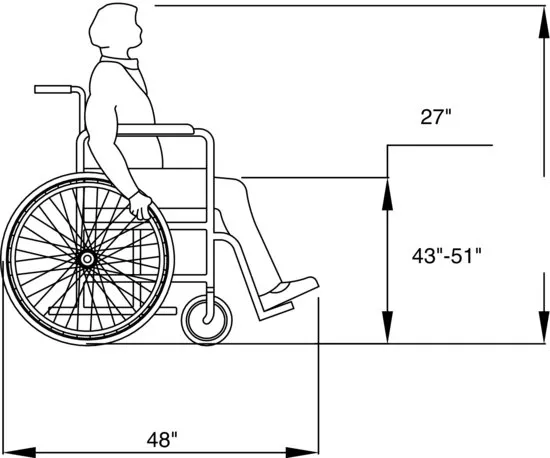
If there are larger wheelchairs, such as power wheelchairs, Segways, and the like, they might even need more space. The ADA Standards are only the minimum requirements, and whenever there is an option to have more space, one should allow for that. Vertical clearances are also required, which allow for maneuvering (see Figure 1.2).
Figure 1.2a: This is a minimum width that a standard wheelchair will require.
c01f002a.eps
Figure 1.2b: Vertical clearances take into consideration the wheelchair and the person using the wheelchair.
c01f002b.eps
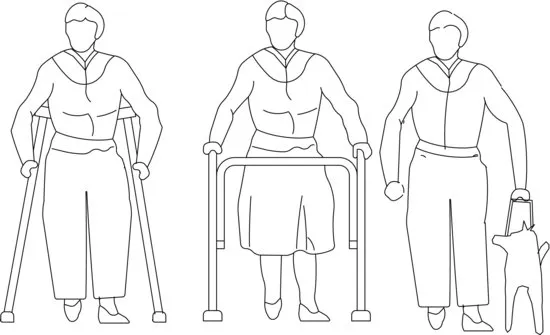
Wheelchairs are not the only type of mobility equipment that requires certain amount of space. Persons with limited mobility who use walkers and crutches, for example, and visually impaired people who use white canes or service animals will also require a certain amount of clear floor space (see Figure 1.3).
Figure 1.3: Crutches, walkers, and service animals will require different clearances. The minimum ADA requirements take into consideration these other devices.
c01f003.eps
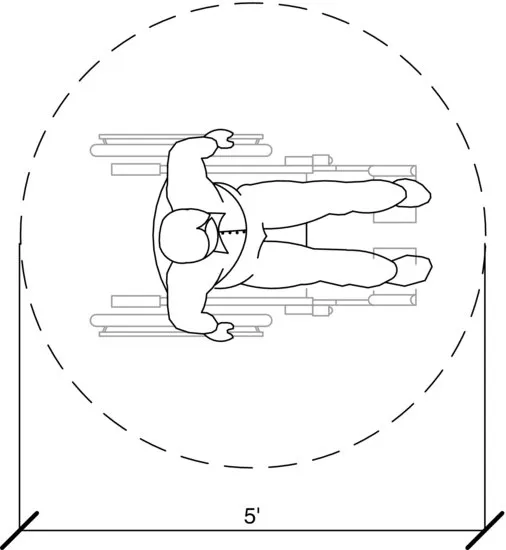
The ADA has an entire chapter that specifically designates all the dimensions for the minimum amount of space that will be required for a person with disabilities to use and maneuver around the area. The clear floor dimensions provided in the chapter also work for the amount of space that a person with disabilities will require to turn around once he or she is inside the space. The chapter gives two types of turning clearances: a circle and a “T” (see Figures 1.4 and 1.5).
Figure 1.4: A 60-inch-diameter circle is the minimum amount of space that a wheelchair will require to make 180º turn.
c01f004.eps
Figure 1.5: “T” turn. When there is not enough room for a 60-inch-diameter circle, space for a “T” turn is allowed.
c01f005.eps
When designing a space for turning, keep in mind that a person in a wheelchair does not make a perfect circle when turning. He or she will probably need a space greater than 60 inches in diameter to turn. Also, the clearances on the floor must be clear from obstructions, as well as have a slope of 2% maximum in every direction of the space where for turning is to be completed.
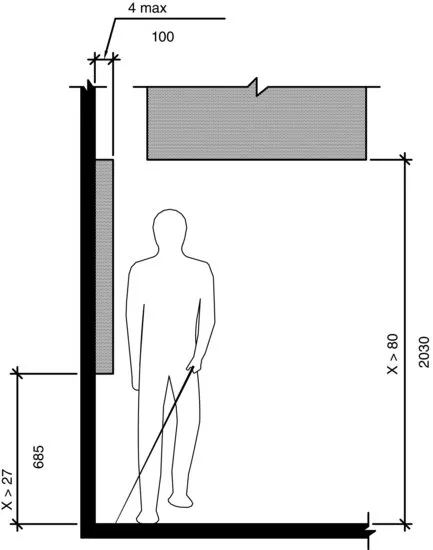
The ADA also has guidelines for persons who are visually impaired, in order to protect them from hurting themselves with objects they cannot detect with their canes as they walk. These are called “protruding objects.” A wall-mounted object is considered a “protruding object” if it is mounted higher than 27 inches from the ground, it projects more than 4 inches from the mounting surface, and it is located along a circulation path (see Figure 1.6).
Figure 1.6: ADA figure 307.2. An object mounted higher than 27 inches from the ground or lower than 80 inches from the ground cannot be detected by a person who is visually impaired. A cane, which some visually impaired people use for wayfinding, can only detect objects mounted below 27 inches.
c01f006.eps
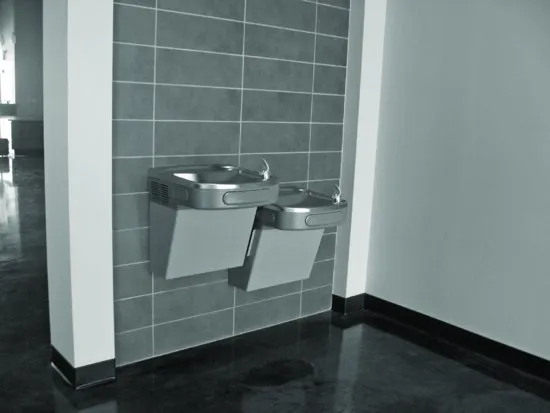
There is a misconception on what constitutes a “circulation path.” A circulation path is not an accessible route for a wheelchair. A circulation path is not the main hallway or corridor where people walk. A circulation path is any path of travel used by a pedestrian, including the path of travel inside and around any interior space. The path of travel that a person uses inside a restroom to find the plumbing fixtures is the circulation path. Because a person who is visually impaired cannot see a sign directing him to a “designated” circulation path, we must design all walls inside an interior space or exterior space without protruding objects. If, along the path of travel, there is a permanent object mounted lower than 27 inches or even mounted on the ground, this will be detectable by a person using a cane for wayfinding (see Figure 1.7).
Figure 1.7: This drinking fountain is not located along the main path of travel, but it is a protruding object because it is along a path of travel that a blind person would use.
c01f007.eps
The ADA not only discusses the clearances for knees, toes, and floor space, but it also gives recommendations and guidelines for the way elements operate. A person with limited dexterity, arthritis, or no use of the hands will have a hard time opening or closing elements or operating any type of mechanism unless it is built in accordance with the standards. An operating mechanism should be able to be used without tight grasping, pulling, or twisting of the wrist. Also the amount of force that is required to operate it should be no more than 5 lbs. (see Figure 1.8). These requirements are universal. They help not only those who are disabled but also others who may not be able to use their hands temporarily.
Figure 1.8: An accessible operable part should not require tight grasping or twisting of the wrist to use.
c01f008.eps
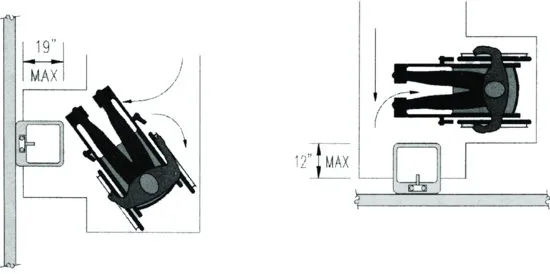
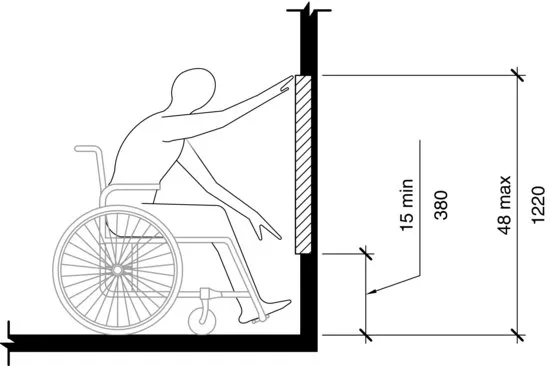
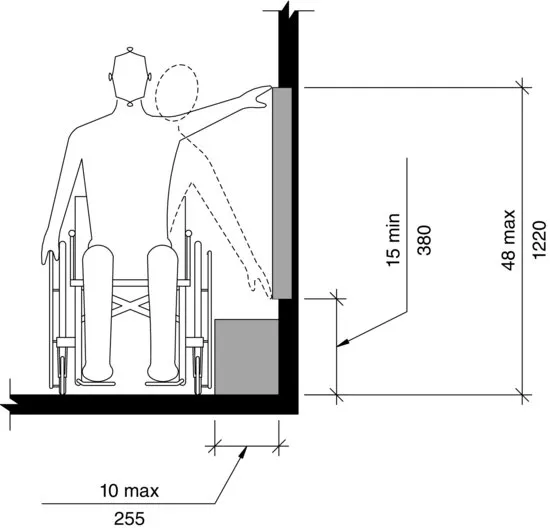
The operating mechanisms will also be required to be at certain heights. There are forward approaches and side approaches that have minimum requirements according to the ADA (see Figure 1.9).
Figure 1.9a and 1.9b: ADA Figures 308.2.1 and 308.3.1. Operating mechanisms are mounted for a forward or a side approach.
c01f009a.eps
c01f009b.eps
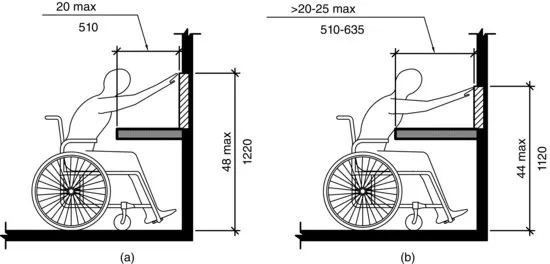
Sometimes the object that people are reaching for is over an obstruction. The obstruction could be a counter, an appliance, or even a doorway. There are reach range requirements provided for those conditions as well (see Figure 1.10).
Figure 1.10a: ADA Figure 308.2.2. Objects mounted over a counter are required to be mounted lower so that a person with a disability can reach and operate them.
c01f010a.eps
Figure 1.10b: ADA Figure 308.3.2 shows the requirements for objects located so that people must reach sideways...

Table of contents

  1. Cover
  2. Title Page
  3. Copyright
  4. Acknowledgments
  5. Introduction
  6. chapter 1: General Guidelines
  7. Chapter 2: Retail and Mixed-Use Facilities
  8. Chapter 3: Primary Education
  9. Chapter 4: Secondary and PostSecondary Education
  10. Chapter 5: Hospitality
  11. Chapter 6: Healthcare and Senior Living Communities
  12. Chapter 7: Amusement Parks and Play Areas
  13. Chapter 8: Historic Preservation and Remodels
  14. Chapter 9: Residential Projects
  15. Chapter 10: Universal Design beyond the ADA
  16. Appendix A: Reference Tables
  17. Appendix B: Resources
  18. Index