![]()
1 Plant food phytochemicals
B.K. Tiwari, Nigel P. Brunton and Charles S. Brennan
1.1 Importance of phytochemicals
Type the word ‘phytochemical’ into any online search engine and it will return literally thousands of hits. This is a reflection of the role plant derived chemicals have played in medicine and other areas since humans have looked to nature to provide cures for various ailments and diseases. While it is often stated, it is worth repeating that the evolution of modern medicine derived from applying scientific principles to herbalism and to this day plants derived compounds provide the skeletons for constructing molecules with the abilities to cure many diseases. In recent times applications of phytochemicals have extended into other areas especially nutraceuticals and functional foods. The focus here is not on curing existing conditions but delaying the onset of new ones and it is not surprising to note that plant foods and plant derived components make up the vast majority of compounds with European Food Safety Authority validated Article 13.1 health claims. Whilst there has been a renewed interest in the use of medicinal plants to treat diseases in recent times and the use of phytochemicals as pharmaceuticals is covered in the present book, this is not the core theme of the book. Given that plant foods are still a major component of most diets worldwide the greatest significance of phytochemicals derives from their role in human diets and health. In fact it is only in relatively recent times that due recognition has been given to the importance of phytochemicals in maintaining health. This has driven a huge volume of work on the subject ranging from unravelling mechanisms of biological significance to discovery and stability studies.
An overview of the health benefits of phytochemicals is essential as many phytochemicals have been reported to illicit both positive and negative biological effects. In recent times some evidence for the role of specific plant food phytochemicals in protecting against the onset of diseases such as cancers and heart diseases has been put forward. Most researchers in this field will however agree that in most cases more evidence is needed to prove the case for the ability of phytochemicals to delay the onset of these diseases. Nevertheless the increasing awareness of consumers of the link between diet and health has exponentially increased the number of scientific studies into the biological effects of these substances.
1.2 Book objective
The overarching objective, therefore, of the Handbook of Plant Food Phytochemicals is to provide a bird’s eye view of the occurrence, significance and factors affecting phytochemicals in plant foods. A key of objective of the handbook is to critically evaluate some of these with a particular emphasis on evidence for or against quantifiable beneficial health effects being imparted via a reduction in disease risk through the consumption of foods rich in phytochemicals.
1.3 Book structure
The book is divided into five parts. Part I deals with the health benefits and chemistry of phytochemicals, Part II summarises phytochemicals in various food types, Parts III and IV deal with a variety of factors that can affect phytochemical content and stability and Part V deals with a range of analytical techniques and applications of phytochemicals. The subject of the biological activity of phytochemicals is approached both from a disease risk reduction perspective in Chapter 3 and from a more traditional pharmacological viewpoint in Chapter 4. Together these chapters are intended to give the reader a sound basis for understanding the biological significance of these substances and to contextualise their roles either as a medicinal plant or as a nutraceutical/functional food. Key to understanding both the stability and biological role of phytochemicals is a sound knowledge of their chemistry and biochemical origin. This often neglected topic is covered in detail here along with an overview of the classification of these compounds. This reflects the ambition of the book to serve as a reference text for students in the field and is intended to provide a basis for understanding some of the complex subjects covered in earlier chapters.
The chemical diversity and number of plant food phytochemicals with reported abilities to protect against diseases numbers in the many thousands. Therefore, to cover all these substances in detail would be impossible. However, myself and my fellow editors felt that providing readers with a reference manuscript for plant food phytochemicals and a basic understanding of the types of phytochemicals in plant foods was essential. Part II of the handbook covers this subject matter by giving an overview of the phytochemicals present in four food categories – fruit and vegetables, food grains, natural products and tree nuts and food processing by-products. Fruits and vegetables are perhaps the best recognised source of phytochemicals and this is reflected in the depth and volume of literature on this food type. Chapter 5 summarises information on major phytochemicals groups in fruits and vegetables as well as some of the more obscure and recently emerged groups. From a consumption perspective food grains form a huge proportion of most diets worldwide – however, due recognition of grains as sources of phytochemicals has only emerged relatively recently. Chapter 6 summarises the phytochemical composition of both cereals and legumes and underlines the importance of this food group as a source of phytochemicals in human diets. Early humans were of course hunter gatherers and nuts would have been important of their diets. It is therefore perhaps not surprising that tree nuts and other natural products have been shown to contain a range of phytochemicals with the potential to deliver benefits beyond basic nutrition. The importance of tree nuts as sources of these compounds is hence covered in detail in Chapter 7 along with related food types such as plantation products. Whilst a core objective of the handbook is to cover the breadth of subject matter in phytochemicals from plant foods this is not merely an academic exercise. Phytochemicals have real commercial uses and this is given due recognition in Chapters 7 and 8 where an overview of the application of phytochemicals derived from foods grains and trees is given. In fact throughout the handbook authors provide detailed information and examples of real applications of plant food derived phytochemicals with a view to underlining the commercial importance of these compounds. Food processing by-products do not of course constitute a food group – however, they have become hugely important sources of phytochemicals in recent times and Chapter 8 is dedicated to revealing the potential of food processing by-products as sources of phytochemicals with real commercial potential. Recovering value from by-products is of course hugely significant to food processors as they seek to maximise the value of a resource that hitherto was considered a waste. This also reflects the drive to identify more sustainable food processing practices and increasing pressures from regulators to reduce waste.
As with most other foods, plant foods are often not consumed in their native form. Therefore, investigators have long been interested in developing an understanding of how processing effects phytochemical composition with view to maximising their potential health promoting properties. Today’s consumers are demanding foods that are healthy, convenient and appetising. The drive for healthy foods has fuelled interest in the effect of processing on the level of components responsible for imparting this benefit, especially phytochemicals. Therefore, much work has been devoted to assessing the effect of processing and storage on levels of potentially important phytochemicals in foods. In addition, a number of novel thermal and non-thermal technologies designed to achieve microbial safety, while minimising the effects on its nutritional and quality attributes, have recently become available. Minimising changes in phytochemicals during processing is a considerable challenge for food processors and technologists. Thus, there is a requirement for detailed industrially relevant information concerning phytochemicals and their application in food products. In addition, industrial adoption of novel processing techniques is in its infancy. Applications of new and innovative technologies and resulting effects on those food products either individually or in combination are always of great interest to academic, industrial, nutrition and health professionals. Part III gives an oversight as to how processing affects phytochemicals in plant foods. This is an area that has received huge attention recently and this has reflected the number of chapters dedicated to it in the handbook. This part of the handbook also summarises and evaluates an area that is often neglected when in the phytochemicals arena but can have profound impact on final phytochemical content, namely on farm and fresh produce management. Given the investment and scale of research required to carry out replicated field trials elucidating the impact of pre-harvest factors, such as fertiliser application, light, temperature, biotic and abiotic stress, this area has perhaps been the most challenging of any of the ‘farm to fork’ factors involved in determining the phytochemical content of plant foods. Indeed assessing the relative effects of intensive and organic farming practices is a highly controversial area but one that consumers appear to take an active interest in given the premium demand for organically produced plant foods. Post-harvest management pertains to the period between harvesting of the plant food and its arrival at the processing plant. This covers many operations including mechanical harvesting, storage and transport. Unsurprisingly many of these operations constitute a stress to the still respiring plant food and thus can activate or deactivate pathways leading to the synthesis of phytochemicals. Ready to eat fruit and vegetables are a relatively recent phenomenon on supermarket shelves. Their emergence is a reflection of consumers’ busy lifestyles and the need to provide healthy and convenient solutions for time poor customers who desire a healthy diet. Products of this nature are often referred to as minimally processed and are subjected to a variety of operations ranging from peeling and cutting to washing. Unlike plant foods, which have been subjected to heat processing, minimally processed products remain viable, albeit in many cases in a wounded state. Therefore a wide variety of responses to minimal processing have been reported and these are summarised and evaluated in Chapter 10, with a particular emphasis on salad mixes. A huge spectrum of full processing techniques is available to food processors nowadays. These range from severe (canning) to mild (sous-vide processing) to non-thermal examples such as high pressure processing, ultrasound and irradiation. Not surprisingly these can have a range of effects on phytochemical content and Chapters 11, 12 and 13 summarise the work done to date on these processes. Grains and pulses undergo a distinctly different processing route to other plant foods involving germination, milling, fermentation and finally baking. Therefore we have dedicated a standalone chapter to food grains, which reviews reports on the grain processing techniques on the content of phytochemicals. Finally, in tune with the farm to fork approach adopted by the handbook, the last chapter in Part III reviews the stability of foods containing phytochemicals during storage after processing. Like most chemical constituents the nature of the matrix they are contained in has a profound effect on their stability. Therefore, in Chapter 15 the stability of phytochemicals with different properties such as low moisture contents, ethnic foods and of course traditional foods is reviewed.
The final part of the book deals with perhaps the first question a researcher must ask him/herself when entering the field namely how do we extract these compounds and how do we measure them. The chapter on extraction is particularly relevant as this is an important consideration not only when analysing these compounds but also when preparing to include them as an ingredient in another food. Phytochemical analysis techniques are advancing at an exponential rate and therefore a chapter reviewing the state of the art in this discipline was one of the first we put on paper when deciding on the content of the book. Finally, the reason we have dedicated a book to the subject of phytochemicals in plant foods is because they have very real applications in industry and everyday life. The final chapter of the handbook drives this point home by providing real examples of industrial uses for phytochemicals ranging from maintaining stability in oxidatively labile foods to enhancing the health promoting properties of others. To conclude we hope you find the proceeding chapters to be informative, clear, concise and that they provide a clear thinking perspective on a subject matter that has benefitted mankind from many perspectives and will no doubt continue to do so into the future.
![]()
Part I
Chemistry and Health
![]()
2 Chemistry and classification of phytochemicals
Rocio Campos-Vega1 and B. Dave Oomah2
1 Kellogg Company Km. Querétaro, Qro. México
2 Pacific Agri-Food Research Centre, Agriculture and Agri-Food Canada, Summerland,British Columbia, Canada
2.1 Introduction
The word ‘biodiversity’ is on nearly everyone’s lips these days, but ‘chemodiversity’ is just as much a characteristic of life on Earth as biodiversity. Living organisms produce several thousands of different structures of low-molecular-weight organic compounds. Many of these have no apparent function in the basic processes of growth and development, and have been historically referred to as natural products or secondary metabolites. The importance of natural products in medicine, agriculture and industry has led to numerous studies on the synthesis, biosynthesis and biological activities of these substances. Yet we still know comparatively little about their actual roles in nature.
Clearly such research has been stimulated by scientific curiosity in the substances and mechanisms involved in the protective effects of fruits and vegetables. Dietary phytonutrients appear to lower the risk of cancer and cardiovascular disease. Studies on the mechanisms of chemoprotection have focused on the biological activity of plant-based phenols and polyphenols, flavonoids, isoflavones, terpenes, and glucosinolates. However, most, if not all, of these bioactive compounds are bitter, acrid, or astringent and therefore aversive to the consumer. Some have long been viewed as plant-based toxins. The analysis of phytochemicals is complicated due to the wide variation even within the same group of compounds, and the metabolic degradation or transformation that may occur during crushing or processing of plants (e.g. for Allium and Brassica compounds), thus increasing the complexity of the mixture. Many phytochemical analyses require mass spectroscopy and therefore are time-consuming and expensive. Furthermore, some compounds tend to bind to macromolecules, making quantitative extraction difficult. Furthermore, many plant food phytochemicals that are poorly absorbed by humans usually undergo metabolism and rapid excretion. It is clear from in vitro and animal data that the actions of some phytochemicals are likely to be achieved only at doses much higher than those present in edible plant foods. Thus, extraction or synthesis of the active ingredient is essential if they are to be of prophylactic or therapeutic value in human subjects.
2.2 Classification of phytochemicals
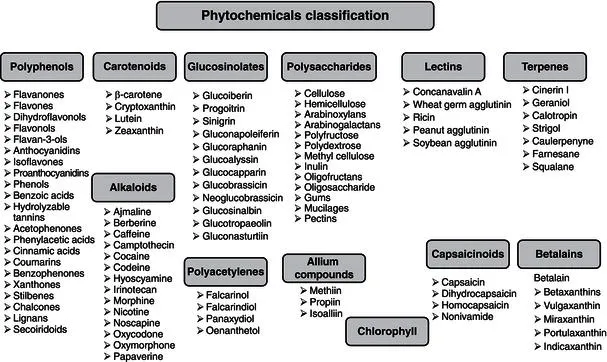
Many phytochemicals have a range of different biochemical and physiological effects, isoflavonoids, for example have antioxidant and anti-oestrogenic activities. These activities may require different plasma or tissue concentrations for optimum effects. A diagram illustrating the classification of the phytochemicals covered in this chapter is shown in Figure 2.1.
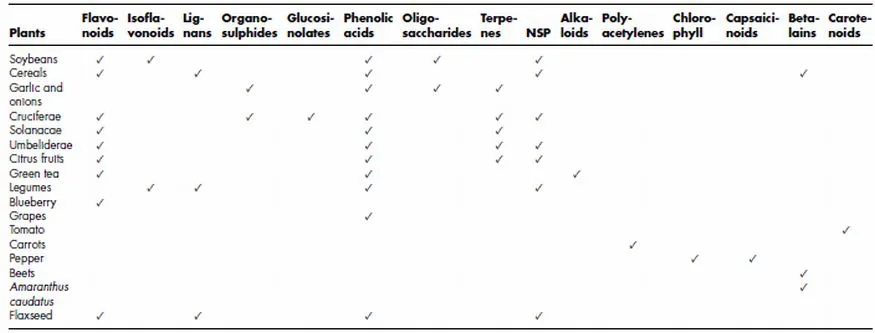
In addition, plants contain mixtures of phytochemicals (Table 2.1), with considerable opportunity for interaction (Rowland et al., 1999). Plant secondary metabolites are an enormously variable group of phytochemicals in terms of their number, structural heterogeneity, and distribution.
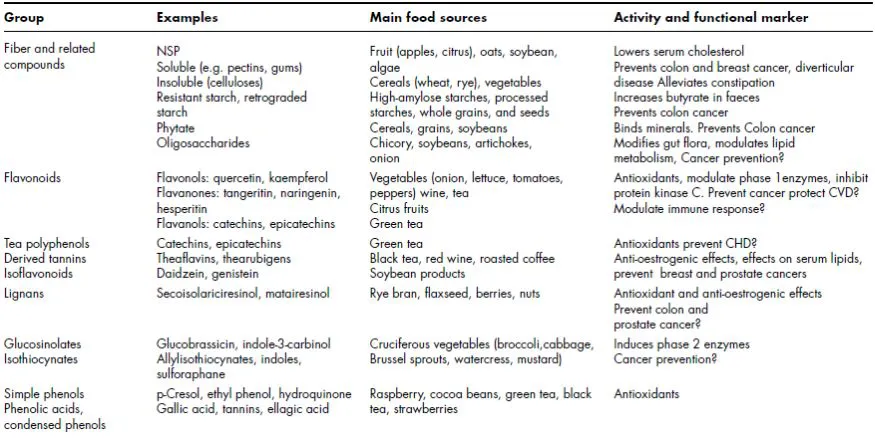
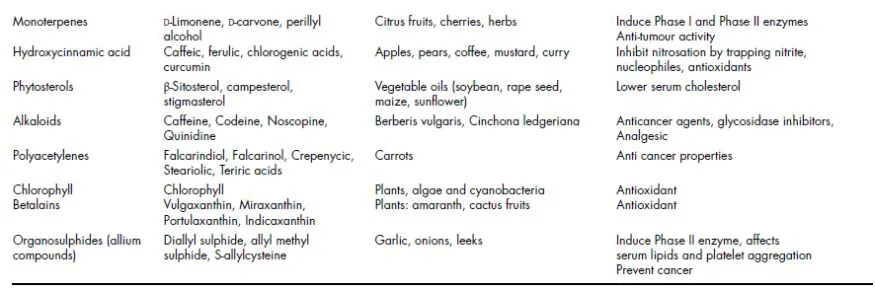
A summary of the main groups of bioactive chemicals in edible plants, their sources, and their biological activities is presented in Table 2.2 (Rowland et al., 1999).
2.2.1 Terpenes
The term terpenes originates from turpentine (balsamum terebinthinae). Turpentine, the so-called “resin of pine trees”, is the viscous pleasantly smelling balsam that flows upon cutting or carving the bark and the new wood of several pine tree species (Pinaceae). Turpentine contains the “resin acids” and some hydrocarbons, which were originally referred to as terpenes. Traditionally, all natural compounds built up from isoprene subunits and, for the most part, originating from plants are denoted as terpenes (Breitmaier, 2006).
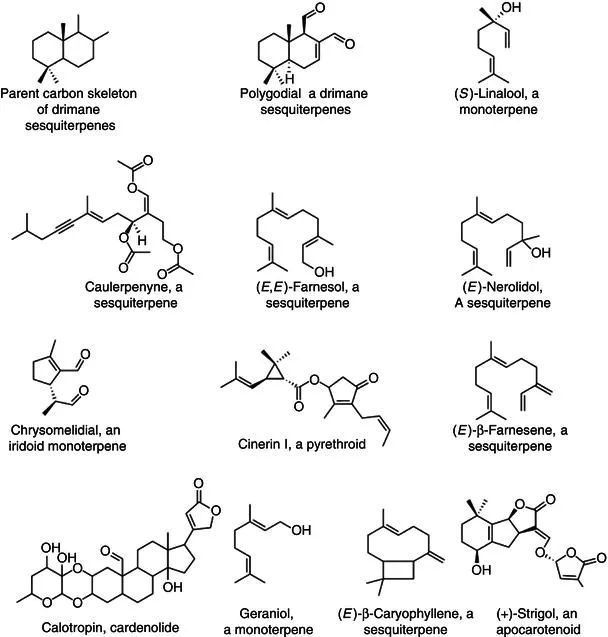
All living organisms manufacture terpenes for certain essential physiological functions and therefore have the potential to produce terpene natural products. Given the many ways in which the basic C5 units can be combined together and the different selection pressures under which organisms have evolved, it is not surprising to observe the enormous number and diversity of structures elaborated (Gershenzon and Dudareva, 2007). Terpenes (also known as terpenoids or isoprenoids) are the largest group of natural products comprising approximately 36 000 terpene structures (Buckingham, 2007), but very few have been investigated from a functional perspective (Figure 2.2).
Table 2.1 Phytochemical content of some edible plants (modified from Caragay, 1992; Rowland et al., 1999)
Table 2.2 Sources and biological activities of phytochemicals (adapted from Rowland et al., 1999)
The classification of terpenoids is based on the number of isoprenoid units present in th...