"The book makes an interesting and substantive contribution to the field of advertising directly, and also to the entire field of marketing communications or promotion. John Philip Jones presents a new and informed perspective that supports and underpins the need for advertising that works rather than emotive rhetoric that obscures its purpose and function."
--Philip J. Kitchen, University of Hull, U.K.
"This is a much needed text that puts misinformation to rest with strong evidence to disprove it. Most texts simply show how ads are developed, media plans are implemented, and lots of beautiful advertisements. This book shows how advertising can be and should be effective."
--Jan S. Slater, Ph.D., Ohio University
The workings of advertising have always remained a bit of a mystery; until about 1960 virtually nothing of the effectiveness of advertising was known. There was even some doubt about whether advertising worked at all. In the absence of facts, theories were developed up to fill the vacuum. These were soon developed into doctrines, which became widely followed—fables that became fashions. Not many of these theories were ever subjected to harsh scrutiny based on factual knowledge, mainly because there was not much factual knowledge available until recently.
John Philip Jones, bestselling author and internationally known advertising scholar, has written a textbook to help evaluate these advertising "fables" and "fashions," and also to study the facts. He uses the patterns and trends revealed by the accumulations of data from cutting-edge research to illustrate the occasional incompleteness, inadequacy, and in some cases total wrongheadedness of these fables and fashions. Each chapter then attempts to describe one aspect of how advertising really works.
Unlike most other advertising textbooks, Fables, Fashions, and Facts About Advertising is not written as a "how to" text, or as a vehicle for war stories, or as a sales pitch. Instead, it is a book that concentrates solely on describing how advertising works. Written to be accessible to the general public with little or no experience studying advertising, it makes the scholarship of an internationally renowned figure accessible to students taking beginning advertising courses.
Fables, Fashions, and Facts About Advertising is ideal as a core or supplemental text for courses in marketing, communication, journalism, and related disciplines. This volume should also be useful to the tens-of-thousands of business people whose careers are directly or indirectly concerned with advertising.
eBook - ePub
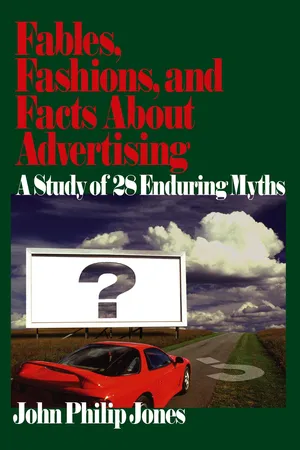
Fables, Fashions, and Facts About Advertising
A Study of 28 Enduring Myths
- 328 pages
- English
- ePUB (mobile friendly)
- Available on iOS & Android
eBook - ePub
Part I
Advertising's Relationship to Business Generally and to the Consumer
Five Myths:
“Consumers are our lifeblood, our entire reason for being.”
“The company integrates and co-ordinates all the activities that will affect customer satisfaction; and the company achieves its profits through creating and maintaining customer satisfaction.”
“Advertising can persuade customers to change their attitudes, beliefs, or behavior.”
“Most products, today, are almost identical. Many clients throw two newly minted half-dollars on the table and ask us to persuade the public that one is better.”
“Products have a limited life…. Most discussions of product life cycle portray the sales history of a typical brand as following an S-shaped curve. This curve is typically divided into four stages, known as introduction, growth, maturity, and decline.”
The first two statements appear sensible yet do not describe how most business is actually practiced in the real world. The others are complete misconceptions of reality.
1

Why Advertisers Advertise
Myth:
“Consumers are our lifeblood, our entire reason for being.”
Common Sense and Its Pitfalls
The quotation given at the start of this chapter seems so obvious that a typical CEO will nod in agreement without thinking too much about it. Yet if this CEO runs a major consumer goods company, he or she will know perfectly well that, in the process of bringing goods to the end-consumer, large roadblocks have to be overcome, and this can be done only by focusing on the roadblocks rather than on the consumer. Although consumers are always in decisive control of what really matters—whether or not any brand will succeed in the marketplace—consumer sovereignty is not quite so high on the typical CEO's agenda as it ought to be.
A major American consumer goods company markets six different (but not directly competing) brands in a single high-volume product category. Although the company's annual advertising expenditure in the category as a whole is decided by its projected profit, the division of the spoils—the advertising budget for each individual brand—is eventually arrived at by each brand manager making a pitch. Whether a brand receives above-average support, or average, or below-average, or zero support, depends essentially on how aggressively the brand manager makes his or her annual plan.
Inevitably a brand manager in this company will be driven by the following principle: “I spend money on advertising to increase sales, by gaining new consumers and persuading both old and new ones to buy more.” Is this sound policy? Such a statement sounds like common sense. Yet it is only truthful as a statement of optimistic intentions. It is certainly not true of the outcomes of most advertising campaigns. Consider the following facts:
- In any year, less than 20 percent of brands increase their sales significantly. These include the very small number of new brands that succeed. In general, introducing new brands is a disheartening activity although most manufacturers feel forced to do it, both to steal a march on the competition and for fear that the competition will steal a march on them.
- Virtually all categories of products and services have stopped growing. This means that, in any market, the increased sales of the growing brands must be balanced more or less by the stagnant or falling sales of everybody else.
- Large brands are generally more profitable than small brands—relatively more profitable, ton for ton or gallon for gallon—a consequence of economies of scale in manufacture and marketing. At the same time, large brands, because they have such great mass, do not grow or decline much. With a relatively small brand, a sales increase of 1 percent may mean an extra 10,000 cases, and an increase of 5 percent only an extra 50,000 cases. But with a fairly large brand, a 1 percent boost can mean 100,000 extra cases, and there comes a time in the life of a successful brand when increases larger than this are extremely difficult and therefore rare.
- The main feature of brand leaders in all categories is the sluggishness of their sales, which is the result of their being bought out of habit by large numbers of consumers, who at the same time regard them as unexciting although indispensable. This is sometimes known as buying inertia. The advertising for such brands reinforces the status quo.
- Advertising influences the success of the 20 percent of brands that grow, and it also helps maintain and sometimes increase slightly the sales of another 20 percent of (mainly large) brands. The overall success rate is therefore about 40 percent.
When we compare markets year by year and see little total growth and only small changes in brand shares, we might conclude that there is a lack of marketing activity. But the truth is totally opposite. The general stability of markets is the end-product of frenetic competitive action, most of which is self-canceling. The aggressiveness of individual manufacturers is counteracted by the aggressiveness of the others. Large-scale and continuous effort on behalf of brands competing against one another produces little overall change.
Consumer-goods markets are mostly oligopolies. This ugly word describes a situation in which the majority of sales—normally at least two-thirds of the total—are made by a handful of competitors: two (as in soft drinks, mouthwash, and toothpaste); three (as in automobiles, beer, and fast-food hamburger restaurants); four (as in bar soaps, breakfast cereals, and credit cards). Categories dominated by one single organization are rare although they exist (Campbell's in canned soup and Kodak in camera film). Fields that are splintered into large numbers of small units are rarer still, especially in consumer categories, although they are more common in business fields (e.g., advertising agencies and firms of attorneys).
Organizations that market consumer goods nationally or in large regions of the United States make sales every year generally worth between $100 million and $20 billion and sometimes more. This is substantial business that needs protecting, and it means that marketers are invariably caught in a dilemma. To what extent should they embark on fresh ventures to expand their volume of sales? On the other hand, to what extent should they stay at home to protect their existing brands (and with them the value of their stockholders’ equity)? When manufacturers make speeches to their annual company meetings or when they are interviewed in the business press, they tend to favor innovation and growth. However, in their actions they tend to favor stability, certainly when business is in recession. A recent inquiry published in the management journal The Economist reported that three times as many manufacturers are concerned with their core businesses as are interested in new strategies.
Consumer Orientation
As already explained, manufacturers will usually say that their eyes are always focused on their end-consumers. This is where their eyes should be directed, because consumers are after all in ultimate control of every manufacturer's destiny. Because of this, wise manufacturers should restage their brands at regular intervals, with functional improvements and new advertising campaigns, to make sure that their consumers are not lured away by the promises of superiority in the advertising for competitive brands.
But this last sentence gives the clue as to where manufacturers’ attention is really directed. Marketing companies are more concerned with their competitors than they are with the people who actually buy their brands. The very size of the companies competing in the market-place—and the threat that each poses to the others—means that each spends most of its time looking over its shoulder. It will continually try to get in first, to preempt competitors; if it does not succeed in this, it will spend the rest of its time responding to what competitors are doing.
There is an additional complication. Marketing companies do not sell to the consumers of their brands. They sell to retail customers who in turn sell to the end-consumers. And the retail trade in the food and drug fields is also made up of national and regional oligopolies. On a local level, the situation is generally the same with bottlers in the soft drinks industry, with franchisees of fast foods, and with automobile dealerships. The result is that many retail organizations are as large as—and sometimes much larger than—the manufacturers who supply them. For example, the annual value of the domestic sales of Wal-Mart (a substantially American operation) is ten times the size of that of Procter & Gamble, and 17 percent of P&G's sales worldwide are made to Wal-Mart.
Substantial advertising campaigns directed at the consumer—but, more important, designed to make things easy for the retailer—are a condition for retailers merely to carry manufacturers’ brands. Significant amounts of shelf space and in-store display have an even higher price. And although manufacturers’ advertising campaigns are important bargaining counters for retailers’ patronage, there is an even more important counter that must be played. This is cash paid out directly or indirectly. It takes two forms: trade promotions, which are another word for large discounts of various degrees of complexity; and consumer promotions (especially coupons), which are also very expensive and are directed less at the consumers they explicitly target than at retailers as a reassurance that they will generate business for them. Without these large bribes, retailers will allow manufacturers’ brands to wither on the vine.
There is a trade-off between promotional expenditures and advertising investments: If there is more of one, there is less of the other. And because of the size and the negotiating muscle of the retail trade, it is not surprising that promotional spending has grown faster than advertising. The ratio of promotional money to advertising money is currently about three to one. This is a distribution of funds that would have been unthinkable to advertisers and advertising agencies during the 1960s, organizations whose main priority was to establish and build a body of buyers who used their brands regularly. As advertising pioneer David Ogilvy said at that time: “It is the total personality of a brand which decides its ultimate position in the market.” Advertising is quite rightly seen as the primary means of creating and strengthening this personality.
Advertisers today—much more so than in the past—are assailed from two directions: from the competition and from distributors. Advertisers have to tread on eggs, for fear of stirring up competitive retaliation to their activities. At the same time, they must disburse large and increasing dollar sums to keep their brands on supermarket shelves.
These realities of the marketplace therefore force us to think more deeply about the question of why advertisers advertise. Manufacturers concern themselves, first, with competitive manufacturers; second, with the large retail chains; and only third with their end-consumers. Readers will remember the astonishing story of Coca-Cola when, during the 1980s, the brand was relaunched with a sweeter flavor modeled on Pepsi-Cola. Existing drinkers of Coca-Cola, who liked the existing formula and whom the company seemed not to care about, were outraged. As a result, the original flavor had to be reintroduced with much trouble and at great cost.
One Voice, Many Voices
Ninety percent of marketing companies base their advertising budgets on what they can afford: a percentage of the value of their sales. This means that a brand's share of consumer advertising in its category (described as share of voice, or SOV) more or less balances its share of market (SOM). If total spending in a category goes up or down but the individual brands’ shares of voice remain intact, individual shares of market will not change much. At the same time, total category sales are unaffected by increases and decreases in total advertising spending. (This seems strange, but it is true.)
If it should so happen that all competitors in the market reduced their advertising budgets by 50 percent, it is very likely that each individual brand would remain where it started—although each would have become more profitable because it would be advertising less. However, this attractive outcome could be brought about only by collusion, which would incur the most serious displeasure of the Federal Trade Commission (FTC), which would quite rightly consider it anticompetitive.
The FTC should have no fear that such collusion is likely, however. The most striking feature of oligopoly is heated and occasionally ferocious competition among individual manufacturers. Any reduction in advertising on the part of one advertiser would certainly be met by increased expenditure by its competitors, who would immediately try to seize market share from the brave but ill-advised advertiser who is attempting to exchange advertising for profit.
Although manufacturers may start by spending what they can afford, they are perpetually driven to increase advertising expenditures to keep competitors at bay. At the same time, however, huge dollar sums are funneled into trade and consumer promotions to persuade retailers to support their brands. The size of these promotions tends to dampen the upward pressure on advertising expenditure, because manufacturers cannot afford both heavy promotions and vast advertising budgets. But since all manufacturers are subjected to the same pressures of retailing buying power, the effect on individual advertising budgets is felt the same way by everybody. Budgets do not go up as much as advertisers (and their agencies) would like.
After manufacturers have responded to the psychological pressure of competition with other manufacturers, and the continuous battles with the retail trade, the consumer is forced to the bottom of the manufacturer's list of priorities. But the consumer is not at the bottom of the retailer's. Retailers compete fiercely for the consumer's dollars through regularly repeated temporary price reductions, an activity that is very obvious from the retailers’ advertisements that adorn every local newspaper in the United States: the unbeautiful inserts that appear on Sundays and the strident trumpet calls to “buy today” that are run later in the week.
Manufacturers’ efforts to use advertising to enrich the personalities of their brands, in the way recommended by David Ogilvy, are largely negated by massive and continuous price cutting. This is not only because this price cutting is funded at the expense of manufacturers’ advertising, but also because cheap prices degrade the image of a brand.
Retailers, who are skilled and tactically aggressive, evaluate the effects of their price cutting with great care. Sales of virtually all brands of consumer goods are sensitive to price changes. On average, a 10 percent price reduction will produce an 18 percent increase in sales. But the problem with price reductions is that they are unprofitable because the direct costs for the extra volume have to be paid for and, in addition, the price reductions themselves take a big bite out of the receipts from each unit sold. However, this unprofitability does not matter much to retailers because the cost of these reductions is being covered to a large degree by manufacturers.
Manufacturers are less skilled in measuring the effects of their advertising. It is admittedly a very difficult task. But the real reason why they do not make the great effort necessary to improve matters is that they are essentially more concerned with their direct competitors and the retail trade than they are with the effect of their advertising on their end-consumers. This is a shocking truth, and it helps to expla...
Table of contents
- Cover Page
- Dedication
- Title page
- Copyright
- Contents
- Epigraph
- Preface
- Acknowledgments
- Part I: Advertising's Relationship to Business Generally and to the Consumer
- Part II: Advertising Strategy and the Difficulty of Locating Target Consumers, the Development of Creative Ideas, and Facts About How Much Advertising Produces an Effect
- Part IV: How Advertising Works
- Part V: Researching Advertising—Before and After It Is Run
- Part VI: How Advertising Is Managed
- Part VII: Sources of Information
- Bibliography
- Glossary
- Index
- About the Author
Trusted by 375,005 students
Access to over 1.5 million titles for a fair monthly price.
Study more efficiently using our study tools.
Frequently asked questions
Yes, you can cancel anytime from the Subscription tab in your account settings on the Perlego website. Your subscription will stay active until the end of your current billing period. Learn how to cancel your subscription
No, books cannot be downloaded as external files, such as PDFs, for use outside of Perlego. However, you can download books within the Perlego app for offline reading on mobile or tablet. Learn how to download books offline
We are an online textbook subscription service, where you can get access to an entire online library for less than the price of a single book per month. With over 1.5 million books across 990+ topics, we’ve got you covered! Learn about our mission
Look out for the read-aloud symbol on your next book to see if you can listen to it. The read-aloud tool reads text aloud for you, highlighting the text as it is being read. You can pause it, speed it up and slow it down. Learn more about Read Aloud
Yes! You can use the Perlego app on both iOS and Android devices to read anytime, anywhere — even offline. Perfect for commutes or when you’re on the go.
Please note we cannot support devices running on iOS 13 and Android 7 or earlier. Learn more about using the app
Please note we cannot support devices running on iOS 13 and Android 7 or earlier. Learn more about using the app
Yes, you can access Fables, Fashions, and Facts About Advertising by John Philip Jones in PDF and/or ePUB format, as well as other popular books in Business & Marketing. We have over 1.5 million books available in our catalogue for you to explore.