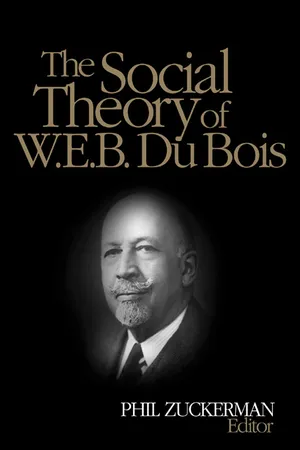
The Social Theory of W.E.B. Du Bois
eBook - ePub

The Social Theory of W.E.B. Du Bois

  1. 224 pages
  2. English
  3. ePUB (mobile friendly)
  4. Available on iOS & Android
eBook - ePub

The Social Theory of W.E.B. Du Bois

About this book

Karl Marx, Max Weber, and Emile Durkheim are widely recognized as the trinity of sociological theory. While these three sociologists were trailblazing social theorists who enhanced the study of human behavior and its relationship to social institutions, other, more contemporary scholars were just as innovative - one of those scholars being W. E. B. Du Bois.

W. E. B. Du Bois was a political and literary giant of the 20th century, publishing over twenty books and thousand of essays and articles throughout his life. In The Social Theory of W. E. B. Du Bois, editor Phil Zuckerman assembles Du Bois?s work from a wide variety of sources, including articles Du Bois published in newspapers, speeches he delivered, selections from well-known classics such as The Souls of Black Folk and Darkwater, and lesser-known, hard-to-find material written by this revolutionary social theorist.

W. E. B Du Bois is arguably one of the most imaginative, perceptive, and prolific founders of the sociological discipline. In addition to leading the Pan-African movement and being an activist for civil rights for African Americans, Du Bois was a pioneer of urban sociology, an innovator of rural sociology, a leader in criminology, the first American sociologist of religion, and most notably the first great social theorist of race. The Social Theory of W. E. B. Du Bois is the first book to examine Du Bois?s writings from a sociological perspective and emphasize his theoretical contributions. This volume covers topics such as the meaning of race, race relations, international relations, economics, labor, politics, religion, crime, gender, and education.

The Social Theory of W. E. B. Du Bois
offers an excellent introduction to the sociological theory of one of the 20th century?s intellectual beacons. It is a dynamic text for undergraduate and graduate students studying sociological theory, African American studies, and race and ethnicity.

Frequently asked questions

Yes, you can cancel anytime from the Subscription tab in your account settings on the Perlego website. Your subscription will stay active until the end of your current billing period. Learn how to cancel your subscription.
At the moment all of our mobile-responsive ePub books are available to download via the app. Most of our PDFs are also available to download and we're working on making the final remaining ones downloadable now. Learn more here.
Perlego offers two plans: Essential and Complete
  • Essential is ideal for learners and professionals who enjoy exploring a wide range of subjects. Access the Essential Library with 800,000+ trusted titles and best-sellers across business, personal growth, and the humanities. Includes unlimited reading time and Standard Read Aloud voice.
  • Complete: Perfect for advanced learners and researchers needing full, unrestricted access. Unlock 1.4M+ books across hundreds of subjects, including academic and specialized titles. The Complete Plan also includes advanced features like Premium Read Aloud and Research Assistant.
Both plans are available with monthly, semester, or annual billing cycles.
We are an online textbook subscription service, where you can get access to an entire online library for less than the price of a single book per month. With over 1 million books across 1000+ topics, we’ve got you covered! Learn more here.
Look out for the read-aloud symbol on your next book to see if you can listen to it. The read-aloud tool reads text aloud for you, highlighting the text as it is being read. You can pause it, speed it up and slow it down. Learn more here.
Yes! You can use the Perlego app on both iOS or Android devices to read anytime, anywhere — even offline. Perfect for commutes or when you’re on the go.
Please note we cannot support devices running on iOS 13 and Android 7 or earlier. Learn more about using the app.
Yes, you can access The Social Theory of W.E.B. Du Bois by Phil Zuckerman in PDF and/or ePUB format, as well as other popular books in Social Sciences & Sociology. We have over one million books available in our catalogue for you to explore.

Table of contents

  1. Cover Page
  2. Title
  3. Copyright
  4. Contents
  5. Acknowledgments
  6. Introduction
  7. Chapter I: On the Meaning of Race
  8. 1. “The Conservation of Races”
  9. 2. “Of Our Spiritual Strivings”
  10. 3. “The First Universal Races Congress”
  11. 4. “Does Race Antagonism Serve Any Good Purpose?”
  12. 5. “Africa and the Slave Trade”
  13. 6. “The Souls of White Folk”
  14. 7. “Social Equality and Racial Intermarriage”
  15. 8. “Should the Negro Be Encouraged to Seek Cultural Equality?”
  16. 9. “The Concept of Race”
  17. 10. “The Negro and the Warsaw Ghetto”
  18. Chapter II: On Race Relations
  19. 1. “Color Prejudice”
  20. 2. “Relations of Negroes to Whites in the South”
  21. 3. “The Negro Problem”
  22. 4. “Bleeding Ireland”
  23. 5. “The Shape of Fear”
  24. 6. “Segregation”
  25. 7. “Anti-Semitism”
  26. 8. “My Evolving Program for Negro Freedom”
  27. 9. “Bound by the Color Line”
  28. Chapter III: On International Relations
  29. 1. “The Hands of Ethiopia”
  30. 2. “Colonies”
  31. 3. “The Trade in Men”
  32. 4. “Mexico and Us”
  33. 5. “The Future of Europe in Africa”
  34. 6. “Colonialism, Democracy, and Peace After the War”
  35. 7. “Haiti”
  36. 8. “Prospect of a World Without Racial Conflict”
  37. 9. “The Disfranchised Colonies”
  38. 10. “Peace is Dangerous”
  39. Chapter IV : On Labor, Economics, and Politics
  40. 1. “Servants”
  41. 2. “The Value of Agitation”
  42. 3. “Of the Ruling of Men”
  43. 4. “Of Giving Work”
  44. 5. “Business as Public Service”
  45. 6. “Employment”
  46. 7. “Economic Disfranchisement”
  47. 8. “Marxism and the Negro Problem”
  48. 9. “The Use of Capital”
  49. 10. “The Release of Earl Browder”
  50. 11. “Human Rights for all Minorities”
  51. 12. “We Must Know the Truth”
  52. 13. “America’s Pressing Problems”
  53. 14. “There Must Come a Vast Social Change in the United States”
  54. Chapter V: On Women
  55. 1. “The Black Mother”
  56. 2. “Woman Suffrage”
  57. 3. “The Damnation of Women”
  58. 4. “The Freedom of Womanhood”
  59. Chapter VI: On Religion
  60. 1. “The Function of the Negro Church”
  61. 2. “Of the Faith of the Fathers”
  62. 3. “Immortality”
  63. 4. “Missions and Mandates”
  64. Chapter VII: On Crime
  65. 1. “The Negro Criminal”
  66. 2. “The Relations of Negroes to Whites in the South”
  67. 3. “Notes on Negro Crime, Particularly in Georgia”
  68. 4. “Morals and Manners”
  69. 5. “Lynched by Years, 1885-1914”
  70. Chapter VIII: On Education
  71. 1. “The Talented Tenth”
  72. 2. “Education”
  73. 3. “Education”
  74. 4. “The Negro College”
  75. 5. “The Freedom to Learn”
  76. Index
  77. About the Editor