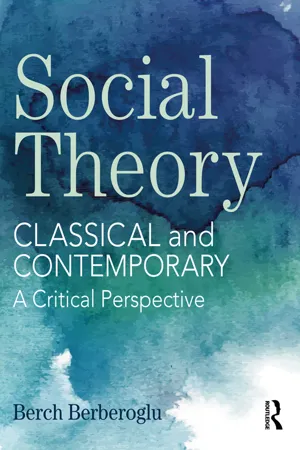
Social Theory provides a sophisticated yet highly accessible introduction to classical and contemporary social theories. The author's concise presentation allows students and instructors to focus on central themes. The text lets theorists speak for themselves, presenting key passages from each theorist's corpus, bringing theory to life. The approach allows instructors the opportunity to help students learn to unpack sometimes complex prose, just as it offers inroads to class discussion. Chapters on Addams and early feminism, on Habermas and the Frankfurt School, on Foucault, and on globalization and social movements round out contemporary coverage. The book presents and explains key theories, just as it provides an introduction to central debates about them.
- 294 pages
- English
- ePUB (mobile friendly)
- Available on iOS & Android
eBook - ePub
About this book
Information
Part I
Classical Social Theory
1
Hegel on Dialectics, the State, and Society
Georg Wilhelm Friedrich Hegel (1770–1831) was a German idealist philosopher and social theorist who had a profound impact on subsequent philosophers and social theorists who adopted a rationalist mode of thought. His influence extended beyond the realm of philosophy to affect the thinking of those, like Karl Marx, who adopted and later opposed his ideas, while crediting him with the contributions that he made in formulating a way of looking at the world through the lens of “dialectics.” This chapter provides an overview of the Hegelian dialectic and lays bare the philosophical foundations of Hegel’s view of the state and society that came to inform his approach to social theory.
The Hegelian Dialectic
The centerpiece of Hegel’s philosophical view of the world is his methodological approach that defines his logic of inquiry to understand society. As a rationalist philosopher, Hegel relied on ideas and metaphysical phenomena. The methodology he adopted was “dialectics”—that is, knowledge derived from an understanding of the unity of opposites. As his approach was based on ideas (or the realm of thought), this meant knowledge is to be attained through the opposition of idea “a” to idea “b” that results in new knowledge embodied in idea “c”—or what came to be known as “thesis” versus “antithesis” leading to “synthesis.” Hegel believed that this dialectical mode of thought would lead to the discovery of “the absolute truth,” for it is in this way, he argued, the inner logic of the spiritual and material world can be understood.1 The Hegelian dialectic was viewed by many as an innovative method of attaining knowledge by understanding the oppositional tendencies between sets of ideas. Others, like Karl Marx, adopted this approach to explain the material world in looking at social conflict and struggle between classes as a way of explaining social change and social transformation, which we will explore in Chapter 2.
The Hegelian dialectic was adopted by idealist philosophers and social theorists to understand the source of knowledge and how it developed over time. Based on philosophical rationalizations of the “Idea” and its evolution through the clash of contradictory thought, Hegel aimed to discover the essence of things without reference to their social context and material conditions. The Hegelian idealist dialectics provided a view of the world that was based on pure speculation mixed with religious (or spiritual) reasoning that came to inform subsequent functionalist theorists who claimed to explain the social world through the lens of idealist dialectics. This was the case with Hegel himself, of course, who developed an entire school of thought that became known as Hegelian philosophy.2
The State and Society
Hegel’s views on politics and the state were heavily shaped by his idealist philosophy of history and society. Thus, in a typical idealist formulation of the problem, Hegel’s concept of the state is based not on any existing state, but on the “idea of the state.”3
In his rational construction of the concept, Hegel viewed the state as having the task of achieving universality (i.e., as caretaker of the “general will”). In this sense, he counter-posed the state’s public mission to the private sphere within which civil society functioned. With the state representing the universal community, Hegel assigned to the state the responsibility of combating the harmful effects of civil society based on the individual will. In so doing, he set out to find a moment of mediation between the public and the private spheres to achieve the desired unity.
The essence of the modern state is that the universal be bound up with the complete freedom of its particular members and with private well-being. . . . The universal must be furthered, but subjectivity on the other hand must attain its full and living development. It is only when both of these moments subsist in their strength that the state can be regarded as articulated and genuinely organized.4
To obtain this equilibrium and thus to maintain social order and stability in society, the process requires the functional integration of the individual into the prevailing sociopolitical order led by the state.
The state is absolutely rational inasmuch as it is the actuality of the substantial will which it possesses in the particular self-consciousness once that consciousness has been raised to consciousness of its universality. This substantial unity is an absolute unmoved end in itself, in which freedom comes into its supreme right. On the other hand, this final end has a supreme right against the individual, whose supreme duty is to be a member of the state.5
In this context, Frederick Copleston points out that for Hegel “the State represents the unity of the universal and the particular” such that “in the State self-consciousness has risen to the level of universal self-consciousness.”6 In this sense, Copleston continues, “The individual is conscious of himself as being a member of the totality in such a way that his selfhood is not annulled but fulfilled.”7 And the state, precisely in this way, becomes the instrument for the expression of collective identity. Thus, for Hegel,
The State is not an abstract universal standing over against its members: it exists in and through them. At the same time, by participation in the life of the State the members are elevated above their sheer particularity. In other words, the State is an organic unity. It is a concrete universal, existing in and through particulars which are distinct and one at the same time.8
Moreover, according to Copleston’s further rendering of the Hegelian state, one that highlights its spiritual content, for Hegel,
The State is the actuality of the rational will when this has been raised to the plane of universal self-consciousness. It is thus the highest expression of objective Spirit. And the preceding moments of this sphere are resumed and synthesized in it.”9
Rationalizing the primacy of the state, Hegel assigned to the state a supreme, all-powerful position that has clearly religious and metaphysical connotations: referring to it as “this actual God,”10 he viewed the existence of the state as part of a divine plan, one that “embodies the true, the eternal wisdom of the Spirit—of God.”11 His statement along these lines—written in the original German as “Es ist der Gang Gottes in der Welt, dass der Staat ist,” and variously translated into English as “The State is the march of God through the world,” “The existence of the State is the presence of God on earth,” “The march of God in the world, that is what the state is,” or “It is the course of God through the world that constitutes the state”12—does, despite the controversy surrounding its precise meaning, convey a link between the state and divine authority that reveals not only its religious or ethically driven character, but also its absolute nature, as some critics have accused Hegel to be promoting.13
This sacred, religiously defined idealist conceptualization of the state and society is similar to Emile Durkheim’s functionalist definition of society as the supreme entity (conceived in similarly religious terms) to which the individual must submit and conform, if the harmony between the individual and the state and society is to be achieved into a unity—the ideal state and society.
But for Hegel, the state’s role and mission is more than that mandated by God; it is sacred not so much because the state represents God’s will but because it involved first and foremost the maintenance of order and harmony in the prevailing feudal society threatened by the rise of private capital (i.e., civil society). “Hegel explains the breakdown of the German state by contrasting the feudal system with the new order of individualist society that succeeded it,”14 writes Marcuse. “The rise of the latter social order,” he adds, “is explained in terms of the development of private property.”15 According to Hegel, “The feudal system proper,” Marcuse continues, “integrated the particular interests of the different estates into a true community. The freedom of the group or of the individual was not essentially opposed to the freedom of the whole.”16 But, “in modern times,” he writes, Hegel believed “exclusive property has completely isolated the particular needs from each other”17 such that the parts have no relation to the whole. Thus, for Hegel, the only institution that serves to hold society together is the state.
Critique
The rationalization and legitimization of the state in these terms, however, serve to justify the continued exploitation of the masses by the dominant ruling class through the harmonizing role of the state over society, notwithstanding the claim that this was done under a divine plan devised by God. In reality, this took place within the context of a feudal social order in which the state was ruled by the landowning class, and the church was among the largest landowners, under the pretext of lifting the people to a higher, spiritual level that would usher in true freedom—one based on the unity of the public and private spheres, through their mutual communion.
Suffice it to say, the Hegelian theory of the state and society, based, in essence, on an idealist, metaphysical conceptualization, provides us no better than the ideology of the dominant classes to legitimize their rule and, in the process, to rationalize the reign of a supreme authority exerting its power over the oppressed and exploited laboring masses.
Moving beyond mythical philosophical statements and rationalizations of the state, an analysis of the class nature of the Hegelian ideal state and its role in society reveals its true nature—a utopian ideal that cannot be achieved in its purest form as projected, on the one hand, and an unconditional support for the state that, however “bad” or “sick” it may be, does represent the entire society, on the other hand. It is this authoritative role that Hegel assigns the state, explained in the abstract and divorced from any fruitful understanding of the class nature of society,18 which, in the final analysis, reinforces his conservative theory of the state as one that rationalizes and legitimizes the exploitation of the laboring masses and their overall place in society in favor of conformity and law and order, rather than helping them liberate themselves from their misery.
In this context, Hegel does not shy away from making his views known on the affinity between his thinking and that of Machiavelli, when he writes:
Profoundly moved by the situation of general distress, hatred, disorder, and blindness, an Italian statesman grasped with cool circumspection the necessary idea of the salvation of Italy through its unification on one state. . . .
Machiavelli’s fundamental aim of erecting Italy into a state was misunderstood from the start by the blind who took his work as nothing but a foundation of tyranny or a golden mirror for an ambitious oppressor.19
Praising The Prince and its author for his brilliant work and its relevance to the nature and tasks of the state, Hegel had this to say about Machiavelli:
You must come to the reading of The Prince immediately after being impressed by the history of the centuries before Machiavelli and the history of his own times. Then indeed it will appear as not merely justified but as an extremely great and true conception produced by a genuinely political head with an intellect of the highest and noblest kind.20
Aside from ...
Table of contents
- Cover
- Title
- Copyright
- CONTENTS
- Preface
- Introduction
- Part I: Classical Social Theory
- Part II: Contemporary Social Theory
- Conclusion
- Bibliography
- Index
- About the Author
Trusted by 375,005 students
Access to over 1.5 million titles for a fair monthly price.
Study more efficiently using our study tools.
Frequently asked questions
Yes, you can cancel anytime from the Subscription tab in your account settings on the Perlego website. Your subscription will stay active until the end of your current billing period. Learn how to cancel your subscription
No, books cannot be downloaded as external files, such as PDFs, for use outside of Perlego. However, you can download books within the Perlego app for offline reading on mobile or tablet. Learn how to download books offline
Perlego offers two plans: Essential and Complete
- Essential is ideal for learners and professionals who enjoy exploring a wide range of subjects. Access the Essential Library with 800,000+ trusted titles and best-sellers across business, personal growth, and the humanities. Includes unlimited reading time and Standard Read Aloud voice.
- Complete: Perfect for advanced learners and researchers needing full, unrestricted access. Unlock 1.5M+ books across hundreds of subjects, including academic and specialized titles. The Complete Plan also includes advanced features like Premium Read Aloud and Research Assistant.
We are an online textbook subscription service, where you can get access to an entire online library for less than the price of a single book per month. With over 1.5 million books across 990+ topics, we’ve got you covered! Learn about our mission
Look out for the read-aloud symbol on your next book to see if you can listen to it. The read-aloud tool reads text aloud for you, highlighting the text as it is being read. You can pause it, speed it up and slow it down. Learn more about Read Aloud
Yes! You can use the Perlego app on both iOS and Android devices to read anytime, anywhere — even offline. Perfect for commutes or when you’re on the go.
Please note we cannot support devices running on iOS 13 and Android 7 or earlier. Learn more about using the app
Please note we cannot support devices running on iOS 13 and Android 7 or earlier. Learn more about using the app
Yes, you can access Social Theory by Berch Berberoglu in PDF and/or ePUB format, as well as other popular books in Social Sciences & Social Theory. We have over 1.5 million books available in our catalogue for you to explore.