![]()
P A R T I
Challenges to Marketing Research
![]()
C H A P T E R 1
New Roles for Marketing Researchers
IAN LEWIS
SIMON CHADWICK
Cambiar LLC
INTRODUCTION
The marketing research profession will experience major changes in the years ahead, with new roles and opportunities emerging for marketing researchers. Importantly, though, we begin with a historical perspective, and then look at how marketing will change in the next 5 to 10 years. With this as a base, we discuss the future expectations for marketing research from the perspective of senior management.
We also highlight emergent information sources and marketing research methodologies. Then, we examine how marketing research departments will need to operate and what this means for the roles of marketing researchers—those in client marketing research departments and those working for marketing research companies.
We delve deeply into the evolving roles and responsibilities, identifying needs, opportunities, and career path implications, and then we look into how the taxonomy of marketing research companies will evolve and what that implies for the changing role of the researcher.
Our chapter concludes with a reprise of the new roles, the drivers, and the keys to success.
A PERPLEXING HISTORY
On November 14, 1938, the newly minted director of customer research staff at General Motors, Henry “Buck” Weaver, was featured on the cover of Time magazine. He was the first—and, perhaps, the last—market researcher to be so honored. Such was the status of research at the time. It only went downhill from there. As marketing research became more and more the norm in corporate America, as methodologies became more and more standardized, and as an entire profession progressed from “cottage” to “industry,” its orbit perplexingly gravitated further and further away from the C-suite and from strongly influencing corporate and marketing strategies.
In 1991, this green British market researcher (Simon Chadwick) arrived in the United States to take the helm of a respected market research company. What he found stunned him. His clients rarely saw, let alone conversed, with their CEOs; his survey results were invariably packaged in thick, boring reports that nobody read; his brilliant researchers were never allowed to make recommendations; and the first conference he attended—the Research Industry Leaders Forum—was dominated by research directors from Fortune 500 companies bemoaning their “lack of a seat at the table.”
Marketing research had declined from the strategic top floor to the basement of tactics and hygiene. Luckily, this was to be its nadir, and over the last 20 years, research has regained much of its strategic luster. That it has done so is due in large part to a generation of research directors and vice presidents who realized that only they could make research more relevant and have more of an impact. To do that, they had to overhaul the product and the entire way in which they and their staff interacted with senior management. It was going to be a long journey.
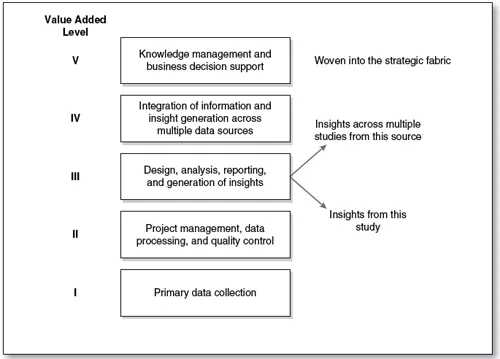
In 2003, Roper Consulting (a division of the research firm NOP World), under the leadership of veteran Boston Consulting Group (BCG) consultant Richard Hermon-Taylor, set out to track that journey. Through an exhaustive study of the research departments of 30 major corporations, Roper constructed a taxonomy of research and the way it impacted the organization in the value added. Figure 1.1 highlights his thinking.
The taxonomy posits five levels of the research process. The first two—primary data collection and project management—define research at its tactical basics and are primarily about its inputs. Beyond that, we start to think about its outputs. At Level 3, there are two possible outputs:
- Studies that yield insights from that study alone (we call this Level 3a)
- Insights that are derived from multiple studies from a particular source (for example, a single research provider—Level 3b)
It is beyond Level 3 that the research function starts to become more strategically critical for an organization. At Level 4, the function derives insights from the integration of information generated across multiple sources—that is, it has become a source of holistically generated insights that have strategic value to the organization. Level 5 is the Holy Grail of research departments and CMOs; it integrates all sources of information and insight into a cohesive knowledge management and business decision support system.
Figure 1.1 Taxonomy of Research Process
When we started our analysis of this taxonomy in 2003, about one third of companies in our study were at Level 3b or above. That is to say, 70% of companies were treating research as a tactical, hygienic necessity. Seven years later, we would estimate that more than half the companies in our database view their research functions more strategically, and they are driving for (level) five. Certainly, the Advertising Research Foundation’s (ARF) initiative in pushing for research transformation would suggest that this drive has assumed strategic importance in many key Fortune 100 companies.
However, we are not there yet.
TAKING STOCK OF TODAY’S SITUATION
Numerous sources paint a picture that is troubling for how marketing research is performing while the need for consumer insight to inform business decisions grows. Dissatisfaction in the performance of marketing research is voiced by clients and marketing researchers.
Company and marketing executives want to see greater business impact from marketing research while researchers want to be in the role of the “most sought after” for advice and counsel. Market Research Executive Board (MREB) reports that 61% of senior executives/business partners want research to be a strategic partner, but only 29% currently view the research function as such. Furthermore, business partners who view research as a strategic partner are much more likely to have changed decisions based on research than those who view research as an analytic resource (54% versus 34%).
In 2009, the BCG conducted a study of 40 global, consumer-facing companies, among researchers and business partners. They found that “Nearly 90% of blue-chip companies aren’t fully leveraging their market research functions. Less than 45% believe that their marketing research/consumer insight function provides a competitive advantage or high ROI” (Egan, Manfred, Bascle, Huet, & Marcil, 2009).
Dissatisfaction with the status quo is voiced by marketing researchers and their clients. An ARF survey conducted in 2008 reported, “85% of research leaders are neutral or dissatisfied with the impact of marketing research in their company” (Rubinson, 2010, slide 6).
Some industry leaders have been highly vocal about how marketing research needs to respond. Stan Sthanunathan, vice president of marketing strategy and insights, Coca Cola, is a frequent speaker at industry events and espouses, “We need to go from insight providers to creative problem solvers, storytellers, disruptive thinkers and visionaries, acting to shape change and light the way” (personal communication).
HOW MARKETING WILL CHANGE IN THE COMING YEARS
A working committee of the ARF Research Transformation Super-Council (RTSC) looked ahead to 2020 and highlighted nine overarching trends that will impact marketing (ARF RTSC General Council meeting, August 3 2010). They are listed here:
- Changing economic power balance, driven by the ascent of China. By 2020, it is forecast that China will overtake the United States and equal the European Union (EU) in gross domestic product (GDP; Avruch, 2010).
- Technology/digitalization. In 2000, we didn’t have Facebook, which in July 2010 had 500 million users (Zuckerberg, 2010). There were no Blackberries, iPhones or iPads. We can count on several major tech innovations in the next decade; we just don’t know what they will be! We do know that the march toward digitalization of everything will continue.
- Privacy. Increasing digitalization will have the effect of increasing privacy concerns.
- More connected, more empowered consumers.
- Media makeover. Media brands will increasingly become multimedia brands, the need for 360 media planning and measurement will escalate, and geosynchronous targeting will be ascendant.
- Globalization. Companies will increasingly need to operate globally yet act locally. Brand Z/Interbrand reported that 6 of the 10 fastest growing global brands are from outside the United States.
- The challenges for developed markets. Developed markets such as the United States, Japan, and major European nations have aging populations, and face challenges with the escalating cost of healthcare and pension costs.
- The multicultural world. In the United States, the aggregate U.S. minority population is expected to become the majority in 2042.
- Sustainability.
THE FUTURE OF MARKETING RESEARCH DEPARTMENTS
What will the marketing and C-suite expectations be for research?
A recent IBM study polled more than 1,500 corporate heads and public sector leaders across 60 nations and 33 industries. Eighty-eight percent of all CEOs and 95% of standout leaders believe getting closer to the customer is the top business strategy over the next five years. This spells opportunity for marketing researchers (Carr, 2010)!
On an analyst call in 2009, P&G CEO Bob McDonald said, “Consumer research has an integral part to play in achieving these [growth] goals” (McDonald quoted in Tarran, 2009, para. 3).
Looking ahead, Monika Wingate of the UW-Madison School of Business noted, “There is an increasing expectation on the part of management for researchers to uncover breakthrough insights” (Wingate quoted in Shepard, 2006, para. 7).
THE EVOLVING ROLE OF MARKETING RESEARCHERS
While there were only data sources in the 1990s, there are now broader and richer information feeds, with video, pictures, emotions, eye movement, facial tracking, body and brain responses, and more. Today, we have mountains of information, and research has a huge need to synthesize the information, tell the story, and take a stand to create business impact.
In 2010, the ARF Research Transformation Super-Council defined the new mission for marketing research as “Inspiring better business futures by listening, learning, and translating humans and markets to bring them to life, in order to anticipate and give knowledge to the enterprise” (personal communication).
Researchers must spend their time productively, addressing the key strategic needs of client corporations rather than the myriad tactical issues. To achieve this, researchers must make the journey to become consultants. The journey requires a shift in how researchers define their purpose, in what they provide their clients, in how they define value, in how they work, and in their ability to influence others. We organize this transformation into four pillars: (1) mindset, (2) principles, (3) tools, and (4) practices.
A consulting mindset is focused on making change happen, going beyond information to provide solutions and provoke action. It measures value creation by the impact on client actions. It’s not about lengthy PowerPoints—it’s about figuring out the important few things that the company needs to act on and being the catalyst for action. At the ARF Industry Leaders Forum October 28, 2010, Margaret Coughlin, CMO of Digital Globe, said, “The presentation should last 10 minutes; the discussion should continue for hours” (personal communication).
Consulting principles include understanding the different levels of client value, stakeholder alignment, empathy, collaboration, individual and organizational value creation, and more. Unfortunately, these principles aren’t taught to researchers progressing through the ranks—researchers are trained to operate independently, with a focus on technical mastery.
Consulting tools include problem/opportunity definition, determination of important deliverables, and solution development. Learning these tools can ensure that research is better focused, with clearer expectations and with higher-level actionable findings.
Consulting practices include being a first mover, synthesizing knowledge and collaborating to leverage expertise, creating intellectual property, communicating for impact, and more. These practices are far from commonplace among researchers today, but are well known to management consultants, and are essential for the new value creation model.
Marketing researchers who step up to the plate and embrace the consulting pillars can make a huge impact in their companies.
As we look ahead, some of the trends are readily apparent. The volume of available information will continue to ...