![]()
Part I
Understanding Advertising
![]()
1
Evaluating Advertising
Does advertising really work? If yes, when, why, and how does it work? Is it a weak force or a strong force? Is it merely background noise or does it control people’s minds? Does it corrupt our societal values or is it an engine of economic growth?
Answers to these questions are critically important because advertising plays an important role in our economy and society. Advertising is a vitally important though much misunderstood force in modern markets. To appreciate the importance of evaluating advertising effectiveness, this chapter first explains the role of advertising in modern markets. The chapter then outlines the complexity of determining the effectiveness of advertising. To understand how advertising works in modern markets, the chapter next explains the key terms used in advertising and the nuances these terms take in this book.
Importance of Advertising in Modern Economies
Advertising is pervasive. Today, advertisers bombard consumers with appeals or reminders from the moment they wake up till the moment they fall asleep. Ads appear on news programs that consumers access, in the entertainment they seek, on billboards as they commute, on Internet sites as they surf the Web, and even in their classrooms and office space. Estimates of the number of ad messages that reach consumers vary from 100 to more than 1,000 a day. Thus, ads greatly impinge on consumers’ awareness and have the potential of greatly affecting their thoughts, attitudes, feelings, and decisions.
Many people think that advertising is a lot of hype. They think firms advertise to sell their products to consumers or to make a fast buck. Such people think advertising is an accident of the free economy or an evil that consumers have to endure in the interests of free speech. However, the reality is quite different. Advertising is a vitally important force for several reasons.
First, advertising is a major means of competition among firms.
In a free market, firms constantly compete with each other for sales by offering consumers better quality or lower prices or both. Firms use brand names to represent a consistent level of quality at particular prices. Firms use advertising to communicate to consumers what these brand names represent and at what prices and where they will be available. The various forms of advertising enable firms to communicate with consumers promptly and efficiently as needed. Thus, advertising is essential for the efficient working of competitive markets.
Second, advertising is the primary means by which firms inform consumers about new or improved products.
Over the past couple of centuries, the quality of life of consumers has improved greatly, primarily because of the better goods and services available to consumers. The great vitality of the American economy, indeed of most free market economies, rests on the ability of firms to produce and market these better products to consumers. To do so, firms must be able to communicate with consumers, to inform them of the innovations at hand, and to persuade them of the value of these innovations. Advertising has emerged as the primary means by which firms achieve this task. Thus, advertising has the potential to ensure the vital functioning of markets for new and improved products.
Third, advertising provides major support for the media in the United States and many other countries.
Several media, including broadcast TV, much of cable TV, newspapers, magazines, and much of the Internet, reach consumers either free or much below cost. The reason is that advertisers pay media owners for displaying their ads. Media owners in turn do not have to charge consumers the full cost of the media. As such, advertising subsidizes these media. The media themselves are an important means of information and entertainment for consumers. Thus, advertising subsidizes the free flow of information and entertainment to consumers.
Fourth, advertising is a huge industry.
Total expenditures on all media advertising (excluding mail and telephone), in 2002, were more than $236 billion.1 The industry involves more than 21,000 firms and employed 302,000 people in 2000.2 In the first decade of this century, employment in the advertising industry is likely to grow 32%, compared with 15% on average for all industries.3
Fifth, the public subsidizes advertising expenditures.
Advertising expenditures in the United States and many capitalist countries are tax deductible. That is, firms can charge these expenditures as costs of doing business to lower their pretax profits. In effect, the public pays for a fraction of the cost of advertising that is equal to the advertiser’s marginal tax rate. More generally, assuming a positive tax rate, the public subsidizes a portion of advertising expenditures.
SUMMARY
All these factors suggest that several groups have a vital interest in knowing how advertising works. These groups include advertisers, ad agencies, public policy makers, consumers, and voters. Advertisers themselves need to know how it works in order to achieve their advertising goals and make the best use of their resources. Ad agencies that plan, evaluate, and implement ad campaigns need to know how advertising works in order to be more efficient stewards of their clients’ resources. Public policy makers need to know how advertising works in order to regulate advertising in the public interest. Consumers need to know how advertising works in order to best interpret ads and make good purchase decisions. Voters need to know how advertising works in order to understand the value of the public subsidy of advertising.
Problems Evaluating Advertising Effectiveness
Despite its importance and wide implications, evaluating the effectiveness of advertising is very difficult. The difficulty occurs because advertising’s working is highly complex. It depends intrinsically on human response to communication. Thus, it involves complexities in the attention, processing, recall, and response to the appeal. To begin to realize how complex this issue is, consider the following problems in evaluating how an ad for a brand can affect a consumer’s purchase of that brand.
First, consumers may buy a product for a variety of reasons. These reasons include seeing an ad for the brand, satisfaction with the product from past purchases, word-of-mouth recommendations from other consumers, change of taste, prestige attached to the product, an attractive package, a store display, a sales promotion, or an attractive price. Advertising is only one of the many causes that prompt a user to buy a brand. Thus, analyzing what effect the ad has on purchase requires the analyst to fully understand and control the effect of all these other factors.
Second, advertising for a brand may occur in different media. Each of these media may have a unique effect on consumers. To fully understand the role of advertising, the analyst must decode the partial effects of the ad in each of these media. Also, when media overlap, their effects interact, requiring further disentangling.
Third, advertising may have not only instantaneous effects but also carryover effects. An instantaneous effect occurs when a consumer sees an ad and responds to it immediately (see Exhibit 1.1A). For example, an ad for a new kitchen knife set may include an 800 number. On seeing this ad, a viewer might dial the number instantly to buy the product. However, in many cases, consumers do not respond instantaneously to ads but after a period of waiting to think about the ad, talk to friends, do some more research, or buy at an opportune moment. This delay in the effect of an ad is called the carryover (see Exhibit 1.1B for one type of carryover). Chapter 7 discusses this phenomenon in depth. So one has to determine how the effect of any single ad decays over the period following its exposure.
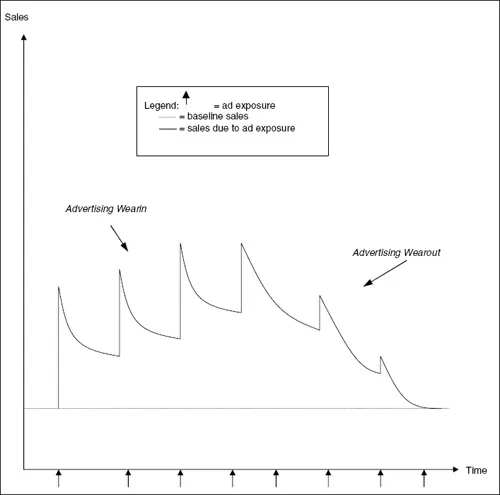
Fourth, the effectiveness of the ad may also vary over the life of a campaign. Advertisers normally resort to repetitive advertising. They keep using an ad or a campaign for several days, weeks, or months. The effect of any single ad exposure decays over a period of time as indicated above. However, the effect of each ad may change over the life of the campaign: Wearin is an initial increase in the effect of one ad, with repetition during a campaign, because of consumers’ increasing familiarity with the ad. Wearout is the ultimate decline over time because of consumers’ increasing tedium with the ad (see Exhibit 1.2). If the effectiveness of advertising is itself changing over time, determining its effectiveness becomes more complex, because one has to analyze the full impact of a moving target.
Fifth, successive ads have overlapping effects and overlapping decays. If one combines the last three effects described above (wearin, wearout, and carryover), one gets overlapping decays of multiple exposures of an ad, each of which may have different levels of response. Each ad exposure may have a different effect due to consumers’ familiarity or tedium. Furthermore, the carryover of one ad exposure adds to or overlaps with the carryover of a prior ad exposure. This overlap in effectiveness creates a new level of complexity in analyzing advertising’s effectiveness (see Exhibit 1.2).
Finally, advertising response varies by segments and individuals within a market. A market can be segmented by groups of consumers, each with a similar response to a brand. Some could be loyal users, others, light users, still others, aware but not users, and still others, not even aware of the brand. Each of these different segments may respond differently to an ad. So when one analyzes ad effectiveness, one has to take into account these different segments to fully understand the phenomenon. If one does not have detailed data, the problem is intractable. But even if one has detailed data, the problem is quite complex, because one has to analyze the effects on these different segments and pool them together to arrive at an overall effect.
Exhibit 1.1 Temporal Effects of Advertising
The analysis of advertising’s effects can be broken down into three important steps or stages:
Exhibit 1.2 Wearin and Wearout in Advertising Effectiveness
- Key measures of advertising
- Research designs to evaluate advertising’s effects
- Models to relate the variables and measure the effects of advertising
Chapter 4 explains the measures of advertising, and Chapter 5 explains the evaluation of advertising’s effects. The next chapter, 2, summarizes common myths about advertising effectiveness in contrast to the major findings from research. The subsequent chapter, 3, presents a general theory of advertising that summarizes and integrates the contents of the other chapters. Chapters 6 and 7 describe the major market findings about advertising’s effects. Chapters 8 to 11 describe the major findings about which creative is effective and why it is effective. (The term creative refers to all design aspects of an ad such as copy, visual and sound aspects, appeal, endorsers, etc.)
Explanation of Key Terms
To explain the broad scope of advertising without getting into a multiplicity of terms, this book uses eight simple terms in a very broad or generic sense that encompasses a variety of contexts in which advertising occurs. This use of the terms may differ from that typically associated with their common use. So this section explains the meaning of the following eight terms: advertising, firm, consumer, product, brand, purchase, advertiser, and market effects.
Advertising is any paid message that a firm delivers to consumers in order to make its offer more attractive to them. The term firm means any person or organization of any size that has something to offer another. Similarly, the term consumer means any person or organization that is the target of a firm’s offer. The term product means any good, service, idea, or person that an organization wants to offer to a consumer. Examples of a firm-product-consumer triad include the following:
- Soap-maker marketing soap to households
- Automaker marketing cars to car rental companies
- Gardener marketing a day’s labor to a homeowner
- Manufacturer recruiting fresh graduates
- Law firm marketing legal services to plaintiffs
- Politician marketing candidacy to voters
- Church marketing inner renewal to believers
The term brand means a clearly distinguishable name, which a firm uses to uniquely identify its product with consumers and distinguish it from that of competitors. For example, Cathedral of Our Lady of the Angels is the brand name of the newly opened Catholic cathedral in Los Angeles. In an attempt to exploit the equity in its brand, in its gift shop, the cathedral sells its own wine, branded Cathedral of Our Lady of the Angels Chardonnay.4 The term purchase means the key behavior of a consumer desired by the firm. In the examples above, the term purchase could mean a believer attending services in the cathedral, a household buying soap, a citizen voting for a candidate, or a plaintiff signing on a law firm as its legal representative. Thus, purchase refers to activities such as buying a car, voting for a candidate, hiring an employee, or praying in a church. We refer to firms that advertise to consumers as t...