The author is a proud sponsor of the 2020 SAGE Keith Roberts Teaching Innovations Award—enabling graduate students and early career faculty to attend the annual ASA pre-conference teaching and learning workshop.
This brief and accessible title integrates contemporary scholarly research with compelling vignettes to make it appealing to both instructors and undergraduate audiences. While focused on the United States in respect to its target audience and emphasis, it contains considerable international data that compares and contrasts social policies adopted in Europe and elsewhere. In so doing, it shows both the strengths and the limitations of the approaches used in the U.S. This title is the only single source that summarizes the origins of work–family concerns, the diversities of needs and experiences, the impact of tensions on the family front, the consequences of tensions for employers, and different types of policies that can make meaningful differences not only in the lives of employees, but also potentially in job quality and national productivity.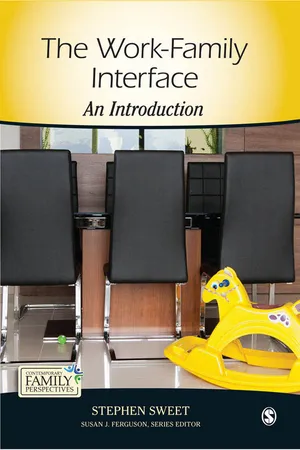
- 176 pages
- English
- ePUB (mobile friendly)
- Available on iOS & Android
eBook - ePub
About this book
Information
1
Origins of Contemporary Work-Family Dilemmas
It is self-evident that work today is performed in ways very different from earlier periods. Few people tend to crops, milk cows, or make their own cheese. And yet new ways of working are reopening opportunities to return to old ways of integrating work and family. For example, the modern technologies that make telecommuting possible enable work to be performed in and around the home, much in the way that work was performed in and around the home in agrarian societies. So although few workers today are engaged in family farming, it is possible for many workers to perform their jobs while also tending to soup simmering on the stove and children at their feet. But one wonders, how familiar would society’s predecessors find the experiences and expectations of these modern work-at-home families? Would the sources of satisfaction and frustration with the work-family interface be similar? This first chapter looks to the past to consider the origins of some major contemporary work-family concerns.
This chapter discusses not only the technological and organizational changes that make work today different from the arrangements of the preceding decades and centuries, but also the profound cultural changes that accompanied the transformation of workplaces and families. Because of these changes, even when opportunities to redesign work or family arrangements are present, it can be difficult to do so because what one expects of (and from) a job and of (and from) a family is to a great extent rooted in the past. Fundamental preexisting templates—such as understandings of what is (and is not) work, job structures, and real and believed boundaries that separate lives at home from those on the job—confront working families today and constrain their options. To illuminate these concerns the focus is on the historical transformation of work-family relations and the shift from household economies to present-day arrangements in which nearly everyone is expected to work. The primary intent here is to identify changes in the ways workplaces and families are connected, as well as changes in the ways ideal arrangements are culturally defined.
When Work Separated From Family: The Household Economy Transitions to the Industrial Economy
For most of human history, work and family institutions overlapped to such a great extent that these domains were inextricably intertwined in the day-to-day lives of people. Rather than “work” or “family” there was, more or less, simply “life.” Even if one traces work-family relations back only a few hundred years, to a time when most families operated on the basis of household economies, work and family were pushed together in intimate ways. Because nearly all economic activity occurred in and around the home, family members did not “go to work” nor did they “come home.” But beyond this observation, it is important to also understand that tasks that later came to be viewed as “not work” (activities such as household maintenance, cooking, and childcare) were understood as essential contributions to the family economy (Boris & Lewis, 2006).
Today there is a tendency to consider the family domain as the place of consumption, the area in a person’s life that absorbs economic resources. People work in order to provide income for their families. Work, on the other hand, is the place of production and the place where people contribute to society by expanding economic wealth. And we engage in considerable boundary work to establish different identities and purposes in each domain (Desrochers, 2003; Nippert-Eng, 1996). For example, people wear different clothes in the home and in the workplace, focus attention on how far they let work intrude into their lives, and contemplate how intimate they should allow themselves to be with coworkers.
In Colonial America (and prior) the division between home and work was not so clear-cut. For example, slave families were treated and defined by their Southern owners as a means to create wealth. But the practice of slavery was not the only way work-family structures were explicitly economic in practice and social definition. In the Northern colonies, it was common for families to take in live-in boarders to assist in the production of goods used for barter or sale. Within the household economy, food and shelter were a part of the compensation received, and in that context the labor involved in keeping a good home had tangible economic consequences. And in addition to live-in boarders, children also were collectively defined as a means to secure labor. Parents understood their children not as precious little creatures but more as miniature adults with a responsibility to contribute to the family economy (not just receive from it). Even in the early stages of industrialization, children brought more income to household economies than did wives (Gratton & Moen, 2004, 2007).
In the 18th century, gender roles were well established, but there also was considerable overlap between the duties and responsibilities of wives and husbands, which enhanced recognition of the economic value of the labor women provided. For example, if a husband lost his capacity to work, the wife (a man’s “help meet”) could assume the role of “deputy husband” and control business affairs until he was able to return to work (Ulrich, 1982). In other words, while a wife’s place might have been primarily in the home, it was not solely restricted to that domain, and she could move beyond it when the family needed. Women also managed workers employed in the household economy and historical records indicate that they could be “wisely awful” to their charges if work did not meet their expectations. Frailty, which came to be viewed as a feminine virtue in the 19th century, had no place in a system that required wives to perform hard physical work. But beyond sometimes engaging in comparable work, because husbands and wives mutually witnessed each other’s efforts, it promoted a sense of shared respect that the maintenance of the home involved real work. Historical analyses reveal with certainty that, prior to industrialization, reproduction and care work were understood as contributing to the family economy, not (as it was later to be culturally defined) as absorbing economic resources (Crittenden, 2001).
Finally, consider that the temporal spaces that separated work and family labor were not rigidly structured and had a much weaker relation to chronological time. For example, most people did not commute from work to home or from home to work. As a consequence, the boundaries between work and family tasks were far more fluid than the way they are today. If crops needed to be harvested, all family members could be called to work in the field. If the merchant capitalist was coming for his order, husbands, wives, children, and boarders might labor late into the night. And if it was winter, and there was little work to be done, one could relax (but also cook, clean, and provide care). So not only were work and family roles understood differently than they are today, they also were organized and paced differently (Thompson, 1967). What all this shows is that the notion of coming home from work or exiting the home to work is a modern cultural construction.
One should be hesitant to view work-family relations as they existed in Colonial America as “the good old days.” Lives were short, division of labor was uneven, multiple forms of abuse and exploitation were present, workplace protections were nonexistent, and supports for families rested almost entirely on kin networks and local charity. However, by looking back, one can see that the organization of work and family relations, as well as the cultural mind-set about how these two institutions are connected, were very different as compared to today’s taken-for-granted arrangements and understandings. Some would go so far as to argue that the integration of work and family within the household economy was a more natural way of arranging lives. After all, work being performed in and around the home was the normative arrangement up until the industrial revolution, pitting thousands of years of human history against the past two centuries. The desire to meld work and family together might explain why many workers today seek greater flexibility in their work arrangements, such that they might be able to bring their work home, or even their families to work. However, not everyone shares those preferences, as cultural values in the wake of the industrial revolution shifted to emphasize the advantages of separating family from work.
The onset of the industrial revolution (which occurred roughly from 1790 to 1830) is commonly attributed to the creation of inventions such as the spinning jenny (which enabled the twining of multiple spools of thread at the same time) and the harnessing of water power (which unleashed the potentials of wide-scale mechanization of production). Factories that combined consistent sources of energy with mass production technologies were able to produce goods at a much higher volume and (when successful) at a much greater profit than was possible under the putting-out system of the household economy. But it was not simply technology that made this possible; it also was the reorganization of work and family institutions to correspond with new temporal arrangements.
Today most employees labor according to schedules that specify when they are to appear at work and when they can leave. While the organization of work according to time rather than task is now a widely accepted (but also increasingly challenged) practice, this was not the case in the early 19th century. The 40-hour work week, weekends, and vacations emerged as products of negotiation and conflict between workers and employers on the terms of labor (Rybczynski, 1991). New standards of conduct also were negotiated, as tardiness and absenteeism were rampant in the early stages of industrialization, leading to systems of enforcing schedule compliance. While workers were accustomed to working on an “as needed” basis in the household economy and continued to assert autonomy on the timing at which work took place, employers lamented that too much honor was given to Saint Monday (the patron saint of the weekend hangover). As the culture attempted to come to terms with what constituted a fair day’s wage for a fair day’s work, new concerns emerged such as whether workers should receive pay if they failed to show up to work for reasons such as sickness or if they should be paid extra after laboring longer hours.
While today industrialization is heralded as a milestone in human history, at the time members of the working class did not view it as a positive step forward—in part because of the impact it had on their ways of organizing family lives. The new industrial order not only created new “work time” arrangements, it also reconfigured “family time” arrangements. For example, the advent of shift work, which required employees to move into and out of work at rigidly defined times, created new sets of tensions in the management of household affairs, as these shifts created absences that undermined the capacity of families to provide care (Hareven, 1982). And in contrast to the household economy, because industrial capitalism curtailed family economic self-sufficiency, the prospect of unemployment presented a looming threat that shaped many aspects of life. For example, workers understood that the reputation of their relatives affected the prospects of receiving employment and that one’s own conduct could result in retaliation against other family members. As parents, spouses, and siblings commonly worked within the same factory walls, and because retribution could be meted out by vindictive supervisors, consequences could be severe (Jacoby, 1991). For these reasons, the intimate connection between work and the family comprised a means by which employers exerted control over their workforces. However, family loyalties also were critical components of the labor movement, as family members could attract and pressure relatives to join unions.
In the early stages of industrialization, employers constructed their operations with a tacit understanding that work was connected to family. Consider that in the 19th century the Amoskaeg textile factory in New Hampshire (at the time the world’s largest textile manufacturer) provided workers with subsidized housing, social activities, recreational resources, profit-sharing options, a retirement program, an employee welfare program, English classes, access to nursing services, charity to widows, an accident ward, dental care for children, and playgrounds. While no doubt these resources created incentives to not seek employment elsewhere, it is noteworthy that the Amoskaeg company was not legally required to provide these services, nor were the resources the product of collective negotiation from organized labor. It is hard not to conclude that the company adopted paternalistic practices because it viewed caring for employees and their families as a social obligation (Hareven & Langenbach, 1978).
In sum, prior to industrialization, work and family were intimately connected both physically and ideologically. With industrialization, a greater physical separation between work and the home was introduced, and some ideological elements began to shift as well. However, families continued to be integrated into the workplace as collectivities (i.e., kin working with kin). Lines between work and family were being drawn, but they were not as tightly configured as they were to become in the 20th century. And as discussed shortly, these new boundaries not only separated work from home, they also built walls between women’s careers and men’s, and they diminished the stature and economic valuation of household labor.
When Family and Work Were Defined as Separate Spheres: The Husband/Breadwinner–Wife/Homemaker Economy
During the 20th century, a new work-family configuration emerged, assigning the duty of economic provision to the husband and the maintenance of home and children to the wife. This arrangement did not solidify overnight, as it involved a gradual renegotiation of gender role assignments, as well as other expectations such as the reconsideration of children as “precious objects.” By the mid-1920s, this husband/breadwinner–wife/homemaker ideal had largely defined employer practices and the very limited public policies that existed at the time (Boris & Lewis, 2006). For example, it was considered acceptable (and in society’s best interests) for employers to terminate a woman’s employment once she had children. But the expectation did not remain consistent throughout the 20th century, as women were temporarily integrated into the paid labor force during World War II and into jobs that had been performed almost exclusively by men. And as noted by social historians, even when this husband/breadwinner–wife/homemaker arrangement was at its cultural peak in the 1950s, numerous families were excluded from this ideal—most notably low-income African American women, who were integrated as domestic workers employed by middle- and upper-class white households (Coontz, 2000; Nakano Glenn, 2002). Nonetheless, the husband/breadwinner–wife/homemaker model was presented in popular culture, academic research, and legal framework as an ideal design, one that should be used to measure one’s own family against and one that should be socially reinforced. And even for those who could not live up to this expectation, many presented fronts suggesting that they were conforming to this template. For example, lower-income immigrant women kept much of their work hidden by performing piecework in the home rather than seeking outside employment.
The ever-present adoring wife and mother became a cultural mainstay of the 20th century. The home was to be a haven in a heartless world, the domain where husbands could recover from the cold instrumental relations of the factory or corporate world (Lasch, 1995). The difficulties that this arrangement placed on family lives—especially for women—were not culturally acknowledged, leading the pioneering feminist Betty Friedan (1963) in The Feminine Mystique to label these strains as “the problem that has no name.” Women who failed to live up to these ...
Table of contents
- Cover Page
- Dedication
- Title
- Copyright
- Contents
- Exhibits
- Series Preface
- Author Preface
- Acknowledgments
- Introduction
- Chapter 1: Origins of Contemporary Work-Family Dilemmas
- Chapter 2: Diversity of Work, Family, and Work-Family Arrangements
- Chapter 3: Individual and Family Frontiers: Personal Responses to Strained Schedules
- Chapter 4: Employer Frontiers: Organizational Intransigence and Promising Practices
- Chapter 5: Global Perspectives on the Work-Family Interface: International Comparative Analysis and Transnational Relationships
- Chapter 6: Work-Family Interface as a National Priority
- Further Exploration
- References
- Index
- About the Author
Trusted by 375,005 students
Access to over 1.5 million titles for a fair monthly price.
Study more efficiently using our study tools.
Frequently asked questions
Yes, you can cancel anytime from the Subscription tab in your account settings on the Perlego website. Your subscription will stay active until the end of your current billing period. Learn how to cancel your subscription
No, books cannot be downloaded as external files, such as PDFs, for use outside of Perlego. However, you can download books within the Perlego app for offline reading on mobile or tablet. Learn how to download books offline
Perlego offers two plans: Essential and Complete
- Essential is ideal for learners and professionals who enjoy exploring a wide range of subjects. Access the Essential Library with 800,000+ trusted titles and best-sellers across business, personal growth, and the humanities. Includes unlimited reading time and Standard Read Aloud voice.
- Complete: Perfect for advanced learners and researchers needing full, unrestricted access. Unlock 1.5M+ books across hundreds of subjects, including academic and specialized titles. The Complete Plan also includes advanced features like Premium Read Aloud and Research Assistant.
We are an online textbook subscription service, where you can get access to an entire online library for less than the price of a single book per month. With over 1.5 million books across 990+ topics, we’ve got you covered! Learn about our mission
Look out for the read-aloud symbol on your next book to see if you can listen to it. The read-aloud tool reads text aloud for you, highlighting the text as it is being read. You can pause it, speed it up and slow it down. Learn more about Read Aloud
Yes! You can use the Perlego app on both iOS and Android devices to read anytime, anywhere — even offline. Perfect for commutes or when you’re on the go.
Please note we cannot support devices running on iOS 13 and Android 7 or earlier. Learn more about using the app
Please note we cannot support devices running on iOS 13 and Android 7 or earlier. Learn more about using the app
Yes, you can access The Work-Family Interface by Stephen Sweet in PDF and/or ePUB format, as well as other popular books in Social Sciences & Sociology. We have over 1.5 million books available in our catalogue for you to explore.