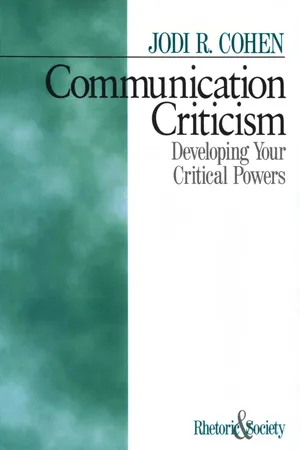
Designed specifically for noncommunication scholars, Communication Criticism is an informally written, practical guide about how to think, how to communicate effectively, and how to filter meaning out of the swarm of communication that seeks our attention daily. Undergraduates will learn how understanding the fundamental principles of communication helps them judge the potential effectiveness, effects, truths, and ethics of all types of communication from classical "soapbox speeches" to reading a magazine, talking to a boy/girlfriend, watching court proceedings, or watching the TV news. In a format similar to most public speaking courses, author Jodi R. Cohen introduces classical theories of rhetoric at the beginning of each chapter, then expands the discussion with contemporary postmodern theories, touching on concerns with aesthetics and cultural bias as well. Question-and-answer sections in each chapter and many specific, down-to-earth examples will attract and encourage students to harness the power of communication that shapes who we are, what we know, and what we do. A highly practical resource, Communication Criticism is the ideal for professionals in popular culture, media studies, mass communication, and film studies.
- 237 pages
- English
- PDF
- Available on iOS & Android
eBook - PDF
About this book
Information
Publisher
SAGE Publications, IncYear
1998Print ISBN
9780761906308
9780761906292
Edition
1eBook ISBN
9781452250427
Table of contents
- Cover
- Contents
- Series Editor's Introduction
- Preface: Author's Notes on the Philosophy and Design of the Book
- Unit I - An Introduction to Communication and Criticism
- Chapter 1 - The Need to Think Critically about Communication
- Chapter 2 - How to Think Critically about Communication
- Unit II - Critical Concepts That Focus on Language
- Chapter 3 - Language as Style
- Chapter 4 - Language as Sign Systems
- Chapter 5 - Language as Metaphor
- Unit III - Critical Concepts That Focus on Structure
- Chapter 6 - Structure as Organization
- Chapter 7 - Structure as Editing Images
- Chapter 8 - Structure as Narrative
- Chapter 9 - Structure as Drama
- Unit IV - Critical Concepts That Focus on Reasoning
- Chapter 10 - Reasoning as Rhetorical Argument
- Chapter 11 - Reasoning as Field-Dependent Argument
- Chapter 12 - Reasoning as Narrative
- Unit V - Critical Concepts That Focus on Character
- Chapter 13 - Character as Ethos
- Chapter 14 - Character as the Second Persona
- Chapter 15 - Character as Identification
- Unit VI - Critical Concepts That Focus on Emotion
- Chapter 16 - Emotion as Pathos
- Chapter 17 - Emotion as Desire
- Unit VII - Developing Critical Powers
- Chapter 18 - Critical Powers Over Who We are, What We Know, and What We do
- Glossary of Key Concepts
- Index
- About the Author
Trusted by 375,005 students
Access to over 1.5 million titles for a fair monthly price.
Study more efficiently using our study tools.
Frequently asked questions
Yes, you can cancel anytime from the Subscription tab in your account settings on the Perlego website. Your subscription will stay active until the end of your current billing period. Learn how to cancel your subscription
No, books cannot be downloaded as external files, such as PDFs, for use outside of Perlego. However, you can download books within the Perlego app for offline reading on mobile or tablet. Learn how to download books offline
Perlego offers two plans: Essential and Complete
- Essential is ideal for learners and professionals who enjoy exploring a wide range of subjects. Access the Essential Library with 800,000+ trusted titles and best-sellers across business, personal growth, and the humanities. Includes unlimited reading time and Standard Read Aloud voice.
- Complete: Perfect for advanced learners and researchers needing full, unrestricted access. Unlock 1.5M+ books across hundreds of subjects, including academic and specialized titles. The Complete Plan also includes advanced features like Premium Read Aloud and Research Assistant.
We are an online textbook subscription service, where you can get access to an entire online library for less than the price of a single book per month. With over 1.5 million books across 990+ topics, we’ve got you covered! Learn about our mission
Look out for the read-aloud symbol on your next book to see if you can listen to it. The read-aloud tool reads text aloud for you, highlighting the text as it is being read. You can pause it, speed it up and slow it down. Learn more about Read Aloud
Yes! You can use the Perlego app on both iOS and Android devices to read anytime, anywhere — even offline. Perfect for commutes or when you’re on the go.
Please note we cannot support devices running on iOS 13 and Android 7 or earlier. Learn more about using the app
Please note we cannot support devices running on iOS 13 and Android 7 or earlier. Learn more about using the app
Yes, you can access Communication Criticism by Jodi R. Cohen in PDF and/or ePUB format, as well as other popular books in Languages & Linguistics & Communication Studies. We have over 1.5 million books available in our catalogue for you to explore.