- 233 pages
- English
- PDF
- Available on iOS & Android
eBook - PDF
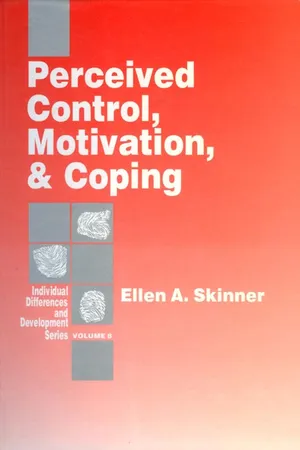
Perceived Control, Motivation, & Coping
About this book
At every point in the life span, individual differences in a sense of control are strong predictors of motivation, coping, success, and failure in a wide range of life domains. What are the origins of these individual differences, how do they develop, and what are the mechanisms by which they exert such influence on psychological functioning? This book draws on theories and research covering key control constructs, including self-efficacy, learned helplessness, locus of control, and attribution theory. Ellen A. Skinner discusses such issues as the origins of control in social interactions; environmental features that promote or undermine control; developmental change in the mechanisms by which experiences of control have their effects on action; and the implications for intervening into the competence system, including interventions for people in uncontrollable circumstances. Written at a level appropriate for upper-division undergraduates, the book can serve as a supplement to the social and personality development course as well as a core text for motivation, educational psychology, or clinical courses at the graduate level. This book won?t be the first one on the topic, but it will be the first one that professionals and graduate students turn to whenever they want a definitive opinion on complex questions of control or an idea for cutting-edge research on the topic of motivation, coping, and control.
Information
Publisher
SAGE Publications, IncYear
1995Print ISBN
9780803955615
9780803955608
Edition
1eBook ISBN
9781452246741
Table of contents
- Cover
- Contents
- Series Editor's Preface
- Acknowledgments
- Introduction
- Part I - Meta-Theoretical Assumptions
- Chapter 1 - What Is Perceived Control?
- Misperceptions About Perceptions of Control
- Challenges to the Study of Perceived Control
- Chapter 2 - What Is the Need for Competence?
- When Needs Are Acquired Versus Innate
- Arguments Against the Need for Competence
- Implications of a Needs Theory
- Part II - Constructs of Control
- Chapter 3 - Are All Perceived Control Constructs the Same?
- Four Major Theories of Perceived Control
- Constructs in the Competence System
- Chapter 4 - Who Needs a New Conceptualization of Perceived Control?
- The Conceptualization
- Beliefs Specific to Domain and Developmental Level
- Profiles of Perceived Control
- Part III - Antecedents of Perceived Control
- Chapter 5 - What Are the Origins of Perceived Control?
- Perceiving Control
- Opportunities for Control
- The Role of the Individual in the Generation of Control Experiences
- The Origins of Individual Differences in Sense of Control
- Chapter 6 - How do Social Contexts Promote and Undermine Control?
- Structure Versus Chaos
- Elements of Structure Versus Chaos
- Conclusion
- Part IV - Consequences of Perceived Control
- Chapter 7 - Why Does Perceived Control Predict Everything?
- When Does Perceived Control Work?
- How Does Perceived Control Work?
- Why D oes Perceived Control Work?
- Where Does Perceived Control Work?
- Conclusion
- Chapter 8 - How Does Perceived Control Work During Times of Stress?
- A Needs Analysis of Coping
- Perceived Control and Structure as Psychological and Social Resources
- Conclusion
- Part V - Development of Perceived Control
- Chapter 9 - How do Individual Differences in Perceived Control Develop?
- The Cycle of Perceived Control and Action
- Implications of Interindividual and Intra-Individual Analyses
- Interindividual Differences in Change Over Time
- Individual Differences in Developmental Change
- Chapter 10 - How Does Perceived Control Change With Age?
- Processing of Control-Relevant Information
- Conceptions of Causes
- Regulatory Beliefs
- Domains of Control
- Action and Action Regulation
- The Development of the Competence System
- Part VI - Intervention into the Competence System
- Chapter 11 - Is More Control Better?
- The Negative Effects of Increased Control
- Perceiving Control in Uncontrollable Circumstances
- Conclusion
- Chapter 12 - What are the Dangers of Intervening Into the Competence System?
- When Control Is Available: Setting up Opportunities for Control
- When Control Is Possible: Regaining Control
- When Circumstances are Uncontrollable: Finding Control
- Conclusion
- Part VII - Empirical Study of Perceived Control
- Chapter 13 - How do I Decide Whether to Include Perceived Control in My Research?
- What Are the Anchors?
- What Are the Mechanisms?
- What Is the Frame?
- What Are the Constructs?
- What Are the Measures?
- What's the Good News and the Bad News?
- Conclusion
- Chapter 14 - What Are the Future Research Issues in Perceived Control?
- Mechanisms
- Beyond the Constructs of Control
- Conclusion
- Appendix
- References
- Author Index
- Subject Index
- About the Author
Trusted by 375,005 students
Access to over 1.5 million titles for a fair monthly price.
Study more efficiently using our study tools.
Frequently asked questions
Yes, you can cancel anytime from the Subscription tab in your account settings on the Perlego website. Your subscription will stay active until the end of your current billing period. Learn how to cancel your subscription
No, books cannot be downloaded as external files, such as PDFs, for use outside of Perlego. However, you can download books within the Perlego app for offline reading on mobile or tablet. Learn how to download books offline
Perlego offers two plans: Essential and Complete
- Essential is ideal for learners and professionals who enjoy exploring a wide range of subjects. Access the Essential Library with 800,000+ trusted titles and best-sellers across business, personal growth, and the humanities. Includes unlimited reading time and Standard Read Aloud voice.
- Complete: Perfect for advanced learners and researchers needing full, unrestricted access. Unlock 1.5M+ books across hundreds of subjects, including academic and specialized titles. The Complete Plan also includes advanced features like Premium Read Aloud and Research Assistant.
We are an online textbook subscription service, where you can get access to an entire online library for less than the price of a single book per month. With over 1.5 million books across 990+ topics, we’ve got you covered! Learn about our mission
Look out for the read-aloud symbol on your next book to see if you can listen to it. The read-aloud tool reads text aloud for you, highlighting the text as it is being read. You can pause it, speed it up and slow it down. Learn more about Read Aloud
Yes! You can use the Perlego app on both iOS and Android devices to read anytime, anywhere — even offline. Perfect for commutes or when you’re on the go.
Please note we cannot support devices running on iOS 13 and Android 7 or earlier. Learn more about using the app
Please note we cannot support devices running on iOS 13 and Android 7 or earlier. Learn more about using the app
Yes, you can access Perceived Control, Motivation, & Coping by Ellen A. Skinner in PDF and/or ePUB format, as well as other popular books in Psychology & Developmental Psychology. We have over 1.5 million books available in our catalogue for you to explore.